


For many Kenya safaris, your international flight lands at Nairobi’s Jomo Kenyatta International Airport (JKIA) while your bush plane to the Masai Mara, Amboseli or Laikipia departs from Wilson Airport across town. That short hop between airports is one of the most sensitive links in any safari itinerary. Understanding road times, baggage rules, immigration and realistic connection buffers can be the difference between a seamless start to your trip and an expensive missed flight into the bush.
Get the latest updates straight to your inbox!
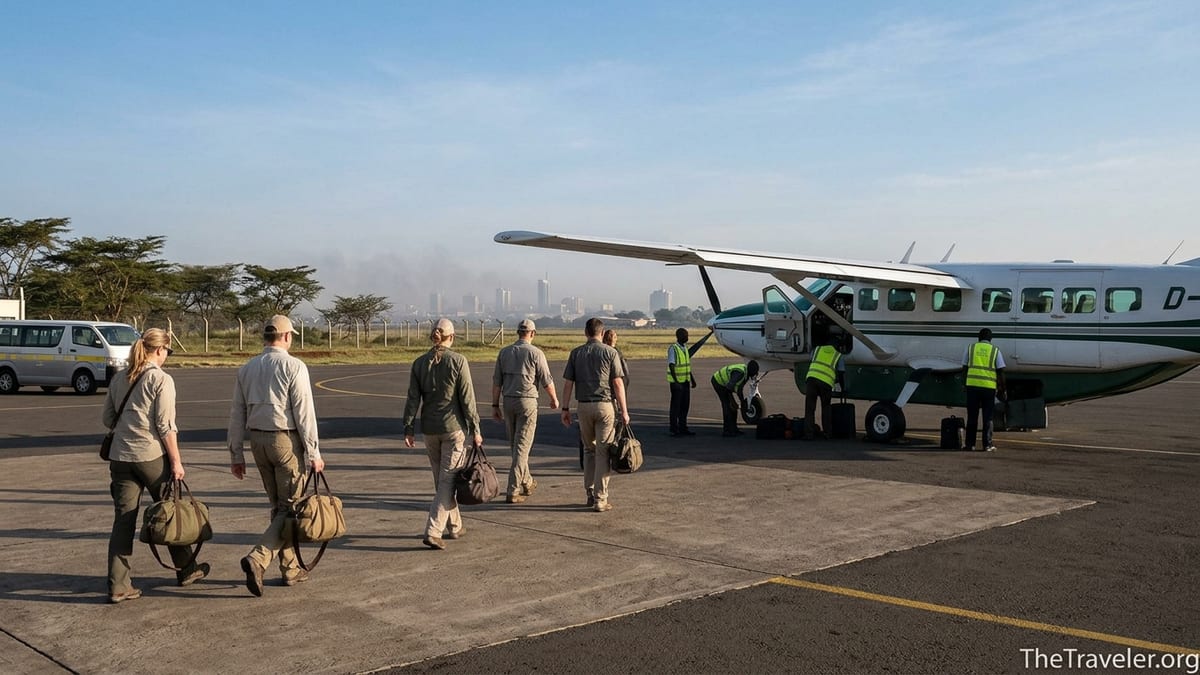
Why Nairobi Has Two Key Airports for Safari Travelers
Most international visitors to Kenya arrive at Jomo Kenyatta International Airport, often ticketed as NBO. JKIA is the country’s main international hub, handling long-haul flights from Europe, the Middle East and North America. It sits on the south-eastern side of Nairobi, close to the main Mombasa Road corridor and the Nairobi Expressway, about 16 to 18 kilometers from the city center.
Wilson Airport, by contrast, is a smaller, domestic-focused field located closer to central Nairobi and Nairobi National Park. It is roughly 18 kilometers by road from JKIA, depending on the route used. Wilson is the primary launch point for safari flights to the Masai Mara, Amboseli, Samburu, Laikipia, Lewa, Loisaba and many coastal or bush strips served by carriers such as Safarilink, AirKenya Express and Mombasa Air Safari. Many scheduled flights to the Mara, for example, depart Wilson mid-morning and early afternoon on light aircraft that land on dirt airstrips near lodges.
In practical terms, this split means your journey to the bush is rarely a simple change of gates. Instead, it is a change of airports with road traffic, immigration formalities and separate check-in rules. A typical pattern might look like this: you arrive at JKIA from London, New York or Dubai early in the morning, clear Kenyan immigration, collect checked bags, meet a driver in the arrivals area, drive 45 to 90 minutes across town to Wilson, then check in again for a 10:00 or 14:30 safari flight to the Mara or Amboseli.
Because Wilson flights tend to be small, tightly scheduled and strictly weight-limited, they cannot easily wait for delayed international arrivals. That makes planning a realistic buffer between your JKIA landing time and Wilson departure one of the most important decisions you will make when structuring your safari.
Road Transfer Between JKIA and Wilson: Time, Traffic and Transport Options
The road distance between JKIA and Wilson is short on a map, but Nairobi traffic can be unpredictable. In light traffic and with clear access to the Nairobi Expressway, the drive can take around 25 to 35 minutes. In heavier conditions, especially during weekday rush hours and when there are incidents on Mombasa Road, realistic door-to-door times often stretch to 60 to 90 minutes. Travelers posting recent experiences commonly report about one hour from clearing customs at JKIA to check-in at Wilson when traffic is average, and up to two hours during bad congestion.
Most safari travelers use one of three transfer options. The first is a pre-booked private transfer arranged by your safari operator or hotel. Many Nairobi lodges and specialist safari outfitters include this in their packages. For example, a Masai Mara fly-in safari sold by a local operator might bundle a private vehicle from JKIA to a city hotel or directly to Wilson, with the driver tracking your international flight. Fares vary, but a realistic ballpark for a private sedan or SUV is the equivalent of 25 to 60 US dollars, depending on vehicle size, time of day and whether Nairobi Expressway tolls are included.
The second option is a metered or negotiated airport taxi or ride-hailing service such as Uber, Bolt or Little Cab. Travelers often report app-based rides between JKIA and Wilson costing in the range of 10 to 25 US dollars equivalent at current exchange rates, plus tolls. These services can be convenient if you are traveling light and are comfortable using a smartphone app on arrival, but they require mobile data access and a bit more self-management than a pre-arranged meet-and-greet.
The third option is a transfer included in your safari package. Many upmarket camps and lodges contract local ground handlers who meet you at JKIA arrivals with a name board, help with bags and handle the cross-city transfer as part of a door-to-door itinerary. For example, a guest booked on a three-day fly-in Mara safari might be met at JKIA at 06:30, driven to Wilson in a safari-branded minivan or Land Cruiser, and checked in for a 10:00 flight to Keekorok or Mara North. You do not usually see a separate line item for this transfer, but the cost is embedded in your overall safari price.
Immigration, Visas and Baggage: Clearing JKIA Before Heading to Wilson
Your first priority on landing at JKIA is to clear Kenyan border formalities and collect your luggage. Most international arrivals enter through Terminal 1, where you will join the queue for passport control. Recent traveler reports suggest that immigration at busy times can take anywhere from 20 minutes to over an hour, especially when several wide-body flights arrive close together. Kenya now relies heavily on online e-visa or eTA procedures for many nationalities, so completing these well in advance and having your approval confirmation ready can significantly reduce stress if you are funneled into different lanes.
After passport control, you collect checked baggage from the carousels and proceed through customs. That point is important for your Wilson transfer planning: there is no through-checking of bags or airside transfer between JKIA and Wilson, even when your safari operator has packaged your flights. You must physically take possession of your luggage at JKIA, exit the terminal and then load everything into a vehicle for the cross-town drive.
Because of this, it is wise to think about your baggage strategy before leaving home. Many bush flights out of Wilson use small Cessna Caravans or similar aircraft with strict weight limits, often around 15 kilograms per person in soft bags, plus a small personal item. Safari airlines commonly insist on duffel-style luggage rather than hard suitcases to make loading into small cargo holds easier. If you arrive in Nairobi with large wheeled suitcases, you may need to leave excess items in storage at a Nairobi hotel or with your operator’s office and repack into soft bags before your Wilson departure.
For example, a couple arriving from Frankfurt with two 23-kilogram hard-shell suitcases and camera gear might pre-arrange with their Nairobi hotel to store one case each for a week, taking only soft duffels and daypacks on the 10:30 Wilson flight to the Mara. They would collect the stored bags on their way back through the city before their international flight home. Having a clear plan like this minimizes last-minute stress in the JKIA arrivals hall.
Understanding Wilson Safari Flight Schedules and Check-in Rules
Wilson Airport is busy during the morning and early afternoon when most safari flights depart. Airlines such as Safarilink, AirKenya Express, Mombasa Air Safari and others operate multiple daily shuttles to key wildlife destinations. Typical patterns include a mid-morning departure to the Masai Mara around 09:30 to 10:30, with returns late morning or around midday, and afternoon departures around 14:00 to 15:00 in some seasons. Individual operators publish detailed timetables, but most flights are designed to get guests into camp in time for lunch and an afternoon game drive or back to Nairobi by early afternoon for onward travel.
Check-in times are stricter than many travelers expect. Wilson airlines commonly request that passengers check in 60 to 90 minutes before departure, especially for Mara and Amboseli sectors that combine multiple lodge stops. Because these are small aircraft with closely managed weight and balance, late arrivals can create operational issues. Airlines and Wilson Airport’s own guidance emphasize that arriving after check-in closes often means you will not be boarded, even if the aircraft is still on the apron.
Another nuance is that each airline at Wilson usually has its own dedicated terminal or check-in building along the airport access road. For instance, Safarilink and AirKenya have separate facilities with security screening, check-in counters and waiting lounges. That means your driver from JKIA needs to know exactly which airline you are flying and where to drop you, especially at busy times when the access road is congested. A good safari operator or hotel transfer will confirm this in advance and build it into your pick-up arrangements.
Real-world experience shows how tight this can feel. Consider an itinerary where a guest’s Emirates flight lands at JKIA at 06:20, and they have been ticketed on a 10:00 Safarilink flight from Wilson to Ol Kiombo in the Mara. If immigration and baggage take 60 minutes, and the cross-town drive takes another 45 minutes, that leaves barely one hour at Wilson before departure. This is doable when everything runs smoothly and the transfer is pre-arranged, but any delay at passport control, baggage carousel or on the road quickly eats into that buffer.
How Much Buffer Time to Allow Between JKIA Arrival and Wilson Departure
The single most important planning question is: how many hours should you allow between your scheduled landing at JKIA and your safari flight departure from Wilson? While individual risk tolerance varies, a conservative approach for separate tickets is to treat this as an unprotected self-transfer and build in enough slack for realistic worst-case delays.
Airport guidance and specialist connection resources often suggest 4 to 5 hours or more as a sensible minimum between a long-haul JKIA arrival and a domestic Wilson flight, particularly if you have checked baggage. That window accounts for potential queuing at immigration, luggage delays, random additional screening, traffic variability on the Mombasa Road and Expressway corridor, and the need to meet Wilson’s early check-in cut-off. Travelers who have tried to connect in less than three hours often report a stressful race, and in some cases missed Wilson flights when immigration ran over an hour or morning traffic seized up.
A practical way to think about this is to break the journey into blocks. Start with 60 to 90 minutes for immigration and baggage at JKIA, acknowledging that some days it will be quicker and some slower. Add 45 to 90 minutes for the cross-town drive, depending on time of day and whether your driver can use the Expressway. Then add at least 60 minutes at Wilson before departure for check-in, security and the boarding process. Stacking those blocks yields a comfortable total in the 3.5 to 4.5-hour range in benign conditions, and more when traveling in peak times like holiday weekends or during the Great Migration season when many visitors converge on the Mara.
In real itineraries, that might translate into booking a Wilson flight no earlier than late morning if you land at JKIA around dawn, or choosing to overnight in Nairobi if your international arrives mid-morning or midday. For example, if your flight from New York arrives at 13:00, trying to catch a 15:00 Mara departure from Wilson would be high risk. In that scenario, spending a night at a nearby airport hotel, visiting the Giraffe Centre or Nairobi National Park, and taking a mid-morning flight to the bush the next day is usually safer and far more relaxed.
Missed-Connection Risks and What Happens If You Are Delayed
Unlike protected connections on a single airline ticket, a JKIA-to-Wilson transfer sits firmly in the category of self-managed travel. If your long-haul flight is delayed, or if queues at immigration are unusually long and you miss your Wilson safari flight, the responsibility to rebook usually rests with you and your safari operator rather than with the airline that brought you to Nairobi. That can have real cost implications, as last-minute changes on small safari airlines may involve change fees, fare differences or even purchasing a completely new ticket.
In peak safari periods such as July through October, morning flights to the Mara or Amboseli sometimes operate close to capacity. If you miss your scheduled departure, there may not be seats available on the next flight that day, especially if several lodges rely on that service. That could mean arriving late into camp or, in an extreme case, losing your first night’s stay or having to arrange a long road transfer as a fallback. Some operators can move guests to an afternoon sector if space allows, but that is never guaranteed and may trigger extra charges.
Real-world stories illustrate the risk. One common anecdote involves travelers who booked a 07:00 Wilson departure to Amboseli on a separate ticket after their international flight was scheduled to land at JKIA at 05:10. A small delay on the long-haul sector, combined with a slow-moving immigration queue, meant they emerged from customs around 06:20. Even with a fast taxi, it was impossible to reach Wilson, check in, clear security and board by 06:30 or 06:40. The airline had to leave without them to keep its schedule to multiple airstrips, and they ended up paying to move to a late-morning flight and missing their first game drive.
Travel insurance with strong trip interruption and missed-connection coverage is therefore highly recommended. Policies vary, but many will cover some of the additional costs if you miss a pre-booked, separately ticketed domestic flight due to a documented delay of your international carrier. Keeping all boarding passes, delay notices and receipts for rebooking fees makes it easier to submit a claim later.
Strategies to Make Your JKIA to Wilson Transfer Smoother
A bit of preparation can transform the JKIA to Wilson hop from a stressful scramble into a manageable, even enjoyable, part of your safari journey. One helpful strategy is to build an overnight stop in Nairobi between your international arrival and your first bush flight. Staying at an airport hotel near JKIA or a boutique property in Karen or near Nairobi National Park gives you time to rest, repack into soft safari bags, and enjoy a local excursion before a relaxed mid-morning check-in at Wilson the next day.
If you prefer to connect on the same day, prioritize early-arriving international flights and later-departing Wilson sectors. For instance, pairing a 05:00 to 06:00 arrival from Europe or the Middle East with an 11:00 or 12:00 Mara shuttle is far safer than trying to squeeze into a departure two or three hours after landing. When comparing options, be mindful that scheduled landing times are optimistic; a touch of delay on a long-haul route is more common than not.
Another practical tactic is to streamline your baggage and documents. Pack your safari clothing and camera gear so that, if your checked bag is delayed at JKIA, you can still travel to the bush with essentials in your carry-on and a quickly purchased change of clothes. Keep printed or easily accessible digital copies of your e-visa or eTA approval, hotel confirmations and Wilson flight details so you are not hunting through emails at the passport desk or trying to remember your airline’s name when your driver asks in the arrivals hall.
Finally, consider leveraging your safari operator’s expertise. Reputable companies based in Kenya work with these transfers every day and can advise on realistic connection times based on the current state of the Expressway, planned roadworks and seasonal traffic. Some operators monitor your inbound flight in real time, coordinate with drivers and, when delays look likely, proactively contact the safari airline to see whether any flexibility exists. While not a guarantee, this local support can make a big difference when minutes matter.
The Takeaway
Transferring from Nairobi’s Jomo Kenyatta International Airport to Wilson Airport is a short journey on the map but a complex one in practice. It combines international border formalities, baggage collection, an unpredictable city drive and a second check-in at a domestic airport where small safari aircraft keep tight schedules and operate with limited spare capacity.
Treat the JKIA to Wilson hop with the same seriousness as a major international connection. Build generous buffers, keep your baggage flexible, use reputable transfer providers and listen closely to the advice of your safari operator. When in doubt, err on the side of an extra hour in a Wilson lounge or a restful overnight in Nairobi rather than gambling on an aggressive same-day dash across town.
Handled thoughtfully, the transfer becomes an integral part of the safari journey rather than a source of anxiety. With realistic expectations and a well-planned schedule, you can step off your long-haul flight, cross the city without drama and find yourself, just a few hours later, touching down on a sunlit bush airstrip as elephants graze in the distance.
FAQ
Q1. How long does it usually take to get from JKIA to Wilson Airport?
In light traffic using the Nairobi Expressway, the drive can be as short as 25 to 35 minutes, but in typical conditions most travelers should expect 45 to 60 minutes, and up to 90 minutes in heavy rush hour or if there are incidents on the main roads.
Q2. What is a safe minimum connection time between my international arrival at JKIA and a safari flight from Wilson?
For separate tickets, a conservative minimum is around 4 to 5 hours between your scheduled landing at JKIA and departure from Wilson. This allows time for immigration, baggage collection, the cross-city drive and the required early check-in at Wilson.
Q3. Can my luggage be checked through from my home airport directly to Wilson Airport?
No. Even when your safari operator has packaged your flights, there is no standard through-checking from international carriers at JKIA to domestic safari airlines at Wilson. You must collect your bags at JKIA, clear customs, then re-check them at Wilson.
Q4. How strict are baggage limits on Wilson safari flights?
Most safari airlines out of Wilson impose relatively low weight limits, often around 15 kilograms per person in soft-sided bags, plus a small personal item. Hard suitcases are generally discouraged because they are difficult to stow in the small holds of light aircraft.
Q5. Is it realistic to land at JKIA early in the morning and fly to the Masai Mara from Wilson the same day?
Yes, provided you build in enough buffer. For example, if you land around 06:00 and book a mid-to-late-morning Mara flight from Wilson, the connection is usually manageable with a pre-arranged transfer and cooperative traffic. Trying to catch a flight within two or three hours of landing is risky.
Q6. Should I book my Wilson safari flights on the same ticket as my international flights?
In most cases, Wilson safari flights are sold separately through local operators or directly by the safari airlines, so they sit on different tickets. That means they are not protected connections, and you should plan your schedule as if you are self-transferring between unrelated flights.
Q7. What happens if I miss my Wilson flight because my international flight to JKIA was delayed?
If you miss a Wilson flight on a separate ticket, rebooking is usually your responsibility. Your safari operator or the airline may help find space on a later departure, but change fees or new ticket costs often apply, and seats are not guaranteed in busy seasons.
Q8. Is it safer to overnight in Nairobi before flying out of Wilson?
For many travelers, especially those arriving midday or after a long overnight flight, an overnight in Nairobi is the least stressful option. It gives you time to rest, adjust to the time zone, repack into soft bags and enjoy a relaxed departure to the bush the following morning.
Q9. Can ride-hailing apps like Uber be used between JKIA and Wilson?
Yes, ride-hailing services are widely used in Nairobi and can be a cost-effective way to travel between the two airports. However, a pre-booked transfer through your hotel or safari operator is often simpler after a long international flight and can be easier if there are any delays or complications.
Q10. Are there any safety concerns with the road transfer between JKIA and Wilson?
The main concern is traffic rather than personal security, though standard big-city precautions apply. Using a reputable, pre-arranged driver or a well-reviewed ride-hailing service, keeping valuables out of sight and allowing for delays will usually make the journey straightforward.