


More news on this day
Security screening moved steadily at Nashville International Airport on the day before Thanksgiving, with only scattered flight delays affecting travelers as BNA handled tens of thousands of passengers during one of the busiest travel periods of the year.
Get the latest news straight to your inbox!
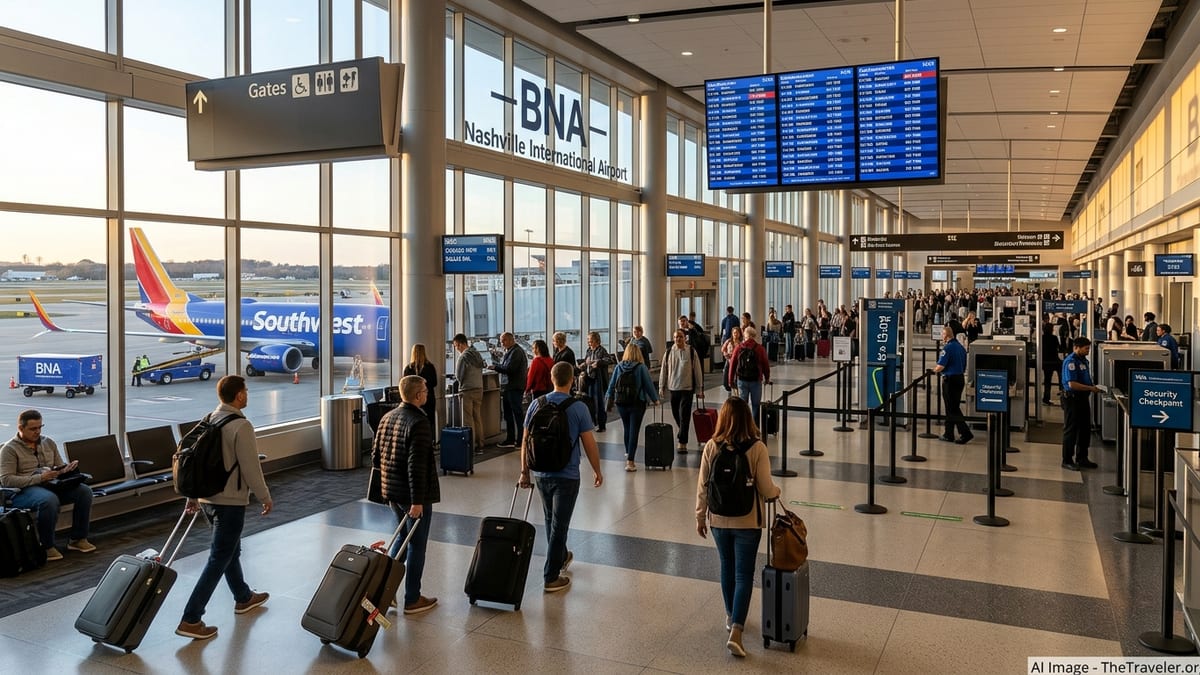
Busy Thanksgiving Eve at BNA but few local disruptions
Nashville International Airport reported that security lines remained short to moderate through most of Thanksgiving Eve even as roughly 35,000 passengers were expected to move through the terminal. Local television crews on site observed only a little more than a dozen delayed departures and no significant operational issues, a relatively smooth picture compared with the broader U.S. network, where weather and congestion often create bottlenecks around the holiday.
The 35,000 passengers expected at BNA on the Wednesday before Thanksgiving represent only a fraction of the airport’s typical monthly throughput but still mark a concentrated surge for a single travel day. Publicly available data compiled from federal throughput records indicate that Nashville screened just over 1 million departing passengers in October 2026, which averages to about 35,000 people per day. In other words, Thanksgiving Eve at BNA this year was close to a peak travel day but not out of line with the busiest days the airport now experiences in a normal month.
The combination of stable security operations and relatively light disruption meant that many passengers who arrived early, heeding national advice to build in extra time, encountered shorter-than-expected waits. Travelers interviewed at the airport reported moving quickly through both the standard security lanes and the TSA PreCheck queues, though some still faced extended overall journeys because of downstream flight delays or missed connections at other hubs.
How Nashville’s experience fits into national Thanksgiving traffic
The stable picture at BNA unfolded against the backdrop of one of the busiest travel periods on the U.S. aviation calendar. The Transportation Security Administration defines the Thanksgiving travel window as the seven days from the Tuesday before the holiday through the Monday after. For 2026, agency projections and industry analyses indicate that approximately 17 to 18 million passengers will pass through TSA checkpoints nationwide during that span, with Sunday 29 November forecast as the single busiest day, potentially exceeding 3 million travelers screened across U.S. airports.
Recent years have already set records. In 2025, federal checkpoint statistics show that TSA screened more than 3.1 million passengers on the Sunday after Thanksgiving, the highest single-day total yet recorded. Forecasts for this year suggest volumes will remain near those record levels, even as early-season storms and scattered airline technology problems introduce more uncertainty into flight schedules. Against that national background, a mid-sized hub like Nashville can experience several relatively calm days even while the overall network is running close to capacity.
On the ground, Tennessee is part of a broader picture in which the majority of holiday travelers still opt to drive rather than fly. AAA’s most recent Thanksgiving outlook projects roughly 81.5 million Americans traveling at least 50 miles from home between the Tuesday before the holiday and the following Monday, with nearly 90 percent of them going by car. Earlier state-level forecasts for Tennessee in recent years have put the number of residents traveling over the Thanksgiving period near or just under 2 million, the vast majority by road rather than through airports such as BNA.
Delays highlight vulnerability of connections even when lines are short
Although the operational story at Nashville’s checkpoints was mostly positive, travelers still encountered the kinds of itinerary problems that are common during peak holiday periods. Some passengers departing BNA on Wednesday reported that their flights left late enough to jeopardize carefully timed connections at large coastal hubs and European gateways. In at least one case, passengers bound for Rome needed to work with airline staff at the airport to rebook their onward flights after a late departure from Nashville made the original connection unrealistic.
These experiences underline a key vulnerability of modern hub-and-spoke networks: even when a departure airport such as BNA is running smoothly, upstream or downstream congestion can ripple into a local travel day. Nationally, flight-tracking services often record thousands of delayed flights on the day before Thanksgiving, as heavy traffic volumes combine with weather systems to slow down operations at major nodes including New York, Atlanta and Chicago. In that environment, a single delayed departure from a regional or mid-sized hub can cause missed connections hours and continents away.
For individual travelers, especially those flying long-haul or connecting to international services, the practical implication is that generous connection times can be as important as early airport arrival. Airlines build schedule padding into many peak-period itineraries, yet tighter connections remain common where carriers seek to maintain attractive total journey times. The relatively small number of delays recorded at BNA on Thanksgiving Eve this year shows that not every heavy travel day translates into widespread disruption, but the handful of missed connections reported locally illustrate how even modest schedule slippage can affect complex itineraries.
Airport and TSA guidance for navigating peak holiday crowds
In advance of the Thanksgiving travel window, Nashville International Airport and the TSA repeated standard holiday advice to passengers, much of it consistent with guidance seen in prior years. BNA has urged departing travelers to arrive at least two hours before domestic flights and three hours before international departures during peak periods, particularly in the early morning and late afternoon windows when departures are most concentrated. The airport also recommends that those dropping off or picking up passengers use the free cell phone waiting lot rather than circling the terminal roads, a step aimed at easing curbside congestion.
The TSA, for its part, emphasizes that understanding security requirements ahead of time remains one of the most effective ways to keep lines moving. That includes reviewing which foods and gifts can be carried through the checkpoint and which items must go into checked luggage, placing liquids and electronics for easy inspection where required, and keeping travel documents ready when approaching screening. The agency notes that passengers enrolled in programs such as TSA PreCheck and CLEAR typically experience shorter wait times, although these benefits can narrow during the very busiest hours when all lanes are heavily used.
Local travel behavior on Wednesday reflected some of this messaging. Reporters at BNA spoke with passengers who arrived at the airport several hours before departure, citing concerns about highway traffic and parking availability. Some said they preferred to build in extra time and pass the hours inside the terminal rather than risk a last-minute rush. With security checkpoints flowing smoothly for much of the day, many of these early arrivals had ample time to spend in BNA’s expanded concourses and food outlets, a scenario airport officials generally prefer to roadway congestion or missed flights.
What travelers should expect for the rest of the holiday period
While Thanksgiving Eve at Nashville International Airport turned out to be manageable, both BNA and federal transportation officials expect the heaviest crowds to appear at the end of the long weekend. Historical data from Thanksgiving 2025 show that the Sunday after the holiday was the busiest day of that period nationwide, and a similar pattern is forecast for 2026, with TSA predicting around 3 million screenings system-wide on Sunday 29 November. At BNA, prior-year throughput suggests that the Sunday return often exceeds Thanksgiving Eve volumes as residents and visitors converge on the airport to head home.
Passengers departing from Nashville over the weekend should therefore plan for the possibility of longer queues and more congested roadways than those observed on Wednesday. Airlines typically schedule additional capacity on the peak Sunday after Thanksgiving, which can strain boarding and baggage systems even when weather is cooperative. Given that November storms are expected to affect some regions of the country during the latter half of the holiday window, travelers connecting through northern or coastal hubs may face a higher risk of weather-related disruptions than those on point-to-point routes within the Southeast.
For those still preparing to travel, officials advise monitoring airline apps or websites closely in the 24 hours before departure, allowing extra time to reach the airport, and checking parking availability or ground transport options in advance. Travelers should also be aware that national forecasts and TSA projections describe expectations rather than guarantees; actual passenger volumes and wait times can vary significantly by hour and by terminal. The relatively smooth Thanksgiving Eve experience at BNA this year provides a useful reference point but not a firm guide to what individual travelers will encounter through the remainder of the holiday period, particularly on the expectedly busy Sunday return.