


More news on this day
Tampa International Airport entered one of its busiest evenings of the year on the night before Thanksgiving, with officials reporting packed terminals, heavy traffic at security and parking garages, and a growing number of weather‑related flight delays as nearly a million passengers move through the airport over the broader holiday period.
Get the latest news straight to your inbox!
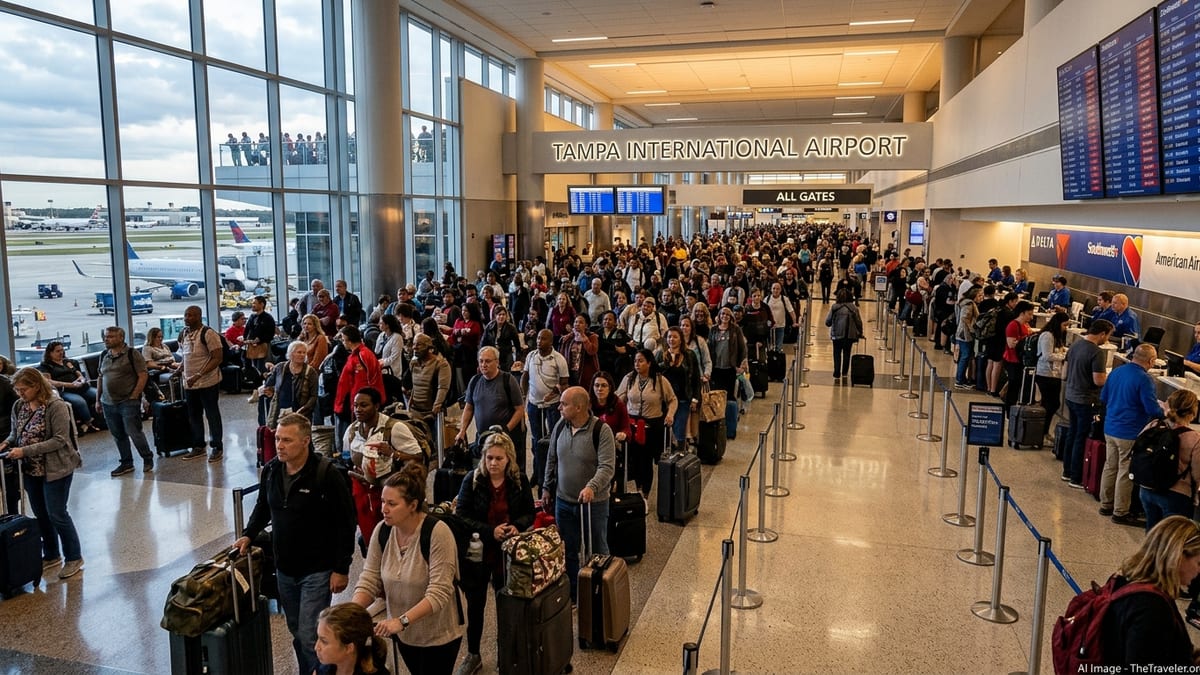
Record Thanksgiving crowds put Tampa International to the test
Tampa International Airport had already warned that the 2026 Thanksgiving period would be one of the busiest in its history, and that prediction appeared to be playing out on the Wednesday before the holiday. The airport expects more than 950,000 passengers over its defined Thanksgiving travel window, averaging around 80,000 travelers per day, according to figures shared by airport officials in the run‑up to the holiday. That volume is similar to or higher than last year’s Thanksgiving period and reflects continuing growth in domestic and international traffic through Tampa.
Airport managers have identified Wednesday, Saturday, Sunday and Monday in the Thanksgiving week as their peak days, each projected to approach or exceed 90,000 passengers. While the Sunday and Monday after Thanksgiving are forecast to be the very busiest, Thanksgiving Eve traditionally produces some of the heaviest evening crowds as travelers race to reach relatives before the holiday. Local broadcasters and regional news outlets reported steady streams of passengers filling Tampa’s main terminal from early Wednesday morning, with crowds persisting into the night.
The evening rush came on top of what is shaping up to be a very active national travel period. Federal aviation planners estimate that more than 417,000 flights will operate across the United States during the broader Thanksgiving window, the highest level in roughly 16 years. Tampa’s forecast of nearly a million passengers mirrors that national pattern, making the airport one of Florida’s key hubs for holiday travel alongside Orlando, Miami and Fort Lauderdale.
Flight delays build as weather and network strains ripple into Tampa
By Wednesday night, Tampa International’s operations were feeling the cumulative effect of a busy week that has included airline technology problems and deteriorating weather along parts of the East Coast. Earlier in the week, a software issue at Delta Air Lines triggered delays and an hour‑long ground stop into Atlanta, while United Airlines experienced its own system outage on a separate day. Those disruptions originated away from Tampa but affected the broader U.S. air network at a time when airlines were already operating near capacity for the holiday period.
At Tampa, the most visible impact for travelers on Thanksgiving Eve was a growing number of delayed departures and arrivals through the evening hours, rather than mass cancellations. Publicly available tracking boards showed a familiar pattern for a busy holiday night: relatively smooth operations during the early morning, followed by longer gaps between scheduled and actual departure times as the day progressed and congestion built across the national system. Even when weather over Tampa Bay itself remained manageable, delays at major connecting hubs such as Atlanta, Newark and Chicago translated into late‑running inbound aircraft and pushed some departures from Tampa behind schedule.
Meteorologists had also been warning of a developing storm system moving up the Southeast coast in the midweek period. Forecasts called for heavy rain, gusty winds and possible coastal flooding for parts of Florida and the Carolinas on Wednesday, then worsening conditions farther north into Thanksgiving Day. While Tampa was not expected to see the most severe impacts of the system, airlines operating through nearby airports in the region faced required spacing between takeoffs and landings, as well as turbulence and low cloud ceilings. These factors contributed to conservative scheduling and occasional ground delays that fed back into Tampa’s timetable as aircraft rotated among different cities.
Airport operations, staffing and parking stretched by holiday demand
Inside Tampa International, airport staff had been preparing for the Thanksgiving rush for several weeks, using spring break operations as a benchmark for how to manage sustained high volumes. The Hillsborough County Aviation Authority reported earlier this year that its spring break period remains its single busiest season, but that major holidays such as Thanksgiving increasingly approach those levels, especially on peak days. For 2026, Tampa International added seasonal staff in customer service and parking, adjusted concession hours and coordinated with federal security agencies to keep passenger screening lanes fully staffed during the morning and evening surges.
Security screening was a key concern for travelers on Thanksgiving Eve. Transportation Security Administration officers at Tampa were screening tens of thousands of passengers through the airport’s three main checkpoints, and local reports indicated that wait times fluctuated significantly over the course of the day. Early morning travelers saw relatively moderate lines, but waits lengthened in the late afternoon and early evening as families and infrequent flyers arrived for departures clustered around dinnertime. The airport has previously reported average wait times of under ten minutes during peak holiday periods when all lanes are open, but on the busiest evenings individual checkpoints can experience longer queues, especially when large tour groups or multiple wide‑body departures coincide.
Parking capacity was another pressure point for the airport. In advance of the holiday, Tampa International advised travelers to reserve parking at least 24 hours before arrival and warned that some garages could reach capacity on the busiest days. Past Thanksgiving travel periods have seen tens of thousands of vehicles parked across the airport’s garages and remote lots at once, prompting temporary closures and rerouting to overflow areas. On the night before Thanksgiving, drivers heading into the airport reported heavy traffic on approach roads and congestion at the entrances to the main parking structures as travelers circled for spaces or queued at entry gates.
How current patterns compare with previous Thanksgiving periods
This year’s busy Thanksgiving Eve at Tampa International fits into a broader pattern of strong holiday demand that has developed over the past several years. Industry data from 2021 through 2025 show that around 5 to 6 percent of Tampa departures during Thanksgiving travel windows experienced significant disruption, defined as arriving more than an hour late, being canceled or being diverted. That share is broadly comparable to the disruption rate at other times of the year, indicating that while Thanksgiving is busier, it is not consistently less reliable than non‑holiday travel once weather and operational issues are factored in.
What has changed since the pre‑pandemic period is the concentration of traffic on a handful of days and the increased use of Tampa as both an origin and connecting airport for visitors to Florida’s Gulf Coast. The Sunday after Thanksgiving has become one of the consistently busiest days of the year for Tampa’s checkpoints, with federal screeners processing tens of thousands more passengers than on an average non‑holiday Sunday. That means that even if Wednesday night experiences noticeable delays and crowded terminals, the most acute strain on facilities, baggage systems and curbside traffic is often still to come at the end of the long weekend.
Local aviation officials also point to the airport’s relative resilience during holiday peaks compared with some larger hubs. In meeting summaries and public briefings, Tampa’s managers have noted that average security wait times have remained in single digits on many high‑traffic days thanks to the airport’s distributed terminal layout and coordination with federal partners. However, those averages do not eliminate the possibility of longer queues at specific points in the day, particularly for travelers who arrive closer to departure times than the airport’s recommended windows. The experience on the night before Thanksgiving underscored that distinction, with some passengers moving quickly through security while others encountered packed lines depending on their timing and terminal.
What travelers using Tampa International should know in the days ahead
For passengers planning to use Tampa International Airport through the remainder of the Thanksgiving period, the main challenges are likely to be crowding, parking and the potential for knock‑on delays from weather and congestion elsewhere in the country, rather than a single local disruption. Forecasts suggest that the nor’easter affecting parts of the East Coast may continue to cause delays into Thanksgiving Day and potentially the following morning, especially for flights to and from the mid‑Atlantic and Northeast. Travelers connecting in or flying directly to airports in those regions from Tampa should pay close attention to airline notifications and real‑time flight status before leaving for the airport.
Airport officials continue to advise that passengers arrive early, even if they hold TSA PreCheck or other expedited screening status. For domestic flights, arriving around two and a half hours before departure is recommended on the busiest travel days, while international travelers are generally urged to plan for three hours. Those recommendations are tied not only to security screening but also to the time required to find parking, navigate potentially crowded rental car return facilities, check baggage and move between the main terminal and airside concourses.
In the days after Thanksgiving, passengers departing Tampa should also be prepared for heavier than usual loads on late afternoon and evening flights as people return home at the end of the long weekend. Sunday and Monday are expected to bring the highest passenger counts of the period, and parking facilities may once again approach capacity if many travelers choose to drive to the airport. Monitoring reservations, using real‑time wait time tools where available and building additional buffer time into travel plans remain the most practical steps for navigating what is shaping up to be one of Tampa International Airport’s busiest Thanksgiving seasons to date.