


More news on this day
Detroit Metropolitan Wayne County Airport is working through an accumulation of delayed and canceled flights after a nationwide Federal Aviation Administration ground stop and subsequent system disruptions collided with one of the busiest travel periods of the year, leaving many passengers facing extended waits, missed connections and uncertain departure times.
Get the latest news straight to your inbox!
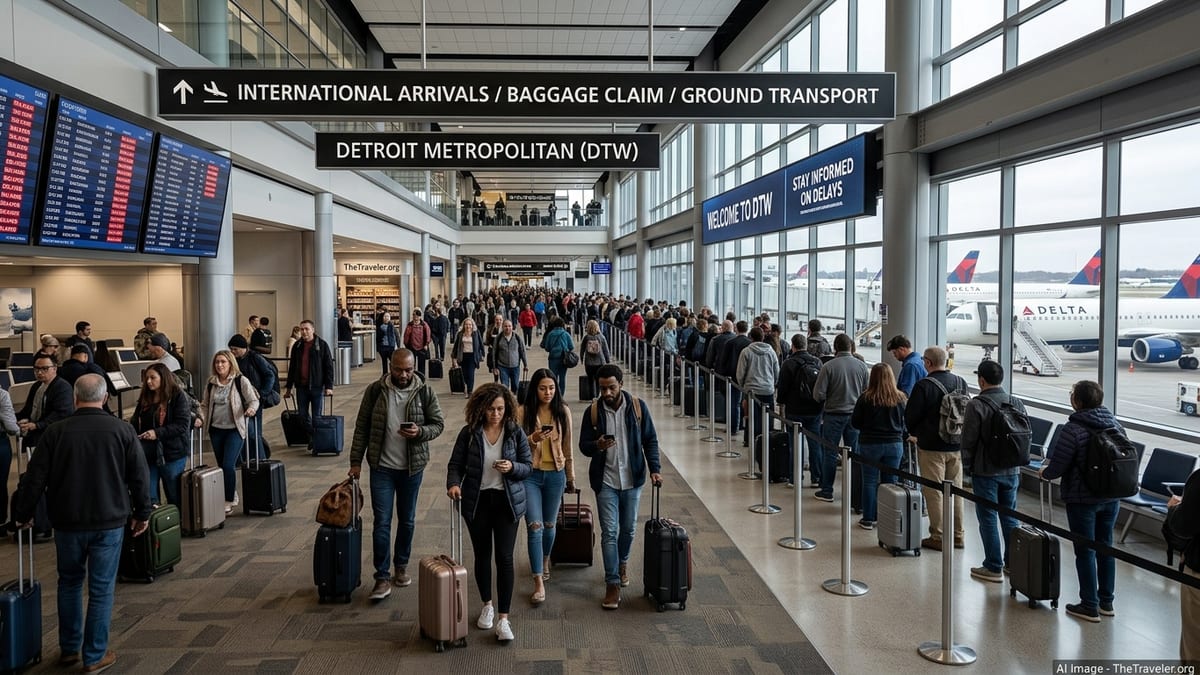
Ground stop fallout leaves lingering delays at DTW
The current accumulation of delays at Detroit Metropolitan Wayne County Airport traces back to a rare nationwide ground stop ordered by the Federal Aviation Administration in mid November 2026, which temporarily halted most commercial departures across the United States. At DTW, the halt quickly translated into long lines, crowded gate areas and rolling rebooking efforts as airlines worked to restart operations following several hours with little or no outbound traffic.
On November 13, travelers at Detroit Metro described a prolonged “waiting game” after the ground stop, with flights held at gates and departure times repeatedly revised while airlines coordinated with federal air traffic managers to safely resume the flow of aircraft. Local coverage from that evening reported a mix of outright cancellations and heavily delayed departures from both the McNamara and Evans terminals as airlines coped with displaced crews and aircraft that were no longer in the right cities when the system restarted.
Federal and airline data from the following days show the disruption did not end when the ground stop was lifted. On November 14, hundreds of flights within, into or out of DTW were delayed or canceled as carriers continued to reposition planes, accommodate stranded passengers and clear the backlog created during the halt. Even as the national system stabilized, Detroit’s role as a major connecting hub meant residual congestion persisted longer than at some smaller airports, with missed connections rippling through weekend schedules.
Busy holiday travel amplifies pressure on Detroit hub
The mid November outage arrived just as Thanksgiving travel ramped up, increasing the impact on Detroit Metro’s passengers. National forecasts pointed to near record volumes for the holiday period, with tens of millions of travelers expected to fly in the days around Thanksgiving. In Michigan, regional reports noted that Thanksgiving volumes were “leveling off” compared with last year but remained extremely high, leaving little slack when an operational shock hit the system.
By the week of November 23, airlines and airport officials described operations at DTW as largely “back to normal” compared with the worst of the outage, yet the hub remained busy. On the Wednesday before Thanksgiving, often one of the heaviest air travel days of the year, flight tracking data showed only a small number of cancellations at Detroit by early morning, though some arrivals and departures still experienced moderate delays. Travelers at the airport reported full security lines and crowded concourses, but many flights departed close to schedule as carriers worked to avoid a repeat of the previous weekend.
The combination of a recent nationwide disruption and the seasonal spike in passenger numbers helps explain why Detroit Metro is seeing an accumulation of delays even when there is no active ground stop or major local weather event. With planes heavily booked and crew schedules tightly sequenced for the holiday period, any minor schedule irregularity, such as a late inbound aircraft or a short-duration weather hold elsewhere in the network, has a greater chance of creating knock-on delays for connecting passengers at DTW.
Current operational picture: incremental improvements but uneven delays
On November 26, federal air traffic status boards listed Detroit Metropolitan Wayne County Airport as experiencing only minimal airborne arrival delays, generally of 15 minutes or less. Separate monitoring tools that track airport-wide performance indicated that roughly three quarters of departures from DTW were leaving on time, with an average delay close to ten minutes among late flights. These figures suggest that, at a system level, Detroit’s operation has improved significantly from the spike of disruptions immediately after the ground stop.
Other live status services that draw directly from FAA advisories reported no active ground stop, no formal delay program and no weather-related closure in effect at Detroit on Thursday. From an air traffic control standpoint, DTW was considered to be operating normally, with both passenger terminals open and the airport’s runways accepting regular arrival and departure flows. That said, individual flights could still encounter delays caused by late-arriving aircraft, airline-specific scheduling issues, or congestion at other airports in their route network.
Passengers’ experiences remain varied. Some travelers connecting through Detroit earlier in Thanksgiving week reported relatively routine journeys, while others described longer-than-expected waits brought on by delays at other hubs that cascaded through DTW. Social media posts from the days following the outage included accounts of passengers missing international connections after earlier domestic delays, illustrating how even when Detroit’s own conditions are stable, its role as a connecting hub can expose passengers to disruptions originating elsewhere.
How Detroit compares on punctuality and resilience
Longer term performance data suggest that Detroit Metro’s punctuality has been broadly comparable to many other large U.S. hubs. In federal transportation statistics for September 2026, DTW recorded on-time performance in the low 80 percent range for both arrivals and departures, based on nearly 9,500 flights. That placed the airport in line with, or slightly better than, several similarly sized connecting hubs, indicating that the current wave of delays is more closely tied to specific events and seasonal pressures than to a chronic punctuality problem.
Detroit’s status as a primary hub for a major U.S. airline, with extensive domestic and international connections, also helps explain how a nationwide ground stop translated into particularly visible disruption for local travelers. When a large volume of connecting passengers pass through a single airport each day, missed connections and rebookings compound quickly when there is a system shock. After the mid November halt, carriers operating at DTW needed to reposition aircraft and crews across multiple continents, a process that can take several days to work through even once airspace is reopened.
At the same time, the airport authority and airlines have indicated that the ground stop was an unusual event rather than a daily risk factor. Both federal regulators and the carriers involved have initiated reviews of the outage and subsequent glitches in automated systems in order to reduce the likelihood of a repeat incident. While detailed findings from those reviews are not yet public, regulators have stressed that safety was prioritized during the outage, and airlines have issued travel waivers for affected passengers, allowing itinerary changes without certain fees on eligible tickets.
What travelers using Detroit Metro should do next
For passengers flying into or out of Detroit in the days ahead, the key implication of the recent disruptions is the need for flexibility and extra time. Even as official metrics show DTW operating without a formal delay program, the combination of high holiday traffic and the lingering repositioning of aircraft in airline networks means that individual flights can still depart behind schedule with limited notice. Travelers are encouraged by airlines, the airport authority and consumer advocates to check their flight status frequently through official websites or mobile apps and to enable notifications for schedule changes.
Airport and travel organizations also emphasize the importance of early arrival during peak periods. With Detroit Metro expecting heavy passenger volumes around Thanksgiving and into the winter holiday season, arriving two to three hours before a domestic departure and at least three hours before an international flight can provide a buffer against longer waits at check in, baggage drop and security screening. In recent days, some Michigan travelers who built in extra time reported smoother experiences, even when their flights encountered modest delays.
Looking beyond the immediate holiday period, federal regulators are scheduled to implement updated rules in early 2027 that will refine how airlines report the causes of delays and cancellations. While these changes will not directly alter day-of-travel operations at Detroit Metro, they are intended to give passengers and policymakers clearer information about whether disruptions stem from weather, air traffic control, airline decisions or other factors. For now, travelers using DTW should continue to monitor advisories from their carriers and the airport, particularly when major storms, nationwide system outages or other unusual events intersect with already busy travel days.