


More news on this day
AAA expects 81.5 million Americans to travel at least 50 miles from home for Thanksgiving 2026, and fresh forecasts from the motoring group and traffic-analytics firm INRIX outline the hours when road congestion and flight delays are most likely to spike in the coming days.
Get the latest news straight to your inbox!
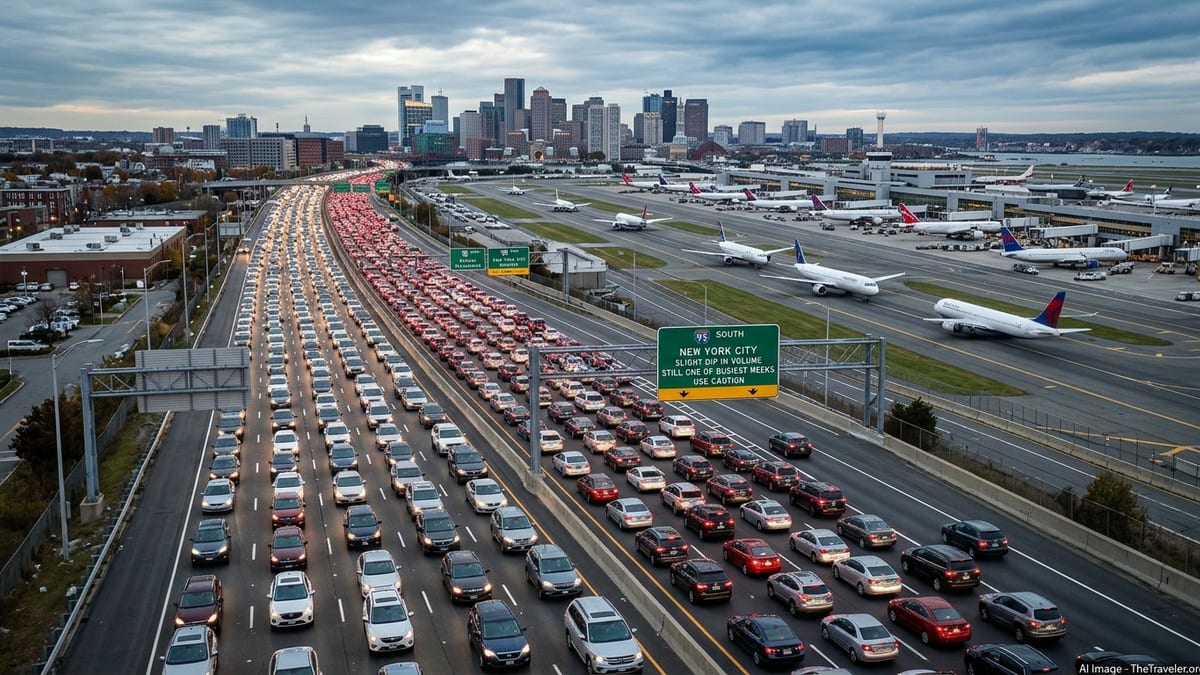
Holiday volumes: Slight dip, but still one of the busiest weeks of the year
AAA’s national Thanksgiving forecast, released on 16 November, projects that 81.5 million people in the United States will travel between Tuesday 24 November and Monday 30 November 2026. That is fractionally below the 81.6 million estimated to have travelled over the 2025 holiday, ending a run of year-on-year increases but keeping volumes near record territory.
Road trips remain the dominant choice. AAA expects about 72.9 million people to travel by car for Thanksgiving this year, a small decline from roughly 73.1 million in 2025. Air travel is forecast at close to 6 million passengers over the seven-day holiday window, or a little more than 7 percent of all Thanksgiving travellers, with the remainder using buses, trains and other modes.
Although the overall forecast is marginally lower than last year, federal and state agencies are treating the period as one of the busiest travel windows in the calendar. The Federal Aviation Administration has pointed out in previous analyses that Thanksgiving traffic levels at major hubs are close to what many airports could see on a typical day later this decade if passenger growth continues, even without a specific holiday surge.
Best and worst times to drive, according to AAA and INRIX
To help motorists avoid the heaviest traffic, AAA has again partnered with transportation analytics firm INRIX to model expected congestion patterns across the United States. Their joint forecast identifies the Tuesday and Wednesday before Thanksgiving, along with the Sunday and Monday after the holiday, as the days when highway delays are likely to be most severe, particularly around major metropolitan areas.
The data suggest that, on most days of Thanksgiving week, afternoon and early evening will see the slowest travel speeds as routine commuters mix with long-distance holiday drivers. INRIX’s national analysis indicates that congestion is likely to build from late morning, peak from mid-afternoon into the early evening, and ease again late at night. For many corridors, the firms recommend setting out before about 11 a.m. or waiting until later in the evening to reduce the risk of extended delays.
This pattern is broadly consistent with earlier INRIX research prepared for the U.S. Travel Association, which found that travel times on the Wednesday before Thanksgiving frequently lengthen the most because of overlapping commuter and holiday flows. On that day, journey times on key routes around large cities have often been significantly higher than normal weekday averages, whereas the Thanksgiving Day period itself can be relatively quieter on some urban freeways.
Weather, parade disruption and what they mean for air and road delays
Short-term forecasts for Thanksgiving week 2026 indicate that weather will be an important factor in how smoothly travel unfolds. Meteorologists at the National Weather Service and independent forecasters expect rain and strong winds along parts of the East Coast, including the New York region, with additional wet and windy conditions possible in parts of the West. In its outlook earlier this week, the Weather Prediction Center highlighted the potential for 1 to 2 inches of rain and gusts around 40 to 45 miles per hour in some coastal areas on Thanksgiving Day.
The same storm system has already had one prominent knock-on effect. Poor weather in New York prompted the postponement of the 2026 Macy’s Thanksgiving Day Parade, the first time the event has been delayed in its modern history. Broadcasters are instead airing a recording of the 2025 parade on Thursday while organisers monitor conditions for a later date. While the parade change mainly affects spectators, the underlying weather conditions are also relevant for travellers, because strong winds, low cloud and heavy rain can lead to ground delays or cancellations at busy airports along the Eastern Seaboard.
Airports elsewhere are facing their own operational strains. In Miami, a FedEx cargo aircraft overran a runway at Miami International Airport on Wednesday night, temporarily closing all but one runway close to the start of the peak travel period. The Federal Aviation Administration and local officials have advised passengers flying through Miami to monitor airline communications for potential disruptions, since the reduction in runway capacity can increase the likelihood of delays until normal operations are restored.
What recent data show about flight punctuality around Thanksgiving
Despite travellers’ anxieties, historical federal data indicate that most Thanksgiving-period flights arrive on time, although there are important exceptions. FAA statistics and analyses based on the Department of Transportation’s on-time performance database show that, over multiple years, flights scheduled between the Saturday before Thanksgiving and the Friday after have tended to perform slightly better than the November average, in part because airlines often build additional buffer time into their schedules for the holiday.
The main outliers are the Sunday and Monday following Thanksgiving. Aggregated data for recent holiday periods suggest that those two days see a noticeably higher share of arrivals at least 15 minutes late compared with other days of the week-long window. Capacity constraints on popular routes, the cumulative effect of earlier disruptions and heavy demand from travellers returning home all contribute to the poorer performance at the end of the holiday break.
At the airport level, the patterns are uneven. Analyses drawing on federal datasets and flight-tracking information show that some of the busiest hubs, including Atlanta, Dallas–Fort Worth, Denver and Chicago O’Hare, typically handle large Thanksgiving volumes with relatively modest additional delay compared with a regular busy day. Others, such as New York’s major airports, can be more vulnerable to weather-related ground stops and delay programs, especially when low cloud and strong winds coincide with peak travel days.
How travellers can use this year’s forecasts in the final days before Thanksgiving
With the bulk of departures expected between Tuesday 24 November and the morning of Thanksgiving Day, the timing of individual trips will play a significant role in how much disruption travellers encounter. Motorists who still have flexibility in their plans can reduce their exposure to congestion by scheduling long drives for the morning hours rather than mid-afternoon, particularly on the Tuesday and Wednesday before the holiday and on the Sunday return. On routes through major metropolitan areas, leaving early enough to clear urban bottlenecks before lunch can make a marked difference in overall travel time.
For those flying, current conditions underline the importance of monitoring both airline messages and local weather. The nationwide ground stop that affected U.S. air traffic earlier this month, along with more recent IT outages at United Airlines and Delta Air Lines, showed how quickly technical problems can cascade into hundreds of delays. During this week’s holiday period, any additional disruption from storms along the East or West Coasts, or from temporary capacity constraints at individual airports such as Miami, is likely to have the greatest impact on already busy days like Wednesday and the Sunday after Thanksgiving.
Looking beyond this year’s holiday, the underlying trends highlighted by AAA and federal agencies suggest that Thanksgiving will remain a stress test for the U.S. transport system even if total traveller numbers fluctuate slightly from one year to the next. For 2026, the most practical steps for individual travellers are to verify departure times shortly before leaving home, allow extra time for airport check-in and security on peak days, and, for those on the roads, to treat AAA and INRIX’s hourly congestion forecasts as a guide for choosing when to depart rather than a guarantee of free-flowing traffic.