


For many travelers, NetJets is the brand name that comes to mind when they picture stepping onto a private jet. Yet even frequent fliers are often unsure what “buying into” NetJets actually gets them in practical terms. Which specific aircraft might show up on the day of travel, how different are the cabins, and what does choosing a light jet versus a long range flagship really mean for your itinerary and comfort? This guide breaks down the current NetJets fleet in plain language so you know exactly which private jets you can fly and how they fit real world trips.
Get the latest updates straight to your inbox!
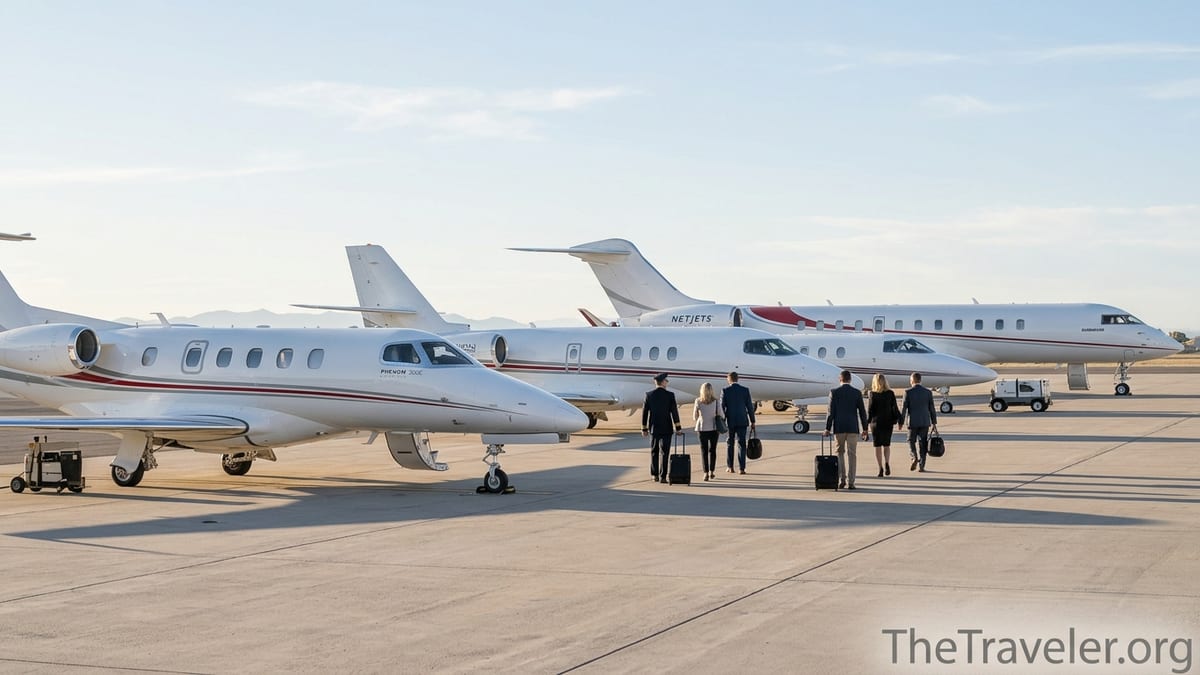
How NetJets Works: From Cardholder To Cabin
NetJets is built around access rather than outright aircraft ownership. Instead of buying an entire jet, most travelers either purchase a fractional share or a NetJets Card (the product that evolved from the Marquis Jet Card). In both cases, you prepay for a number of flight hours in a certain cabin size, then call or book digitally when you want to travel. NetJets assigns an aircraft that matches the size and performance you purchased, typically with 4 to 10 hours’ notice for cardholders and owners.
In practice this means that if you hold a light jet card, you might fly an Embraer Phenom 300E on one trip and a Cessna Citation XLS on another. If you are in the large cabin or long range category, your flights might be on a Bombardier Challenger 650, Global 6000, or Global 7500, depending on aircraft availability and your route. You are buying access to a category, not a specific aircraft tail number, though in the upper tiers you can often specify a preferred type when it matters for range or cabin layout.
Most leisure travelers encounter NetJets in very concrete scenarios. A family in New York booking a February escape to the Turks and Caicos on a light jet, a private equity team needing a same day New York to Chicago to Dallas roadshow on a super midsize, or a group of executives flying nonstop from Los Angeles to London on a long range Global. Understanding how the fleet is structured helps you pick the right product for these real world missions.
Because NetJets operates the largest private jet fleet in the world, with hundreds of aircraft across multiple cabin sizes, the company can usually substitute a larger aircraft at no extra cost if your specific type is unavailable. That flexibility is a core part of the value: you are not waiting for “your” jet to get back from another owner, you are tapping into a network where there is almost always another Phenom, Latitude, Challenger, or Global available.
NetJets Fleet At A Glance: Key Cabin Categories
NetJets divides its core fleet into a handful of practical cabin categories that roughly mirror the rest of the private aviation market: light jets, midsize, super midsize, large cabin, and long range or ultra long range. Today, those categories are filled by a focused set of models from four major manufacturers: Embraer, Cessna (Textron Aviation), Bombardier and, at the top end, Gulfstream or Bombardier Globals depending on the program vintage.
The light jet workhorses are the Embraer Phenom 300 and 300E, and in some markets the Cessna Citation XLS. These aircraft typically seat 6 to 7 passengers, excel on trips under about 2.5 to 3 hours, and serve popular routes like New York to Palm Beach or Dallas to Aspen. For many first time private fliers, this is where they start, because hourly rates and card pricing are lower than larger cabins while still delivering the speed and privacy of business aviation.
In the midsize bracket, NetJets highlights the Cessna Citation Latitude and Embraer Praetor 500. These aircraft offer a flat floor, more generous headroom, and longer legs. A Latitude, for example, is commonly used on routes like Chicago to San Jose del Cabo or Austin to Bozeman without fuel stops. If your typical mission includes four adults plus luggage for a long ski weekend or golf trip, midsize becomes an attractive step up from light jets.
Above that, the super midsize and large cabin jets, such as the Bombardier Challenger 350 and Challenger 650, carry 8 to 12 passengers in more spacious, often flight attendant staffed cabins. At the very top, ultra long range aircraft like the Bombardier Global 6000 and Global 7500 handle nonstop intercontinental flights, such as Los Angeles to London or New York to Dubai, in residential style comfort. These categories matter when you decide which NetJets card or share to purchase, because moving up delivers more range and space but also higher hourly costs.
Light Jets: Phenom 300E And Citation XLS In Real Use
For many North American NetJets clients, the Embraer Phenom 300 or 300E is the jet they see most often. It is one of the most numerous types in the NetJets light fleet and is widely regarded as a highly efficient “Swiss Army knife” of private aviation. In practice, this jet is ideal for point to point flights like Teterboro to Hilton Head, Van Nuys to Napa, or Miami to Nassau, typically under about 1,800 nautical miles. Cabin layouts usually feature club seating for four plus additional seats, with a comfortable but not stand up cabin.
Travelers appreciate the Phenom 300E for its relatively large baggage hold and bright, modern interior. For example, a couple with two children and golf bags heading from Chicago to Scottsdale can comfortably stow luggage and still enjoy a quiet, wifi equipped ride. In terms of pricing, while NetJets does not publicly post card rates, independent jet card indexes often show entry level light jet card costs starting around the mid to high six figures for 25 hours, with effective hourly rates that are meaningfully lower than midsize or large cabin categories.
NetJets also uses the Cessna Citation XLS and XLS+ as part of its light or light midsize segment. With a slightly larger cabin cross section than the Phenom and a more traditional business jet feel, the XLS is popular with travelers who want a bit more space without committing to a full midsize product. A typical mission might be a legal team flying from Boston to Raleigh for a day of meetings or a family of five traveling from Los Angeles to Jackson Hole. The XLS can access many secondary airports while offering a familiar Cessna flight deck and solid runway performance.
In everyday terms, if your flying is mostly regional within the eastern United States, West Coast, or intra Europe, and your groups are four to six people, light jets often provide the best balance of cost, speed, and airport flexibility. Travelers based in cities like New York, Atlanta, Dallas, or Los Angeles frequently use NetJets light jets to reach resort destinations such as the Florida Panhandle, Colorado ski towns, or Caribbean islands that may lack nonstop commercial service.
Midsize And Super Midsize: Latitude, Praetor 500 And Challenger 350
Moving into midsize jets, the Cessna Citation Latitude has become the backbone of the NetJets fleet in this category, with more than a hundred examples in service globally. The Latitude offers a flat floor, six foot class cabin height, and seating for around eight passengers. Its range covers popular nonstop routes such as New York to Jackson Hole or Dallas to Cabo San Lucas, and its baggage capacity easily swallows skis, golf clubs, and large suitcases for group trips.
For travelers, the Latitude represents the point where you can stand up, walk around more comfortably, and host a full complement of adults without feeling tight on space. Think of a corporate team of six flying from Chicago to Silicon Valley for a two day board meeting or a multigenerational family leaving Washington Dulles for a week in Telluride. The midsize cabin feels meaningfully more spacious than a light jet, and catering, connectivity, and onboard service are a step closer to a large cabin experience.
NetJets has also added the Embraer Praetor 500 into its midsize portfolio. The Praetor 500 brings enhanced range and cutting edge avionics, aimed at missions like Miami to Denver or London to Marrakech nonstop. Clients who often fly coast to coast in the United States, or who need extra range in Europe and the Middle East, may specifically request the Praetor when they want midsize comfort with almost super midsize reach.
Above midsize, the super midsize Bombardier Challenger 350 is a core NetJets type for travelers who frequently fly between major business centers. A Challenger 350 can comfortably operate nonstop missions like New York to Los Angeles, Seattle to Chicago, or London to Riyadh, typically seating eight to nine passengers in a quiet, flat floor cabin. For a private equity firm doing multi city deal roadshows or a sports team’s ownership group shuttling between coasts, super midsize is often the sweet spot between speed, range, and operating cost.
Large Cabin And Long Range: Challenger 650, Global 6000 And Global 7500
When your trips regularly cross oceans or you travel with eight to twelve passengers and need full size, stand up comfort, the NetJets large cabin and long range fleet becomes the main focus. A centerpiece here is the Bombardier Challenger 650, a large cabin jet that balances intercontinental range with relatively modest runway requirements. A Challenger 650 in the NetJets fleet might be used on routes like New York to London, Houston to Honolulu, or Toronto to Barbados with a full family group and baggage.
Travelers stepping onto a Challenger 650 will notice the residential feel of the cabin: wide seats, divans that convert into beds, full galleys and often a dedicated flight attendant. This allows for proper, plated meal service, real overnight rest on red eye flights, and a more polished experience when hosting clients. Many NetJets fractional owners in this category are corporations that shuttle executives between headquarters and regional hubs in Europe, Asia, and the Americas, where reliability and consistent branding onboard matter.
Further up the ladder, NetJets operates Bombardier Global series jets, notably the Global 6000 and Global 7500, as its ultra long range flagships. These aircraft are capable of some of the longest nonstop flights in business aviation, such as Los Angeles to Hong Kong or New York to Johannesburg, depending on payload and conditions. In practice, a NetJets Global 7500 might be used by a multinational CEO commuting between North American and Middle Eastern headquarters, or by a family combining multiple legs of a round the world itinerary with minimal stops.
Cabins on the Global series are divided into multiple distinct zones, such as a forward club seating area, a conference or dining zone, and an aft stateroom with a proper bed and closing door. For travelers, that translates into an experience closer to a boutique hotel in the sky than a traditional jet cabin. On a typical overnight New York to London sector, executives can dine, work at a conference table, then sleep in a quiet rear cabin while staff remain in a separate seating area, all within the same aircraft.
Matching Aircraft To Mission: How To Choose The Right NetJets Product
Choosing which NetJets aircraft category to buy into is ultimately about your most common trips. A traveler who primarily flies from Miami to the Bahamas, Palm Beach to New York, and Atlanta to Sea Island with three or four people will often find that a light jet product like the Phenom 300E card offers the best combination of cost and convenience. On the other hand, a West Coast based entrepreneur who regularly flies Los Angeles to New York with six passengers and uses secondary airports such as White Plains or Teterboro will likely be happier starting at the super midsize Challenger 350 level.
Range is a major practical differentiator. If you live in Dallas and want the option to fly nonstop to Cabo, New York, and Vancouver without fuel stops, midsize jets like the Citation Latitude or Praetor 500 make sense. If you need to reach London, Paris, or Sao Paulo from New York or Miami with eight passengers, large cabin and long range aircraft like the Challenger 650 or Global 6000 become necessary. NetJets publishes general range profiles for each aircraft, and advisors will walk you through likely nonstop capabilities for your most frequent routes.
Cabin comfort and passenger count matter just as much. A group of three founders may be entirely comfortable in a light jet on a three hour sector, while a board of eight directors in full business attire would be more at ease in a midsize or super midsize cabin. Families often underestimate luggage volume: skis, strollers, golf clubs, and checked size bags can quickly overwhelm a light jet’s hold. In those cases, moving up one cabin category avoids last minute baggage reshuffles on the tarmac.
Pricing is typically structured so that hourly rates step up with each cabin size. Recent private jet card surveys show that midsize cards can cost tens of thousands of dollars more than light jet cards for the same 25 hour block, and large cabin products can be significantly higher again. That said, the incremental cost often makes sense once you factor in time saved from fewer fuel stops, greater productivity for executives able to work around a conference table, or the ability to bring additional family members on a single flight instead of splitting into two aircraft.
What To Expect On Board: Service, Interiors And Amenities
Regardless of aircraft type, NetJets aims to deliver a consistent cabin experience so that a Phenom 300E departing Teterboro and a Challenger 650 leaving Van Nuys both feel recognizably part of the same brand. Interiors generally share a neutral, understated aesthetic, with leather seating, wood or stone look surfaces, and signature inlays. In recent deliveries, the company has focused on large windows, improved soundproofing, and modern lighting to reduce fatigue on longer sectors.
On board service varies by cabin size. Light and midsize jets are typically operated with two pilots and no flight attendant, with snacks, beverages, and catered meals pre loaded to your specifications. Many regular travelers pre arrange preferred wines, snacks, or children’s items that crews stock in advance. In the large cabin and long range fleets, a dedicated flight attendant is standard, able to serve plated meals, manage bedding turn down in stateroom areas, and coordinate more elaborate celebrations such as birthdays or deal signing dinners in flight.
Connectivity has become almost as important as cabin size for frequent travelers. Most NetJets aircraft offer in flight wifi suitable for email, web browsing, and basic video calling, though speeds and availability can vary by aircraft and region. Executives often treat a New York to San Francisco leg on a Challenger 350 or Latitude as a fully productive work session, complete with slide reviews on cabin monitors and encrypted calls back to headquarters. For leisure travelers, streaming a film for children on a Phenom 300E between Chicago and Vail can make the difference between a stressful and relaxing trip.
Catering ranges from simple refreshments on short hops to multi course meals prepared by partner caterers in major private aviation hubs. A typical pre departure order for a Friday evening New York to Miami flight on a midsize jet might include sushi, salads, and champagne from a well known Manhattan caterer. On a Global 7500 flight from Los Angeles to London, travelers might enjoy plated steak or fish, curated wines, and breakfast service before arrival, mirroring the offerings of international first class but on a schedule and menu designed entirely around their preferences.
The Takeaway
Understanding the NetJets fleet is ultimately about understanding what your travel life looks like and which aircraft types naturally fit those patterns. For regional trips with small groups, light jets like the Embraer Phenom 300E and Citation XLS deliver fast, efficient access to a wide range of airports. As your routes stretch to cross country or international journeys, midsize and super midsize jets such as the Citation Latitude, Praetor 500 and Challenger 350 offer more space, range, and comfort without the full cost of large cabin ownership.
For travelers whose calendars are filled with transatlantic board meetings or whose families are spread across continents, the large cabin and long range segment, from the Bombardier Challenger 650 up to the Global 6000 and Global 7500, turns the aircraft into a mobile apartment and conference room. Across all these categories, NetJets’ scale means you are buying not only a specific jet type but also the reassurance that an equivalent or larger aircraft will usually be available when you need it.
Before choosing a NetJets product, take the time to list your ten most likely trips by city pair, passenger count, and luggage. Match those against the real world capabilities described here, and use that as the basis for conversations with NetJets sales advisors or independent aviation consultants. With a clear view of how Phenom, Latitude, Challenger, and Global models differ in range, capacity, and onboard experience, you can make a confident decision about which private jets you want to fly for years to come.
FAQ
Q1. Which specific aircraft are currently most common in the NetJets fleet?
NetJets does not publish an official public roster by tail number, but industry data and fleet trackers show that the Embraer Phenom 300 and 300E, Cessna Citation Latitude, and Bombardier Challenger 350 make up a large portion of the active fleet, with additional numbers of Citation XLS, Praetor 500, Challenger 650, and Bombardier Global series aircraft.
Q2. If I buy a NetJets Card, can I choose the exact aircraft model for each trip?
NetJets Cards are typically sold by cabin category such as light, midsize, or large cabin rather than by a single aircraft model. You can usually express a preference, for example asking for a Phenom 300E instead of a Citation XLS, but final assignment depends on availability, routing, and operational factors on the day of travel.
Q3. What type of jet do I need for a nonstop flight from New York to Los Angeles?
Nonstop New York to Los Angeles flights are most comfortably operated by super midsize or larger jets, such as the Bombardier Challenger 350 or Challenger 650. While some midsize aircraft might technically make the trip under ideal conditions, super midsize and large cabin types provide a better combination of range, comfort, and performance margins for this coast to coast mission.
Q4. How many passengers can a typical NetJets light jet carry?
Most NetJets light jets, such as the Embraer Phenom 300E or Citation XLS, are configured for around six to seven passengers, though the most comfortable load for luggage and legroom is often four or five adults. If you routinely travel with more than six passengers, it is usually worth looking at midsize or super midsize cabins.
Q5. Do NetJets large cabin and long range jets always include a flight attendant?
Yes, large cabin and long range aircraft in the NetJets fleet, such as the Bombardier Challenger 650 and Global series, normally operate with a dedicated flight attendant. This allows for plated meal service, better management of multi course dining, and more personalized attention during longer flights.
Q6. Can a NetJets midsize jet reach Caribbean destinations nonstop from the U.S. East Coast?
In many cases, yes. Jets like the Cessna Citation Latitude and Embraer Praetor 500 are frequently used on nonstop flights from East Coast cities such as New York, Boston, or Atlanta to Caribbean destinations including the Bahamas, Turks and Caicos, and the northern Lesser Antilles, subject to final payload, runway, and weather conditions.
Q7. What are the advantages of choosing a Global 6000 or Global 7500 with NetJets?
Global 6000 and Global 7500 jets offer ultra long range capabilities suitable for nonstop intercontinental flights, along with multi zone cabins that can include a dedicated bedroom, conference area, and separate crew rest. For travelers who frequently fly between continents or need true overnight rest onboard, these aircraft provide a significantly more residential experience than smaller jets.
Q8. Is there a big comfort difference between a Phenom 300E and a Citation Latitude?
Yes, there is a noticeable difference. The Phenom 300E is an excellent light jet with a comfortable interior for its size, but the Citation Latitude offers a wider, taller, flat floor cabin and more legroom, particularly appreciated on flights of three hours or more or when carrying six to eight passengers.
Q9. How does NetJets handle my flight if the specific aircraft type in my ownership share is unavailable?
One of the advantages of NetJets’ scale is that if your specific aircraft type is unavailable due to maintenance or scheduling, the company will usually provide another jet of the same category or a larger one at no additional hourly cost. This substitution policy helps ensure your trip still operates on schedule, even if the exact model changes.
Q10. Are pets allowed on NetJets flights across the different aircraft types?
Yes, NetJets is generally pet friendly across its fleet, and many owners and cardholders regularly travel with dogs and other small animals. There are specific policies regarding carriers, cabin behavior, and, for international flights, vaccination and documentation requirements, so it is important to discuss your pet travel plans with NetJets before booking.