


More news on this day
Rail passengers in the Midlands and North West are set to gain a long-sought direct link between Birmingham New Street and Manchester Airport, with a new London Northwestern Railway service expected to start running in 2027 and reshape how travellers connect to one of the UK’s busiest aviation hubs.
Get the latest news straight to your inbox!
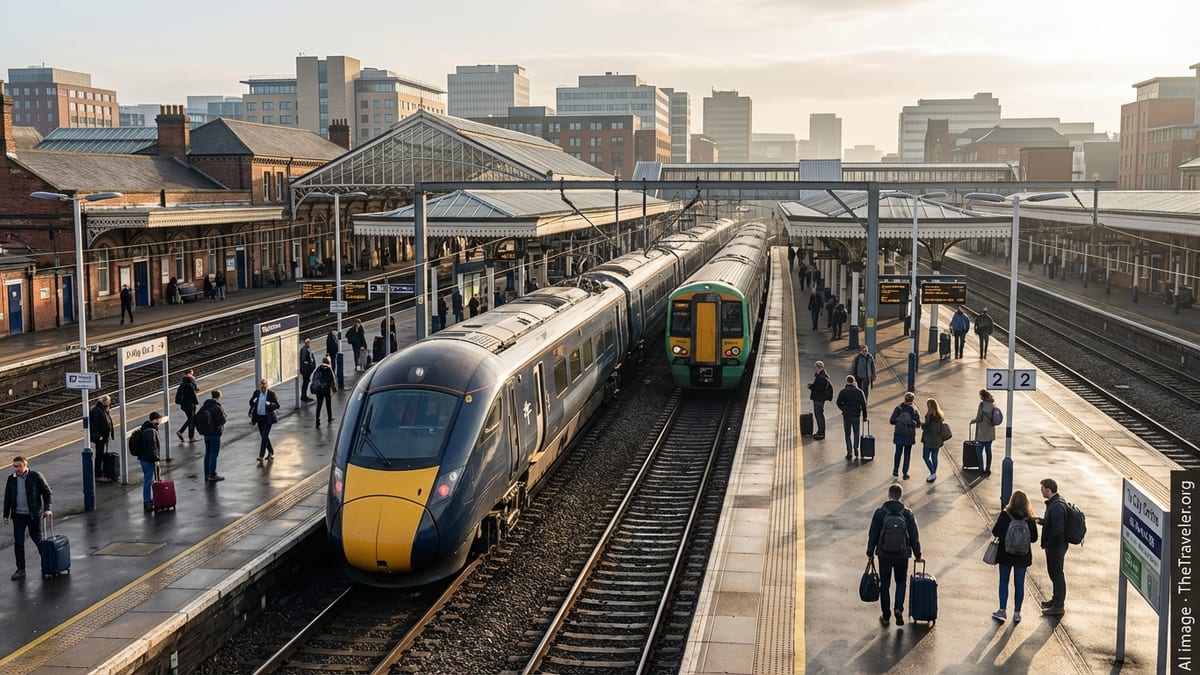
New Route Extends Existing Birmingham–Crewe Services
According to publicly available information and recent timetable discussion, the planned Birmingham to Manchester Airport route will be an extension of London Northwestern Railway’s existing stopping service between Birmingham and Crewe via Stoke-on-Trent. The proposal would see the current Birmingham New Street to Crewe trains continue north beyond Crewe, serving stations through Cheshire and south Manchester before terminating at Manchester Airport.
Draft stopping patterns shared in public forums indicate that trains would call at a series of intermediate stations, including key interchanges such as Wolverhampton, Stafford, Stoke-on-Trent and Crewe, before heading through Cheshire and onto the Styal line into Manchester Airport. The pattern points to a route designed to balance regional connectivity with access to the country’s third-busiest airport by passenger numbers.
While the new service is not yet reflected in the main public journey planners, the operator’s outline suggests a two-phase roll-out. A first phase would introduce a strengthened Birmingham to Crewe service from December 2026, followed by the full extension through to Manchester Airport from May 2027, subject to final industry approvals and pathing on the busy rail corridor into the airport.
Industry watchers note that the concept effectively knits together two existing local flows, Birmingham to Stafford and Crewe to Manchester Airport, into a single through service. That approach is seen as a relatively low-cost way to create a headline new connection without major infrastructure works, while also testing long-distance demand patterns across the West Midlands, Staffordshire and Greater Manchester.
Closing a Gap in UK Airport Rail Connectivity
At present, passengers travelling between central Birmingham and Manchester Airport typically make at least one change, most often at Manchester Piccadilly, Crewe or Wolverhampton. Journey planning sites show average travel times of around two hours, with options combining CrossCountry, Avanti West Coast, TransPennine Express and regional operators, but no direct train from Birmingham New Street to the airport on standard timetables.
The new London Northwestern Railway service is intended to close that gap by offering a through train from Birmingham’s principal hub to the airport station. For travellers heading to early morning flights or returning late in the evening, the ability to remain on a single train is expected to remove both uncertainty and transfer time, particularly for those carrying luggage or travelling with families.
The development also adds a counterpart to Birmingham’s existing rail-air connections. Birmingham Airport already markets its on-site station, Birmingham International, as one of the UK’s best-connected for surface access, with frequent services to Birmingham New Street and direct trains to a range of cities, including Manchester. The new Birmingham to Manchester Airport flow would effectively mirror that pattern in the opposite direction, putting both regions’ airports within easier reach of each other’s catchment areas.
Transport observers argue that the link could play a role in spreading demand more evenly between airports. With Birmingham and Manchester both serving long-haul and European destinations, improved rail access widens travellers’ choice of departure point, particularly for those in the West Midlands who might otherwise default to London airports for certain routes.
Route, Frequency and Journey Time Expectations
Although final timetables have not yet been confirmed, indicative information suggests the Birmingham to Manchester Airport trains will follow the established northbound corridor out of Birmingham New Street, serving suburban and regional stops before reaching Stoke-on-Trent and Crewe. From Crewe, trains are expected to take the existing route via Cheshire and the Styal line into the airport’s rail station beneath the terminal complex.
Public speculation based on existing stopping services and typical line speeds points to journey times that are competitive with current one-change itineraries. Depending on the number of intermediate stops north of Crewe, end-to-end travel times between Birmingham New Street and Manchester Airport may sit in the region of two hours, with the trade-off being a direct ride rather than a faster but more complex multi-operator journey.
Frequency has not been formally published, but observers analysing current diagrams for the Birmingham to Crewe via Stoke service expect a regular-interval pattern, likely hourly, across most of the day. Such a timetable would align with industry practice for regional interurban services and dovetail with existing airport-bound services from other parts of the North West.
Capacity and rolling stock are also attracting attention. London Northwestern Railway currently uses electric multiple units on many of its West Coast Main Line routes. Any future decision on train type for the extended service will influence on-board facilities, luggage space and passenger comfort standards, which are key considerations on airport routes where travellers often carry bulky baggage.
Implications for Passengers Across the Corridor
The benefits of the new link are expected to extend beyond Birmingham and Manchester. Intermediate towns such as Wolverhampton, Stafford, Stone, Stoke-on-Trent and Crewe would gain a direct rail connection to Manchester Airport without the need to change at a major hub. For communities along the line, this effectively turns the airport into a reachable regional destination rather than one primarily accessed via car or coach.
For business travellers, the direct route could support same-day trips that combine rail and air, particularly for flights to European financial centres. For leisure passengers, the new option may help reduce reliance on road access, easing pressure on the motorway network that links the Midlands and the North West, notably the M6 and connecting routes.
Travel planners also highlight the potential to link with local public transport at both ends. In Birmingham, New Street is within walking distance of Moor Street station and connected to tram and bus routes, while in Manchester the airport rail station provides interchange with local buses and coach services across Greater Manchester and beyond. The addition of a direct inter-regional rail leg could make integrated, ticketed journeys more attractive.
At the same time, some rail commentators caution that the service will need to demonstrate consistent punctuality to win over airport users, who are often highly sensitive to delays. The Styal line into Manchester Airport is known to be busy, and any new service will have to fit into a timetable that already carries a mix of intercity, regional and commuter traffic.
Part of a Wider Shift in UK Rail and Aviation Links
The Birmingham to Manchester Airport development comes as the UK continues to debate long-term plans for rail capacity and regional connectivity following changes to the High Speed 2 project. While high-speed links between Birmingham and Manchester are no longer expected to materialise as originally proposed, incremental improvements to classic rail services are gaining prominence as a pragmatic way to enhance north–south and cross-country travel.
Observers describe the planned route as an example of that incremental approach: using existing infrastructure and reconfigured service patterns to deliver new, marketable connections without waiting for large-scale construction projects. In that context, the Birmingham to Manchester Airport link is seen as one of several medium-term timetable changes that could cumulatively reshape how travellers move between major cities and airports.
For travellers, the practical message is simple. If the service launches as planned from May 2027, the journey from central Birmingham to the departure lounge at Manchester Airport could soon involve just one train ride instead of a series of connections. As timetables are firmed up over the coming months, passengers will be watching closely to see how the new link is scheduled and priced, and how it fits alongside existing options on one of the country’s busiest inter-regional corridors.