


More news on this day
The European Union has moved to ease pressure at some of its busiest external borders, allowing nine European countries to continue limiting full use of a new biometric border system after a summer marked by long queues, missed flights and growing anxiety among airlines and holidaymakers.
Get the latest news straight to your inbox!
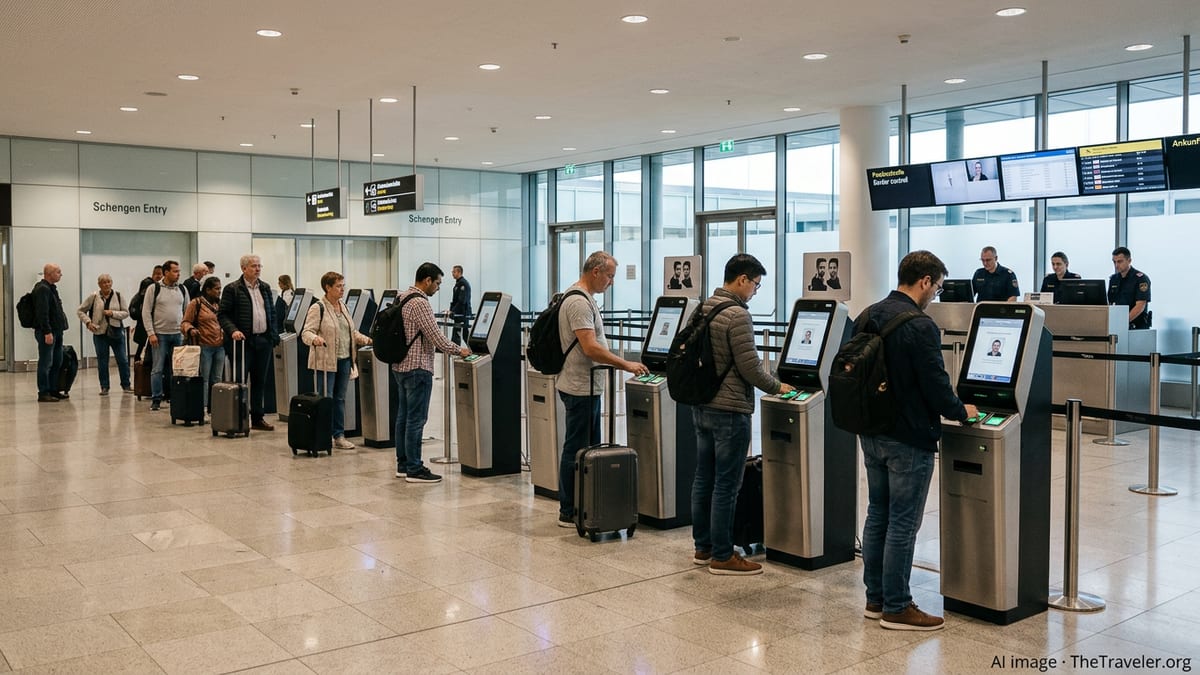
Post-Brexit Checks Collide With New EU Border Technology
The disruption follows the rollout of the Entry/Exit System, or EES, a long-planned digital scheme that replaces passport stamping for most non-EU nationals with electronic records and biometric data. Publicly available information from the European Commission indicates that EES became fully operational across external Schengen borders in April 2026, covering 29 participating countries.
For British travellers and other visitors from outside the Schengen area, the changes arrived on top of requirements introduced after the United Kingdom left the EU. Since Brexit, UK passport holders have been treated as third-country nationals, subject to systematic entry and exit checks and limited to short stays in the zone. The shift to a biometric system amplified those controls, concentrating demand at newly installed kiosks and e-gates.
Reports from major European airports describe scenes of passengers queueing for several hours as staff guided first-time EES users through fingerprint and facial scans. Travel industry groups have repeatedly warned that the combination of post-Brexit formalities and the new technology risks turning peak holiday periods into a severe stress test for border infrastructure.
According to published coverage in European media, airlines have complained that they are bearing the commercial fallout when passengers miss flights despite arriving at terminals far earlier than before. Consumer advocates have pointed out that under existing rules, carriers can often classify border delays as extraordinary circumstances, limiting compensation options for affected travellers.
Nine Countries Seek, and Receive, Extra Flexibility
Amid mounting disruption, Belgium, France, Germany, Greece, Italy, Malta, the Netherlands, Portugal and Switzerland jointly urged Brussels to prolong temporary safeguards that allow national authorities to scale back EES processes in specific circumstances. A joint letter reported by European news outlets argued that border infrastructure and staffing levels in several locations were not yet sufficient to handle full biometric checks while maintaining acceptable waiting times.
According to this coverage, the European Commission has accepted the request in part, agreeing to extend flexibility on how rigorously the new regime is applied at particularly congested airports and seaports. The adjustment effectively delays full implementation of the post-Brexit style biometric checks in these nine countries, even though the legal framework for EES remains in place.
Publicly available documents describe the safeguards as time-limited and targeted. Border police can temporarily switch off biometric registration for certain passport holders or at particular crossing points when queues reach critical levels, reverting to conventional document checks to keep passengers moving. The aim is to avoid a repeat of recent scenes where travellers reported missing flights after spending three or more hours in line.
Officials in several of the nine states have previously drawn attention to legacy terminal layouts and the lack of physical space for large banks of kiosks. Industry voices have also noted that many facilities were designed for the era of minimal checks within the Schengen area, leaving them poorly suited to processing large numbers of non-EU holidaymakers under the new system.
Airports and Airlines Warn of Longer-Term Strain
European travel associations have used the recent chaos to renew calls for a slower, more flexible rollout of EES. Trade bodies representing airports and airlines have cautioned in public statements that the current approach risks undermining confidence in European destinations, particularly among short-haul visitors from the United Kingdom, Ireland and nearby non-EU countries.
Reports from the travel press highlight particular pressure points in Spain, Greece and Portugal, where large volumes of leisure traffic converge on seasonal hubs that only recently completed infrastructure upgrades. In some cases, airport operators have been described as deactivating parts of the EES system during peak rushes, then reactivating the checks once queues subside.
Carriers serving popular Mediterranean routes have responded by advising passengers to arrive much earlier than before and to complete online pre-checks where available. However, passenger accounts gathered by European media suggest that early arrival alone is no guarantee, as terminal access, check-in opening times and security queues can still leave limited margin for delays at border control.
Analysts quoted in recent coverage argue that the summer turmoil reflects a broader mismatch between the ambition of the EU’s new border architecture and the investment made in frontline facilities. While EES is designed to automate repeat crossings and strengthen security, the initial enrolment phase requires hands-on support that many airports are still struggling to provide at scale.
Focus Shifts to ETIAS and Future Travel Authorisations
The difficulties surrounding EES have also cast a spotlight on a second major change in the pipeline for non-EU travellers, the European Travel Information and Authorisation System, or ETIAS. According to official guidance, ETIAS will function as a pre-travel screening requirement for visa-exempt visitors, including many tourists from the UK, North America and parts of Asia.
Recent reporting from European outlets indicates that, after the chaotic EES rollout, the launch of ETIAS is now expected to be pushed back again, with some coverage suggesting 2027 as a more realistic start date. The authorisation, which is due to carry a modest fee, is intended to be valid for multiple visits over several years.
EU materials describing the relationship between the two systems explain that ETIAS is meant to work in tandem with EES, allowing basic risk checks to be completed before travellers arrive at the border and leaving biometric verification to be handled on site. Industry observers note that this sequencing could ease pressure at airports once both schemes are fully stable, but warn that the transition period will require careful management.
For now, the delay and partial easing of post-Brexit style border checks in the nine countries is being viewed by many travel businesses as a necessary pause. Analysts suggest that the breathing space may allow authorities and operators to refine passenger flows, expand staffing and improve public communication before the next major phase of Europe’s digital border transformation.
What Travellers Should Expect in the Coming Months
For passengers planning trips to the EU in the months ahead, the immediate effect of the latest move is likely to be uneven. At some major gateways, particularly those in the nine countries granted additional flexibility, travellers may notice a lighter touch in biometric processing during peak periods, with more reliance on conventional passport stamping and manual checks.
In other locations, especially land borders and smaller airports where EES infrastructure has bedded in more smoothly, the system may continue operating more or less as originally designed. Public guidance from European institutions continues to advise non-EU visitors to allow extra time at departure and arrival points and to ensure passports are valid and machine-readable.
Travel advisers recommend that passengers check airport and airline notices shortly before departure, as local arrangements can change rapidly in response to congestion. Many carriers are updating boarding time recommendations, and some are adjusting check-in opening hours in an attempt to spread demand more evenly across the day.
Despite the current turbulence, policy documents and public statements from EU institutions underline that the bloc remains committed to its digital border agenda. For travellers, that means that biometric checks and pre-travel authorisations are likely to become a routine part of visiting most of continental Europe in the medium term, even if the path to that destination involves further delays, adjustments and occasional bouts of airport chaos.