


More news on this day
A newly announced U.S. government travel ban targeting 13 countries designated as “unsafe” is sending shockwaves through the global travel industry, as carriers, booking platforms, and travelers scramble to understand who can still enter the United States and how existing trips will be affected.
Get the latest news straight to your inbox!
How the New 13-Country Ban Fits Into Existing U.S. Restrictions
Publicly available information shows that the latest directive builds on a series of entry restrictions that have steadily expanded in scope since 2025, when a presidential proclamation reinstated and widened earlier U.S. travel bans. Those policies already limited or fully suspended entry for nationals from more than a dozen countries assessed as presenting elevated security or vetting concerns. The new move specifically identifies 13 additional states as “unsafe,” placing them under a mix of full bans and sharply tightened visa rules.
Government documents and specialist summaries indicate that the modern travel-ban framework rests on a standardized security review of foreign governments. Countries that are judged to provide inadequate identity data, share too little information on terrorism or serious crime, or show limited cooperation on deportations can be designated for entry restrictions. The 13 newly targeted countries were added following this type of risk review, rather than in response to a single incident, and their status is now reflected in updated visa procedures and airline guidance.
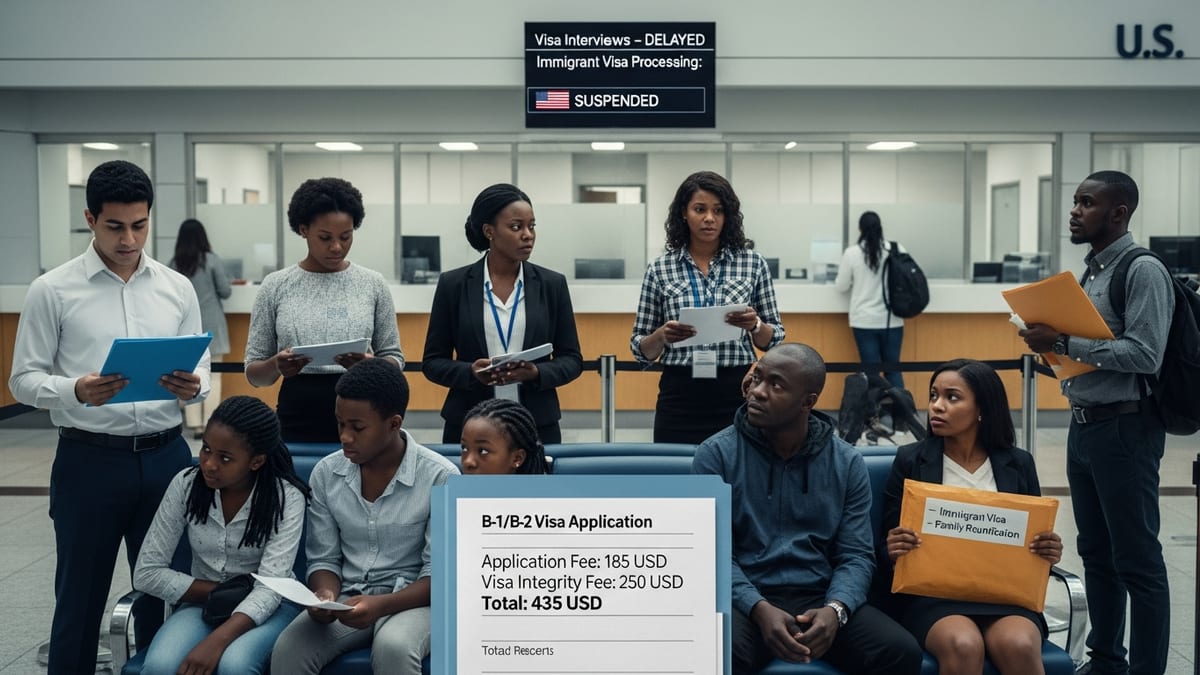
The designation does not typically cancel previously issued U.S. visas outright, but it can prevent new visas from being approved for most ordinary travelers, including tourists and business visitors. Some categories, such as permanent residents returning to the United States, recognized refugees, and certain diplomatic travelers, generally remain outside the scope of the bans. However, consular services for nationals of the 13 countries are already reporting longer processing times, more intensive security checks, and, in many cases, a halt to routine nonimmigrant visa appointments.
The 13-country action also intersects with the State Department’s separate travel advisory system, which rates destinations from Level 1 to Level 4. Many of the newly banned countries already carried Level 3 “Reconsider travel” or Level 4 “Do not travel” advisories based on terrorism, armed conflict, kidnapping, or wrongful detention. The new ban effectively flips that logic: instead of warning U.S. citizens about risks abroad, it restricts nationals of the affected states from entering the United States at all, except under narrow exemptions.
Who Is Affected and What Happens to Existing Trips
The immediate impact is felt most sharply by citizens of the 13 countries, along with dual nationals and families with mixed citizenship. The new order generally bars the issuance of new visitor, student, and many work visas for these travelers. Airline and immigration briefings indicate that anyone who has not yet received a visa in their passport is highly unlikely to obtain one while the designation remains in place, even if an application was already under review.
Those who already hold valid visas face a more complex reality. Publicly available consular guidance on similar bans shows that travelers may still be able to board flights and seek entry at a U.S. port of entry, but they can be subject to secondary screening, lengthy interviews, and, in some instances, denial of admission. Carriers are being reminded that they are responsible for transporting inadmissible passengers back to their point of origin, so some airlines may choose to apply additional document checks at check-in or boarding, even for travelers whose visas have not been formally revoked.
The ban also affects multinational companies, universities, and research institutes that rely on staff or students from the 13 countries. Many institutions had already adapted to earlier rounds of restrictions by shifting programs online, relocating projects to third countries, or sponsoring participants through alternative visa categories where possible. The new wave of designations will make those workarounds harder, as security-triggered checks are now embedded more deeply in U.S. immigration databases and airline reservation systems.
Family travel is another flash point. Based on patterns seen under prior bans, U.S. citizens and permanent residents with close relatives in the affected countries may find family-reunification petitions delayed or effectively frozen. While the latest measure includes theoretical case-by-case waivers for urgent humanitarian situations, such as medical emergencies, documentation from earlier years shows that approvals for such waivers have been extremely limited in practice, leaving many families separated indefinitely.
Implications for Airlines, Routes, and Travel Planning
The latest 13-country designation arrives at a moment of heightened tension in global aviation, particularly around the Middle East and parts of Africa. Air-safety agencies in several regions have recently advised carriers to avoid certain airspace corridors due to missile and drone activity, while governments have updated their outward-facing travel advisories for destinations affected by conflict and terrorism risks. The U.S. entry ban adds an inbound layer to that patchwork, forcing airlines to reassess not only where they fly, but whom they can safely and legally carry to American gateways.
Carriers serving hubs in countries subject to the ban are reviewing passenger manifests more aggressively, with automated checks flagging passport nationality and place of birth. Industry reports suggest that some airlines may scale back nonstop links between those hubs and the United States if demand from ineligible travelers falls sharply or if the compliance burden grows. Code-share partners and alliance members are also re-evaluating itineraries that currently route passengers from banned countries through third-country hubs onto U.S.-bound flights.
For travelers who are not citizens of the 13 countries but who rely on major hubs within them, the main effect is likely to be fewer connecting options to the United States and a greater risk of last-minute schedule changes. Travel-management firms monitoring the situation advise booking itineraries that route through airports in countries without U.S. entry restrictions and avoiding complex multi-ticket journeys where a missed leg could strand a traveler in a state that is now subject to tighter controls.
Insurance is emerging as another fault line. Under many policies, disruption caused by government action is treated differently from operational delays like weather or mechanical problems. Travelers whose trips are canceled or rerouted because a traveling companion is suddenly barred from boarding may find that standard coverage does not reimburse their losses. Policy wording varies substantially, so travelers are being encouraged by consumer advocates to review clauses that refer to “sanctions,” “denied boarding,” and “government-imposed restrictions” before committing to nonrefundable bookings.
How This Ban Interacts With Other Global Warnings and Restrictions
The move to designate 13 additional countries as unsafe for entry purposes comes against a backdrop of intensifying worldwide security messaging. In recent months the U.S. State Department has issued broad “worldwide caution” notices highlighting the risk of attacks against American interests and updated region-specific alerts for parts of the Middle East, East Africa, and Eastern Europe. Other governments, including the United Kingdom and New Zealand, have likewise updated their own outward travel advisories for a similar cluster of destinations, pointing to terrorism, state-sponsored threats, and the risk of airspace disruption.
These outward-facing warnings do not by themselves block travel, but they shape airline decisions, insurance coverage, and the willingness of tour operators to serve affected regions. The new 13-country entry ban adds a separate inward-facing layer for the United States, focusing on who may cross its borders rather than where its own citizens should or should not go. For travelers trying to plan multi-country itineraries, the result is a two-way matrix of restrictions that can be difficult to map: a destination might be considered high-risk for outbound travel yet still have its citizens allowed into the United States, while another is now barred from entry even if U.S. travelers face no formal prohibition on visiting it.
Some of the 13 banned countries are also subject to additional U.S. designations, such as being listed for “wrongful detention” risks or carrying terrorism and kidnapping indicators in State Department advisories. That combination can have indirect effects on travelers who are not citizens of the banned countries but live or work there. For example, dual nationals may face extra questions at U.S. ports of entry about where they have recently resided, and third-country nationals working in those states may find that their previous travel history triggers more intensive screening.
Travel industry analysts note that the layered approach to restrictions is likely to persist even if individual countries are someday removed from the 13-country list. The framework used to justify the bans is built into U.S. security and immigration law, and the same risk metrics can be used to shift countries between categories, tighten or loosen visa rules, and introduce new conditions such as enhanced data-sharing requirements. For travelers, that means the current list is unlikely to be the final word, and future changes may come with limited advance notice.
Practical Steps for Travelers Navigating the New Landscape
For travelers directly affected by the new ban, the most important step is to verify entry eligibility before making any nonrefundable arrangements. Publicly accessible resources from the U.S. government now consolidate country-specific restrictions, including whether entry is fully suspended or whether limited categories remain open. Travel-law practitioners recommend checking those resources again shortly before departure, as designations can be revised, clarified, or expanded with little public debate.
Travelers with complex profiles, such as dual citizenship, long residence in one of the 13 countries, or prior overstays in the United States, may wish to seek individualized legal advice before attempting to fly. Airline staff have limited discretion once a ban is in place, and front-line decisions are typically driven by machine-readable data within reservation and border-control systems rather than by case-specific explanations at the airport.
Those planning itineraries that transit regions under heightened security advisories, even if they are not subject to the entry ban, should build in additional time for missed connections and airspace detours. In recent months, several governments and aviation regulators have cautioned carriers about flying over certain conflict zones, which has already led to rerouted flights and extended travel times. Pairing those operational realities with the new U.S. entry ban means that itineraries that used to be routine can now involve both longer flight paths and tighter scrutiny at the border.
Finally, observers across the travel sector underline the importance of flexibility. Fully refundable tickets, hotels with lenient cancellation terms, and comprehensive travel insurance that explicitly addresses government restrictions can significantly reduce the financial impact if a country is suddenly added to or removed from a restricted list. With the new 13-country ban underscoring how quickly entry conditions can shift, travelers are being urged to treat border policies as a key planning variable, not an afterthought.