


More news on this day
Europe’s long-planned overhaul of its external borders has moved from policy papers to departure boards, as new biometric checks at EU airports and ports begin to reshape how British holidaymakers travel, triggering reports of lengthy queues and rising concern ahead of the peak summer season.
Get the latest news straight to your inbox!
What Has Changed at Europe’s Borders
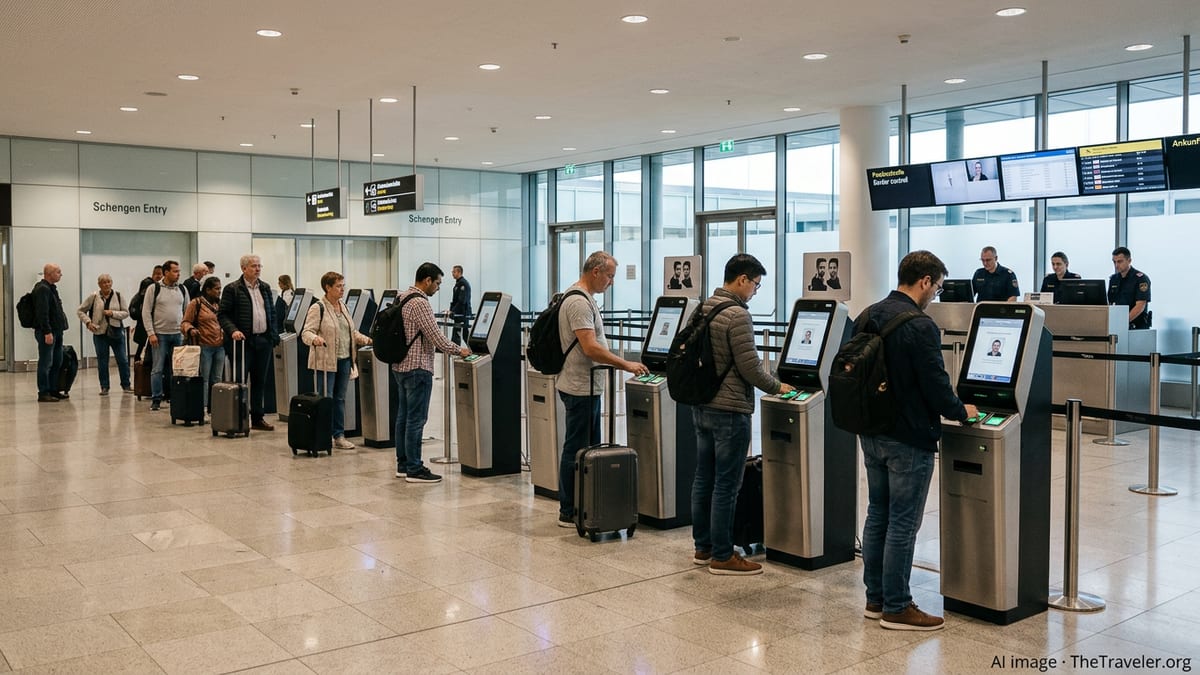
The European Union’s Entry/Exit System, known as EES, is now fully operational across the Schengen area, replacing passport stamps with a digital register of when non-EU travellers enter and leave the bloc. Publicly available information shows that the system stores fingerprints, facial images and travel history for short-stay visitors, including those from the United Kingdom.
The change is particularly significant for Britons because they are now treated as “third-country nationals” after Brexit. Each time a UK traveller crosses into the Schengen zone, they must undergo biometric enrolment if they have not done so already, followed by verification at subsequent trips. Reports indicate that these extra steps, which can be completed at staffed desks or self-service kiosks depending on the airport or port, are adding valuable minutes to the processing time of every passenger who is not an EU or Schengen national.
EU institutions have framed the new system as a modernisation measure designed to improve security, curb overstays and eventually speed up border checks by automating processes that were previously manual. However, the early phase is proving bumpy as airports, ferry ports and rail operators recalibrate staffing, install new hardware and adjust passenger flows to an entirely different way of handling non-EU arrivals.
Early Evidence of Long Queues and Missed Connections
In recent weeks, a series of peak travel weekends has provided the first real-world test of EES for British holidaymakers. Coverage from European and UK outlets has highlighted queues stretching to several hours at some continental airports, with passengers reporting missed flights and tight connections lost because they were still waiting to be processed at border control when their boarding closed.
Travel industry reports describe particularly acute pressure at hub airports where large numbers of UK passengers arrive at once from multiple flights. Each traveller who has not yet been registered in EES must provide fingerprints and a facial image, as well as answer basic questions about their stay, which increases the interaction time at the desk. Airports that lack a sufficient number of staffed booths or functioning kiosks have struggled to clear queues quickly at busy times.
Ferry ports and rail terminals are also exposed. At the Port of Dover, publicly available coverage shows that additional EES-related checks contributed to hours-long tailbacks for car passengers heading to France during a recent holiday weekend, before extra data collection was temporarily suspended to ease congestion. Similar warnings have been issued for peak getaway periods at the Eurotunnel terminal in Folkestone and for cross-Channel rail passengers whose EES enrolment now often takes place before departure from the UK.
Industry bodies representing airports and airlines have started to share survey data suggesting that average processing times for non-EU travellers have risen sharply since the system went fully live. Some reports mention worst-case waits of three to six hours at certain locations during peak surges, although performance remains highly variable from one border point to another.
Why British Holidaymakers Are Hit Hardest
While EES applies to all non-EU nationals entering the Schengen area, British travellers are among those feeling the impact most immediately. Before Brexit, UK passport holders could pass through EU lanes with minimal friction. Now they must line up with other third-country nationals for full checks, including biometrics, on each entry and exit.
Travel analysts note that the UK remains one of Europe’s largest outbound tourism markets, with millions of Britons flying to Spain, France, Italy, Portugal and Greece each year. The high volume of UK leisure traffic, often concentrated on school holidays and weekend getaways, collides with the slower processing of the new system to create a risk of bottlenecks that did not exist when passport stamping was swift and largely manual.
Another factor is infrastructure. Some regional airports and ferry ports that are popular with British holidaymakers have limited space to expand border-control areas or install large numbers of biometric kiosks. Where terminals were originally designed for faster intra-EU flows, the sudden need to spend several minutes per family at a booth is exposing physical constraints, with queues snaking into departure halls and, in some reported cases, all the way back toward check-in.
Travel planners also point out that the EU’s forthcoming travel authorisation scheme, ETIAS, will add another layer of formality within the next couple of years, although it is not yet in force. When it does arrive, UK nationals will be required to apply online and receive approval before travelling, in addition to undergoing EES checks at the border, further reinforcing the sense that Europe trips now involve more paperwork and planning than before.
How Airports, Carriers and Travellers Are Responding
European airports and carriers are in a race to adapt. Airport operators have been reconfiguring queues, reallocating staff and expanding the use of self-service kiosks in an effort to cut down on the time non-EU passengers spend at border control. Some hubs are trialling pre-registration areas where travellers can complete parts of the biometric process before they join the main queue, a model that could be scaled up if it proves effective.
Airlines with large numbers of UK passengers are quietly adjusting their guidance. According to published coverage, several carriers are now recommending that British travellers allow at least three hours between arriving at the airport and scheduled departure when flying home from EU destinations, especially at weekends and during school holidays. Industry advisories emphasise that the first EES registration is the most time-consuming, so travellers who have not yet been enrolled are being urged to factor in extra margin.
Package holiday operators are also reviewing their timetables. Longer processing times on arrival can delay transfer coaches departing from airports to resorts, with knock-on effects for hotel check-in and tour schedules. Some companies are building more buffer time into itineraries or warning customers that late-evening arrivals may run even later if queues at immigration are heavy.
On the ground, local authorities in key tourist regions are monitoring flows and, in some cases, deploying extra staff to guide passengers through new procedures. Public messaging campaigns at airports and ports are being updated to explain EES requirements in English and other languages, reflecting the high share of British and other non-EU visitors unfamiliar with the new rules.
What UK Travellers Should Expect This Summer and Beyond
For now, the picture for British holidaymakers is mixed. Travellers arriving at quieter times of day and at well-resourced airports report relatively modest additional waits, while those hitting peak weekend or holiday waves at popular leisure gateways have faced far longer delays. The gap suggests that staffing levels, terminal layouts and local planning are as important as the technology itself in determining how painful EES feels at the front of the queue.
Travel organisations and consumer groups are broadly advising UK passengers to adapt their habits. That means arriving earlier at departure airports on the continent, allowing more time for cross-Channel journeys that involve border checks on the UK side, and building additional margin into connections, especially when changing planes within the Schengen zone. Families with young children, passengers with reduced mobility and large tour groups are being told to pay particular attention to timing.
In the longer term, many experts expect the teething problems to ease as border staff become more familiar with the system, equipment is upgraded and a larger share of regular travellers complete their initial enrolment. Proponents of EES argue that, once established, automated gates and digital records should enable faster and more predictable crossings than the previous stamp-based model.
For now, however, the message for British holidaymakers is clear: travel to Europe has entered a new era in which extra checks, biometric data collection and more complex border procedures are a built-in feature of every trip. That reality is likely to shape when and how UK travellers head for the beaches, cities and ski slopes of the continent in the summers to come.