


More news on this day
New locomotive orders by Spanish and international freight operators are set to reinforce rail freight capacity across Spain and the wider Mediterranean Corridor, as investment in modern rolling stock catches up with years of infrastructure upgrades.
Get the latest news straight to your inbox!
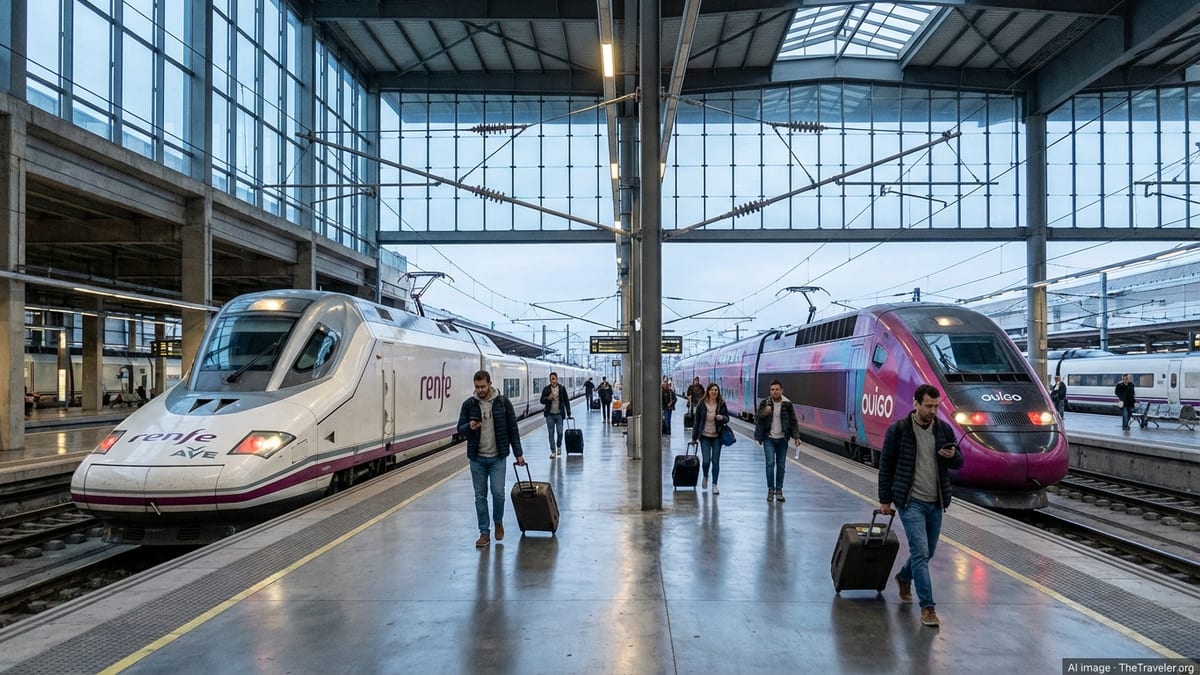
Locomotive Investments Match Billions in Corridor Works
For more than a decade, public investment has focused on upgrading tracks, electrification and signalling along the Mediterranean Corridor from Algeciras and Madrid to the French border. Recent figures released for 2018 to late 2025 point to more than 6 billion euros committed to works on this strategic axis, with transport authorities highlighting that spending in 2025 alone exceeded 1.2 billion euros. This has created a modern, largely interoperable backbone for freight, but also a pressing need to renew locomotive fleets able to exploit the new capacity.
Network documentation for the 2026 timetable shows that the corridor is being configured to handle longer and heavier freight trains, including paths for 740 metre formations and higher axle loads. That shift requires more powerful multi-system locomotives capable of reliable performance on steep gradients and mixed-traffic sections while complying with European Train Control System requirements.
Against this backdrop, leasing firms and private rail freight operators have accelerated orders for new traction, signalling a second phase in the Mediterranean Corridor rollout in which rolling stock becomes as critical as civil works.
Captrain España and Others Expand Electric Fleets
Captrain España, one of the leading private freight operators on the Iberian Peninsula, has become a central player in this renewal drive. Publicly available information indicates that the company plans to add 11 locomotives between 2025 and 2026, with five of them designed to operate on the international standard gauge that underpins cross-border sections of the Mediterranean Corridor. This follows an earlier order that will bring its fleet of Stadler Euro 6000 multi-voltage locomotives to 24 units by 2025.
The Euro 6000 platform has emerged as a reference model for Iberian freight. With six axles, high tractive effort and dual-voltage capability, it is tailored for long intermodal and bulk trains on routes combining 25 kV AC high speed infrastructure and conventional lines. Industry coverage notes that multiple Spanish operators, including alternative freight companies and subsidiaries of larger European groups, have turned to this locomotive type to run services linking ports, logistics terminals and border crossings.
By concentrating on multi-system electric power, operators aim to maximise the use of newly electrified segments while preparing for further standard-gauge conversions. At the same time, these locomotives are intended to reduce operating costs and emissions per tonne kilometre compared with older diesel or single-voltage fleets.
Hybrid and Electro‑diesel Units Cover Unelectrified Gaps
Despite rapid electrification, key freight links in southern Spain remain non-electrified, particularly around the port of Algeciras, one of the busiest container gateways in the western Mediterranean. Reports on recent deliveries show that operators have responded by ordering electro diesel or dual-mode locomotives able to switch between electric power on main lines and diesel in last mile or non-electrified stretches.
Stadler’s Euro Dual family, already in service with Catalan operator FGC for freight, illustrates this approach. The locomotives combine electric traction with a powerful diesel engine, allowing heavy freight trains to run directly from industrial sidings and ports onto electrified trunk routes without time consuming locomotive changes. Similar concepts are being adopted by other operators active on Mediterranean flows, including those serving automotive and steel traffic between inland plants and coastal terminals.
This hybrid traction strategy is particularly relevant for the Mediterranean Corridor, where the long term objective of full electrification coexists with near term operational constraints. By deploying locomotives that can bridge infrastructure gaps, operators are able to launch new services and capture market share from road transport while works continue.
European Leasing Orders Extend the Corridor’s Reach
The strengthening of Spain’s freight traction is closely tied to developments on the wider north south axis connecting North Sea ports with the western Mediterranean. Leasing companies have placed substantial orders for high performance locomotives such as the Stadler Euro 9000, designed for heavy cross border freight across several European countries. Recent announcements describe how some of these locomotives will work on routes that ultimately feed into Spanish and Mediterranean flows via Alpine and Italian corridors.
The Euro 9000 platform combines multi-system electric operation with a powerful diesel module and very high traction capability. This allows long intermodal and automotive trains to cross mountain sections and congested mixed traffic lines while remaining competitive with road haulage. Although initial deployments are focused on the Rhine Alpine axis, the locomotives are expected to support services that connect Central European industrial regions with Mediterranean ports and logistics hubs.
By spreading the cost and risk of new traction across several markets, leasing companies are helping operators in Spain and neighbouring countries gain access to state of the art locomotives without large upfront investment. This model is particularly attractive for new entrants and mid sized freight carriers that wish to expand on the Mediterranean Corridor.
From Infrastructure Project to True Freight Corridor
The Mediterranean Corridor has often been described as an infrastructure project centred on new high speed lines, tunnel sections and gauge conversions. However, the current wave of locomotive orders suggests that it is evolving into a genuine freight corridor, where capacity, performance and reliability are shaped as much by rolling stock as by tracks and signalling.
As new locomotives are delivered over 2025 and 2026, freight operators are expected to lengthen trains, consolidate services and offer more competitive schedules on key flows such as automotive traffic between Spain and Central Europe or container traffic between Iberian ports and inland terminals. The combination of interoperable infrastructure and powerful multi-system traction could also facilitate new open access services and partnerships across borders.
For shippers, these developments point to a more resilient and predictable rail alternative to road haulage on some of Europe’s busiest trade lanes. For the Spanish network, they mark a transition from construction site to operational corridor, with locomotives at the centre of efforts to shift more freight onto rails along the Mediterranean coast.