


More news on this day
A high-profile proposal to build a cruise ship terminal on the northern edge of Manatee County appears effectively derailed after new state legislation blocked the dredging needed for the project, leaving local leaders and residents to reassess what cruise tourism should look like in Tampa Bay.
Get the latest news straight to your inbox!
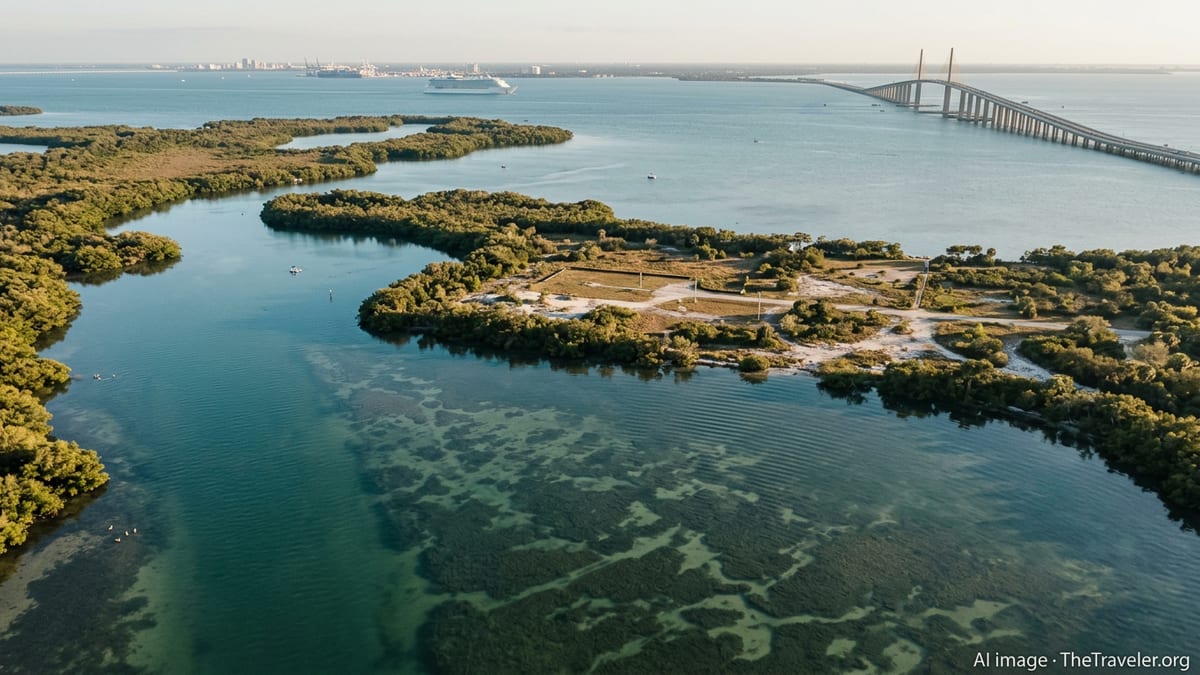
State legislation closes the door on key dredging
The turning point for the Manatee County cruise port concept came in March 2026, when a coastal resiliency bill was signed into law with language that restricts dredging in the Terra Ceia Aquatic Preserve. Publicly available information on the legislation shows that the new rules prohibit the kind of channel-deepening work that would have been required to bring large cruise ships to the proposed terminal site near the Sunshine Skyway Bridge.
Coverage from multiple Florida news outlets indicates that the bill was advanced in part to clarify and strengthen environmental protections in the preserve, a shallow and ecologically sensitive section of Tampa Bay. By sharply limiting dredging to narrow circumstances such as water quality improvements or navigation safety, the measure removes the central permitting path the cruise project would have needed.
Cruise industry observers now broadly describe the Manatee terminal as unworkable under current law, with niche travel coverage characterizing the Tampa Bay expansion concept as “dead” from a practical standpoint. While the statute does not name the project directly, the dredging language targets the same waters where the terminal had been envisioned, effectively halting it.
How the Manatee cruise terminal plan took shape
The project first surfaced publicly as a privately led proposal to develop a large-scale cruise complex on a 300-plus acre waterfront tract at the northwest tip of Manatee County. Reporting in regional outlets describes the concept as a multiphase resort-style destination, combining a deepwater cruise pier with villas, crew housing, entertainment venues and a water taxi link into the wider bay.
The site, situated just south of the Skyway Bridge and within or adjacent to the Terra Ceia Aquatic Preserve, was pitched as an origin port capable of hosting ships too tall to pass under the bridge into downtown Tampa. Industry blogs suggested the facility could complement or partially replace some sailings from Port Tampa Bay by offering berths for larger vessels.
At the same time, documents and statements gathered by local media show that SeaPort Manatee, the county’s existing deepwater cargo port farther south on the bay, was not formally part of the cruise terminal application. Port planning materials continue to emphasize cargo, logistics and container growth, and a statewide seaport mission plan lists Manatee among ports without scheduled cruise passengers, underscoring how separate the controversial terminal concept was from the established port’s operations.
Opposition grew from residents and environmental advocates
From early 2026 onward, the Manatee cruise terminal plan quickly became one of the region’s most contentious development proposals. Local newspapers and broadcasters documented a wave of criticism from environmental organizations that warned of seagrass loss, manatee habitat disruption and changes to tidal flows in a section of the bay that has seen years of restoration work.
Publicly reported protests in Terra Ceia and nearby communities drew hundreds of residents, with organizers arguing that the preserve represented some of the last relatively undeveloped shoreline in the county. A widely shared online petition opposing the port collected tens of thousands of signatures, according to coverage by regional outlets, reflecting concern about traffic, storm risk and the scale of ships that might call there.
Several municipal bodies around Tampa Bay also moved to formally register their disapproval. Resolutions adopted by local commissions, described in community newspapers, urged county and state leaders to reject the cruise proposal, citing both environmental risks and quality-of-life impacts for nearby neighborhoods that already struggle with congestion during peak tourist season.
Officials distance SeaPort Manatee from the proposal
As criticism intensified, publicly available statements show that Manatee County and state-level representatives took steps to separate the county’s existing port from the private cruise terminal concept. Reports in local media noted that SeaPort Manatee’s governing authority emphasized its focus on cargo, logistics and industrial expansion rather than mass-market cruising.
Those same reports indicate that county commissioners framed the cruise terminal as a private landowner’s initiative that would still require significant zoning changes and a lengthy state and federal permitting process. The new dredging limits now sit squarely in the middle of that process, making any future application substantially more difficult.
Regional coverage also highlights tensions that flared around the debate, including law-enforcement reports of threats directed at county staff connected to the review of the proposal. The charged atmosphere added pressure on elected bodies to clarify their positions and may have contributed to the desire in Tallahassee to resolve uncertainty over the preserve’s legal protections.
What the decision means for Tampa Bay cruise growth
The demise of the Manatee terminal plan comes at a time when Florida’s cruise industry is expanding rapidly from long-established hubs such as Port Canaveral, PortMiami and Port Everglades. Recent statewide port reports show multi-year increases in passenger counts at those facilities, supported by major terminal upgrades and new ship deployments.
Within Tampa Bay, Port Tampa Bay has been pursuing its own long-range capital program aimed at accommodating more and larger vessels within the constraints of the Skyway Bridge. With the Manatee concept effectively sidelined, analysts following the sector suggest that most near-term cruise growth in the region is likely to concentrate at existing ports that already have deepwater access and passenger infrastructure in place.
For Manatee County, the new law leaves open broader questions about future waterfront development along its northern shoreline. SeaPort Manatee remains an important cargo hub, and separate local initiatives are focusing on passenger ferries and smaller-scale marine tourism. The blocked cruise terminal proposal, however, appears to have reached the end of the line in its original form, and any attempt to revive it would require navigating both strong local resistance and a significantly changed regulatory landscape.