


More news on this day
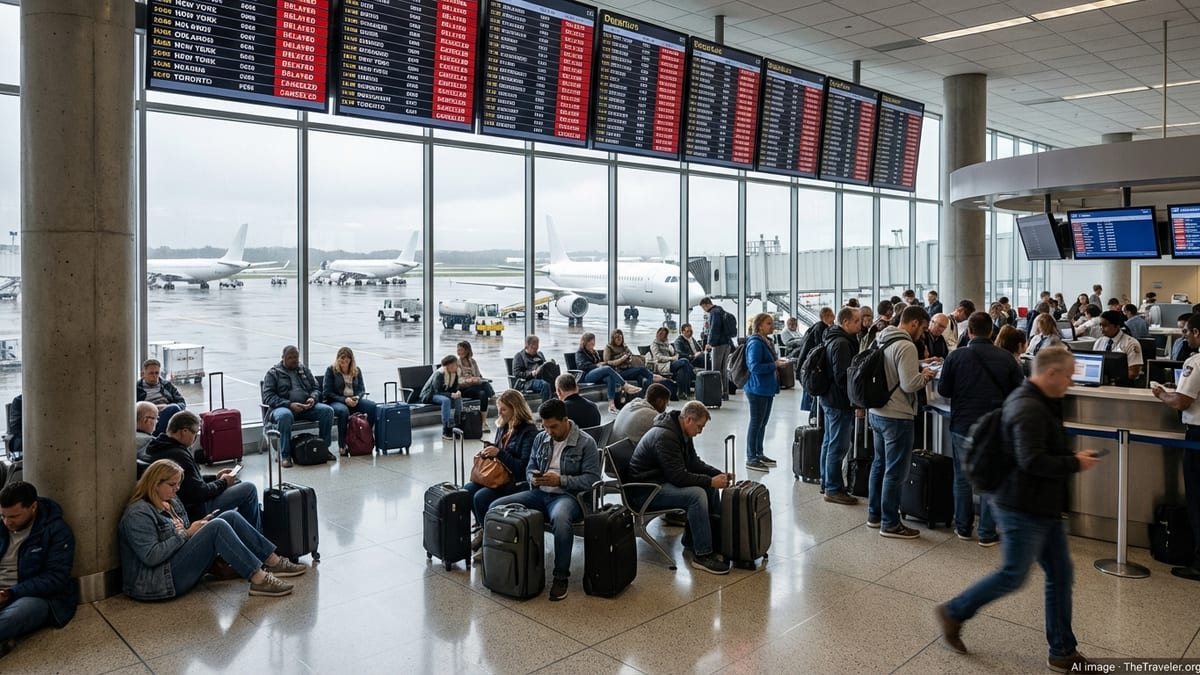
Flights in and out of Newark Liberty International Airport, John F. Kennedy International Airport and LaGuardia Airport were hit with widespread delays after the Federal Aviation Administration reported an equipment outage that disrupted air traffic control in the New York and New Jersey region.
Get the latest news straight to your inbox!
What happened, and why it slowed New York-area flights
Published coverage indicates the disruption traced to failures in communications infrastructure supporting an FAA air traffic control facility responsible for managing traffic flows in the region, including arrivals and departures for Newark. When controllers lose reliable communications links and radar display capability, the system typically shifts into a safety-first posture that reduces the number of aircraft that can be handled, or pauses movement entirely.
Reports describe a compounded problem: a primary communications line failed, and a backup fiber-optic line was also unavailable because it had been cut during nearby construction work. With both paths impaired, the region’s already busy airspace could not support normal arrival and departure rates for extended periods.
The immediate operational result was the use of FAA traffic management programs that can include “ground stops” and “ground delay programs.” In a ground stop, departures bound for an affected airport are held at their origin to prevent airborne holding and congestion from building over the destination. Even after restrictions are lifted, long lines of delayed aircraft, repositioning needs, and crew-time limitations can keep schedules disrupted for much of the day.
How the outage spread from Newark to JFK and LaGuardia
Newark is often the first New York-area airport to show significant impacts from disruptions tied to the approach-control facilities and the tightly packed airspace shared with nearby airports. Coverage notes the affected facility manages Newark’s airspace, and once arrival rates drop at one major hub, knock-on effects ripple across the network of New York and New Jersey airports.
As the day progressed, JFK and LaGuardia were also subjected to FAA ground stops and delay programs, according to publicly available coverage and airline advisories. The New York region’s airports operate in close proximity with intersecting routes, so a slowdown in one segment of the system can force wider spacing between aircraft across multiple airports.
That cascading effect is especially pronounced in the Northeast corridor, where Newark, JFK and LaGuardia interact with Philadelphia-area traffic, Washington-area flows, and a dense set of smaller airports. When traffic is metered to keep the system safe, departures and arrivals across the region can be throttled, and inbound flights may face diversions or extended ground holds at their origin airports.
How bad were the disruptions, and what travelers saw
The outage produced an unusually large wave of cancellations and lengthy delays. Published reports described hundreds of cancellations at Newark alone during the disruption, and delays at multiple major airports throughout the New York City area. Even as service began to resume, travelers continued to face rolling delays as airlines worked through backlogs.
Some coverage cited severe average delays at Newark during the afternoon and evening hours, with delays stretching to several hours for many flights. Because aircraft and crews are scheduled to operate multiple legs per day, a multi-hour disruption at a hub can cause later flights to cancel when crews time out, aircraft are out of position, or gates and ramps become congested.
For passengers, the operational impacts typically show up as repeated departure time changes, late-arriving aircraft, and missed connections. Longer disruption windows also increase the chance that an airline will consolidate flights, rebook passengers onto later departures, or route travelers through alternate hubs when seats are available.
Why New York-area airports are vulnerable to single-point failures
The New York metro area is one of the most complex pieces of airspace in the United States, with three major commercial airports operating close together and competing for limited runway and airspace capacity. When air traffic control tools are degraded, the margin for maintaining peak throughput shrinks quickly.
Public FAA materials about New York-area operations have emphasized that complexity and capacity constraints make the system sensitive to disruptions. Over the past several years, the region has also faced pressure from staffing and equipment challenges at key facilities, making the network less able to absorb sudden shocks.
Even if an outage is repaired in hours, the recovery can take much longer. Airlines must reposition aircraft, rebuild rotations, and accommodate passengers displaced by cancellations. In the New York region, where late-afternoon and evening banks are densely scheduled, that recovery can extend well into the night and affect flights the following day.
What travelers can do right now if flying via EWR, JFK or LGA
For travelers flying through Newark, JFK or LaGuardia during or immediately after a major air traffic control disruption, the most practical step is to monitor airline apps and airport departure boards frequently before leaving for the airport. Even after a ground stop ends, departure times can shift as airlines wait for aircraft to arrive, crews to be reassigned, and air traffic flow restrictions to ease.
Many airlines publish short-term rebooking flexibility during irregular operations, including change-fee waivers for affected travel dates. If your itinerary is still pending, checking whether your carrier has issued a waiver can open options such as moving to a different departure time, routing through another hub, or departing from a different New York-area airport, depending on seat availability.
Passengers with tight connections should consider proactively exploring alternatives rather than waiting for missed-connection scenarios at the airport. If a flight cancels late in the day, rebooking inventory can tighten quickly, so earlier action, even just placing an alternate itinerary on hold within an airline’s app, can reduce the risk of being stranded overnight.