


Belgrade will almost certainly be your first stop in Serbia. The harder question is where to go next. For most travelers deciding between Novi Sad on the Danube and Niš in the south, the choice comes down to how much you value easy transport versus deeper Ottoman and Roman history, and whether you picture wine bars by the river or smoky grills and burek at midnight.
Get the latest updates straight to your inbox!
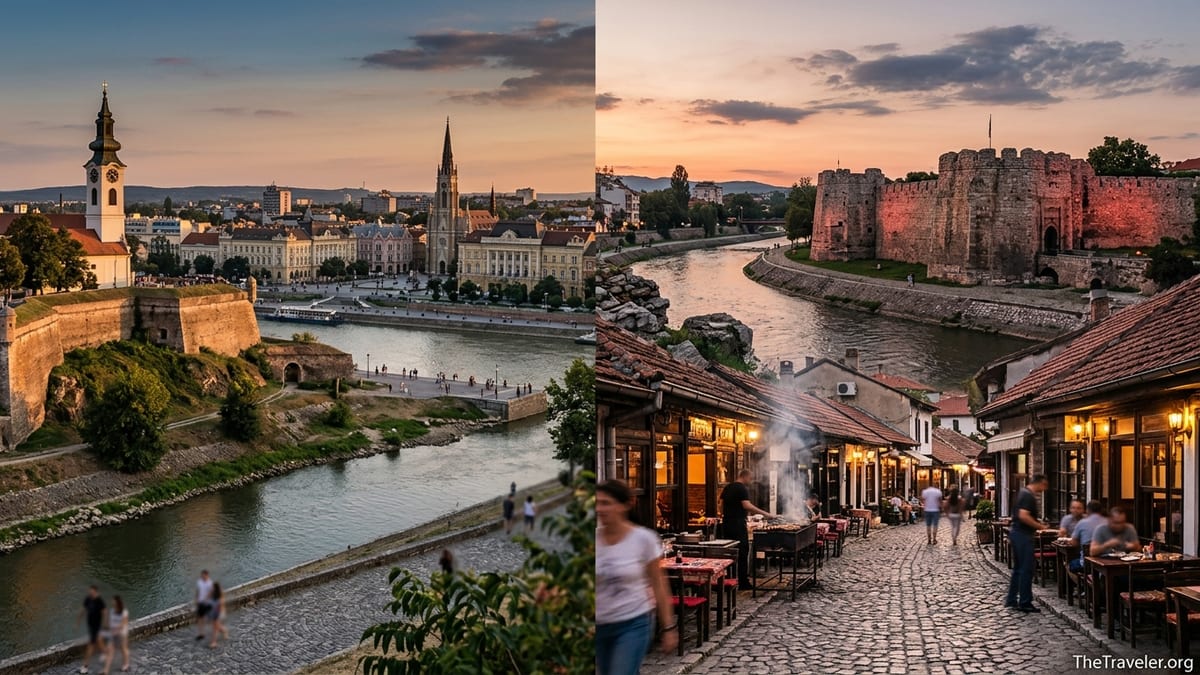
Danube elegance vs southern grit: first impressions
Novi Sad and Niš feel like two different countries inside one small state. Novi Sad is Serbia’s second city, spread along a broad curve of the Danube, dominated by Petrovaradin Fortress on the opposite bank and center‑stage Austro‑Hungarian facades around Liberty Square. Walking Zmaj Jovina and Dunavska streets in the evening, you pass pastel townhouses, Viennese‑style cafés and wine bars that would not look out of place in Budapest.
Niš, by contrast, wears its Ottoman and 20th‑century layers more visibly. The star‑shaped Niš Fortress on the Nišava river is largely Ottoman in form, while Tinkers Alley is a pocket of low, tiled houses and kafanas recalling an older Balkan trading town. Roman Niš appears in the remains of Mediana, an imperial estate on the city’s edge, and in museum collections. The overall feel is rougher, more local and more overtly southern Serbian, from the accent to the food culture on offer.
If Novi Sad’s architectural story is about Habsburg order and 19th‑century prosperity, Niš is about contested frontiers: Ottoman rule, uprisings against it, occupation in both world wars and socialist reconstruction. This difference shapes not only which monuments you will visit, but the tone of an evening walk, the kinds of restaurants you find, and even the fellow travelers you are likely to meet.
For many visitors, the decision is also emotional. If you are drawn to riverfront promenades, summer festivals and café culture, Novi Sad feels instantly familiar. If you are more interested in the heavier chapters of Balkan history and hearty grilled food, Niš may be more rewarding despite its rough edges.
Getting there from Belgrade: Soko to Novi Sad, slower lines to Niš
From Belgrade, Novi Sad is by far the simpler trip. The Soko high‑speed trains on the Belgrade–Novi Sad–Subotica corridor cover Beograd Centar to the Novi Sad area in under an hour. According to current timetables valid into late 2026, Soko and Regio Express services reach Petrovaradin in around 38 to 40 minutes and continue to the new TPS Novi Sad stop inside the city in roughly 47 minutes in total. Seat reservations are compulsory on Soko, and recent fare examples put a one‑way standard‑class ticket at roughly 5 to 7 euros equivalent, depending on train type and how you buy.
Niš, about 240 kilometers south, fits into a different transport world. A direct Regio service from Beograd Centar to Niš typically takes about 6 hours and 30 minutes, with one daily InterRegio train shaving roughly an hour off that running time according to the 2025–2026 timetable published by Srbija Voz. Bus companies from Belgrade’s main bus station offer a more practical alternative, with journey times of about 3 hours and 30 minutes to 4 hours. As of mid‑ to late‑2026, online booking engines and Niš Express price examples show one‑way bus tickets in the region of 1,500 to 2,000 dinars, depending on departure time and operator.
Price alone is not the whole story. Novi Sad’s fast trains are clock‑reliable and frequent across the day, which means you can comfortably plan a two‑day side trip from Belgrade and be back the next evening. Niš bus services are frequent too, but the longer travel time effectively steals half a day each way. Niš rewards that investment with depth of history and food, but if your second city needs to slot neatly into a short itinerary, Novi Sad is much easier to fit.
Arrival experience also matters. Novi Sad’s new rail arrangements require a short local transfer to reach the postcard‑pretty center. Niš buses, by contrast, arrive at a central bus station about 10 to 15 minutes on foot from the main square, so you can often walk straight to your hotel.
Novi Sad’s station changes: why older directions are wrong
Guidebooks and older blog posts still describe rolling directly into “Novi Sad main station” a short walk from the center. That stopped being accurate in November 2024, when a canopy collapse at the old Novi Sad railway station led to its closure for passenger use. For nearly two years most Belgrade trains terminated at Petrovaradin station, across the Danube from the old town, with a temporary shuttle bus linking the two banks.
In October 2026 there was another shift. Serbia’s rail operator introduced a new timetable that extended many services, including Soko, beyond Petrovaradin to TPS Novi Sad, a technical and passenger stop on Rumenački put within the urban area. Local news from Novi Sad in October 2026 confirms that as of 12 October, Soko and Regio Express trains started calling at TPS Novi Sad, while still serving Petrovaradin according to the latest notices. This means current Soko trains from Beograd Centar typically stop at Petrovaradin first, then continue a few minutes to TPS Novi Sad.
For travelers, the crucial detail is that neither Petrovaradin nor TPS Novi Sad is in the historic center. Petrovaradin station sits on the fortress side of the river; it is roughly a 20‑minute uphill walk to reach the main part of Petrovaradin Fortress and then another 15 to 20 minutes across the bridge to Liberty Square. TPS Novi Sad lies on the western edge of the city and requires a city bus or taxi to reach Zmaj Jovina. Local transport maps show several municipal bus lines running between Rumenački put and the center; at current ticket levels you can budget around 100 to 150 dinars for a single ride if you pay with a contactless card on board, or a bit less with a city transport card.
Because of this, any directions that promise “step off the train directly into the pedestrian center” are now misleading. You must plan for at least one extra local leg: either a short bus ride from TPS Novi Sad, or bus and possibly a short walk if you alight at Petrovaradin. Some travelers still choose Petrovaradin intentionally so they can drop bags at a guesthouse near the fortress and walk back across the bridge; others prefer TPS Novi Sad for easier access to city buses and taxis. Either way, Новi Sad in 2026 is a two‑step rail journey: fast intercity, then short city hop.
Historic and cultural sights: fortresses, skulls and squares
Novi Sad’s main historic set piece is Petrovaradin Fortress. The fortress itself is open at all hours and free to wander, with cafés, ateliers and hotel terraces tucked into its bastions. For a structured visit, the City Museum of Novi Sad runs exhibitions inside the fortress and guided tours of the underground military galleries. Tourism publications from Vojvodina’s official organization list the City Museum’s Petrovaradin site as open from 9:00 to 17:00 and closed on Mondays, with modest admission fees that in 2026 sit around a few hundred dinars; children and students usually benefit from reduced rates. Liberty Square, the Catholic Name of Mary Church, and the Serbian Orthodox Cathedral form Novi Sad’s main historic ensemble and are all in the compact pedestrian core.
Niš offers a more scattered but arguably more powerful set of historic sites. The central Niš Fortress, largely Ottoman in its current form, is free to enter and always open as a public park, with sections of Roman and medieval remains incorporated into the walls. The National Museum Niš administers three of the city’s key historic sites: Skull Tower, the February 12 Red Cross Concentration Camp Memorial and the Mediana archaeological park.
According to the National Museum’s official visiting information, Skull Tower and its associated exhibition have defined daily opening hours with last entry 15 minutes before closing. The February 12 Memorial Complex and Mediana use a stricter rule of last entry 30 minutes before closing. Exact hours vary slightly by season; in 2026 examples from the museum’s own English pages show Skull Tower typically operating during standard daytime hours, with summer days finishing later than winter ones, and ticket prices in the low hundreds of dinars range per site. Combination tickets are sometimes offered, but travelers should check the museum directly in the week before visiting, as Mediana has periodically closed for archaeological work and conservation.
Logistically, Novi Sad’s core sights cluster together. Liberty Square, Danube Park and the municipal museums can be covered in a relaxed half day with little more than flat walking. Petrovaradin Fortress requires either a long stroll over the bridge or a short taxi or bus ride. In Niš, on the other hand, Skull Tower lies several kilometers east of the center, Mediana further out on the same axis, and the February 12 camp site another short ride away. Most visitors combine taxi and occasional buses for these: expect a taxi from the main square to Skull Tower to cost the equivalent of 3 to 5 euros in 2026 prices, depending on traffic and company.
Food and drink: grills of Niš vs cafés and wine in Novi Sad
Niš has a strong claim to being Serbia’s grilling capital. The city is famous for pljeskavica (grilled patties), ćevapi, sausages and hefty mixed plates often shared between two. Areas around the fortress and Tinkers Alley are packed with kafanas such as traditional grill houses where a generous plate of meat, salad and bread still tends to land in the 800 to 1,500 dinar range per person in late‑2026 examples. Burek is another local highlight; bakeries around the center turn out heavy, buttery spirals filled with cheese, meat or spinach, and you can still get a large slice and yogurt for a few hundred dinars.
Novi Sad’s food scene tilts more towards Central European plates and café culture. Traditional Vojvodina restaurants on quiet streets parallel to Zmaj Jovina serve pork stews, chicken with dumplings and gibanica pastries rooted in the region’s mix of Serb, Hungarian and German influences, with mains commonly priced in the 1,000 to 2,000 dinar band. Along the Danube waterfront, riverfront restaurants and bars pair grilled fish and river specialties with local wines, and the city’s cafés are rarely far from a glass of Grašac or Frankovka from nearby Fruška Gora wineries.
Wine is one of Novi Sad’s genuine edges over Niš. Fruška Gora National Park, just across the Danube, is dotted with wineries and monastery cellars, many reachable on organized tours or by car. A half‑day tasting trip from Novi Sad, including transfers and a couple of cellar visits, is regularly marketed in the 40 to 70 euro per person range, depending on group size and inclusions. Niš has access to southern Serbian wine regions, but these are less visible on short‑stay tourist itineraries; what most visitors remember are grilled plates, simple salads and smoky interiors.
Café and bar culture tracks these differences. Novi Sad’s pedestrian streets are thick with modern specialty coffee bars, patisseries and cocktail spots, popular with students and weekenders from Belgrade. Niš has its own bar scene, especially near the river and university, but the visual identity is more low‑rise terraces and old‑school cafés than design‑driven third‑wave spots. Prices in both cities are lower than Belgrade: in 2026, a macchiato in a central Novi Sad café is often around 200 to 300 dinars, and a draft beer in Niš rarely breaks 350 dinars outside the trendiest bars.
Accommodation costs and seasonal swings
As of late‑2026 booking data, both cities offer a good spread of budget and midrange rooms, but Novi Sad’s prices spike around events, particularly the EXIT Festival held every July at Petrovaradin Fortress. In ordinary autumn or spring weekends, simple private rooms or hostels near the pedestrian zone can still be found in the 20 to 30 euro per night range for two people, while well‑rated midrange hotels one or two streets off Liberty Square often sit between 60 and 90 euros per night for a double including breakfast.
During EXIT, those same hotels can easily double their tariffs, and basic guesthouses near the fortress or on the Petrovaradin side are frequently reported at 50 to 80 euros per night even for simple rooms. Travelers visiting in July should either book months ahead or consider staying in Belgrade and commuting for a day of the festival on the Soko.
Niš is consistently more affordable. Across recent weekends outside New Year and major local events, centrally located three‑star hotels near King Milan Square have been available for roughly 40 to 70 euros per night for a double room, with breakfast included in many cases. Private apartments around the fortress and pedestrian zone may drop as low as 25 to 35 euros per night for two. Because Niš does not yet host a world‑famous festival of EXIT’s size, seasonal volatility is milder; prices rise slightly in summer but rarely approach Novi Sad’s peak levels.
In both cities, expect to pay a small city tax on top of room rates, typically a modest per‑person, per‑night charge collected at check‑in. This is usually clearly listed in booking engines, but some independent guesthouses still quote base prices without it, so it is worth confirming your “total” in advance.
Two‑day sample itineraries and budgets
For Novi Sad, a realistic two‑day itinerary from Belgrade might start with a morning Soko from Beograd Centar, arriving at Petrovaradin or TPS Novi Sad before lunch. After a short city bus or taxi to the old town, you could spend your first afternoon exploring Liberty Square, Zmaj Jovina, Dunavska and Danube Park, with coffee stops and a casual dinner at a Vojvodina restaurant. Day two could focus on Petrovaradin Fortress and the City Museum’s exhibitions and underground galleries, followed by a sunset drink overlooking the Danube before an evening train back.
A budget traveler on this plan in 2026 might spend about 15 euros return on Soko tickets, 10 euros across four city bus rides and a couple of taxis, 60 euros for two nights in a basic but central guesthouse, and 60 to 80 euros on modest café meals and a single restaurant dinner. That totals somewhere around 145 to 165 euros for two days and two nights, excluding nightlife splurges. A midrange couple choosing a 75 euro per night hotel, a wine bar evening and a Danube‑side dinner could easily see the same period reach 260 to 320 euros.
In Niš, a two‑day itinerary usually starts and ends at the bus station. Day one could include Niš Fortress, the riverside promenade and Tinkers Alley, finishing with a grill‑heavy dinner. Day two could be dedicated to Skull Tower, Mediana and the February 12 Memorial, using taxis or a mix of buses and walking. If the emotional weight of the latter is too much, many visitors substitute Bubanj Memorial Park, a wooded site on the outskirts, for the final stop.
Budgeting for Niš, a return bus from Belgrade at current 2026 prices is likely around 3,000 to 4,000 dinars in total, approximately 25 to 35 euros. Two nights in a simple central apartment for two might come to 50 to 70 euros. Attraction tickets run into only a few euros per site, so even visiting all three main National Museum sites rarely breaks 15 euros per person. Add around 50 to 60 euros for generous food and drink over two days for a light‑spending traveler, and a realistic total for a budget‑minded visitor hovers around 150 to 180 euros. A midrange traveler choosing a 60 euro per night hotel, more taxis and a couple of sit‑down restaurant dinners might land closer to 230 to 260 euros.
Both itineraries assume shoulder‑season prices. For Novi Sad during EXIT, adjust the accommodation line sharply upwards; for New Year in Niš, expect a softer rise as local tourism and diaspora visitors fill central hotels.
Walkability, safety, weather and accessibility
Novi Sad is one of the most walkable cities in the region. The entire historic center and riverside promenade are flat and compact, with pedestrian streets radiating from Liberty Square. The main accessible challenge is Petrovaradin Fortress, which sits on a hill reached by slopes and staircases, although taxis can drop visitors fairly close to the upper gates. Sidewalk quality within the center is generally good by regional standards, and crossings are clearly marked.
Niš is also walkable in the core, with the fortress, main square and Tinkers Alley all within a tight radius. However, reaching Skull Tower, Mediana and the February 12 Memorial involves longer stretches along busy roads or short taxi rides, which can be trickier for those with mobility issues if vehicles cannot drop directly at site gates. Pavements outside the immediate center are more uneven, and some crossings lack ramps. Visitors with specific accessibility needs should contact the National Museum Niš in advance to ask about step‑free access at each site.
Safety in both cities is broadly good. Petty theft can occur in any crowded area or on public transport, but violent crime targeting tourists is rare. Novi Sad’s student population and busy cafés mean the center stays lively into the late evening, while Niš’s main squares and pedestrian street remain active at night without feeling threatening. Standard urban precautions apply: keep valuables out of sight, be cautious in very late‑night bars, and use licensed taxis or reputable ride‑hailing services where available.
Weather can influence the decision. Novi Sad’s Danube setting makes summer evenings particularly pleasant, with river breezes and outdoor terraces, but daytime temperatures in July and August often climb above 30 degrees Celsius, and EXIT Festival weeks are hot and crowded. Spring and early autumn are ideal. Niš, being further south and inland, can feel even hotter in high summer, with more intense heat on its paved streets; December through February can be raw and cold but have their own atmosphere, especially around Orthodox Christmas and New Year.
Which city suits which traveler?
For history enthusiasts, Niš generally offers more depth. The combination of Roman Mediana, the Ottoman‑era fortress, Skull Tower as a physical remnant of 19th‑century uprisings, and the February 12 Memorial covering World War II makes for a dense, sometimes emotionally heavy narrative. Novi Sad has its own history, from Habsburg citizenship to the 1848 revolution and socialist development, but the accessible monuments within a short stay are more about pleasant architecture and fortress views than about raw historical scars.
Food travelers often gravitate to Niš for its grilled meats and burek culture, but Novi Sad is stronger for those who value variety, café life and wine. Couples and first‑time city‑break visitors may appreciate Novi Sad’s softer edges: a strollable old town, sunset above the Danube, wine by candlelight and relatively easy logistics. Families with younger children might prefer Novi Sad as well, thanks to its plentiful parks, open riverfront and the option to dip into Belgrade and back in a single day without long bus rides.
Visitors who prioritize very easy access from Belgrade, including those with only one spare night or traveling with large luggage, should almost always choose Novi Sad. The Soko‑plus‑local‑bus combination remains faster and more straightforward than any journey to Niš. Those willing to accept a slower reach in exchange for a more distinct southern Serbian atmosphere, powerful historic sites and lower prices will find Niš rewarding, especially if they can spare at least two nights and three days.
In the end, there is no single “better” second city. Novi Sad offers a polished Danube city with festival energy and café charm; Niš offers grit, memory and the taste of meat sizzling over charcoal. Knowing which of those appeals more to you after Belgrade will answer the question better than any ranking ever could.