


Albania has two UNESCO-listed Ottoman towns that tempt almost every itinerary: hillside Berat, the “City of a Thousand Windows,” and stony Gjirokastër, the “City of Stone.” Both offer castle views, cobbled lanes and evocative architecture, but they fit quite differently into a trip. This guide compares them side by side for history, atmosphere, transport, walking demands, food, costs and short stays, using 2025–2026 information where available, so you can decide which is more rewarding for a one or two night stop.
Get the latest updates straight to your inbox!
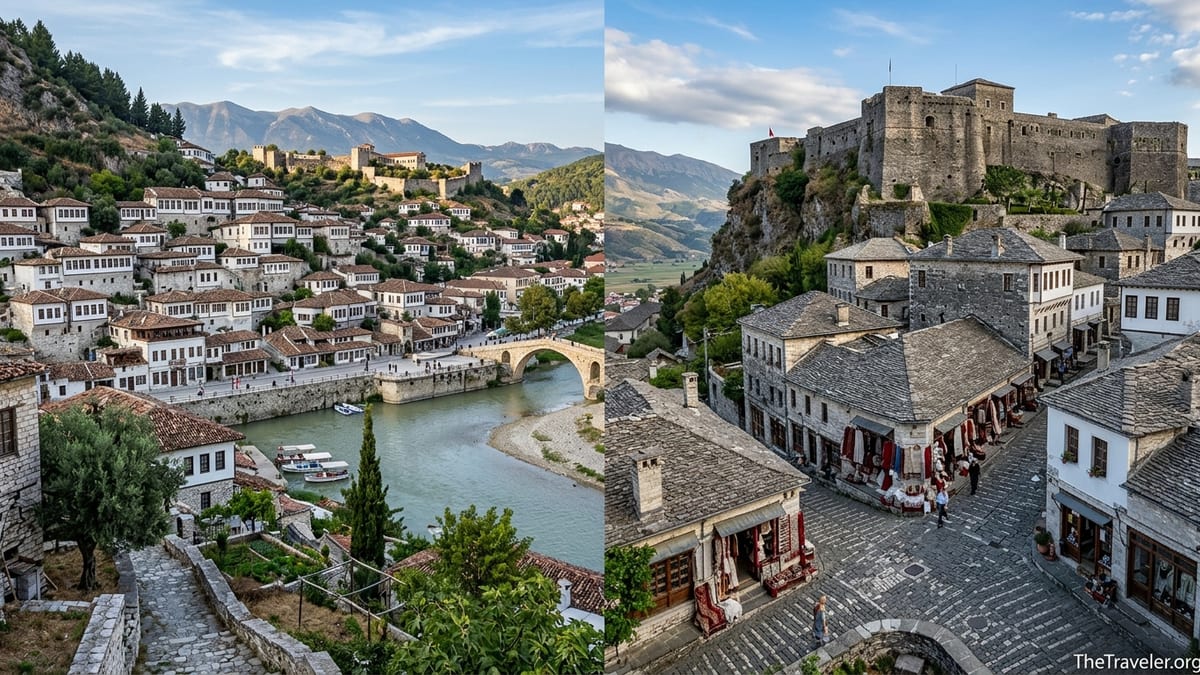
First impressions and architecture: white hillside vs city of stone
Berat and Gjirokastër share Ottoman roots yet feel distinct the moment you arrive. In Berat, the twin quarters of Mangalem and Gorica climb steeply on opposite sides of the Osum River, whitewashed houses stacked above each other with rows of dark wooden windows that earned the town its nickname. Above them rises the walled Kala (castle) district, still inhabited and threaded with tiny lanes and church courtyards.
Mangalem is the classic postcard view: tightly packed Ottoman houses, many converted into small guesthouses, tumbling toward the river and linked by stepped alleys. Across the old stone Gorica Bridge, the quieter Gorica quarter offers a slightly more residential feel and gentler slopes, with a growing cluster of restored inns in traditional buildings. An evening riverside walk lets you look back at both hillsides lit up in tiers of windows.
Gjirokastër’s identity sits in the heavy grey stone that gives the town its UNESCO inscription. Roofs are made of thick slate tiles, streets are paved with shiny cobbles that can feel almost polished underfoot, and tall fortified tower houses dominate the view. The old bazaar district fans out on steep streets beneath the massive clifftop fortress, whose walls loom over the Drino Valley.
While Berat’s architecture reads softer and more Mediterranean, with trees and gardens between houses, Gjirokastër feels sterner and more monumental. Iconic sights include the stone roofs cascading down from the castle, traditional dwellings such as Skenduli House with their defensive design, and the tight, V-shaped bazaar streets lined with souvenir shops and small cafes. If your priority is a single dramatic skyline, Gjirokastër’s combination of fortress and stone roofs arguably feels more singular; for an ensemble of river, castle and lived-in medieval quarters, Berat wins.
Historic sights: castles, museums and riverside walks
Berat’s main historic sight is Berat Castle, or the Kala, which still forms a lived-in hilltop village above the town. Within its walls you find several churches and the Onufri Iconography Museum, housed in the Church of the Dormition of St Mary and dedicated to the 16th century master of vivid Byzantine-style icons. Recent local information puts combined admission for the castle and museum in the low hundreds of lek per person, and opening hours generally run through daylight, with slightly shorter hours in winter; times and prices are occasionally adjusted by the Ministry of Culture, so it is wise to check details locally the day you visit.
Below the castle, the Gorica Bridge dates from the 18th century in its current form and is one of the most photogenic Ottoman stone bridges in the country, linking Gorica with Mangalem. From here you can follow simple paths along both sides of the Osum River, looking back at the rows of windows in Mangalem’s facades. These riverside walks are relatively gentle compared with the castle climb and give a good feel for the town even for less mobile travelers.
Gjirokastër’s counterpart is its vast stone fortress above the bazaar. The official municipal and cultural heritage sources describe opening hours of roughly 09:00 to 19:00 from April to September and 09:00 to 17:00 from October to March, with tickets for adults quoted around 200 lek in older Ministry documents, though newer travel resources note that prices were increased in late 2025 and again in 2026. You should expect something in the region of a few hundred lek and carry cash, as online systems and card payments can be inconsistent. Inside the fortress you find a museum, the remnants of a prison and the famous American airplane on the ramparts.
Down in town, the Old Bazaar preserves a network of 19th century shops under stone arches, while Skenduli House and other traditional dwellings act as small ethnographic museums, usually charging modest entrance fees and sometimes offering guided explanations from family members. These houses showcase wooden ceilings, guest rooms for receiving visitors, defensive elements and views over the town. In terms of depth of domestic Ottoman heritage and fortress size, Gjirokastër has the edge. For a blend of castle, churches and river scenery in a smaller, more relaxed package, Berat shines.
Getting there and around: buses, routes and itinerary fit
Most visitors will arrive from Tirana, Sarandë or another coastal town, and here the two cities diverge. For Berat, multiple coach operators run daily services from Tirana’s South and North Bus Terminal near Sheshi Shqiponja. A recent survey of licensed routes and transport guides in late 2026 reports about 20 to 23 departures spread across the day, with a scheduled journey time around 2 hours 20 minutes and fares of roughly 600 to 700 lek when booked locally, or about 5 to 7 euro through online platforms. This makes Berat a straightforward there-and-back day trip from Tirana or an easy first overnight stop when heading south.
Gjirokastër lies much further south on the main inland corridor between Tirana and Sarandë. In 2026 transport specialists record around 13 direct buses per day between Tirana and Gjirokastër, typically taking about 4.5 hours and priced near 1,200 lek when paid in cash at the station, with slightly higher euro prices if reserved online. From Sarandë, buses and furgons (minibuses) up the Drino Valley to Gjirokastër cover the 55 to 60 kilometer journey in roughly 1.5 hours for about 400 lek according to recent traveler reports and local bus information videos.
Because the main Tirana to Sarandë highway already passes through the Gjirokastër area, it is particularly logical to build Gjirokastër into a southern Albania itinerary that includes Sarandë, Ksamil and perhaps the Albanian Riviera beaches. Backpackers often route Tirana to Berat, then continue via Fier and Tepelenë to Gjirokastër, then south to Sarandë. Others come up from Sarandë for a one night stay in Gjirokastër before continuing north.
Berat, by contrast, sits off the coastal axis in central Albania, about 120 kilometers south of Tirana and linked by fast roads through Kavaja and Lushnjë. That makes it ideal to pair closely with the capital, either as a day trip or one night excursion, but less direct if your main focus is beaches. In practical terms, if your trip is mostly Tirana and central Albania, choose Berat. If your plan revolves around Sarandë, Ksamil and the south, Gjirokastër fits more naturally along your route.
Walking experience, gradients and accessibility
Both towns are built on hills and rely on cobbled streets, so walking here is beautiful but can be demanding. Berat’s Mangalem quarter has steep stepped lanes that run straight up from the river, though many guesthouses are on lower terraces a short climb from the main road. The path to the castle gate from the town involves a sustained uphill walk, with uneven stones and little shade in summer, so visitors who tire easily often take a taxi to the castle entrance and walk back down at their own pace.
Gorica, on the opposite side of the river, tends to feel slightly gentler, with some parallel streets partway up the hill rather than every path climbing directly upward. The riverside roads and pavements along the Osum also provide relatively flat options for strolling. For travelers with children in strollers, these riverside walks and the lower stretches of Gorica are the most manageable parts of Berat, while the stepped alleys of Mangalem and the top of the Kala are challenging without baby carriers.
In Gjirokastër, the gradients are more intense and the cobblestones smoother. The bazaar streets leading up to the fortress gate are steep and in places quite slippery in wet weather, a feature that local tourism materials and many recent trip reports emphasise. Luggage with small wheels often struggles here; soft bags or backpacks are easier to manage, or you may want to ask your accommodation to arrange a taxi drop as close as possible to your door.
Accessibility for travelers with limited mobility is therefore somewhat better in Berat, especially if you choose accommodation close to the river and use taxis up to the castle. Gjirokastër’s topography and shinier cobbles mean more care is needed when walking, especially for older visitors, families with toddlers and anyone traveling in very hot conditions when exertion on these slopes feels tougher.
Where to stay: character guesthouses, parking and taxi access
Berat’s most atmospheric accommodation is split between the Kala itself and the Mangalem hillside. Inside the castle walls, small guesthouses occupy centuries-old stone houses along narrow lanes. Staying here feels immersive, with quiet evenings and early morning light over the valley, but car access is restricted. Typically, you will either park below the walls or at a designated parking area and walk in with luggage, occasionally with help from the guesthouse. Taxis can sometimes drop close to one of the main gates but do not usually penetrate the interior lanes.
Mangalem offers a compromise between atmosphere and access. Traditional houses just above the riverside road have been converted into family-run hotels and guesthouses that can still be reached by taxi, with private parking in small yards or nearby pay lots in several cases. In 2026 mid range double rooms with breakfast in Mangalem often cluster in the 35 to 60 euro range when booked directly, with slightly higher prices in high summer. More modern hotels and apartments in the new town provide easier car access and parking but less historic charm.
In Gjirokastër, the Old Bazaar area is the heart of the UNESCO zone, and many restored stone houses have become boutique hotels and guesthouses. Streets around the bazaar are narrow and steep, and public parking is limited at the top, so many properties advise guests to park below and walk or arrange short taxi hops. Parking-sensitive travelers often choose guesthouses a little above or below the bazaar, where small terraces or roadside spaces allow easier stops.
Room prices in Gjirokastër’s historic houses in 2025 and 2026 typically sit in a similar bracket to Berat, from about 35 euro for simple doubles with breakfast in shoulder seasons to 70 euro or more for larger, fully restored suites in peak summer. In both towns, booking platforms quote higher prices than direct contact with the property, and cash is frequently preferred. For drivers, Berat’s layout around a main riverside road arguably makes navigation and parking slightly less stressful than Gjirokastër’s tighter mountain streets.
Food, evening atmosphere and seasonal conditions
Traditional Albanian food features prominently in both towns. In Berat, riverside and Mangalem restaurants serve typical central Albanian dishes such as baked tave kosi (lamb and yogurt), grilled meats, stuffed vegetables, fresh salads and house wines, often drawn from nearby vineyards. In 2026, mains at well regarded local restaurants are usually priced between 500 and 1,200 lek, with a glass of house wine frequently around 200 to 300 lek. Several places offer terrace seating overlooking the river and illuminated hillside at night.
Gjirokastër’s cuisine shares many dishes but adds local specialities like qifqi (rice balls with herbs), which you will see on menus near the bazaar, and heartier mountain fare suited to cooler evenings. Restaurants cluster around the old bazaar square and on the lanes leading toward the castle. Here, too, you find mains often in the 500 to 1,200 lek bracket, though some rooftop terraces with particularly strong views price a little higher. Because Sarandë and the Riviera draw many beachgoers away in the evening, Gjirokastër’s nightlife is more about relaxed dinners and strolls than late bars.
Summer heat and crowds differ slightly between the two towns. Inland Berat can become very hot in July and August, especially in the afternoons on the exposed climb to the castle, so planning sightseeing early and late in the day is essential. Day trip groups from Tirana add to numbers at peak hours, but the town still feels calmer than the coastal resorts. Gjirokastër, at a higher altitude, cools faster at night but during the day the stone surfaces store heat; the fortress plateau and upper bazaar can feel baking at midday. It also sees a steady flow of day trips from Sarandë and Corfu, so late morning to mid afternoon can be busy around the castle and main bazaar streets.
Families with children will find both towns atmospheric but should factor in the walking. Berat offers riverside promenades where children can let off steam with fewer steep drops, and several restaurants have outdoor spaces. Gjirokastër’s steeper slopes and slipperier cobbles require closer supervision, though the fortress itself has large open areas for children to explore under guidance. In the shoulder seasons of May to June and September to early October, temperatures in both destinations are milder and better suited to family visits.
Sample itineraries: one, two and three day plans
For Berat in one day from Tirana, an early bus arriving by late morning lets you check into a Mangalem guesthouse and walk up or taxi to the castle before lunch. Spend early afternoon exploring the Kala and Onufri Museum, then descend toward late afternoon for a stroll across the Gorica Bridge and a riverside drink. After dinner in Mangalem, you can catch a late bus back to Tirana if you are not staying overnight, though most travelers find one night more relaxed.
A two night Berat stay allows a slower rhythm. Day one focuses on the historic quarters and castle; day two can be spent revisiting the Kala in softer morning light, exploring Gorica’s backstreets, and enjoying long lunches and coffee on the river terraces. With a rental car or an organized excursion, a second or third day can incorporate Osum Canyon, about 50 to 60 kilometers east of town near Çorovodë, where rafting operators and hiking guides run seasonal trips when river conditions permit. Without a car, joining a small group tour from Berat is the most realistic way to reach the canyon.
In Gjirokastër, a one day visit from Sarandë works well. Take a morning bus up the valley, drop bags at a bazaar area guesthouse, then climb to the fortress for a few hours, including its museum and viewpoints. Descend through back lanes into the Old Bazaar for lunch, visit Skenduli House or another traditional dwelling in the afternoon, and linger over dinner on a terrace overlooking the stone roofs before heading back or staying overnight.
With two nights, you can explore more side streets, additional houses turned museums, and perhaps walk down to the lower neighborhoods for broader valley views. A three day southern itinerary often links Sarandë, Gjirokastër and the Blue Eye (Syri i Kaltër), a vivid karst spring between the two. Local bus information in 2026 indicates services from Sarandë to the Blue Eye area and onward toward Gjirokastër for about 400 lek per segment, though schedules remain informal and are best confirmed locally. With a rental car, the loop Sarandë to Blue Eye to Gjirokastër and back becomes a very straightforward two or three day circuit.
Costs compared: buses vs rental car for a two night stay
Costs fluctuate, but late 2025 and 2026 information allows some broad comparisons. For a couple spending two nights in Berat using buses, you could expect to pay roughly 1,200 to 1,400 lek in total for two Tirana to Berat tickets and the return. Two nights in a mid range Mangalem guesthouse with breakfast might come to about 90 to 140 euro depending on season. Add perhaps 8,000 to 12,000 lek per day for food and drinks for two, and a small allowance for local taxis. In practice, a conservative estimate for a comfortable but not lavish two night visit by bus might sit around 230 to 280 euro equivalent all in.
The same couple doing Gjirokastër with buses might pay around 2,400 lek for Tirana to Gjirokastër return, or about 800 lek if coming from Sarandë and back. Accommodation prices are similar to Berat, so two nights may again land between 90 and 140 euro, with daily food costs close to those in Berat. Including a small buffer for castle and house entry tickets, a realistic band for a two night Gjirokastër trip by bus would also be in the 230 to 300 euro range for two people, depending mainly on starting point and restaurant choices.
With a rental car, daily rates in Albania in 2026 frequently hover between 25 and 40 euro per day for a small vehicle booked in advance, plus fuel. Driving Tirana to Berat and back uses noticeably less fuel and toll expenditure than a Tirana to Gjirokastër round trip, which is roughly twice the distance. Over two nights, a couple might spend an extra 60 to 100 euro on car rental plus 20 to 40 euro on fuel for Berat, and more like 30 to 60 euro on fuel for Gjirokastër depending on route, but would gain flexibility, especially for reaching Osum Canyon or the Blue Eye.
These indicative figures highlight that neither town is dramatically more expensive than the other for short stays. The main financial differences come from the length of journeys and whether you plan side trips that are easier with a car. Travelers on tighter budgets who stick to buses and simple guesthouses will find both destinations very good value compared with many European heritage towns.
Verdict: which UNESCO town wins for your trip?
For architecture, Gjirokastër edges ahead thanks to its uniquely cohesive stone-roofed skyline, monumental fortress and remarkably preserved tower houses. Berat, however, offers a powerful visual of white Ottoman houses flanking the river and a castle that still feels like a lived-in village, so those who prefer softened, lived heritage rather than stark stone might still favor Berat.
For atmosphere, Berat is the winner for many travelers seeking a gentler pace, with its riverside promenades, twin hillsides and smaller volume of day trippers than southern coastal hubs. Gjirokastër can feel more dramatic and imposing, especially at sunset from the fortress, and its bazaar buzzes in summer, but the slopes and shiny cobbles make it more intense too.
On accessibility and ease of logistics, Berat clearly comes out ahead for visitors starting in Tirana. Buses are more frequent, journey times are shorter, and walking routes along the river give options for those who find steep hills tiring. Gjirokastër is less forgiving for those with mobility issues and requires a longer coach ride from the capital, though it integrates perfectly with itineraries based around Sarandë and the southern coast.
On food and value, it is broadly a draw. Both towns offer excellent Albanian cooking at similar price levels, with distinctive local touches like Berat’s nearby vineyards and Gjirokastër’s qifqi. Accommodation prices for characterful guesthouses are comparable and still significantly below those in Western Europe for similar heritage settings.
For short itinerary convenience, Berat is generally the better fit as a one or two night side trip from Tirana or as part of a central Albania loop that might also include Apollonia or the Osum Canyon. Gjirokastër is the stronger choice if you are already committed to southern Albania, especially with a plan that includes Sarandë, Ksamil and the Blue Eye. If time allows, linking both in a north to south route gives a rich sense of how varied Albania’s Ottoman urban heritage can be within a relatively small country.