


More news on this day
A Canadian National (CN) freight train derailed on Sunday afternoon in the Le Gardeur sector of Repentigny, northeast of Montreal, disrupting a residential neighborhood but early reports indicate there were no serious injuries or hazardous material leaks.
Get the latest news straight to your inbox!
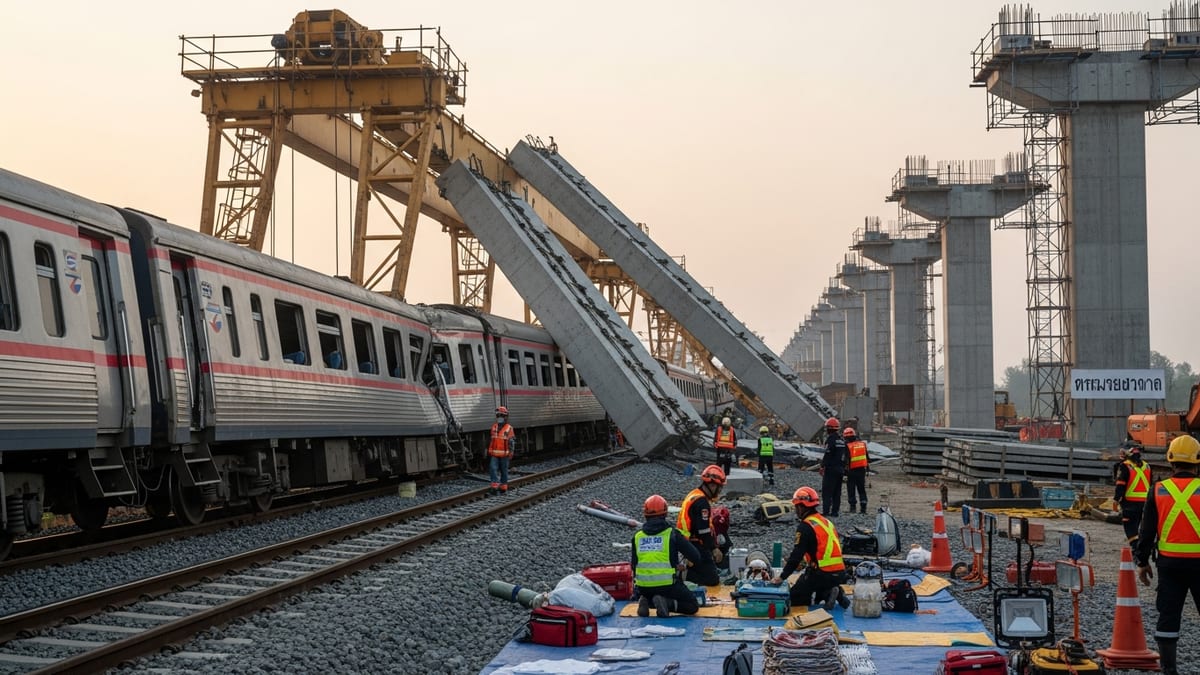
Freight wagons leave the tracks near homes
Publicly available information shows that the derailment occurred late Sunday afternoon on July 5 in the largely residential Le Gardeur district of Repentigny, on the north shore of the St. Lawrence River. Initial coverage from Quebec news outlets indicates the incident took place near local streets including rue De la Paix and boulevard Le Bourg-Neuf, where rail lines run close to single-family homes and small businesses.
Reports from local media describe more than twenty CN freight wagons leaving the tracks as the train passed through the neighborhood. Several cars reportedly came to rest at the edge of backyards and near residential streets, illustrating how close the line runs to housing in this suburb of greater Montreal.
Images published by regional news organizations and shared on social media show a chain of derailed cars scattered along the line, some leaning at sharp angles. The scene prompted a rapid response from fire services, police and CN rail teams, who moved to secure the site and assess potential risks to nearby residents.
No serious injuries or hazardous cargo reported
According to Canadian Press reporting and regional news coverage, there were no serious injuries reported in connection with the derailment. Early information circulated by the municipality and summarized in local media indicates that emergency responders did not transport any residents to hospital as a result of the incident.
Publicly available statements referenced in Quebec news reports also indicate that the cargo on board the CN freight train did not include dangerous goods. Coverage notes that information shared by municipal leaders and rail representatives pointed to the absence of hazardous materials, which significantly reduced the risk of fire, explosion or toxic release in the affected neighborhood.
The confirmation that the train was not hauling dangerous goods drew attention precisely because of Quebec’s history with high-impact rail disasters. Observers have noted that the Repentigny derailment, while visually dramatic and disruptive to local life, unfolded very differently from events such as the Lac-Mégantic tragedy, where flammable cargo magnified the consequences of a rail incident.
Evacuations, power outages and traffic disruption
Coverage from outlets focused on local emergency incidents reports that around 200 residents were evacuated as a precaution in the hours following the derailment. These evacuations primarily affected homes closest to the tracks and to the line of derailed wagons, allowing responders to work without exposing residents to potential secondary risks.
News reports indicate that power outages were recorded in parts of the Le Gardeur sector after the train left the rails. The combination of downed infrastructure, emergency cordons and work crews created additional challenges for residents who remained in their homes just outside the restricted area.
By early evening on Sunday, municipal updates relayed through regional media signaled that most evacuated residents were allowed to return home once the site was stabilized and immediate safety checks were completed. However, traffic restrictions persisted around several intersections near the derailment location, as authorities maintained a security perimeter to accommodate heavy equipment and inspection teams.
Investigation and recovery operations underway
Information compiled from Canadian and Quebec news reports indicates that CN and transportation safety specialists have begun examining the scene to determine what caused the derailment. At this early stage, publicly available coverage notes that no single cause has been identified, and investigators are expected to review track conditions, train speed, equipment performance and recent maintenance records.
CN crews are reported to be coordinating the complex process of clearing and rerailing cars, repairing damaged track and inspecting nearby infrastructure. Such operations typically require cranes, specialized rail equipment and careful planning to avoid further damage to both rolling stock and the surrounding environment.
Regional coverage suggests that rail traffic through the sector will remain disrupted while the damaged section of line is repaired and tested. Depending on the severity of infrastructure damage, freight movements through this corridor northeast of Montreal may be rerouted or temporarily suspended, potentially affecting logistics for shippers that rely on CN’s network in the region.
Local concerns over rail safety in residential areas
The Repentigny derailment has renewed discussion about freight rail lines that run through densely populated areas in Quebec and across Canada. Commentary in regional news and on social platforms highlights longstanding concerns around the proximity of heavy rail traffic to homes, schools and small commercial districts, particularly when trains are long and heavily loaded.
Observers note that while this incident did not involve hazardous materials or serious injuries, its location underscores the importance of robust track maintenance, operational safeguards and clear communication with residents. The sight of multiple wagons tipped or off the rails a short distance from backyards has been described in coverage as unsettling for those who live along the corridor.
Travel and transportation analysts following the event point out that incidents like the one in Repentigny may push municipalities and rail operators to revisit risk assessments and emergency planning near busy freight routes. For travelers and commuters in the greater Montreal region, the derailment serves as a reminder of the interconnected nature of rail safety, urban development and regional mobility, even when an incident ends without serious physical harm.