


More news on this day
A cluster of major cancellations affecting Air Canada, United Airlines and American Airlines departures from Seoul Incheon International Airport has triggered fresh disruption across transpacific and transatlantic networks, highlighting how even a short burst of schedule cuts at one Asian hub can cascade into missed connections and overnight delays worldwide.
Get the latest news straight to your inbox!
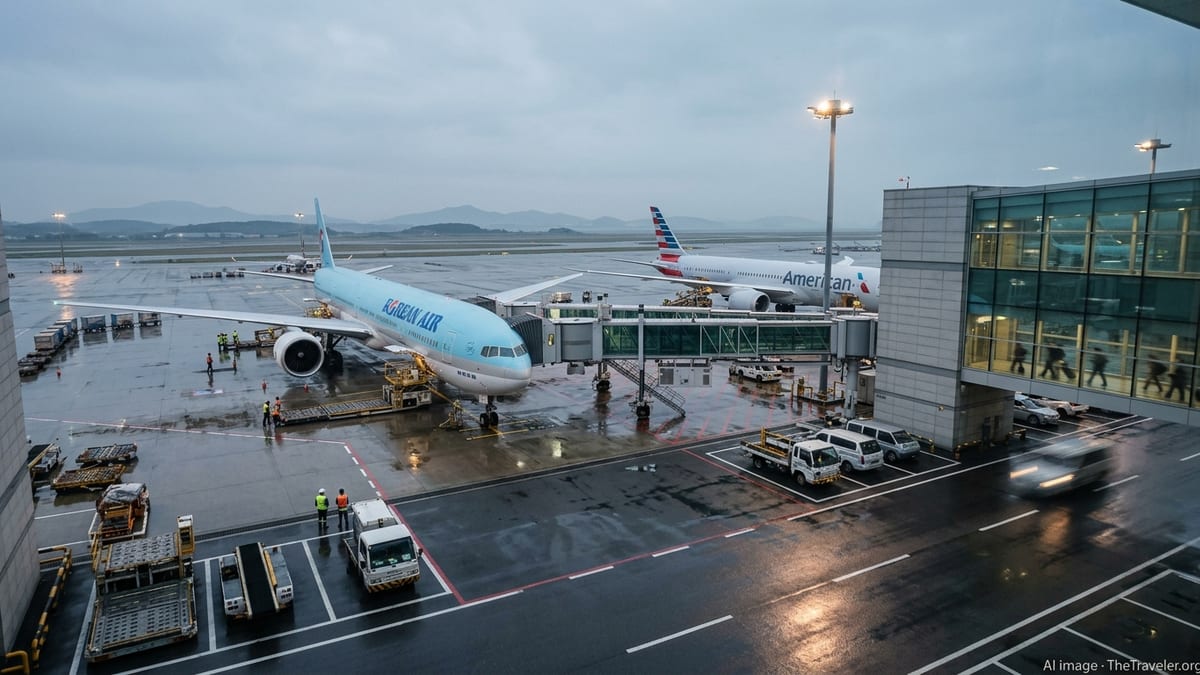
Five Long Haul Cancellations Concentrated in a Single Operating Window
Publicly available departure boards and schedule data show that five intercontinental flights operated by Air Canada, United Airlines and American Airlines were withdrawn from Seoul Incheon over a compressed operating window, rather than being spread throughout the day. While individual carriers have cited a mix of operational and knock-on network factors in similar recent disruptions, the concentration of cancellations at one hub amplified the impact on passengers in multiple time zones.
The affected services, primarily widebody departures linking Incheon with major North American gateways, were due to operate during peak long haul departure waves when many travelers are connecting from regional Asian feeds. When these high-capacity flights disappear from the schedule at short notice, hundreds of passengers can be left without same day alternatives, particularly on routes where load factors are already high as peak summer travel approaches.
Incheon is one of Asia’s key transfer points for journeys between North America and the wider region, including Southeast Asia and Australasia. Industry data consistently ranks the airport among the busiest in the region for international connections, meaning any disruption on long haul sectors quickly proliferates onto shorter segments as aircraft and crew are repositioned or held back.
Observers note that this latest cluster of cancellations follows a series of weather related and technology driven disruptions over the past two years that have tested airline and airport resilience worldwide. Each new episode underlines how tightly synchronized global networks have become, and how little slack exists when several major flights are removed at once from a core hub like Incheon.
Knock-On Effects for Connecting Passengers Across Continents
The immediate consequence of the five cancellations has been a wave of missed onward connections for travelers whose itineraries depended on timely arrivals into North American hubs such as San Francisco, Los Angeles or Dallas Fort Worth. With fewer widebody departures available from Incheon on the same day, many passengers have found themselves rebooked a full 24 hours later or rerouted through secondary hubs, extending overall journey times by half a day or more.
Because Air Canada, United and American all market itineraries that combine their own transpacific services with partner flights onward into Canada, the United States and Latin America, a single cancellation at the Asia end of the route can unravel multiple subsequent legs. In some cases, replacement routings have involved entirely different alliance partners, shifting travel via Europe or the Middle East when nonstop or direct options from Incheon are no longer available.
Travel data providers tracking day-of-operations performance indicate that capacity constraints on key Incheon North America city pairs make rapid recovery challenging. With many summer season flights already operating with high seat occupancy, airlines have limited room to absorb disrupted passengers into the next available departures, particularly in premium cabins and on days when other carriers are also managing residual backlogs from earlier storms or technical incidents.
Across social platforms and passenger forums, reports describe longer than usual queues at transfer desks, as well as confusion over whether itineraries involving multiple carriers can be reprotected automatically. While some travelers have successfully secured rebookings via alternate routings, others have reported overnight stays in Seoul and the need to arrange temporary accommodation while awaiting confirmed seats out of Incheon.
Operational Pressures Behind North American Carriers’ Schedules
The cancellations at Incheon come against a backdrop of sustained operational pressure on North American airlines. Over the past 18 months, major carriers have confronted a combination of severe weather events, crew and aircraft imbalances, and periods of technology outages that have disrupted flight operations across key domestic and international hubs.
Industry analyses of recent disruptions point to how quickly localized issues such as winter storms or air traffic control constraints in the United States can propagate into overseas schedules. When aircraft and crews arrive late or out of position at North American gateways, the knock-on effect is often felt the next day on outbound transpacific sectors. In some cases, airlines have proactively canceled flights from Asia when it became clear that required aircraft or minimum rested crews would not be available to operate safely and on time.
Technology resilience has also become a significant factor. Aviation bodies have documented how major IT outages in recent years led to widespread ground stops, with carriers scrubbing a portion of their flights worldwide while systems were restored. Although no single triggering incident has been publicly identified behind the latest Incheon cancellations, analysts note that carriers remain cautious about operating long haul services when key scheduling, dispatch or crew-tracking tools are degraded, as operational risk and potential downstream disruption rise sharply.
At the same time, airlines have been rebuilding long haul capacity across the Pacific as demand recovers, reintroducing routes and frequencies that were reduced or suspended during earlier phases of the pandemic and subsequent supply chain constraints. This expansion, while welcome for travelers seeking more options, leaves limited room to maneuver when unexpected disruptions require rapid consolidation of flights or temporary route suspensions.
What Stranded Passengers Are Experiencing at Incheon
For travelers caught up in the latest wave of cancellations, the experience at Incheon has ranged from smooth rebookings to extended periods of uncertainty. Reports from passengers indicate that those with simple, point to point itineraries on a single carrier have generally been rebooked more quickly, while travelers on complex multi segment journeys involving several airlines have faced longer waits as agents coordinate with partners and assess available inventory.
Airlines typically prioritize rebooking onto their next available services from Incheon, but when multiple widebody departures are fully booked, alternative options can include rerouting via other Asian hubs or shifting passengers onto alliance partners flying to the same North American destinations. This can create additional complications with checked baggage, seat assignments and through-checking of future legs, especially when systems are under stress and manual interventions are needed.
Public guidance from consumer advocates emphasizes the importance of monitoring flight status frequently on airline websites and apps, as well as confirming any rebooked itineraries before heading to the airport. Travelers are also encouraged to retain all receipts for meals and accommodation in case they are eligible for reimbursement under carrier specific policies that apply when cancellations stem from factors within the airline’s control.
At Incheon itself, airport information screens and terminal announcements have been central to keeping passengers updated as schedules shift. While the hub is known for its efficient layout and array of amenities, extended unplanned layovers still present challenges, particularly for families and those requiring visas or special assistance when moving between airside and landside areas to access hotels.
Broader Implications for Intercontinental Network Reliability
The disruption triggered by the five cancellations at Incheon highlights a wider issue facing global aviation in 2026: how to maintain reliability across highly interconnected long haul networks during a period of strong demand and recurring external shocks. As airlines push utilization of aircraft and crews to maximize capacity, the margin for absorbing irregular operations has narrowed.
Aviation strategists point out that hubs like Incheon sit at the crossroads of multiple alliances, codeshares and joint ventures. When several major North American carriers adjust their schedules simultaneously at such a node, the effects can ripple through partner networks spanning six continents. This places additional pressure on coordination mechanisms that govern how seats are shared, how disrupted passengers are reaccommodated and how schedules are rebuilt after a day of heavy cancellations.
The latest events may prompt renewed scrutiny of contingency planning for long haul operations, including the availability of spare aircraft, reserve crew pools and backup digital infrastructure. Some industry observers argue that carriers will need to invest further in resilience even as they chase growth on lucrative transpacific and transatlantic corridors, noting that repeated episodes of high profile cancellations can erode traveler confidence and push passengers toward carriers perceived as more stable.
For now, the focus remains on clearing backlogs at Incheon and restoring normal patterns on North American bound routes. But as the summer peak approaches, the cancellations affecting Air Canada, United and American at the Seoul hub are likely to be cited as another example of how tightly stretched global airline networks have become, and how quickly local disruption can escalate into intercontinental travel chaos.