


More news on this day
Norway is pressing ahead with plans for a new rail tunnel beneath Oslo, despite fresh analysis indicating the flagship capacity project could face a cost increase of as much as 25 billion Norwegian kroner.
Get the latest news straight to your inbox!
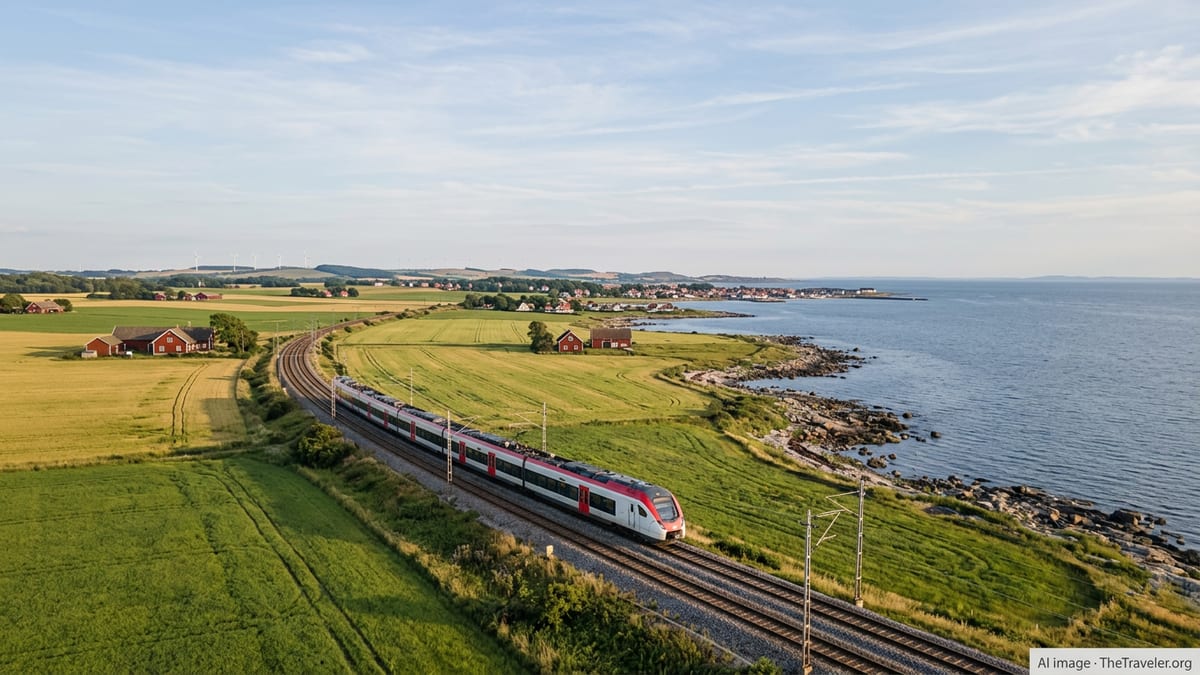
A crucial bottleneck for Norway’s rail network
The existing Oslo Tunnel is the busiest section of railway in Norway, carrying virtually all trains running west from the capital and a large share of commuter and airport services. Publicly available information shows that the double-track link has operated close to capacity for years, limiting the number of additional departures that can be scheduled through the city’s central hub.
Transport planners have long argued that a second tunnel is essential if Norway is to shift more passenger and freight traffic from road to rail. Without new capacity under central Oslo, reports indicate that future growth in long-distance services and regional trains will be difficult to accommodate. The project has therefore been treated as a central piece of the country’s broader rail strategy for the densely populated eastern region.
Recent feasibility work around potential high speed connections between Oslo and neighboring countries has also highlighted the bottleneck role of the current tunnel. According to published assessments, even incremental upgrades elsewhere on the network risk being constrained unless a new cross-city rail link is built.
Cost estimates surge by up to NKr25 billion
New cost projections circulating in Norwegian media suggest that the Oslo tunnel expansion could end up being significantly more expensive than earlier planning figures. Reports indicate that the latest calculations point to a potential increase of around 25 billion kroner compared with previous estimates, placing the scheme among the most expensive rail infrastructure investments in the country’s history.
The upward revision reflects a combination of factors that have affected large transport projects globally in recent years. Published coverage points to higher prices for materials, stricter environmental and safety requirements, and the complexity of tunneling beneath a dense urban core that already contains extensive underground infrastructure.
Commentary in Norwegian specialist outlets has drawn comparisons with other high-profile projects in the Oslo area, warning that the tunnel could risk becoming another example of large public works where costs escalate during the detailed design and construction phases. Analysts have underscored that such overruns would place additional pressure on national transport budgets, which already juggle competing priorities ranging from road maintenance to coastal infrastructure.
Government signals to continue planning despite price pressure
Despite the emerging cost concerns, publicly available policy documents and recent coverage indicate that Norway’s government still views a second Oslo rail tunnel as strategically important. The project is referenced as part of efforts to secure reliable passenger flows into and through the capital, particularly on the heavily used commuter lines serving the wider Oslo region.
While formal investment decisions are still expected to be several years away, the authorities are advancing the technical and conceptual planning needed to keep the project on track. This includes work on alignment options, station locations and integration with existing lines that feed into Oslo Central Station. Continuing this phase allows Norway to refine the design and explore potential savings before committing to full-scale construction.
At the same time, the sizable projected cost increase has prompted renewed debate about how quickly the project should move forward. Commentators note that, in an environment of tighter public finances, major rail schemes must compete for funding with highway upgrades, tunnel rehabilitation and other infrastructure. Delaying or staging the Oslo tunnel investment is therefore being discussed as a way to manage budget exposure while preserving long-term ambitions for the rail network.
Implications for travelers and wider Scandinavian connectivity
For travelers, the second Oslo tunnel is framed as a project that could ultimately bring more frequent and more reliable services across eastern Norway. With the current tunnel already heavily utilized, minor disruptions can quickly ripple through the timetable. Additional capacity under the city center would give rail operators greater flexibility in scheduling and recovery from delays, which is seen as crucial for commuters who rely on punctual departures.
In the longer term, the new tunnel is also seen as an enabler for improved international rail links. Studies examining potential Oslo to Stockholm and Oslo to Gothenburg enhancements identify limited capacity through the capital as a key constraint. A higher-capacity cross-city tunnel would provide a more robust backbone for future cross-border services, aligning with broader European goals of shifting more travel onto rail.
However, the rising price tag raises questions about how quickly such benefits will be realized. With the possible 25 billion kroner increase, the project faces heightened scrutiny from those arguing for more modest, targeted upgrades that could deliver improvements sooner at lower cost. The discussion reflects a wider European debate about the balance between transformative megaprojects and incremental investments in existing infrastructure.
A test case for Norway’s approach to megaprojects
The evolving Oslo tunnel plan is emerging as a test case for how Norway manages large and complex transport investments in a period of higher construction costs. Recent experience with other major tunnels and urban infrastructure has shown how quickly budgets can grow once detailed geotechnical conditions and engineering solutions become clearer.
Analysts following the sector suggest that the planning phase for the Oslo rail tunnel will be watched closely for signs of tighter cost control, more robust risk assessments and clearer prioritization among different elements of the scheme. Suggestions under discussion include phasing construction, simplifying station designs and reviewing technical standards where possible without compromising safety.
For the travel sector, the outcome will shape how rail serves Oslo and its surrounding regions for decades to come. A well-executed tunnel could unlock new capacity, support tourism flows through more reliable intercity services and strengthen the city’s role as a Scandinavian rail hub. If costs continue to mount, however, the project could fuel further debate over how far Norway is willing to go in financing transformative, but expensive, rail infrastructure beneath its capital.