


More news on this day
American Airlines operations across the United States were thrown into disarray this week after a major information-technology outage prompted the Federal Aviation Administration to briefly halt departures for the carrier, marking the third time in two years that an IT failure has led to an FAA ground stop involving the airline.
Get the latest news straight to your inbox!
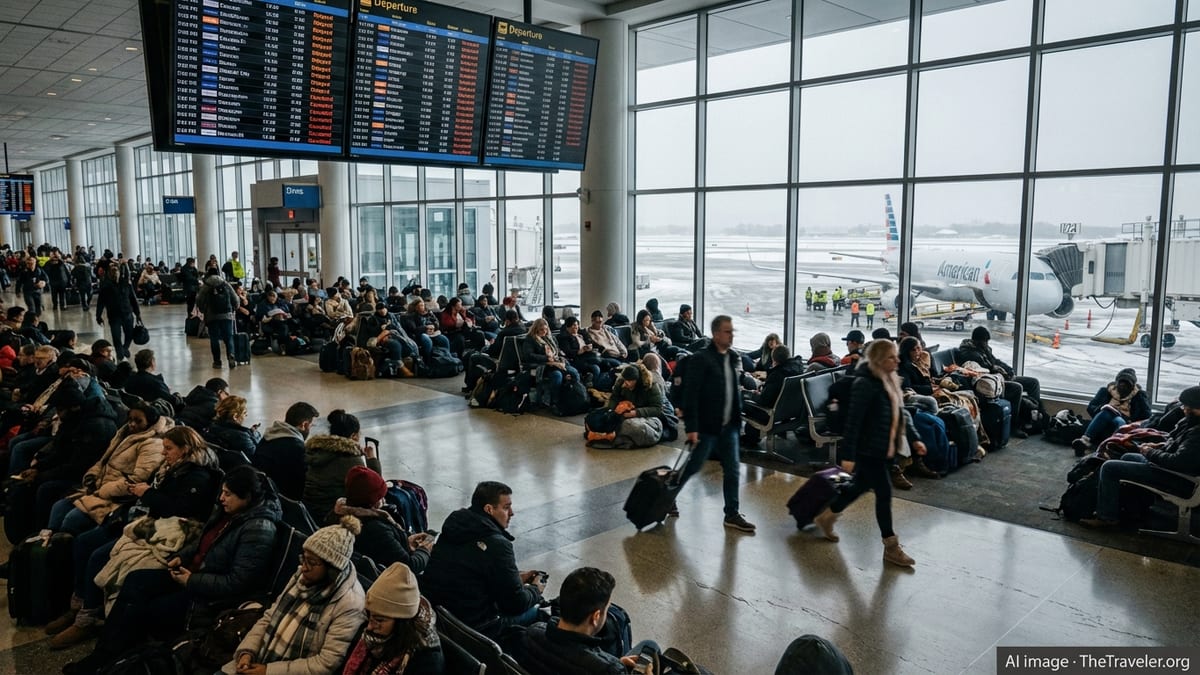
Nationwide Departures Paused as Systems Go Dark
According to publicly available FAA traffic management advisories and flight-tracking data, the latest disruption began on Tuesday, July 28, when a widespread systems issue affected American Airlines’ ability to manage flights across its network. Departures for American and its regional affiliates were paused nationwide for a period while aircraft already in the air were allowed to continue to their destinations.
Reports from major hubs such as Dallas Fort Worth, Chicago O’Hare and Miami indicated that check-in, boarding and crew-management systems were intermittently unavailable. Passengers described aircraft holding on taxiways and boarding gates closing and reopening as staff attempted manual workarounds while waiting for confirmation that core systems were stable.
Flight-status feeds showed a sharp spike in ground delays and a growing number of cancellations as the outage persisted. Once the ground stop was lifted, operations resumed gradually, but congestion at key hubs and crew-displacement issues extended the disruption into the evening.
Third Ground Stop in Two Years Tied to IT Failures
The incident adds to a series of technology-linked stoppages affecting American Airlines in recent years. In 2024, the carrier was among several airlines that temporarily halted departures during a global technology outage related to a third-party software update. That event forced a coordinated pause in takeoffs while airlines restored affected systems and verified the integrity of flight-planning and operational data.
American has also been involved in earlier disruption episodes arising from internal and industry infrastructure problems, including a nationwide ground stop in 2018 and participation in the 2023 halt to U.S. departures caused by a failure of a critical FAA safety-notification system. Those prior events underscored the extent to which modern airline operations depend on a complex web of software platforms, telecommunications links and data centers.
The latest outage stands out because it represents a recurrence within a relatively short period, again tying American’s schedule reliability to the resilience of its IT architecture. For travelers, the headline effect is similar each time: aircraft on the ground stop moving, airport departure boards fill with delays, and rebooking options quickly narrow as disrupted flights stack up.
Impact on Passengers Across the U.S. Network
Publicly shared accounts from airports across the country described long lines at customer-service counters and crowded gate areas as the outage unfolded. Travelers reported being informed that a system-wide technology issue was preventing new clearances for departure, even as some flights already in the air continued normally.
At large connecting hubs, particularly Dallas Fort Worth and Charlotte, the knock-on effects were significant. Grounded departures there translated into missed connections for passengers traveling onward to smaller cities, with some travelers facing overnight delays once aircraft and crews fell out of position. At airports with limited alternative service, the lack of spare seats on later flights made same-day recovery difficult.
Typical disruption protocols appeared to come into play as operations resumed, with passengers offered rebooking options through digital channels and airport agents where capacity permitted. However, the scale and sudden onset of the outage meant that many travelers encountered extended waits, both for updated information and for available seats on replacement flights.
Renewed Scrutiny of Aviation IT Resilience
The incident is likely to intensify scrutiny of how airlines and aviation authorities manage the risks posed by critical technology failures. Industry observers note that U.S. air travel has seen a series of large-scale IT disruptions in recent years, ranging from airline-specific scheduling and crew-system breakdowns to outages of federal systems that support flight safety and routing.
Publicly available government and policy analyses point to aging infrastructure, overlapping legacy platforms and the growing complexity of cyber and software supply-chain risks as contributing factors. When a single point of failure emerges, the cascading impact can quickly extend across an airline’s entire operation, as illustrated by the latest American Airlines stoppage.
For regulators, repeated IT-linked ground stops raise questions about redundancy requirements, data-center architecture, and contingency procedures designed to keep at least a portion of the system functioning during partial failures. For airlines, the pattern highlights the financial and reputational costs that can follow when technology systems prove less resilient than the schedules built on top of them.
Travelers Confront a New Normal of Tech-Driven Delays
For passengers, the growing role of IT outages in disrupting air travel adds another layer of uncertainty to an already complex system of weather risks, staffing challenges and air-traffic constraints. Even on clear-weather days, a software malfunction at a major carrier or within federal aviation infrastructure can now trigger nationwide ripple effects.
Travel advisers increasingly recommend that passengers build additional buffer time into itineraries, especially when making tight connections or traveling for time-sensitive events. Many also encourage travelers to monitor their flights through airline apps and third-party tracking tools, which can provide early signals of widespread disruption when status changes begin appearing simultaneously across multiple airports.
As American Airlines works to stabilize its systems following the latest outage and examines the root causes, passengers and industry analysts alike are watching for indications of deeper resilience improvements. With this event marking the third IT-related ground stop involving the carrier in two years, the question for many travelers is whether such disruptions are becoming a recurring feature of modern air travel or a catalyst for more robust safeguards ahead.