


More news on this day
Train services are resuming on the Nuremberg–Regensburg rail corridor following an intensive modernisation programme, restoring a key Bavarian link that had been closed for months for comprehensive track, signalling and station upgrades.
Get the latest news straight to your inbox!
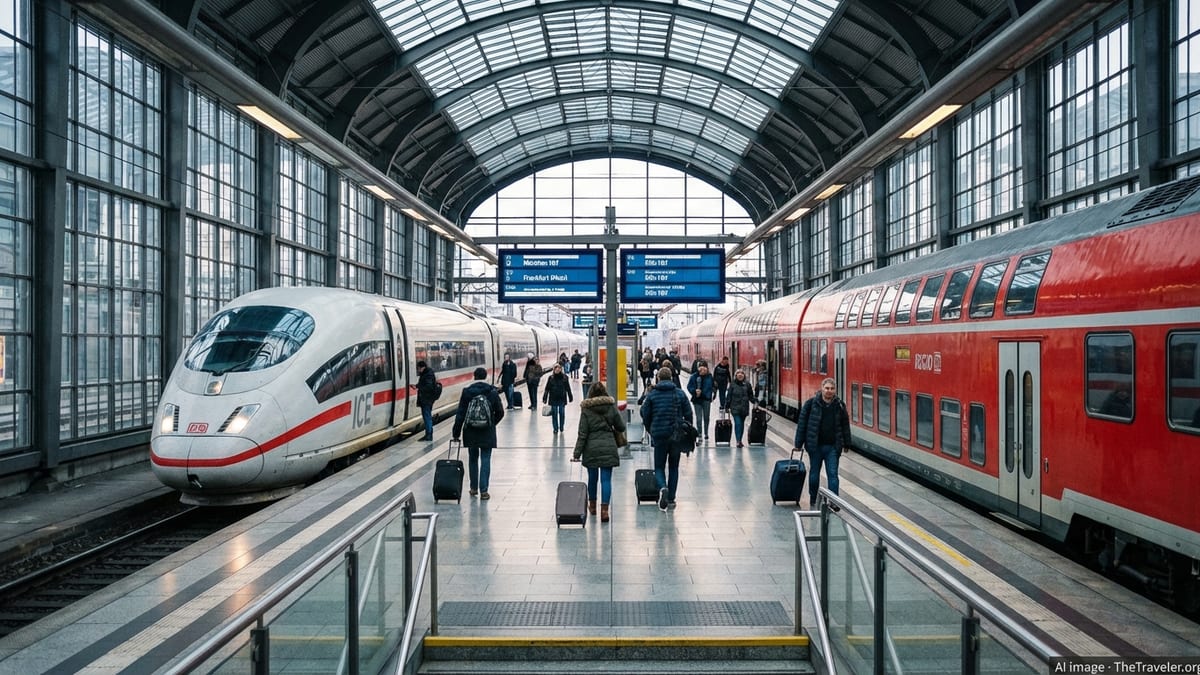
A central Bavarian artery back in service
The line between Nuremberg and Regensburg is regarded as one of Bavaria’s most important regional and long-distance corridors, carrying a mix of intercity, regional and freight traffic across roughly 90 kilometres. Publicly available information describes it as a double-track main line that has long functioned as a backbone for travel between northern Bavaria, the Danube valley and onward connections toward Austria and the Czech Republic.
The reopening follows a prolonged full closure that began in early February 2026 as part of a broader programme to renovate heavily used sections of the German rail network. During that period, all regular trains were suspended from the route, with traffic rerouted via alternative corridors or replaced by extensive bus services. Published updates from rail operators described the works as a “corridor renovation” intended to concentrate years of maintenance and upgrade activity into a single, intensive phase.
With the line now back in operation, regular passenger services are gradually returning to the core route instead of diverting via longer itineraries through Ingolstadt, Schwandorf or Munich. Regional transport associations and long-distance operators have begun restoring direct connections, while maintaining some strengthened bus services in the first days to ease the transition back to normal operations.
The restart marks a significant moment for commuters who had faced extended journey times and complex detours, as well as for freight operators seeking more predictable paths across southern Germany. Early timetables indicate that both regional express and stopping services will again form an hourly backbone between the two cities, supplemented by long-distance trains on selected paths.
What the modernisation achieved on the Nuremberg–Regensburg line
Information released during the works shows that the project went far beyond simple track maintenance. The corridor renovation bundled track renewals, bridge repairs, embankment stabilisation, overhead line work and station improvements into one coordinated programme, aiming to extend asset life and improve reliability on a route exposed to heavy daily use.
Technical summaries indicate that more than 80 kilometres of track and dozens of sets of points were renewed, together with extensive sections of overhead electrification equipment. In several locations, embankments were reinforced and drainage improved to protect the line from weather-related disruptions. At key bottlenecks, the geometry of track and switches was refined to support smoother operations and more robust timetables.
A central element of the project was the upgrade of signalling and safety systems. Recent material on Germany’s rail modernisation drive highlights the introduction or expansion of digital interlockings and European Train Control System technology on priority routes. The Nuremberg–Regensburg corridor forms part of this push, with new signalling designed to support higher capacity, standardised safety functions and better traffic management across the wider network.
Station improvements along the route included raising or rebuilding platforms to create level boarding at selected stops, clearer passenger information systems and accessibility-focused adjustments. These changes are intended to make the line more convenient for daily commuters and travellers with reduced mobility, while also reducing dwell times and improving punctuality.
Passenger experience after months of disruption
For travellers, the most immediate change is the end of the replacement bus network that had become a daily reality since early 2026. Regional transport notices described a complex web of express and stopping buses linking Nuremberg, Neumarkt, Parsberg and Regensburg, at times running along motorways and local roads to approximate the rail timetable. While reports suggest that the substitute services generally stabilised after an initial adjustment period, they also highlighted overcrowding at peak times and longer door-to-door journey times.
With trains back on the mainline, journey times between the two cities are expected to fall back to pre-closure levels on most connections, and in some cases improve slightly where track and signalling upgrades permit tighter schedules. Travel planners now again show direct regional and intercity trains without the need for rail-replacement segments or circuitous detours via secondary lines.
The reopening is particularly significant for smaller communities along the corridor, which had seen their rail access replaced by buses with limited space for bicycles, prams and luggage. Restored rail services are expected to bring more predictable travel times and greater comfort, factors that local business groups and chambers of commerce had previously identified as important for labour mobility and investment decisions in the corridor.
Tourism is also likely to benefit, as Nuremberg and Regensburg are both major destinations for domestic and international visitors. Travel organisations had been advising visitors to allow significantly more time for journeys during the closure. With rail operations normalising, promoters anticipate a smoother flow of visitors to historic centres, river cruises on the Danube and surrounding cycling regions.
Network-wide context and future upgrades
The Nuremberg–Regensburg project is one of the flagship schemes in a multi-year initiative to refurbish Germany’s busiest rail corridors. Public documents on the “high-performance network” strategy describe a shift away from piecemeal night and weekend works toward concentrated rebuilding of entire corridors, with the aim of returning them to service in significantly better condition and with modern digital technology in place.
This corridor was among the earliest in the national sequence, alongside sections such as Hamburg–Berlin and Hagen–Wuppertal–Cologne. By concentrating construction activity, infrastructure managers seek to minimise the cumulative disruption caused by repeated partial closures and to deliver more tangible improvements in reliability and capacity once each route reopens.
Attention in Bavaria is now turning to subsequent stages, including the regeneration of the Obertraubling–Passau route and ongoing discussions about electrification and capacity enhancements on connecting lines toward Hof, Prague and the Bavarian Forest. Policy papers and regional position documents have underlined the importance of these follow-on measures if the modernised Nuremberg–Regensburg line is to realise its full potential as a north–south and east–west connector.
Observers of the rail sector note that lessons learned from this corridor renovation, including the management of replacement services, communication with passengers and the commissioning of complex signalling systems, are likely to inform how later projects are organised. As more sections of the German network undergo similar “all-at-once” rebuilds, the experience on the Nuremberg–Regensburg line will be seen as an important reference point.
Balancing construction complexity with public expectations
While the reopening restores a critical link, the extended closure period has highlighted the challenges of executing large-scale works on a live national network. Transport commentators have pointed to the tension between the need for deep, technically complex upgrades and the expectations of passengers and freight customers for reliable daily services.
The Nuremberg–Regensburg corridor has illustrated how intricate modern signalling and safety systems can lengthen testing and commissioning phases, even after visible track and overhead work is complete. Publicly available commentary suggests that reconciling these technical demands with clear, realistic communication about timelines will remain a central issue for future corridor renovations.
For now, attention along the route is focused on the performance of the newly reopened line. Punctuality statistics, feedback from transport associations and the resilience of the upgraded infrastructure during peak periods and adverse weather will be closely followed in the coming months. The success of this corridor will play a role in shaping public confidence in Germany’s broader rail modernisation programme and its promise of a more reliable, higher-capacity network by the mid-2030s.