


More news on this day
A sudden systems breakdown at a major Oceania ground-handling provider has unleashed a wave of cancellations and delays across Qantas and Air New Zealand networks, throwing trans-Tasman travel into disarray and highlighting the fragility of the region’s tightly wound aviation system.
Get the latest news straight to your inbox!
Systems Failure at Ground Handler Ripples Across Region
Reports indicate that a core operations platform at a leading Oceania ground-handling company malfunctioned during the busy morning peak on 14 June 2026, disrupting aircraft turnarounds at major gateways in Australia and New Zealand. Check in, baggage loading, refuelling coordination and pushback scheduling were all affected, forcing airlines to hold aircraft on the ground while technicians worked to restore connectivity.
The outage quickly escalated from local inconvenience to regional crisis as aircraft ran out of allowable crew duty time and missed onward slots, leading airlines to cancel or significantly delay hundreds of services. Published disruption data cited in aviation industry coverage points to at least 14 outright cancellations and more than 400 delays in a single day across the region, with Sydney, Melbourne, Brisbane and Auckland among the worst affected airports.
Aviation analysts quoted in trade and business publications describe the event as a textbook example of how a single point of failure in outsourced airport logistics can paralyse a geographically dispersed network. With many airlines having shifted large portions of their ramp and passenger services to third-party providers over the past decade, a technical fault in one operation can now rapidly cascade across multiple carriers and hubs.
Industry commentary further notes that the timing of the breakdown, at the onset of the Southern Hemisphere winter and amid already tight capacity on core routes, amplified the impact on travellers and airline schedules.
Qantas Cancellations Add to Existing Capacity Cuts
Qantas was among the hardest-hit carriers, with tracking data and media reports showing widespread disruption to domestic services and trans-Tasman flights linking Australia with New Zealand. Services between Sydney, Melbourne and Brisbane and key New Zealand cities experienced a mix of rolling delays and same-day cancellations as aircraft and crews fell out of position.
The disruption arrived on top of earlier capacity reductions the airline had already announced for 2026 in response to surging fuel costs and broader operational pressures. Publicly available statements from Qantas in April and May indicated that the group was trimming domestic capacity by around five percent and extending these cuts into the September quarter, with some New Zealand routes already operating at reduced frequencies.
Travel commentators point out that the ground-handling failure therefore collided with an operating environment in which there was less spare capacity for Qantas to rebook passengers. With fewer empty seats on alternative flights, many travellers faced multi day delays or complex reroutings through secondary airports, particularly on popular leisure and business corridors.
Guidance on the airline’s customer policies shows that Qantas typically rebooks affected passengers on the next available service and, in some circumstances, may provide additional support such as accommodation or reimbursements when disruptions are within the carrier’s control. In this case, with a third-party operational failure at the core of the meltdown, assessments of responsibility and entitlements may vary by itinerary and jurisdiction.
Air New Zealand Network Strains Under Trans-Tasman Pressure
Air New Zealand also faced significant operational stress as the ground-handling outage reverberated through its domestic and international network. Media coverage and passenger reports from Auckland and Wellington describe lengthy queues, rolling gate changes and last-minute cancellations on flights to and from Australia, particularly on routes to Sydney and Brisbane.
The airline entered the disruption period with high load factors and tightly scheduled aircraft utilisation following the post pandemic rebuild of capacity. Recent updates from Auckland Airport show that international passenger numbers in May were already under pressure amid capacity tightening, meaning there was limited room to absorb sudden surges in stranded trans-Tasman travellers.
Information published in Air New Zealand’s customer service commitments outlines that the carrier aims to notify customers of delays or cancellations within 30 minutes of becoming aware of an issue and to provide rebooking options or refunds in line with local law and fare conditions. However, aviation observers note that the speed and scale of the Oceania handling failure tested these processes, particularly for travellers connecting between domestic and international legs.
Consumer advocates in New Zealand have pointed to the event as another reminder of how quickly localized operational issues can undermine confidence in regional connectivity, especially for travellers in smaller centres who rely on seamless links through Auckland to reach Australia and beyond.
Travel Chaos for Passengers on Both Sides of the Tasman
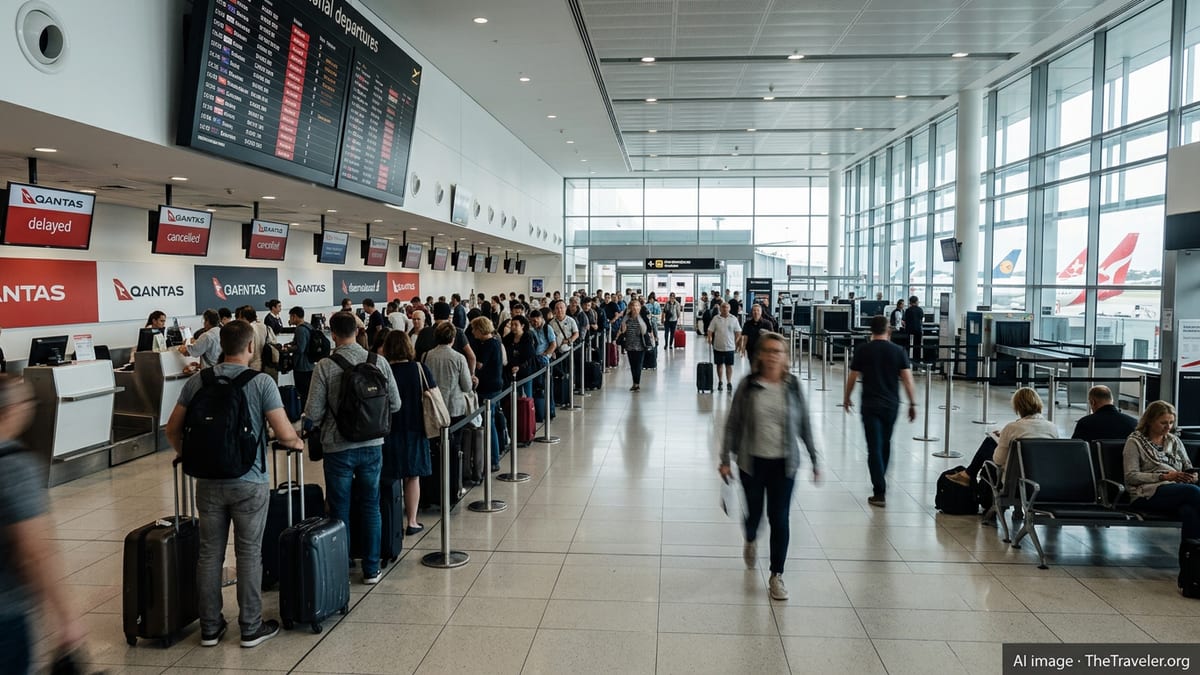
For passengers, the operational nuances translated into a very visible breakdown of normal travel patterns. Social media posts and local news coverage from 14 and 15 June document crowded terminal halls, snaking queues at check in and service desks, and ad hoc announcements as airlines attempted to sequence limited departure slots.
Travellers on both Qantas and Air New Zealand reported missed connections, abandoned weekend trips and unexpected overnight stays when onward flights were withdrawn at short notice. In some cases, itineraries that would ordinarily involve a three-hour hop across the Tasman stretched into journeys of more than 24 hours via alternative routings or next day departures.
Airport-level statistics compiled by aviation data services suggest that cancellations on the worst hit routes far exceeded normal baselines, with some corridors experiencing disruption rates more than ten times their usual levels. On a typical operating day, major airports in the region see a relatively low cancellation rate, but on the day of the handling system failure, analysts recorded double digit percentages on select trans-Tasman services.
Travel agents and online booking platforms, drawing on publicly available airline advisories, urged passengers to check flight status frequently, use airline apps where available and consider more flexible ticket types during the current period of heightened operational risk.
Questions Over Outsourcing, Resilience and Passenger Protections
The Oceania aviation breakdown has sparked renewed debate about the region’s reliance on outsourced ground-handling operations and the resilience of key digital systems that underpin aircraft turnarounds. Commentaries in specialist aviation and business outlets argue that cost-focused outsourcing may have left critical infrastructure more exposed to single-point failures.
Experts cited in these analyses highlight that ground handlers now sit at the centre of airport ecosystems, coordinating fuel, baggage, catering and safety checks for multiple airlines. Any disruption to their digital platforms can therefore bring a broad mix of carriers to a standstill, regardless of individual airline investments in fleet or crew resilience.
The event is also prompting scrutiny of passenger protections on both sides of the Tasman. While airlines such as Qantas and Air New Zealand publish clear policies on compensation, rebooking and care obligations, the extent to which travellers are covered can depend on whether an issue is defined as within the airline’s control, the nature of the third-party fault and the regulatory framework of the country of departure.
Policy analysts suggest that the June disruption may accelerate calls for harmonised trans-Tasman standards on compensation and information rights, bringing the region closer to the more prescriptive regimes seen in parts of Europe. For now, consumer guidance continues to emphasise careful reading of fare rules, the value of travel insurance and the importance of retaining documentation of any costs incurred during major aviation disruptions.