


I arrived in Juan-les-Pins with moderate expectations. Guidebooks had painted it as the sandy, slightly sleepy little sister to Antibes: good for a beach day, light on character. Yet within an hour of stepping off the train and following the salty breeze toward the sea, it was obvious I had underestimated the place. Juan-les-Pins may look relaxed in the afternoon light, but once you start paying attention, there is a steady, pulsing energy here that only really reveals itself when you walk it, linger in its bars, and stay long enough for the music to start under the pines.
Get the latest updates straight to your inbox!
Arriving With Low Expectations
My trip began at Nice-Ville station, where I boarded one of the frequent regional trains that shuttle along the coast. In summer there are roughly trains every half hour between Nice and Juan-les-Pins, and the ride takes about twenty minutes, just enough time to watch the city slip away and the coastline open up. The carriage was a mix of office workers, students, and beachgoers in flip-flops balancing tote bags and folded parasols. Juan-les-Pins station itself is compact and unpretentious, a short walk from the water, which already sets the tone: here, the sea is never far away.
Stepping out of the station, I still half-expected a generic resort strip. On paper, Juan-les-Pins is a purpose-built seaside resort attached to the older and more storied Antibes. It has modern blocks of apartments, a grid of streets, and none of the medieval drama that makes Antibes’ old town so famous. Yet the closer I walked to the waterfront, the more I felt that first, subtle shift in atmosphere. Scooters buzzed past, shopkeepers were chatting on doorsteps, and café terraces were busy even with a late-morning sun. For a place I had been warned could be quiet outside peak season, it felt anything but lifeless.
I checked into a small two-star hotel one street behind the promenade, the kind of simple, tiled-floor place where the receptionist hands you a physical key and reminds you that breakfast is served until ten. My room faced a side street bustling with a bakery, a pharmacy, and a corner bar already clinking espresso cups. Even from the balcony I could hear the soft crash of waves over the murmur of conversation. I had come looking for the slow side of the Riviera, but the soundtrack told a livelier story.
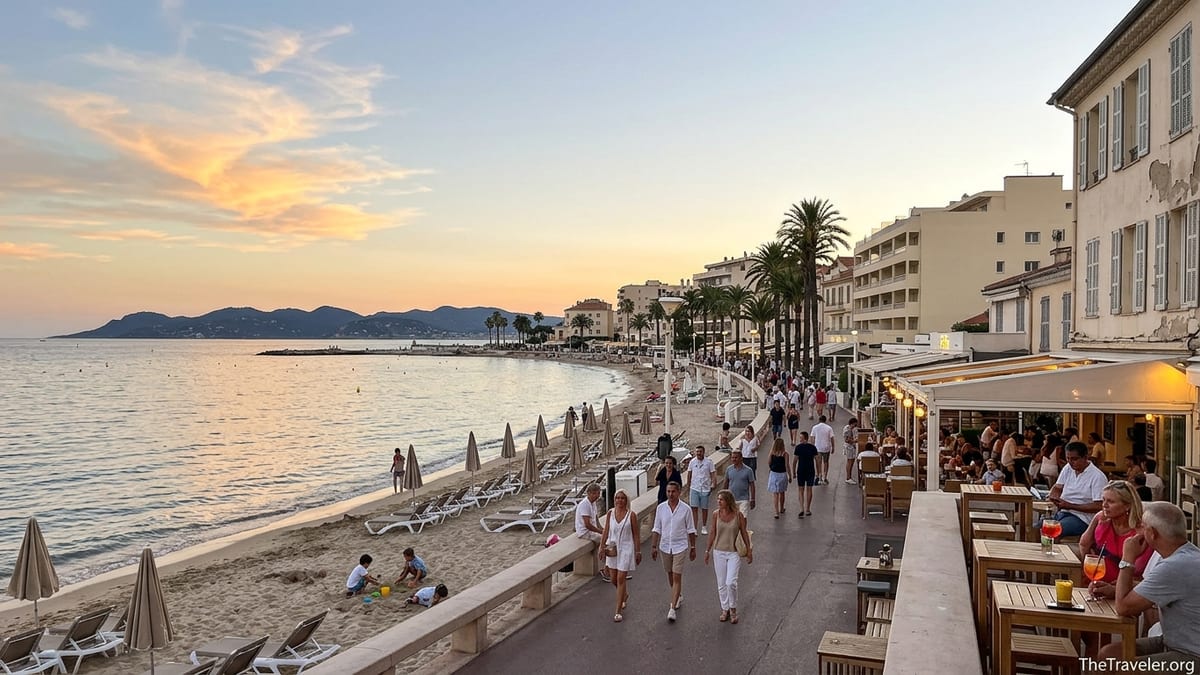
My plan for the first afternoon was modest: walk the length of the main beach, find a coffee, and see whether Juan-les-Pins really had much life beyond the summer school-holiday rush. Within half an hour I was dodging paddleboards, weaving between families on the sand, and eyeing menus at beach clubs that were already setting up for sunset cocktails. Relaxed, yes. Sleepy, no.
First Walk: Sandy Beaches and a Surprising Buzz
The defining feature of Juan-les-Pins is its long sweep of sandy beach that curves gently around the bay. Unlike the pebbles of central Nice, this is soft, pale sand, easy on bare feet and ideal for families. On my first walk along the seafront, the public stretches were already dotted with towels and inflatable flamingos, while the private sections were neatly arranged with sunbeds and umbrellas in regimented rows. By midday most of the front-row loungers were taken.
Prices at the private beaches, which I had feared might be stratospheric, turned out to be in line with much of the Riviera. A front-row sunbed with umbrella at a mid-range place hovered around 30 to 45 euros for the day in high season, slightly cheaper for the second or third row. One attendant mentioned that weekday afternoons in June and September were the sweet spot for spontaneous arrivals, while July and August often required reservations, especially at weekends. I watched a family negotiate a half-day rate so they could arrive after lunch and still have a comfortable base until sunset, a useful tactic if you want to keep costs in check.
The promenade behind the beach was busier than I anticipated. Boutiques selling linen dresses and espadrilles alternated with ice-cream counters and small art galleries. On a side street I found a bakery whose front window was piled with pissaladière, the local onion tart, thick slices of pizza-style focaccia, and rows of still-warm croissants. I grabbed a slice of pissaladière and ate it on a low wall facing the sea, watching a paddleboard class form a slow-moving line along the shallows.
What struck me most on that first walk was the variety of people around me. There were older couples with straw hats and hardback novels, teenagers sharing giant milkshakes at a café, and clusters of friends drifting between beach clubs in loose shirts and sandals. French was the dominant language, but I heard snatches of Italian, German, English, and Spanish. It felt far more local and mixed than the purely touristic resort I had been bracing myself for. Juan-les-Pins, at least in the shoulder months, attracts as many weekenders from nearby Nice and Cannes as it does foreign visitors, and that mix gives the seafront a steady, genuine buzz.
Daylight Rhythm: From Coffee to Aperitif
By late morning on my second day I had already fallen into the local rhythm. I started with a coffee at a simple bar near the station, the kind of place where the counter was lined with regulars and the espresso cost barely two euros. The bar owner leaned out to chat with a neighboring florist, traffic hummed along the avenue, and delivery vans jostled for space. For a supposed resort town, Juan-les-Pins felt like it had a working everyday life underneath the holiday sheen.
Later I walked back toward the sea and chose one of the more casual beach bars that spill right onto the sand. A café crème here was noticeably pricier than up by the station, closer to four or five euros, but in exchange my toes were almost touching the sand and the view was all glittering water and anchored boats. Teenagers were taking turns diving from the floating platforms, and a group of local retirees played pétanque under the shade of the pines just behind the promenade. It was a reminder that on the Riviera, daily life and leisure are constantly overlapping.
Around lunchtime, many of the beach clubs shift gear from lounging to dining. I watched waiters reset tables, swap espresso cups for wine glasses, and carry out platters of grilled fish and colorful salads. Fixed-price lunch menus hovered around 25 to 35 euros for a starter and main, sometimes including dessert. A neighboring table ordered whole sea bass baked in salt to share and paired it with a bottle of cold local rosé, a splurge but one that obviously turned an ordinary lunch into something celebratory. At a more modest café across the street, you could still find a sandwich on a baguette for under ten euros and a carafe of tap water, proof that you do not have to commit to a full beach-club budget to enjoy the same views.
By late afternoon, the mood shifted again. Groups began to arrive in brighter clothes, and speakers at the beach bars switched from relaxed playlists to more upbeat tracks as staff prepared for aperitif hour. Simple Aperol spritzes and mojitos were priced in the 12 to 16 euro range at many of the beachfront spots, squarely in Riviera territory but served with generous bowls of olives and crisps. On the sand, people lingered over their last swims while the sky slowly turned peach and the first fairy lights flickered on above the terraces. It was clear the day was not winding down. It was merely changing tempo.
After Dark: Bars, Clubs and Jazz Under the Pines
It was once night fell that Juan-les-Pins truly caught me off guard. I had been prepared for a few hotel bars and perhaps a quiet stroll, but the town revealed a very different side. By nine in the evening, the side streets parallel to the sea were flowing with people. Restaurant terraces were full, gelato lines had formed again, and the small square near the casino had become an informal meeting point for groups debating their next stop.
One evening I followed the crowd to a rooftop venue above the Palais des Congrès. From up there, the bay spread out in shimmering curves, with the lights of Cap d’Antibes twinkling in the distance. Inside, the atmosphere was part restaurant, part lounge, and part nightclub. Couples lingered over dinner on the terrace while, later, a DJ took over and people moved indoors to dance. The music was current but not aggressive, the dress code more “smart holiday” than flashy nightclub. What stood out to me was the time: on the Riviera, nights can run late, and here the energy stayed high well into the small hours.
If rooftop cocktails and late-night dancing are one face of Juan-les-Pins after dark, the other is unmistakably its jazz heritage. Each July, the town hosts the long-running Jazz à Juan festival in the pine grove known as La Pinède, just a few steps from the beach. During my visit, the festival was not in full swing, but the legacy was everywhere: statues of jazz greats along the promenade, posters announcing upcoming concerts, and photos in bar windows of legendary performers who had played here under the stars.
On a warm evening, I wandered into La Pinède just as a smaller, free concert associated with the festival’s summer program was starting. Locals had already claimed the benches and low walls, while children spun in front of the stage. The air smelled of pine sap and sea salt. The band played a mix of classic standards and more contemporary pieces, and even from the fringe of the crowd, the sound was rich and clear. Around me, people sipped plastic cups of wine bought from a nearby kiosk, and a few couples danced quietly in the shadows. It was relaxed, communal, and deeply atmospheric, a reminder that the town’s liveliness is not limited to cocktails and clubs.
Later, back on the main drag, the energy was still going strong. Street performers had set up near the promenade, drawing circles of onlookers with juggling acts and live music. A small side-street bar was hosting an open-mic night, and tables spilled onto the pavement. Throughout, I felt a sense of safety; solo travelers, including women, were walking comfortably, and while the bars were busy, the crowds did not feel unruly. The liveliness was vibrant rather than chaotic, the kind that encourages you to stay for one more drink or one more song.
Side Trips and Contrasts: Antibes, Cap d’Antibes and Beyond
One of the reasons Juan-les-Pins feels livelier than its small size suggests is its position. It is effectively welded to Antibes, and the two together form a continuous patchwork of neighborhoods, beaches, and nightlife. On my second day, I took the short walk and bus ride over to Antibes’ old town to appreciate the contrast. Within fifteen minutes I had gone from modern resort blocks to narrow, cobbled lanes lined with pastel shutters and overflowing bougainvillea. The covered market was a swirl of color and scent, with stalls piled high with peaches, herbs, and local cheeses.
Antibes has its own energy, anchored in history and daily life, but Juan-les-Pins began to seem like the lighter, more extroverted twin. Where Antibes offers ramparts, a Picasso museum, and busy local markets, Juan-les-Pins answers with beach clubs, live music, and late-night terraces. Good public transport ties them together: TER trains stop at both Antibes and Juan-les-Pins stations, and local buses and coastal paths link the two. For visitors, it effectively means you can base yourself in one and sample the atmosphere of both without needing a car.
Another short outing worth making is along Cap d’Antibes itself. I followed the coastal path for a stretch, walking past grand villas partly hidden behind stone walls and lush gardens. At certain points, steps led down to small rocky coves where swimmers slipped into the water away from the crowds. Back in Juan-les-Pins, I realized that many of the elegant couples I had seen at dinner the night before were likely guests in these quiet enclaves, coming into town for a hit of energy before retreating to their more secluded corners.
In the other direction, the train makes quick work of reaching Cannes or Nice for further contrast. Yet each evening I found myself glad to return to Juan-les-Pins. Its manageable size, direct access to the beach, and easygoing, sociable mood made it feel like a place where you could improvise each day: a morning swim here, a quick trip along the coast there, then back in time for a sunset drink and perhaps some live music under the pines.
Practical Tips: Costs, Seasons and Where the Energy Collects
For all its charm, Juan-les-Pins is still part of the Côte d’Azur, and planning with some practical details in mind will shape how lively it feels. Summer, especially from late June through August, is the busiest period. Beach clubs are in full swing, the Jazz à Juan festival brings extra crowds, and restaurant terraces hum until late at night. Outside this core season, in April, May, September, and early October, the town is still active but less intense, with more space on the sand and better chances of last-minute tables at popular spots.
Accommodation prices reflect this seasonality. During a June weekend, simple two-star hotels one or two streets back from the sea often price around 120 to 180 euros per night for a double room, while mid-range seafront properties can climb significantly higher, especially during major events. Booking a place a short walk inland, closer to the station, can shave a noticeable amount off the nightly rate without sacrificing convenience. In shoulder seasons, those same hotels may offer more approachable deals, particularly for midweek stays.
Daily expenses vary depending on how heavily you lean into the beach-club lifestyle. A budget-conscious traveler can rely on bakeries, supermarkets, and casual cafés: a takeaway sandwich and a pastry might come to under 12 euros, and a glass of house wine on a side street can still be found for around five or six euros. By contrast, a full day renting loungers at a private beach, ordering lunch and cocktails, can easily push your daily spending into three figures. Choosing a mix of public beach time and occasional indulgent afternoons at a private club is an effective way to balance comfort with cost while still tapping into the town’s social energy.
Location within Juan-les-Pins also shapes your experience. The streets directly behind the main beach are the most animated, especially in the evenings, with a constant murmur of music and conversation. If you want to be at the heart of the action, aim for these blocks. If you prefer a quieter base, look at residential streets five to ten minutes’ walk inland, where you can still reach the promenade easily but retreat to relative calm at night. Either way, the town is compact enough that you will rarely be more than a ten-minute stroll from the sand, which keeps even a low-key visit connected to the livelier center.
The Takeaway
By the time I rolled my suitcase back toward the station, Juan-les-Pins had thoroughly overturned my initial assumptions. I had expected a simple beach bolt-on to Antibes, pleasant but forgettable. Instead I found a compact seaside town that manages to be both relaxed and high-spirited, where sandy beaches, live music, rooftop cocktails, and pine-shaded jazz evenings coexist within easy walking distance.
What made it feel more lively than I had imagined was not just the nightlife, although that is undeniably part of the story. It was the way the town hums from morning coffee to late-night concerts, the mix of locals and visitors sharing the same spaces, and the sense that you can slip between moods within a few streets: a quiet swim at dawn, a bustling market in nearby Antibes by late morning, a leisurely lunch overlooking the water, and a crowded square echoing with saxophones after dark.
If you are debating whether to include Juan-les-Pins in a French Riviera itinerary, it is worth planning at least one full day and night, not just an afternoon on the sand. Stay long enough to see the pines lit by stage lights, to watch the promenade fill and empty, and to hear the town change gears as the sun goes down. Only then does its character become clear. Juan-les-Pins may not have the postcard-perfect old stones of its neighbors, but it has something just as appealing: an easy, unpretentious liveliness that quietly gets under your skin.
FAQ
Q1. Is Juan-les-Pins a good base for exploring the French Riviera?
Yes. Juan-les-Pins sits between Nice and Cannes, with a local train station that connects quickly to both, as well as to Antibes, Monaco and smaller coastal towns, making it a convenient and lively base.
Q2. How does Juan-les-Pins compare to Antibes’ old town?
Antibes’ old town is historic, with ramparts and markets, while Juan-les-Pins is more modern and beach-focused, with sandy shores, bars and nightlife. Many travelers enjoy staying in one and visiting the other for contrast.
Q3. When is the best time to visit if I want atmosphere but fewer crowds?
Late May, June, and September usually strike a good balance. The weather is warm, many venues are open, and the town is lively without the peak July and August crowds.
Q4. Do I need a car in Juan-les-Pins?
No. The town is walkable, and regional trains and local buses make it easy to reach Antibes, Nice, Cannes, and other coastal spots. A car is useful for inland villages but not essential.
Q5. Are the beaches in Juan-les-Pins suitable for children?
Yes. The main beaches are sandy with relatively gentle slopes into the water, and there are both public stretches and private clubs. Families often appreciate the soft sand compared with the pebbles in some neighboring towns.
Q6. Is Juan-les-Pins very expensive?
Prices reflect its Riviera location, but costs vary. Beach clubs and seafront restaurants are pricier, while bakeries, supermarkets, and simple cafés a few streets inland can keep daily spending reasonable.
Q7. What is the nightlife like outside the peak summer months?
In spring and autumn, nightlife is still present but more low-key, centered on bars, smaller live-music events, and a handful of clubs. In winter, the scene is much quieter, with some venues closing or reducing hours.
Q8. How early do I need to reserve for Jazz à Juan?
For popular nights during the Jazz à Juan festival, it is wise to buy tickets and book accommodation several months ahead, especially for July dates and weekend concerts, as hotels and prime seats sell out quickly.
Q9. Is Juan-les-Pins safe for solo travelers at night?
Overall it feels safe, with many people out in the evenings along the main streets and promenade. As in any busy resort, it is sensible to stay aware of belongings and stick to well-lit, central areas late at night.
Q10. Can I enjoy Juan-les-Pins on a smaller budget?
Yes, if you prioritize public beaches, picnic-style meals from bakeries or supermarkets, and drinks at simpler bars rather than daily beach-club rentals and high-end restaurants, you can still enjoy the town’s lively atmosphere without overspending.