


I gave myself one full day to get a first taste of Hanoi and tried to squeeze in what every “perfect first-time itinerary” seems to recommend: the Old Quarter, Hoan Kiem Lake, Ngoc Son Temple, the Temple of Literature, a water puppet show, Train Street, and as much street food as my stomach could handle.
On paper, it looked like a beautifully curated immersion in the city. In reality, it was a mix of vivid moments, a lot of walking, a few logistical annoyances, and a lingering feeling that one day is just enough to be intrigued, but not enough to really breathe.
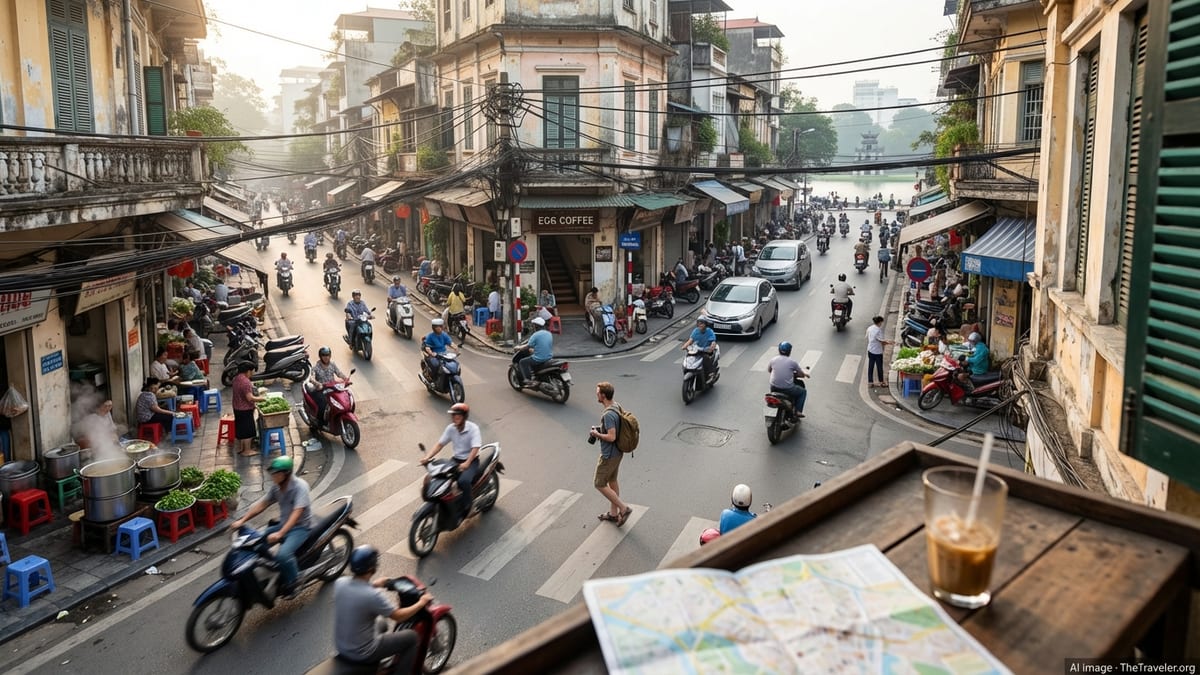
Arriving In Hanoi And My First Impression Of The Old Quarter
I stayed right in the Old Quarter because every guide made it sound like the obvious base for a short visit. It was the right call in terms of convenience, but also a bit of a shock to the system. The streets hit me immediately: dense traffic, motorbikes squeezing through every gap, tangled overhead wires, and sidewalks that were more like overflow space for shops, food stalls, and parked scooters than anything meant for pedestrians.
Crossing the street in Hanoi deserves its reputation. The first time I stepped off the curb I genuinely hesitated, waiting for a break in traffic that never came. Eventually I did what locals do: walk slowly and predictably so the swarm of bikes could flow around me. It worked, but I never quite relaxed about it. If you are nervous in chaotic traffic, the Old Quarter is not gentle. Still, there was an undeniable energy that I liked more than I expected, especially in the morning when the city was just warming up.
The Old Quarter itself is compact enough to explore on foot, at least in theory. In practice, the heat and humidity made even short distances feel longer, and I was grateful I had booked somewhere with decent air conditioning and a shower I could hop into mid-day. I quickly learned that “short walk” means something different when you are dodging scooters, jumping over puddles, and weaving between tiny plastic stools and people cooking on the pavement.
Hoan Kiem Lake And Ngoc Son Temple: Calm, But Not Quite As Serene As Advertised
I started early at Hoan Kiem Lake because everyone insists it is magical in the morning, and that part did live up to the hype. The lake itself is open all day and free, and around 6:30 to 7:30 a.m. it became one of the few genuinely gentle experiences in the city for me. Locals were walking or jogging, some groups were practicing tai chi, and there was enough space to breathe and just watch the rhythm of daily life. It felt like a communal outdoor living room.
I crossed The Huc Bridge to Ngoc Son Temple not long after opening. Current information puts the temple’s daily opening around 7 to 8 a.m. and closing late afternoon on weekdays, later into the evening on weekends, with an adult ticket costing only a small fee in Vietnamese dong. That part was straightforward: I bought my ticket at the small booth before the bridge and walked across the iconic red span. The temple itself, though, left me a bit conflicted. Architecturally, it is attractive and modest rather than grand, and the lake views are undeniably pretty. I appreciated the preserved giant turtle inside and the sense of history you get from the displays and altars.
But it was also more crowded and more commercialized than I had hoped, even earlier in the day. Groups clustered for photos on the bridge, selfie sticks everywhere, people jostling for the same angles. I had imagined a more meditative space based on what I had read, and while I could grab a few quiet moments at the edges, it felt more like a quick-stop attraction than a place to linger. If I am honest, I would still go inside on a first visit, but I would mentally file it as a short, expectedly touristy stop rather than a spiritual highlight.
Temple Of Literature: Beautiful, But Timing Matters
From the lake, I walked to the Temple of Literature. It is technically walkable from the Old Quarter, roughly two kilometers, but I underestimated how draining the combination of heat, humidity, and traffic would be. If I did it again, I would take a short Grab or taxi ride and save my energy for actually exploring the complex. The walk itself is not especially scenic and crossing major intersections did wear on my nerves.
The Temple of Literature is open daily, generally from around 7:30 or 8 a.m. until late afternoon, with a modest entrance fee at the gate. It remains one of the more organized and clearly signed attractions I visited in Hanoi, which I appreciated after the sensory overload of the Old Quarter. Inside, the series of courtyards, ponds, and pavilions felt like stepping into a different city entirely. The Constellation of Literature Pavilion is striking, and the stone steles with carved turtles are as atmospheric in person as they look in photos.
That said, my timing was not ideal. I arrived mid-morning, which turned out to coincide with multiple tour groups and a wave of local visitors. Several areas became congested with people posing for graduation photos in traditional outfits. It made for great people-watching and beautiful snapshots, but not for quiet reflection. I spent part of my time simply waiting for gaps in the crowds to take in the details. If I were advising my past self, I would either go right at opening time or closer to late afternoon to avoid the peak influx.
Despite the crowds, the Temple of Literature was one of the few places in Hanoi where I felt I had space to slow down and properly look at things. The signage about the history and the role of Confucian learning helped anchor the visit in something deeper than just “old buildings and nice courtyards.” It was one of the experiences that matched my expectations in a good way, just on the condition that you accept you will not have it to yourself.
Chasing Food And Coffee: Highlights And A Few Missteps
Lunch in Hanoi was when the city really started to win me over. I chose a small pho place in the Old Quarter that at first glance looked a little too rough around the edges. Plastic stools, steam rising into humid air, napkins scattered underfoot. But the bowl of broth that arrived in front of me was deep, clean, and fragrant. The beef was tender, the herbs fresh, and the whole thing cost less than a coffee back home. It is cliché to say food “tastes better there,” but it really did, even in such a basic setting.
Not all my food choices landed as well. I followed an online recommendation for a “must-try” bun cha spot that turned out to be clearly focused on tour groups. The staff were efficient but rushed, pushing set menus, and the flavors, while solid, felt muted compared with smaller places I tried later. It was not bad, but it did feel more like ticking a box than discovering something special. If you value atmosphere and authenticity, you have to be willing to ignore some of the “top 10” lists and just trust your eyes and nose on the street.
Coffee, on the other hand, rarely disappointed. I tried egg coffee in a tucked-away café up a narrow staircase and was surprised by how pleasant it was. I had braced for something overly sweet and gimmicky. Instead, it was more like a dense, warm dessert layered over strong coffee: rich but not cloying. Sitting by a second-floor window, watching the chaos below from a safe distance, was one of the few times I felt genuinely relaxed that day.
Water Puppet Show: Traditional, Charming, And Slightly Overrated
For the afternoon and early evening, I had pre-booked a ticket to a traditional water puppet show near Hoan Kiem Lake. The theater runs several shows daily, and tickets are not expensive, but I would still recommend buying ahead if you have only one day to play with; the timetable is fixed, and you do not want to waste your limited hours waiting for a later performance. The booking system is simple enough, but the pick-up at the venue was a bit chaotic, with groups clustering around the entrance and staff shouting instructions.
The show itself was charming and clearly crafted with tourists in mind. Short vignettes played out over a shallow pool, with brightly painted wooden puppets gliding on the water, accompanied by live traditional music and narration in Vietnamese, with basic translations on a screen. The first fifteen minutes felt genuinely magical, especially when I tried to imagine how impressive this must have been centuries ago.
By the halfway mark, however, I found my attention drifting. The skits started to feel repetitive, and the constant flashes from phones around me broke the spell. It is one of those experiences that I am glad I did once, mostly for the cultural context, but I would not go again or build a tight day around it. If you have kids, I can see it being a bigger hit; for me, it sat somewhere between meaningful tradition and carefully packaged tourist product.
Train Street: A Curious Mix Of Crackdown, Hype, And Awkwardness
No “perfect” Hanoi itinerary seems complete without mentioning Train Street, so I went, knowing the situation has been fluctuating in recent years. Officially, authorities have tried multiple times to restrict access on safety grounds, and as of my visit, parts of it were still subject to sudden closures or active monitoring. In practice, that meant the northern section near the Old Quarter was blocked by barriers and watched by guards, with clear no-trespassing signs and the promise of fines if you ignored them.
The southern section, however, closer to the other end of the tracks, was more relaxed, with cafés still operating along the rails. Staff from these cafés would intercept visitors and guide them in, emphasizing that you had to sit inside a venue if you wanted to stay. It felt like a semi-legal compromise between the authorities and local businesses who depend heavily on tourists. I ended up at a small café, ordered a drink, and waited for a scheduled train. The owners shared the timetable and made sure everyone stepped back at the right time.
Watching a train rumble past just meters from where I was sitting was undeniably thrilling, but I could not shake a sense of discomfort. It felt voyeuristic and a little contrived, like we were intruding on a space that was never meant to be a tourist backdrop. The tension between safety concerns and the lure of Instagram-friendly footage was palpable. If I am honest, if the area becomes more tightly restricted again, I would not urge anyone to go out of their way to experience it. It is interesting, yes, but Hanoi has plenty of other places where you can see daily life without feeling like you are part of a contested spectacle.
Night In The Old Quarter: Atmosphere, Exhaustion, And Sensory Overload
By evening, I looped back through the Old Quarter and around Hoan Kiem Lake again. On weekend nights, the streets surrounding the lake are turned into a pedestrian zone, and while the details can shift slightly, the general pattern is that the area becomes car-free and fills with families, street performers, and food sellers. It is one of the few times I felt I could walk without constantly scanning for incoming motorbikes, and that alone made it worth being there at night.
The atmosphere was lively rather than wild: kids playing games, couples wandering, live music drifting from different corners. I grabbed another snack from a street vendor and sat on a low stool facing the lake. It was one of the rare moments that matched the romanticized photos I had seen beforehand. At the same time, the crowds were thick, and by then I was tired enough that the noise began to grate a little. If you are sensitive to sensory overload, cramming all of this into one day will test your patience.
Back in the narrower streets of the Old Quarter, the evening trade was in full swing. Bars pushed happy hour deals, motorbikes still threaded through gaps where they technically should not fit, and a thin layer of exhaust hung in the air. I ended the night feeling both stimulated and drained. Hanoi after dark is not restful, at least not in this central area, and if I had planned a second full day of sightseeing starting early the next morning, I know I would have struggled.
What I Would Do Differently With One Day In Hanoi
Looking back on the day as a whole, I would not say I wasted time, but I did try to fit in too much. The main problem with most “perfect one-day itineraries” for Hanoi is that they treat the city like a sequence of checkboxes instead of a place you actually inhabit for a while. The walking distances add up, the heat is real, and the constant low-level alertness required to move through traffic is more tiring than it looks on a map.
If I were to plan the same day again, I would cut at least one major stop. For me, the water puppet show would be the first to go if time was tight. I would also be more strategic about transport, taking short rides between the Old Quarter, the Temple of Literature, and any other outlying spots rather than insisting on walking everything. The money saved by walking does not compensate for starting each visit already fatigued.
I would also slow the pace around food. Hanoi’s street food culture is one of its biggest strengths, but on a rushed itinerary it becomes something you shove in between attractions. Allowing time to actually sit and watch a vendor at work, asking a few questions if possible, or just lingering with a coffee away from the very busiest corners would add more to the overall experience than squeezing in one more minor temple.
The Takeaway
My one day in Hanoi was messy, noisy, occasionally frustrating, and yet still genuinely memorable. The city did not present itself as a polished backdrop for my photos, and some of the “must-sees” felt more curated for visitors than deeply authentic. Ngoc Son Temple was pretty but crowded, the water puppet show was charming yet repetitive, and Train Street hovered uncomfortably between local livelihood and tourist spectacle. Even Hoan Kiem Lake, lovely as it is, was rarely as tranquil as the pictures suggest outside the very early hours.
Despite that, there were moments that surprised me in a good way: the quiet discipline of morning tai chi around the lake, the hidden calm of certain corners inside the Temple of Literature, the impossible depth of flavor in a bowl of street-side pho, and the simple pleasure of egg coffee in a small, slightly worn café above the street. Those moments felt more real and more valuable than any perfectly staged itinerary highlight.
If you are the kind of traveler who needs order, wide sidewalks, and predictable quiet, Hanoi in a single day might feel like an onslaught rather than an introduction. You will probably leave more exhausted than enchanted. But if you are willing to accept some discomfort, embrace a certain amount of chaos, and not expect every stop to live up to its online reputation, one day in Hanoi can be a vivid, if incomplete, initiation into the city’s character.
Would I return and do it the same way? No. With hindsight, I would slow down, choose fewer sights, and prioritize atmosphere over a checklist. But I would return. For all its rough edges and contradictions, Hanoi left me curious, and that, more than a perfectly executed itinerary, is what makes a place worth coming back to.
FAQ
Q1. Is one day in Hanoi really enough for a first visit?
One day is enough to get a strong first impression and see a few key sights, but it is not enough to do the city justice. I managed the Old Quarter, Hoan Kiem Lake, Ngoc Son Temple, the Temple of Literature, a water puppet show, and Train Street, but it felt rushed. If you can spare at least two full days, the experience will be far more relaxed.
Q2. How early should I start my day to make the most of it?
I found that starting around 7 a.m. worked well. It let me see Hoan Kiem Lake while it was still relatively calm and cool, and gave me enough time to visit the Temple of Literature mid-morning and still fit in food, a show, and evening exploring. Starting later would have forced me to cut something or accept more time in the harshest heat and worst traffic.
Q3. Is it safe and practical to walk everywhere in Hanoi for a day?
It is physically possible but more draining than it sounds. The main issue is not distance but conditions: heavy traffic, narrow or blocked sidewalks, and heat. I did a lot of walking and ended up more tired and irritable than I expected. Next time, I would walk within the Old Quarter and around the lake, but use short taxi or Grab rides for anything more than 15 to 20 minutes on foot.
Q4. Are Hoan Kiem Lake and Ngoc Son Temple worth visiting?
Yes, with realistic expectations. The lake is a central landmark and a good orientation point, and the early morning atmosphere is genuinely special. Ngoc Son Temple adds some historical and cultural context, but it is small and often crowded. I would still go for a first visit, but I would not expect a serene spiritual escape.
Q5. How much time should I allow for the Temple of Literature?
I would set aside about 60 to 90 minutes. That gives you enough time to move through the courtyards, read some of the signage, and sit for a moment in a quieter corner. If you are very interested in history or architecture, you might stretch it to two hours, but anything less than an hour will feel rushed.
Q6. Is the water puppet show a must-do in a one-day Hanoi itinerary?
It depends on your priorities. I enjoyed it for the first half and appreciated the tradition behind it, but it did feel somewhat touristy and repetitive. If you have children or a strong interest in performance arts, it is worth including. If your time is tight and you prefer informal street experiences, you might skip it without much regret.
Q7. What is the current situation with Train Street for visitors?
Access to Train Street has been inconsistent due to safety concerns and enforcement. When I visited, the northern end near the Old Quarter was blocked by barriers and monitored, while the southern end had cafés operating with a kind of unofficial tolerance. I could visit only by sitting in one of these cafés and following their instructions when trains approached. Be prepared for sudden changes and accept that you might not be able to see it at all.
Q8. How did I handle food safely in just one day?
I stuck to busy places with high turnover and food cooked to order. Street food in Hanoi can look chaotic, but I had no issues. I avoided anything that had been sitting out too long in direct heat and chose stalls where locals were clearly eating. I also carried hand sanitizer and drank only bottled or filtered water.
Q9. What was the biggest challenge of doing so much in one day?
The constant combination of traffic, noise, and heat was the hardest part. Individually, each sight was manageable, but stringing them together meant I rarely had a mental break. By evening, I was overstimulated and tired. If you are not used to dense, hectic cities, build in more downtime than you think you need.
Q10. Who would I recommend a one-day Hanoi itinerary like this to?
I would recommend it to travelers who are curious, relatively resilient, and comfortable with urban chaos, and who understand that this will be a fast-paced overview, not a deep dive. If you need calm and comfort, or if you dislike crowds and traffic, you might prefer to slow down, see fewer places, and use your day just to explore the Old Quarter, Hoan Kiem Lake, and perhaps one major historical site rather than trying to do everything.