


More news on this day
Europe’s signature air passenger rights law, known as EU261, has survived another round of reform talks. Yet while the regulation remains largely intact on paper, disruption across the continent’s skies shows no sign of easing, raising questions about how much compensation rules can really do to fix Europe’s flight delay problem.
Get the latest news straight to your inbox!
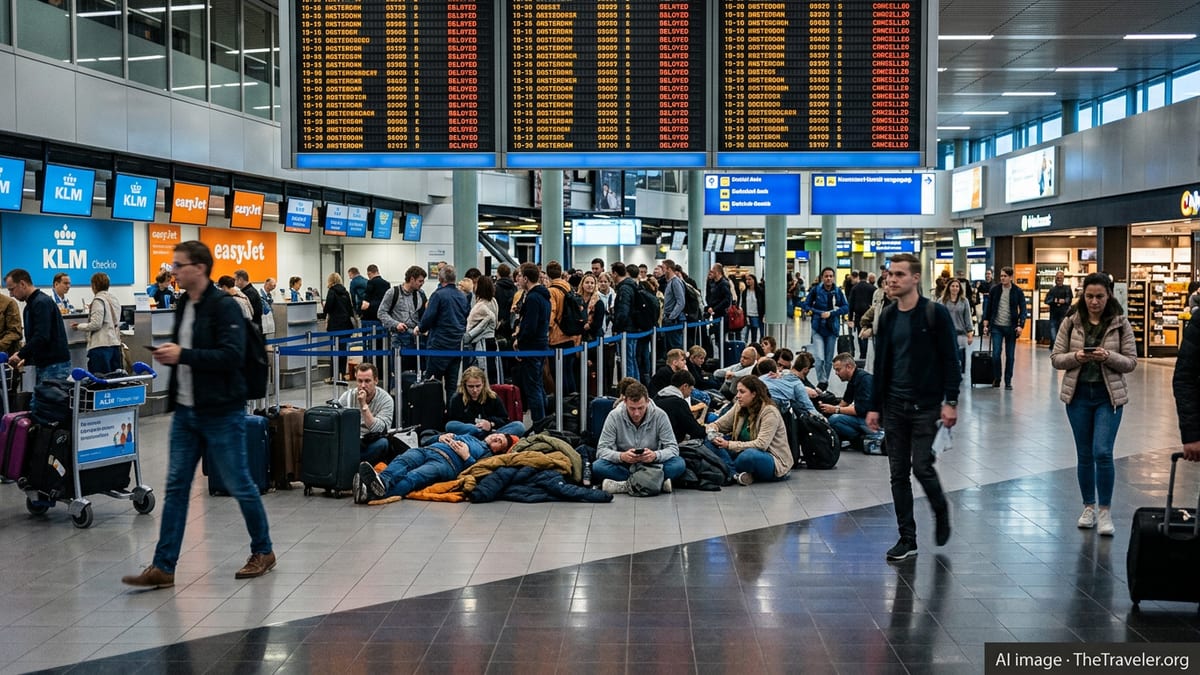
A Strong Law That Almost Changed
Regulation EC 261/2004, better known as EU261, has long been held up as the gold standard for air passenger protection. It grants travelers on eligible flights fixed cash compensation of up to 600 euros when they arrive three hours or more late in the absence of “extraordinary circumstances.” Court rulings over the past decade expanded these rights, confirming that long delays can be treated much like cancellations when it comes to compensation.
In recent years, however, airlines and several member states pushed hard to rewrite the rules. Proposals circulating in Brussels sought to raise the threshold for delay compensation well beyond the current three hours and to narrow the situations in which carriers must pay. Industry groups argued that EU261 created disproportionate costs and legal uncertainty, especially during the post‑pandemic recovery when operations were already under strain.
According to publicly available information on the legislative file, those efforts have run into a deadlock. The European Parliament has largely sided with consumer groups, favoring the existing three‑hour trigger and fixed compensation bands, while national governments have been less willing to endorse strong passenger‑first language. With no political consensus, the original structure of EU261 remains in force, even as calls to modernize it in areas such as digital claims and enforcement continue.
On paper, that outcome looks like a win for travelers: a powerful regulation survives largely unscathed. In practice, though, the standoff over reform has left deeper operational issues untouched, and flight delay statistics show that Europe’s punctuality problem has outgrown the legal framework designed to shield passengers from its worst effects.
Delays Climb Even As Traffic Recovers
Recent data from Eurocontrol, the intergovernmental air traffic manager for much of Europe, paints a stark picture of how disruption has rebounded along with demand. Reports on all‑causes delay show that in 2023 nearly three in ten flights arrived more than 15 minutes late, a higher share than in 2019 despite traffic volumes still only approaching pre‑pandemic levels. Average delay per flight hovered around 17 to 18 minutes, significantly above the performance seen a decade earlier.
The summer of 2024 was particularly problematic. Eurocontrol’s aviation trends analysis describes en‑route air traffic flow management delays per flight increasing by more than 50 percent compared with 2023, driven by constrained airspace, capacity bottlenecks and staffing pressures in key control centers. Weather played an outsized role as well, with reports indicating a sharp rise in convective storms and heat‑related disruptions that slowed traffic across large parts of the network.
By late 2024, a year‑in‑review briefing from the same organization concluded that Europe experienced record‑breaking delay levels comparable to the early 2000s, even though traffic growth remained moderate. Capacity‑related constraints and staffing issues at air navigation service providers were singled out as major contributors, alongside industrial action in some states and recurring bottlenecks at busy hubs.
Commercial research compiled by compensation and claims firms points in the same direction. One analysis of 2024 disruption estimated that roughly 1.5 percent of all departures from airports across the European Union, European Economic Area and the United Kingdom were either canceled or delayed by more than three hours, representing hundreds of thousands of flights and billions of euros in potential compensation exposure for airlines each year.
When Compensation Is Not a Cure
The mismatch between strong passenger rights on paper and stubbornly high disruption levels raises a basic question: what is EU261 actually fixing? The regulation was designed to deter poor operational planning by making certain delays expensive, and to provide redress when journeys go badly wrong. It was never intended to expand runways, train air traffic controllers or end strikes.
Today’s delay patterns reflect systemic stresses that compensation cannot easily reach. En‑route airspace capacity in Europe is limited by a patchwork of national providers, restricted zones related to geopolitical conflicts and slow progress on the long‑planned Single European Sky initiative. Weather‑related delays are becoming more frequent and severe as hotter summers bring more storms and heatwaves that force traffic restrictions. These factors routinely trigger knock‑on disruptions far beyond the airline that eventually pays compensation.
At the same time, EU261’s design leaves significant gray areas. Carriers can avoid paying when they demonstrate “extraordinary circumstances,” a term interpreted by courts but still contested in practice. Disputes are common over whether a given delay stems from controllable technical or staffing issues on the one hand, or air traffic control restrictions and severe weather on the other. For travelers, the result is a patchwork of outcomes even when journeys are similarly disrupted.
Consumer‑rights groups argue that the combination of systemic constraints and contentious exemptions means EU261 functions more as a safety net than a true incentive to improve reliability. Airlines, for their part, warn that ever‑increasing delays tied to infrastructure and airspace limitations shift a growing share of costs onto carriers for problems they say they cannot fully control.
Enforcement Gaps and Uneven Awareness
Another weakness exposed by recent disruption seasons is enforcement. While the regulation is harmonized at the EU level, national enforcement bodies retain primary responsibility for overseeing compliance. Their resources and approaches vary, and published commentary from legal experts notes that passengers in some countries face lengthy processes or must pursue claims through courts or arbitration when airlines refuse to pay.
Parallel data from a 2024 Eurobarometer survey on passenger rights suggests that many travelers still do not know when EU261 applies. Only a minority of respondents reported being aware of their rights as air passengers, even though a significant share had experienced delays or cancellations during the previous 12 months. For airlines, that lack of awareness can reduce the effective cost of disruption, since a portion of eligible travelers never file claims.
The enforcement patchwork also creates uncertainty for carriers operating across multiple jurisdictions. Some national authorities are perceived as stricter than others in interpreting what counts as an extraordinary circumstance or adequate care and assistance. Inconsistent rulings risk encouraging “forum shopping,” where persistent passengers or specialist claims firms target venues seen as more favorable, while many individual travelers simply give up.
Efforts to streamline enforcement through digital tools have moved more quickly in other transport modes. Recent EU measures for rail, for example, introduced standard claim forms and simplified reimbursement procedures. Similar modernization for air travel has lagged behind the broader political fight over compensation thresholds and airline liability.
Why the Delay Crisis Outlived the Reform Battle
The collapse of efforts to significantly rewrite EU261 means Europe will continue relying on a robust but aging passenger‑rights tool to manage an increasingly complex aviation system. From a consumer perspective, preserving the three‑hour compensation rule and fixed payment levels is valuable. Yet recent summers have made clear that generous after‑the‑fact payments do little to prevent missed weddings, lost cruise departures or ruined holidays when the network itself is unstable.
Addressing that instability will require decisions far beyond the scope of EU261. Eurocontrol’s own assessments highlight the need for sustained investment in air traffic control staffing and technology, more resilient capacity planning and better coordination across borders in periods of convective weather or military airspace restrictions. National policy choices over airport expansion, curfews and environmental constraints also shape how easily traffic can be accommodated when demand spikes.
Meanwhile, travelers are responding in their own ways. Some are building longer connection buffers into itineraries, avoiding chronically congested hubs at peak times or relying more on rail where high‑speed alternatives exist. Others are turning to specialist claim services that maximize payouts under EU261 but do nothing to reduce the likelihood of the next disruption. The net effect is a system in which rights are strong, but reliability remains fragile.
For now, Europe’s flight delay problem has outlived the most recent political battle over passenger compensation. EU261 survived reform, but the structural causes of disruption are still very much in the air.