


More news on this day
A train driver is believed to have died and several passengers have been reported injured after two passenger services collided near Bedford, triggering a large emergency response and severe disruption across a key rail corridor into London.
Get the latest news straight to your inbox!
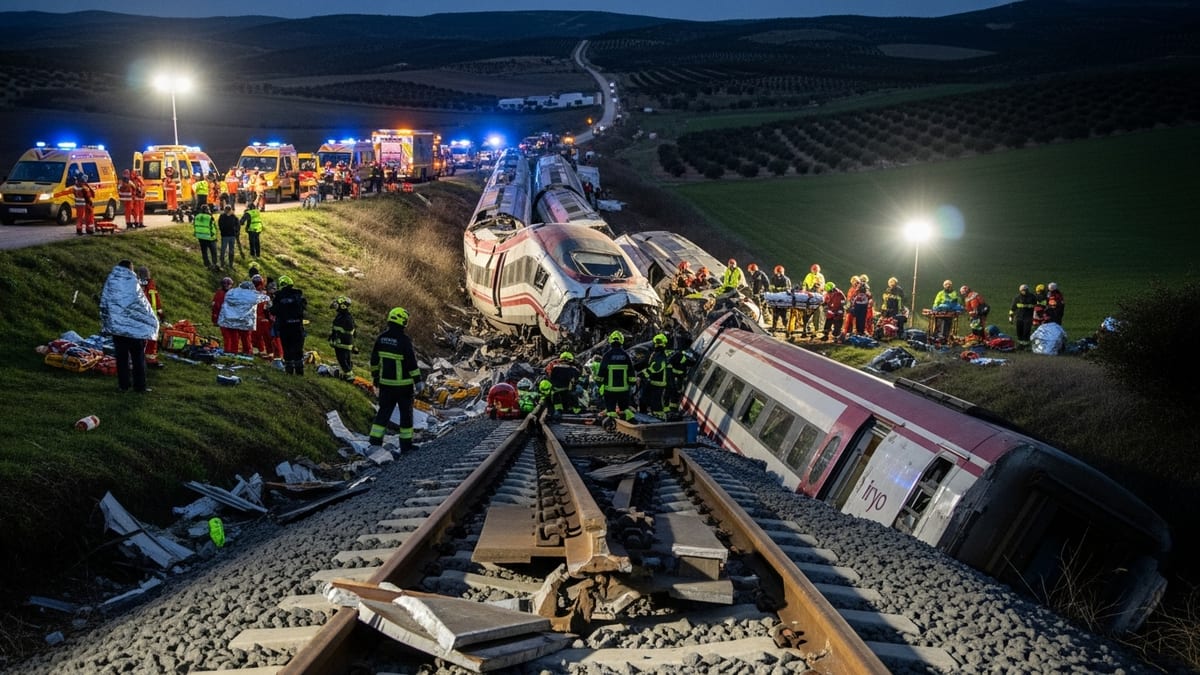
Collision on busy commuter route near Bedford
Published accounts describe the crash occurring on a section of track just south of Bedford on a main route serving London St Pancras. Two passenger services operating on the Midland Main Line were involved, with one train reportedly running from Corby and another from Nottingham, both bound for the capital on Friday afternoon.
Coverage in national and regional outlets indicates that one of the trains came to a halt before being struck in the rear by the second service. Early descriptions suggest that a significant impact occurred at the front of one unit, causing extensive deformation in the driver’s cab area and leaving coaches visibly damaged.
Images shared on social media and referenced in news reports show one train standing on the track with its nose section crumpled, while a second set of carriages appears to be in close proximity on the same line. Passengers reported a sudden jolt, flying debris and immediate darkness in some carriages as internal power briefly failed.
The incident took place on a line that carries heavy commuter and intercity traffic into London, resulting in an almost instant halt to services through the area and stranding passengers on trains backed up along the route.
Driver believed dead as investigators begin work
Initial reporting from major newsrooms states that one person has been confirmed dead, with multiple accounts specifying that the victim is believed to be the driver of one of the trains involved. The condition of the second driver has not been clearly detailed in the early coverage available.
Rail accident specialists and police investigators are expected to concentrate on the circumstances that left one train apparently stationary on the line when it was hit by another passenger service. Industry-focused commentary notes that investigators will examine onboard data recorders, signalling logs and any trackside systems that may have played a role in the sequence of events.
Some technical coverage highlights suggestions that a safety system known as Automatic Warning System may have been involved, with one train reportedly coming to a stop after a possible fault or activation. Analysts commenting publicly have stressed that such indications are preliminary and that official findings typically take months to be completed and released.
The serious damage to the leading cab of one train has prompted concern within the rail community about forces endured by the driving crew and whether crash energy management features performed as designed. Comparisons are already being drawn with previous low-speed rail collisions in Britain where drivers suffered serious injuries despite relatively modest impact speeds.
Major incident declared and overnight disruption expected
Reports from the scene describe a large-scale mobilization of emergency services, with fire and rescue crews, ambulances and police units attending the crash site. A major incident was declared shortly after the collision, allowing additional medical and logistical resources to be directed to the area.
Passengers on board have reported being instructed to remain in their seats immediately after the impact while staff assessed damage and checked for injuries. Some accounts mention controlled evacuations along the track once the area was made safe, with travellers guided to a nearby access point for onward transport.
Rail operators have advised that all lines in the vicinity of Bedford were initially blocked while recovery and investigation work continued. Services between the East Midlands and London St Pancras faced severe disruption, with cancellations, diversions and extended journey times expected well into the evening and potentially into the following day.
Travellers on connecting regional lines were also affected, as operators adjusted timetables and re-routed trains around the affected section. At key London and regional hubs, passengers were advised to check departure boards and seek alternative routes where possible.
Passengers describe sudden impact and confusion
Accounts shared by passengers and summarized in media coverage convey scenes of shock and confusion in the immediate aftermath of the collision. Individuals described being thrown forward in their seats as the train lurched, with luggage falling from overhead racks and windows briefly obscured by dust and debris.
Several passengers reported that interior lighting flickered or briefly went out, before emergency systems activated and staff moved through the carriages checking for injuries. Early descriptions suggest that most of the injuries reported so far have been the result of falls and impacts with seats or fittings, though the full picture of casualties remains incomplete.
Travellers also described lengthy waits on board as emergency crews worked outside the train, with some carriages positioned in areas that were difficult to access from nearby roads. Those evacuated along the track spoke of walking past damaged sections of the train and seeing the extent of the impact at the front.
Despite the disruption and distress, many accounts highlight calm behaviour among passengers, with individuals assisting each other with luggage, offering water and supporting those who appeared particularly shaken by the crash.
Safety record under scrutiny after rare collision
The Bedford collision has quickly focused attention on Britain’s rail safety record, which is often cited in public data as one of the strongest in Europe for passenger rail. Serious train-to-train collisions are considered rare events, particularly on mainline routes that are heavily equipped with modern signalling and automatic protection systems.
Commentary from rail specialists and transport analysts notes that any incident involving a likely fatality, particularly of a train driver, is treated as a major test of existing safety layers. Investigators are expected to consider whether signalling, train protection technology, driver procedures or rolling stock design contributed to the outcome or mitigated what might otherwise have been a more severe disaster.
Public discussion has also turned to recent reports into other rail incidents in the United Kingdom, with observers drawing parallels and asking whether previous safety recommendations were fully implemented. The Bedford crash is likely to prompt detailed technical reviews and may lead to renewed debate about investment priorities across the national network.
For now, rail users along the Midland Main Line face ongoing disruption while specialists document the scene, remove the damaged trains and assess track and signalling infrastructure. A fuller understanding of what happened near Bedford is expected to emerge over the coming weeks as official investigations progress and detailed findings are made public.