


More news on this day
More than 1,469 flights were delayed and at least 91 were canceled across the United States during a fresh wave of travel disruptions, as a mix of severe weather, staffing constraints and recent technology outages continued to strain the nation’s summer air travel system, according to flight-tracking and aviation data reports.
Get the latest news straight to your inbox!
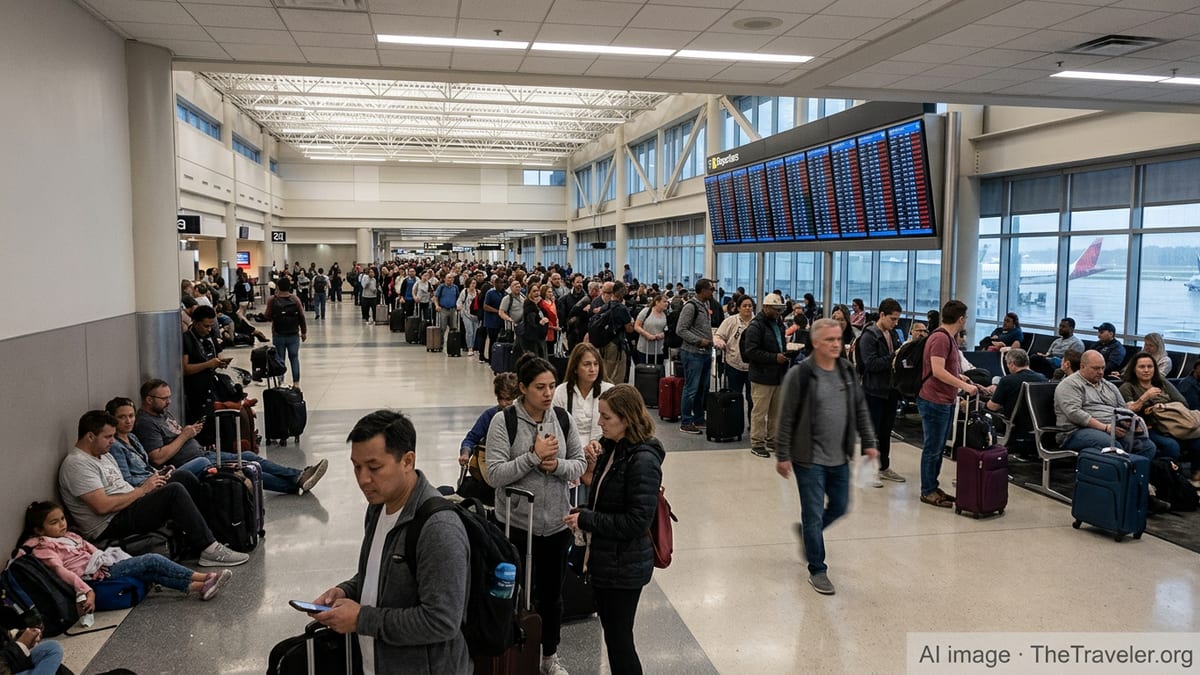
Flight delays ripple across major U.S. hubs
Publicly available data from flight-tracking services indicate that the latest disruption affected travelers nationwide, with more than 1,469 flights arriving or departing late and at least 91 canceled across U.S. airports. The figures reflect a pattern of elevated operational strain that has persisted through the summer peak, rather than a single isolated incident.
Recent coverage shows that large hubs such as Chicago O’Hare, Denver, Atlanta and New York area airports have repeatedly appeared among the most disrupted facilities on heavy travel days, often registering dozens of late departures and cancellations in a single afternoon. On one recent day, for example, published reports noted that Chicago O’Hare led the nation by number of delayed and canceled flights, while a separate storm system in the Northeast was linked to hundreds of additional schedule changes across the network.
FAA air traffic planning summaries point to recurring bottlenecks at a handful of high-volume airports, where demand is close to or above pre-pandemic levels and where even modest slowdowns can quickly cascade into nationwide delays. As airlines operate fuller schedules with tighter aircraft and crew rotations, the system has become more vulnerable to shocks such as pop-up thunderstorms or short-lived ground stops.
The cumulative effect for travelers is a landscape in which a single day with more than 1,000 delayed flights, once considered notable, now occurs with increasing regularity during peak periods, particularly on Thursdays, Fridays and Sundays when leisure and business demand intersect.
Weather, staffing and technology combine to snarl operations
Weather remains the most visible driver of disruption, with the FAA’s daily air traffic reports frequently highlighting thunderstorms, low clouds and strong winds in key regions. In recent weeks, storms around major hubs in Florida, the Midwest and the Northeast have resulted in ground delays, reroutes and airborne holding, all of which reduce the system’s capacity and push departure times back for hours.
Staffing constraints within air traffic control facilities and ground operations have added another layer of complexity. Reports from Denver earlier this month, for example, described high winds and staffing challenges contributing to ground delays, with outbound flights from the contiguous United States experiencing average waits of more than two hours at the height of the disruption. Separate industry analyses have noted that some busy East Coast facilities remain below targeted staffing levels, limiting the ability to absorb surges in traffic.
Technology issues have also played a notable role this summer. A recent information-technology outage affecting American Airlines prompted a brief nationwide halt to departures for the carrier and its regional affiliates, leading to more than 1,000 delays and over 200 cancellations in a single day, based on FlightAware data cited in financial news reporting. While operations resumed later that evening, the scheduling ripple effects lasted well into the following day as aircraft and crews were repositioned.
Taken together, these weather, staffing and technology factors increase the likelihood that a normal afternoon of peak demand can tip into a day where well over a thousand flights arrive or depart late, with dozens or more completely scrubbed from the schedule.
Recent incidents underscore fragile summer travel system
The latest count of more than 1,469 delays and 91 cancellations fits into a broader sequence of incidents that have exposed the fragility of the current summer travel environment. Earlier this month, a temporary outage at a major air traffic control facility serving Minnesota and surrounding Midwestern states led to planes being held on the ground or diverted across a wide swath of airspace, according to national broadcast coverage. While the issue was resolved, the episode demonstrated how a single technical fault at a key facility can disrupt traffic across multiple states.
In the Northeast, a slow-moving storm system recently produced hundreds of cancellations and thousands of delays over the course of a day, with travel-news and technology outlets reporting that more than 700 flights were canceled nationwide by midday. Travelers also reported difficulty relying on airline mobile apps for accurate, real-time status information as departure times shifted repeatedly or reverted without clear notifications.
Separately, a labor dispute involving Canadian carrier WestJet over the Civic Holiday weekend in early August led to hundreds of cancellations affecting U.S.-bound and transborder flights. Regional coverage and airline statements indicated that nearly 500 flights were canceled in a single day and roughly a quarter of a million trips were disrupted as the carrier’s operations were gradually restored. While this particular dispute centered on a non-U.S. airline, its impact was felt at several American airports that handle cross-border traffic.
These events, layered on top of the day-to-day summer congestion at large domestic hubs, help explain why total delay and cancellation figures can rise quickly even when there is no single headline-grabbing nationwide shutdown.
What the data show about long-running disruption trends
Longer-term government statistics place the latest day of 1,469 delays and 91 cancellations within a trend of elevated disruption that began as air travel rebounded after the height of the pandemic. Department of Transportation and Bureau of Transportation Statistics data for recent years show millions of domestic flights arriving at least 15 minutes late annually and hundreds of thousands of cancellations, with performance in several months rivaling or exceeding previous records from the mid-2000s.
Congressional and regulatory analyses reviewing this data have cited factors including aggressive scheduling by airlines, limited slack in crew and aircraft availability, and ongoing hiring and training needs for air traffic controllers. Hearing documents and proposed rulemakings note that sustained multi-day disruption events, in which carriers cancel large shares of their schedules over several consecutive days, have become more common as demand has surged.
FAA operational dashboards and performance tools, while often used by industry professionals, are increasingly referenced in public reporting to contextualize daily delay numbers. These tools break down disruptions by cause categories such as weather, volume and equipment issues, illustrating that most large-scale days feature a combination rather than a single trigger.
The picture that emerges is of a system operating close to its limits during the busiest travel weeks, where modest shocks push large numbers of flights into delayed status and where full recovery can take days, especially when aircraft and crews end up out of position across far-flung networks.
What travelers can do as disruptions continue
Consumer advocates and travel experts cited in recent coverage recommend that passengers treat high summer travel days as inherently disruption-prone, particularly when flying through major hubs in the Midwest and Northeast or during late afternoon and evening hours. Booking earlier departures, allowing longer connection times and avoiding tight same-day commitments are recurring suggestions aimed at reducing the impact of unexpected delays.
Publicly available guidance from the Department of Transportation emphasizes that passengers are generally entitled to a refund when a flight is canceled and the traveler chooses not to proceed, even on nonrefundable tickets. New and proposed rules in recent years have also sought to clarify refund obligations in cases of significant delays, while encouraging airlines to clearly publish their own policies on meals, hotel vouchers and rebooking assistance during irregular operations.
Travelers are also encouraged to monitor multiple sources for real-time information, including airline apps, airport displays and FAA air traffic updates, especially when storms or ground delays are affecting key hubs. Because disruption patterns can shift quickly, particularly with summer thunderstorms, a flight that appears on time in the morning can face substantial knock-on delays by afternoon if earlier banks of traffic are affected.
With the summer season not yet over, industry data suggest that days with more than 1,000 delays and dozens of cancellations are likely to recur. Passengers who build additional flexibility into their plans, stay informed and understand their rights may be better positioned to navigate an environment where large-scale disruptions have become a recurring feature of U.S. air travel.
FlightAware flight status and delay data