


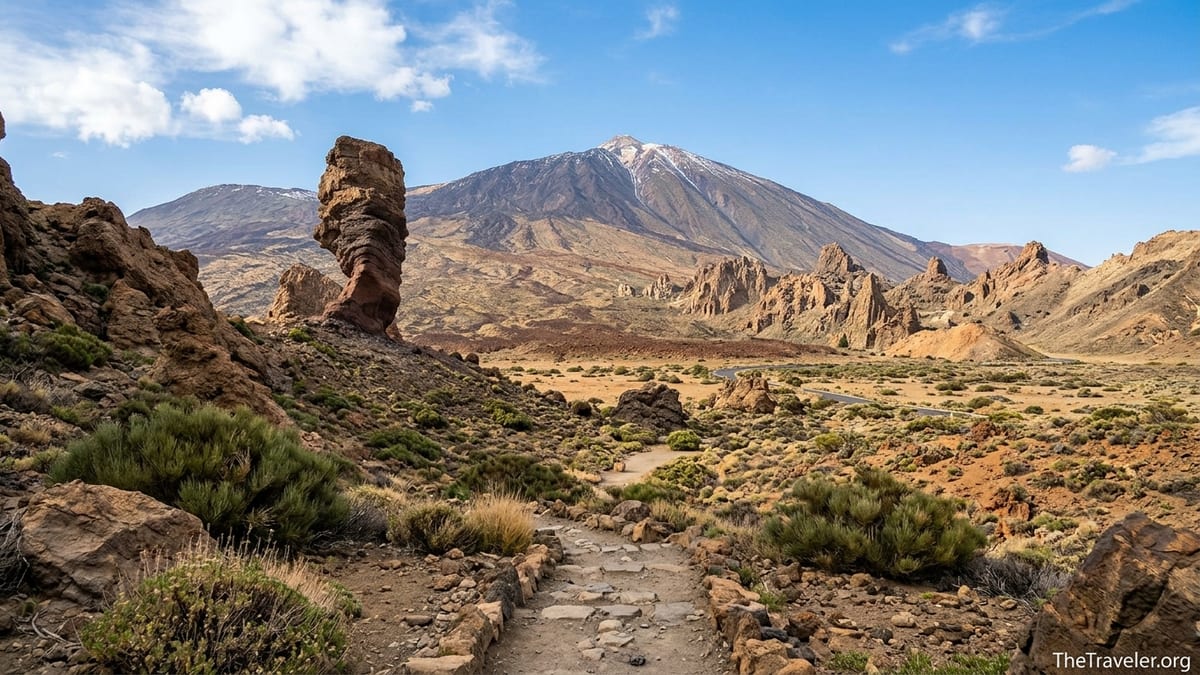
Roques de García is one of the most recognisable landscapes in Teide National Park, and for many visitors it ends up being the classic “this is Teide” experience. A serrated line of volcanic rock towers, including Roque Cinchado, El Burro, El Torrotito, Roques Blancos and La Catedral, rises from the floor of the Las Cañadas caldera at around 2,100 metres above sea level. The formations sit directly opposite the Parador de Cañadas del Teide and the Mirador de La Ruleta viewpoint on road TF‑21, offering easy access, signature postcard views and a short but rewarding loop hike suitable for most casual to moderately experienced walkers.
Get the latest updates straight to your inbox!
What and where is Roques de García
Roques de García is a compact group of eroded volcanic plugs and lava formations standing in a line on the southern edge of the Teide caldera. The best known of these is Roque Cinchado, a narrow column with a bulbous top that often appears in Tenerife postcards. Nearby are other named towers such as El Burro, El Torrotito, Roques Blancos and the larger mass of La Catedral, all formed by complex volcanic and erosive processes over hundreds of thousands of years.
The rocks sit on the floor of Las Cañadas, the wide depression that surrounds the central Teide–Pico Viejo volcanic complex. Elevation here is roughly 2,050 to 2,150 metres, which means cooler temperatures, stronger sun and noticeably thinner air than on the coast. Directly opposite the rocks, across the TF‑21 road, you will find the Mirador de La Ruleta viewpoint and, a short distance away, the Parador de Cañadas del Teide hotel and visitor services.
For a first‑time visitor to Tenerife, Roques de García offers a concentrated version of the park: views of Mount Teide’s cone, the broad Ucanca plain, the cliffs of Guajara and the secondary volcano Pico Viejo, all accessible within a short walk from the car or bus stop. The site combines a fully accessible viewpoint section with a marked loop trail, so mixed‑ability groups can still share part of the experience.
This combination of dramatic scenery, relatively gentle walking and straightforward access from both the north and south coasts explains why Roques de García is one of the busiest corners of Teide National Park. Planning your timing, transport and expectations in advance will help you avoid congestion and make the most of the landscape.
Who Roques de García is best suited for
Roques de García works particularly well for first‑time visitors who want to see Teide’s high‑altitude scenery without committing to a long or technical hike. The main loop, signed as trail PNT‑03, is about 3.5 to 3.6 kilometres long with roughly 175 to 200 metres of total elevation gain. Fit walkers with some experience on rocky paths will find it straightforward, while occasional hikers may simply need to take the final ascent slowly.
Families with school‑age children often enjoy the loop because it offers constant visual interest and varied terrain without being excessively long. Parents should however be prepared for strong sun, cool wind and some uneven volcanic rock underfoot. Younger children or those not used to walking may prefer to explore only the first, almost flat section and the viewpoint, rather than attempting the entire circuit.
Photographers are very well served here. From the Mirador de La Ruleta you get a classic alignment of Roque Cinchado in the foreground and Teide rising behind. Along the loop you can frame Pico Viejo, the Ucanca plain and the dramatic walls of Guajara. Light is generally softer and colours warmer around the first and last hours of daylight, while the high midday sun can feel harsh both for images and for comfort.
Visitors sensitive to altitude or strong sun should approach with some caution. At around 2,100 metres, some people notice mild shortness of breath or light fatigue on climbs, particularly in the final section of the loop. Those with known cardiovascular or respiratory issues should consult a medical professional before planning strenuous activity at altitude and may prefer to enjoy the short accessible section and viewpoint only.
How to get to Roques de García
Roques de García lies beside the TF‑21, the main road that crosses Teide National Park. From the south coast resorts around Costa Adeje and Playa de las Américas, drivers typically reach the area via the TF‑1 motorway and then climb inland on secondary roads that join the TF‑21 near Vilaflor. Depending on your exact starting point and traffic, the drive usually takes around 1 hour 15 minutes to 1 hour 45 minutes. The final section involves sustained climbing on a winding mountain road, so allow extra time if you are not used to driving on bends.
From the north, most visitors start in Puerto de la Cruz or Santa Cruz / La Laguna and follow roads that climb through La Orotava to join the TF‑21. From Puerto de la Cruz, the journey to the Parador and Roques de García typically takes around 1 hour 30 to 1 hour 45 minutes, again on a winding but well maintained road. From La Laguna or Santa Cruz, timing is often similar or a little longer, depending on the chosen route and traffic in the urban areas.
There is a large free parking area accessed by a side road near kilometre 46 of the TF‑21, signposted for Mirador de La Ruleta and close to the Parador. Spaces include some reserved for visitors with reduced mobility. In practice, this car park fills quickly on fine days, especially between mid‑morning and mid‑afternoon and on weekends or holidays. In recent years the authorities have discussed and tested various parking management measures inside Teide National Park, and future reservation or restriction systems are possible. Before you travel, check the latest information from official Teide National Park and island transport channels to see whether parking rules or any booking requirements have changed.
For those using public transport, regional operator Titsa runs bus routes that serve Teide National Park, including line 348 from Puerto de la Cruz via La Orotava and line 342 from Costa Adeje. These usually stop at or near the Parador and Roques de García. Timetables, operating days and seasonal adjustments can change, and services may be suspended temporarily during adverse weather or road works. At the time of writing, for example, official notices have shown temporary relocations of the “Parador del Teide” stop to Roques de García during construction, and occasional suspensions of lines 342, 348 and 341 during storms. Anyone relying on buses should consult the most recent timetables and service updates directly from Titsa shortly before their visit.
Key on site experiences
The signature experience at Roques de García is the circular PNT‑03 trail, a loop that starts and ends at Mirador de La Ruleta. From the viewpoint, the path initially follows a wide, almost level track passing close to Roque Cinchado and other formations, before descending gradually towards the Llano de Ucanca plain. It then curves behind the rocks, passing below cliffs and lava flows, and finally climbs back up the flank of La Catedral to regain the starting level. Most visitors take around 2 hours to complete the circuit at a relaxed pace without extended photo sessions; keen photographers or those taking frequent breaks should plan for 2.5 to 3 hours.
Technically, the loop is considered easy to medium difficulty. The surface includes compacted earth, loose volcanic gravel and rock steps, and the elevation gain, while moderate on paper, comes mostly in the latter part of the hike. This final ascent can feel noticeably more demanding at altitude, especially under strong sun or wind. Anyone with knee issues may also find the initial descent section requires attention. Sturdy footwear, a basic level of fitness and a realistic pace make the trail accessible to a wide range of walkers.
For visitors unable or unwilling to tackle the full circuit, there is a short, accessible section starting at Mirador de La Ruleta and heading towards the first rock formations. This path is roughly 200 to 210 metres long, built with an easy gradient and a smooth surface designed for wheelchair users and those with reduced mobility. It provides an up close view of the rocks and wide panoramas of Teide and Pico Viejo without any significant climbing.
Some travellers simply stop at Mirador de La Ruleta for a quick taste of the scenery. From the viewpoint terrace you can look east towards the Ucanca plain, south towards Guajara, and north to the Teide cone. If you are driving across the park and short on time, this is a practical place to step out, walk a few minutes along the accessible path and capture the classic images of Roque Cinchado with Teide behind, all in well under an hour.
Scenery, viewpoints and what you will see
One of the main reasons Roques de García appeals to such a broad audience is the density of viewpoints in a small area. From the accessible path, Teide’s symmetrical cone dominates the skyline to the north, often capped with snow in winter. Slightly to the west you can pick out Pico Viejo, the lower but still substantial volcano with a broad summit crater that once produced significant lava flows.
Looking south from the loop trail, the cliffs and slopes of Guajara frame the edge of the caldera. Hikers with binoculars or a keen eye can sometimes make out the path of the separate Guajara summit trail high above. Below, the wide expanse of the Llano de Ucanca plain spreads out in rusty and ochre tones, particularly striking in the low light of morning or evening.
As you progress around the PNT‑03 circuit, the angle on the rock towers shifts continuously. Early on you walk just below Roque Cinchado, observing the contrast between its narrow base and top heavy cap. Further along, you gain better views of La Catedral and the lava cascades behind it, as well as of the extensive lava fields to the west. The loop therefore rewards those who take their time to look in all directions rather than only towards Teide.
Photographers should be mindful that the high elevation and clean air produce sharp contrasts and deep blue skies but can also create harsh shadows around midday. A visit timed for early morning or late afternoon not only improves comfort in terms of temperature and crowds but also often yields more balanced light. Night sky photography is also exceptional in this area, but after dark visits require careful planning, warm clothing and close attention to park regulations on parking and overnight presence.
Seasonality, weather and trail conditions
Although Teide National Park enjoys generally stable weather, conditions at 2,000 metres bear little resemblance to those on the coast. Even in summer, early mornings and evenings can feel cool, especially in the wind. In winter, temperatures around Roques de García regularly drop close to or below freezing, and snowfall is not uncommon. After significant snow or ice, authorities may partially or fully close roads and hiking trails for safety, including the PNT‑03 circuit.
Strong sun is a constant factor year round. The high elevation and often clear skies mean ultraviolet exposure is intense even on days that feel breezy or cool. Sunburn and dehydration are common risks for unprepared visitors who have driven up directly from sea level. Wind can also be stronger than expected, particularly along exposed sections of the loop and at the Mirador.
Occasionally, adverse weather systems can lead to temporary suspension of bus services into the park and temporary closures of particular roads or facilities. Storm events in recent years have prompted operators to suspend lines such as 342 and 348 to Teide National Park for periods until conditions improved. Before any visit, check up to date park alerts, road information and bus operator notices rather than assuming that both the TF‑21 road and the Roques de García loop will be open.
The volcanic terrain itself can be dusty and slippery when dry, and muddy or icy in cold, wet spells. Rockfalls are relatively rare on the established trail but still a natural possibility, which is one reason the park authorities insist that visitors remain on marked paths and respect warning signs. Sturdy footwear with good grip and a walking pace adapted to conditions will significantly reduce the risk of slips or minor injuries.
What to bring and park rules to respect
Even though the Roques de García loop is short, treating it as a proper mountain walk makes the experience more comfortable and safer. The essentials are sturdy walking shoes or hiking boots, layered clothing to adapt to temperature and wind, sun protection in the form of high factor sunscreen, sunglasses and a hat, and enough water for the duration of your visit. There are no water fountains or natural sources along the route, and services at the Parador, while useful, should not be relied on as your only supply.
A light windproof or thermal layer is advisable in all seasons, as conditions can change quickly and shaded sections feel considerably cooler than sun exposed slopes. Simple snacks are useful for maintaining energy on the climb back to the Mirador. Hiking poles are not mandatory but some walkers appreciate them on the descent and final ascent, particularly if knees or balance are a concern.
Teide National Park has clear rules intended to protect its fragile volcanic and high mountain environment. Visitors must stay on marked trails and should not shortcut bends or trample vegetation at the path margins. Collecting rocks, plants or any natural or archaeological material is prohibited, as is leaving litter, marking or painting rocks, lighting fires or camping outside authorised areas. Vehicles must remain on public roads and designated parking areas, and commercial activities require authorisation.
Regulations and visitor management measures continue to evolve, especially as authorities respond to growing visitor numbers and environmental pressures. Before your trip, review the most recent official guidance for Teide National Park, including any new rules related to hiking, parking, guided groups or night visits. Following these guidelines not only avoids fines but also helps preserve the landscapes that make Roques de García so compelling.
Fitting Roques de García into a Teide day
For many travellers, Roques de García forms one key stop on a full day exploring Teide National Park. If your priority is a scenic drive with short walks, you could combine a 30 to 60 minute visit to Mirador de La Ruleta and the accessible path with other roadside viewpoints such as Minas de San José or other miradores along the TF‑21. In this case, your time commitment at Roques de García is modest, and the main planning considerations are parking availability and bus schedules if you are using public transport.
If you intend to complete the full PNT‑03 loop, it is realistic to treat Roques de García as a half‑day activity. Allow around 2 to 3 hours for the hike itself, plus additional time for rest, photography and a possible break at the Parador or other viewpoints. For visitors travelling from the coast, this usually means a long but manageable day with several hours spent in the high mountain environment and similar time spent on the road.
The site also combines logically with a visit to the Teide cable car, which lies a short drive away on the same road. Some visitors choose to ride the cable car in the morning, when winds tend to be lighter and operations more reliable, then continue to Roques de García for the loop hike and late afternoon views. Others reverse the order, hiking first and scheduling the cable car for later, but here you need to pay close attention to ticket times and potential weather related closures.
Whatever itinerary you choose, build in flexibility for changing weather and potential traffic or parking bottlenecks. Starting early in the day or visiting outside peak holiday periods often results in a quieter experience on the trail and at the viewpoints, which in turn makes the landscape feel more impressive and less crowded.
Is Roques de García the right Teide experience for you
Roques de García is an excellent choice if your main goal is to enjoy Teide’s high mountain scenery rather than to summit the volcano. It offers a concentrated mix of volcanic formations, broad caldera views and striking perspectives of Teide and Pico Viejo in a package that fits comfortably into half a day. There is no permit required for the loop, access is free, and you can tailor the experience anywhere from a brief viewpoint stop to a two or three hour hike.
If you are a casual hiker, travelling with a family, or visiting Tenerife for a short beach‑based holiday and want to add a single high‑altitude outing, Roques de García is often the most practical option. The altitude is noticeable but generally manageable for healthy visitors, and there is an accessible section for those who prefer a minimal walking option. Costs are limited mainly to transport, parking if applicable and any food or drink purchased at the Parador or along the way.
On the other hand, if you are an experienced mountain walker looking for a longer and more strenuous day, or if you strongly value summit experiences, you may wish to combine Roques de García with other hikes or activities. Options include the Guajara trail, longer routes across the caldera floor, or the Teide summit route, which requires separate permits or guided arrangements for the upper section. In such cases, Roques de García becomes one highlight among several rather than the main objective.
Ultimately, whether Roques de García should be your primary Teide stop comes down to your available time, fitness level and expectations. For many first‑time visitors, its combination of access, scenery and moderate effort makes it the single best value experience in the park. Others will see it as a scenic addition to a fuller programme of hikes and high‑altitude activities. With realistic planning and respect for the conditions, it is hard to leave Roques de García without a strong sense of what makes Teide National Park unique.