


Teide National Park looks close on the map, but the crater rim sits at around 2,000 metres and every access road winds steeply up from the coast. Working out how to get there from Tenerife’s resorts is not always obvious, especially if you do not plan to rent a car. This guide explains the main driving routes, the limited but useful public buses, and the range of tours and excursions, so you can choose the option that fits your budget, schedule and comfort level behind the wheel.
Get the latest updates straight to your inbox!
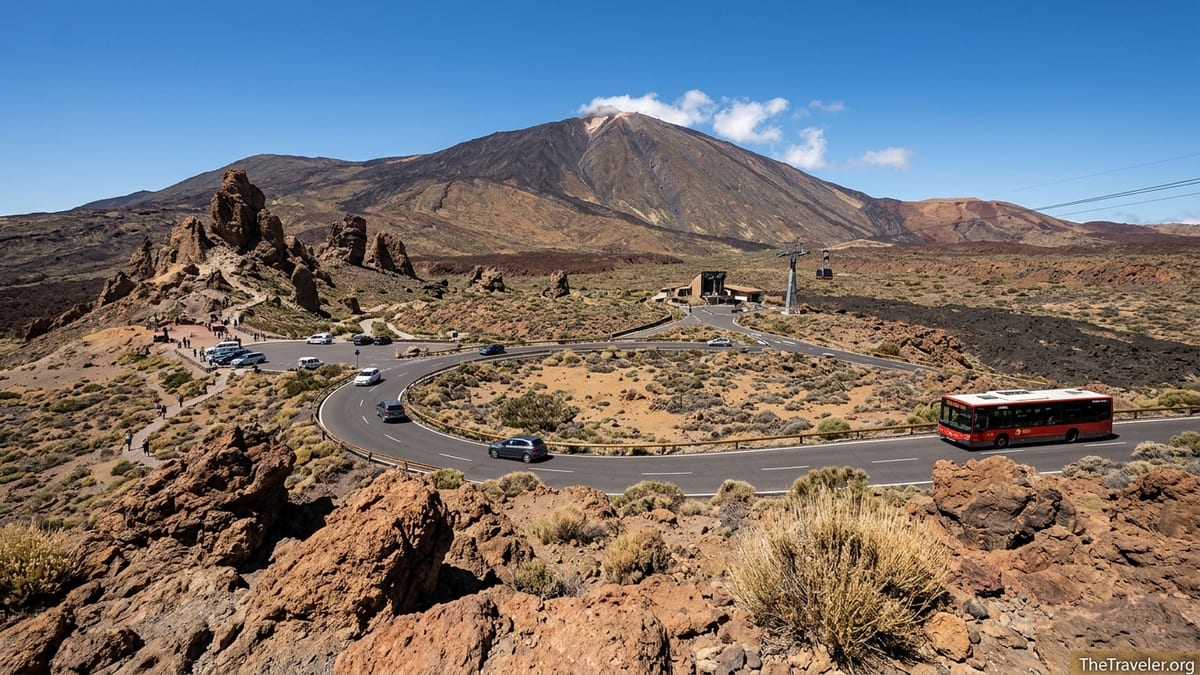
Understanding the Layout of Teide National Park
Teide National Park occupies the high volcanic plateau known as Las Cañadas, with the cone of Teide rising above it. Most visitors arrive at around 2,000 metres on the crater floor, then explore viewpoints, short trails and the Teide cable car base station. The distances inside the park are not huge, but the altitude, lack of shade and exposure to weather mean you need to plan your transport carefully.
Four main mountain roads climb into the park from different sides of Tenerife. From the south, the classic route comes up via Arona, Vilaflor and then into Las Cañadas. From the north, roads climb via La Laguna and La Esperanza, or via La Orotava and El Portillo. From the west, a scenic but curvier approach runs up from Santiago del Teide, eventually joining the southern side of Las Cañadas. All of them are paved, signposted and suitable for normal rental cars in good conditions, but they are narrow and sinuous in places.
The most popular stopping points are the Teide cable car base station, the Parador and Roques de García area, and the El Portillo visitor centre on the northern rim. Public buses and many tours stop at some or all of these, while drivers can pull into numerous miradores along the crater road. There are no petrol stations on the high plateau and very limited services, so you should treat Las Cañadas as a destination rather than a place to refuel or shop.
Weather and access can change quickly at altitude. Winter and spring can bring ice and snow closures on sections of road, strong winds can suspend cable car operations, and the authorities sometimes restrict access or parking during high-risk periods. Before setting out, especially in winter or after bad weather, check same-day updates from the island authorities, the national park and road information services.
Reaching Teide by Car: Main Driving Routes
Most visitors still reach Teide National Park by car, whether in a rental vehicle or on a self-drive excursion. This offers maximum freedom to stop at viewpoints, adjust to changing weather and stay for sunset or stargazing. It also means taking full responsibility for mountain driving, fuel management and timing the descent safely.
From the south coast resorts around Costa Adeje, Playa de las Américas and Los Cristianos, the usual approach heads inland via Arona and Vilaflor. After leaving the motorway and built-up areas, the road climbs steadily through pine forest, with a mix of long curves and tighter bends. As you approach 2,000 metres, the trees thin and the landscape opens suddenly onto the pale pumice and lava fields of Las Cañadas. In light traffic you might expect around an hour and a half of driving for the ascent, but this can be longer in peak holiday periods or if you make multiple photo stops.
From the metropolitan area of Santa Cruz and La Laguna, there are two main options. The road via La Esperanza is one of the most beautiful approaches, rising through dense Canary pine forest and offering broad views over the north-east coast and, on clear days, over the sea to other islands. It is a classic mountain drive with numerous curves but a steady gradient. The alternative is to head west towards La Orotava and then climb into the park via El Portillo, which is generally a little more direct if your aim is the El Portillo visitor centre or the northern side of Las Cañadas.
From Puerto de la Cruz and other north-west towns, drivers typically climb through La Orotava towards El Portillo. The road starts in suburban streets, then becomes more rural and forested as it gains altitude. Expect a continuous series of bends, moderate gradients and regular places to pull over. From the west around Santiago del Teide and the coastal resorts near Los Gigantes, a narrower, more twisting road climbs to join the southern flank of the crater. This approach rewards confident drivers with dramatic views down to the western cliffs and across to La Gomera on clear days.
Driving Conditions, Parking and Safety on the Mountain Roads
All paved park access roads are two-way and can feel narrow compared with motorways or urban dual carriageways. There are barriers along exposed sections, but drivers should expect tight curves, changing light under tree cover and occasional patches of loose debris after bad weather. Overtaking is limited and local drivers who know the route may travel faster than visitors. It is better to pull into a lay-by to let faster vehicles pass than to feel pressured into driving beyond your comfort level.
Parking is concentrated at a few nodes: the Teide cable car base station, the Parador and Roques de García area, and the El Portillo visitor centre. Spaces at the cable car are particularly sought after from late morning through mid-afternoon. On busy days drivers report the main car park filling by late morning, especially in peak holiday seasons and on clear winter days when the summit may be snow-capped. There is currently no island-wide reservation system for these general car parks, but local authorities have discussed and piloted various visitor management measures in recent years, and you should check for any new controls or pilot schemes before you travel.
Mountain driving demands mechanical sympathy and attention on the way down as well as up. Use low gears on descents rather than riding the brakes, especially after sunset when temperatures drop and you may be tired. Fog can form suddenly on some forested stretches, particularly on the northern slopes, and visibility can be sharply reduced. Build in time for extra caution on the way back, and avoid planning a tight late-night airport dash immediately after a long high-altitude day.
There are no petrol stations inside Teide National Park. The nearest fuel points depend on your approach: around the south coast they are found in and around Costa Adeje, Los Cristianos and along the TF-1 motorway; in the north they are in Santa Cruz, La Laguna, La Orotava and Puerto de la Cruz; in the west they are near Santiago del Teide and the coastal resorts. Fill up near your resort or at the last large town before the climb so fuel is not a concern at altitude. Tenerife enforces drink-driving laws strictly, and controls sometimes take place on or near the access roads. If you plan to enjoy wine or other alcohol, arrange for a sober driver or choose a tour instead of self-drive.
Public Buses to Teide: TITSA Lines 342 and 348
For visitors without a car, public buses provide an affordable way to reach Teide, although services are limited and require careful planning. The island company TITSA operates two key routes that climb into the park: line 342 from the main south coast resorts and line 348 from the north. Both connect coastal bus stations with stops inside Teide National Park, including the cable car area and viewpoints around Las Cañadas.
Line 342 currently runs from Costa Adeje bus station through Playa de las Américas, Los Cristianos, Arona and Vilaflor before entering the park. Scheduled departure from Costa Adeje is in mid-morning, stopping at or near the main south coast hubs, then reaching the park around late morning. The same bus returns to the south in mid-afternoon, stopping at the cable car base, the Parador area and El Portillo before descending. Timetables available at the time of writing describe this as a once-daily service in each direction, operating every day, but travellers should always confirm exact departure times and any seasonal changes on the official TITSA channels just before their trip.
Line 348 serves the northern side, running from Puerto de la Cruz bus station via La Orotava up to El Portillo and then on to the cable car and Parador areas. As with line 342, information available in late 2026 indicates a single morning bus up and one afternoon bus down on normal days, though precise times and intermediate stops are subject to periodic adjustment. Both routes are described by local tourist offices as daily services, but public holidays or adverse conditions can affect operations, so it is essential to check the current timetable rather than relying on an old leaflet or second-hand advice.
Buses to Teide are generally reliable and comparatively inexpensive, making them attractive for independent travellers on a budget. However, they are not suitable for very early starts, late-night returns or highly flexible itineraries. With only one bus up and one bus down most days, you must build your entire visit around those fixed times. If you miss the return bus, you may need to pay for a long taxi ride down the mountain, and availability of taxis at high altitude cannot always be guaranteed. At the time of writing, tourist information materials highlight that fares for the Teide lines are typically paid in cash on board; this policy can change, so confirm current payment options in advance and carry small notes and coins just in case.
Tours and Excursions: From Coach Tours to Stargazing Trips
Organised tours remove almost all logistical stress: operators arrange the vehicle, driver, timing and usually cable car or observatory arrangements, while you focus on the scenery. A wide range of commercial offers link Teide with resort hotels, including half-day sightseeing coach tours, full-day island circuits with Teide as a highlight, sunset and stargazing trips, and combinations that include the Teide cable car or the Teide Observatory. Prices and exact itineraries vary by operator and season, but examples from reputable providers show that simple coach excursions can start from a relatively modest per-person price, while small-group or private experiences cost more.
Large-coach tours are the most common and budget-friendly. They typically pick up guests from multiple hotels around Costa Adeje, Playa de las Américas, Los Cristianos and, in some cases, from Puerto de la Cruz in the north. After consolidating the group, the coach ascends to the park, stopping at headline viewpoints such as the cable car base and Roques de García, and may include an optional or pre-booked cable car ride. Commentary is often delivered over the bus loudspeaker in two or three languages, and free time at each stop is limited but structured.
Smaller-group tours use minibuses or vans and cater to travellers who prefer fewer people, more interaction with the guide and sometimes access to quieter corners of the park. Some focus on photography, geology or hiking, while others build the day around a sunset viewpoint followed by stargazing with telescopes and an astronomy guide. These tours can include dinner at a rural restaurant or at the Parador area, and many provide warm jackets or blankets for night-time temperatures, which can be close to freezing even when the coast is mild.
Several operators bundle transport with Teide cable car tickets or summit permit arrangements, removing the need for visitors to handle separate bookings. Others partner with the Teide Observatory to offer daytime or sunset visits combined with park sightseeing. Because availability on the cable car, observatory and summit routes can change with weather and official rules, tours sometimes adjust routes or substitute viewpoints at short notice. When comparing offers, pay attention to what is actually included in the advertised price, which languages the guide will use, total time spent in the park and whether hotel pick-up is from your specific resort or from a central meeting point.
Practical Logistics Inside the Park
Whether you arrive by car, bus or tour, your day in Teide National Park will revolve around a handful of access nodes. Drivers typically park at the cable car base station, the Parador and Roques de García parking areas or the El Portillo visitor centre, then explore nearby viewpoints and short trails on foot. Those travelling by public bus will be dropped off at signed stops near the same locations and can walk short distances to trailheads and viewpoints. Surfaces are mostly paved or compacted volcanic gravel, but the altitude makes even gentle slopes feel more demanding.
There is currently no dense internal shuttle network inside the park. On some timetables and maps you may see references to short internal bus connections along the crater road, but as of late 2026 these services operate very infrequently or as limited extensions of the main lines. In practice, most visitors move around either in their own vehicle, on foot, or as part of a tour bus that shuttles them from one stop to another. If you plan to walk between points, keep in mind that distances that look close on a map can involve exposed stretches with little shade, and you should carry water, sun protection and layers for changing temperatures.
Official management plans for the park allow for temporary restrictions or controls in response to crowding, weather or conservation needs. In recent years the island authorities have also introduced specific reservation and fee schemes for certain high-demand walking routes near the summit and for the cable car. These systems are designed to limit numbers on the most fragile paths and to spread visits more evenly across the day. Rules, prices and booking platforms can change, so you should always consult the latest information from the park and the Teide cable car operator before committing to a schedule.
Food and services in Las Cañadas are limited to a small number of cafés, restaurants and visitor facilities around the Parador, cable car base and El Portillo. There are toilets at key nodes, but not at every roadside mirador. Mobile coverage is variable and can drop out between ridges, especially on less built-up stretches of the approach roads. It is wise to download offline maps for navigation and to let someone know your route and approximate return time if you plan to hike away from the road network.
South Resorts: Best Options from Costa Adeje, Las Américas and Los Cristianos
For visitors staying in the large south coast resort strip between Costa Adeje and Los Cristianos, all three main transport options work well, and your choice will depend mainly on budget and driving confidence. Driving up via Arona and Vilaflor gives the greatest freedom to stop at viewpoints, schedule a late descent after sunset and combine Teide with other sights such as the pine forests or neighbouring villages. Expect a full-day outing even if the driving time itself is only a couple of hours each way, because you will want to allow for frequent photo stops and rest breaks at altitude.
Those without a car can take TITSA line 342 from Costa Adeje bus station or intermediate stops in Playa de las Américas and Los Cristianos. The mid-morning departure and mid-afternoon return mean this option is ideal for a relaxed middle-of-the-day visit that includes some walking around Las Cañadas and, potentially, a ride on the cable car if timings fit the operating schedule. It is less suitable if you want to be on the first cable car up or to stay out for sunset and stargazing, because public transport back to the coast does not run in the evening.
Resort-based tours are plentiful in the south. Large-coach excursions offer the lowest per-person prices and systematic hotel pick-ups, while small-group or premium tours cater to guests willing to pay more for flexibility and quieter viewpoints. For families or travellers who dislike mountain driving, these tours can be the simplest solution: you are collected at or near your hotel, taken to several park highlights with commentary and returned to the resort in time for dinner. For those keen on night skies, dedicated sunset and stargazing tours from the south often include hotel pick-up, warm clothing, telescopes, and a planned stop on the way down for a late meal.
North Resorts and Santa Cruz / La Laguna: Best Options from the North
Visitors based in Puerto de la Cruz, La Orotava and other northern resorts can reach Teide by driving up via El Portillo or by taking TITSA line 348. Driving gives you the flexibility to choose between the La Esperanza route, which starts near La Laguna and offers broad coastal views, and the more direct La Orotava climb to El Portillo. Both routes have continuous curves and altitude gain, so plan for an unhurried ascent and multiple viewpoint stops rather than a fast dash to the crater floor.
From Puerto de la Cruz, line 348 is the key public bus to Teide. It usually leaves the main bus station in the morning, passes through La Orotava and arrives at El Portillo and Las Cañadas late morning, then returns in the afternoon. As with line 342, the latest timetables show essentially one departure up and one back most days, and seats are first-come, first-served. Travellers who want to be sure of boarding often arrive at the station a little early, especially in holiday periods, and carry cash for the fare.
From Santa Cruz and La Laguna, there is no direct public bus into the park at the time of writing, so visitors generally connect via Puerto de la Cruz or the south for the Teide lines. In practice, many independent travellers staying in the metropolitan area prefer to rent a car for the day or join an organised excursion that includes pick-up from central hotels or designated meeting points. Several tour companies advertise departures from Santa Cruz, La Laguna and Puerto de la Cruz, combining Teide with other northern highlights such as La Orotava or traditional villages.
If you plan to link a Teide visit from the north with a cable car reservation or a summit permit, allow extra margin in your schedule in case of delays. Buses can be slowed by traffic in coastal towns, and the mountain roads may require cautious driving in poor weather. When using public transport, avoid booking non-refundable cable car or observatory slots too close to the theoretical arrival time of the bus; give yourself a comfortable buffer for ticketing, queuing and possible timetable shifts.
Choosing the Right Option for Your Trip
Teide National Park is accessible from every main resort area on Tenerife, but each mode of transport suits a different type of traveller. Self-drive works best for those who are confident on mountain roads, happy to navigate curves and altitude, and keen to stop often, explore short trails and perhaps stay after sunset. It is also the only realistic way to reach certain early-morning trailheads or to link Teide with remote viewpoints in a single long day. The trade-offs are the need to manage fuel, parking, changing weather and a careful night-time descent.
Public buses provide an economical and low-impact alternative, particularly appealing to solo travellers or couples without a hire car. They deliver you directly into the heart of the park and allow enough time for a cable car ride and a short walk on the crater floor, but their rigid schedules and once-daily frequency mean you must plan your day around them. Missing the return bus can be costly and stressful, so this option suits travellers who are punctual, comfortable limiting their time frame and do not need to stay for sunset.
Tours and excursions are ideal for visitors who prefer a guided experience, do not want to drive or are travelling with family members who might find independent logistics tiring. Cheaper large-coach tours prioritise value and convenience, while small-group and specialist experiences emphasise comfort, in-depth interpretation and access to astronomy or observatory activities. Prices and availability vary widely with season, so it is sensible to compare a few reputable providers and read recent descriptions of what each tour actually includes.
Whichever option you choose, success on Teide depends on preparation. Leave resorts early to avoid traffic and midday heat, carry layers for the abrupt temperature change at altitude, drink plenty of water and allow extra time if you have fixed reservations for the cable car or summit routes. Check the latest information on road conditions, park advisories, bus timetables and any current access controls before you leave. With realistic expectations and a transport plan that matches your budget and comfort level, reaching Teide National Park from Tenerife’s resorts becomes a memorable journey rather than a logistical headache.