


Palma de Mallorca Airport is the main gateway to Mallorca and the starting point for thousands of holidays in Alcúdia every week. The resort sits on the northeast coast, about 60 kilometers from the airport, so choosing how you travel that last stretch can shape the start and end of your trip. This guide walks you through the main options from the terminal to Alcúdia: Aerotib/TIB buses, taxis, private transfers and rental cars, with a clear focus on travel time, luggage, and what works best for families.
Get the latest updates straight to your inbox!
Understanding the Route: Palma Airport to Alcúdia
Palma de Mallorca Airport, also known as Son Sant Joan, lies about 8 kilometers east of Palma city and roughly 60 kilometers from Alcúdia on the Ma-13 motorway. In normal conditions it is about a 45- to 55-minute drive from the terminal to Alcúdia’s main hotel areas such as Port d’Alcúdia and Platja d’Alcúdia. In high summer, especially on Saturday changeover days, that can stretch to around 1 hour 15 minutes due to traffic and airport congestion.
Most routes to Alcúdia follow the same basic pattern. Whether you are in a taxi, an Aerotib airport bus or a rental car, you will join the Ma-19 from the airport, skirt Palma, then connect with the Ma-13 northbound towards Inca, Sa Pobla and finally Alcúdia. This means there are no mountain roads or tight village streets to worry about. It is a straightforward highway-style run, which is reassuring for less confident drivers and families with tired children after an early flight.
Because Alcúdia is one of Mallorca’s biggest family resorts, transport services on this corridor have been steadily reinforced. The island’s interurban operator, TIB, now runs dedicated airport routes that continue all the way to Alcúdia and beyond, while taxis and private transfer companies treat it as a standard, high-demand run. The result is a route with plenty of choice across comfort levels and budgets, from under 10 euros per person on the bus to a private door-to-door ride for a family of five.
When deciding what suits you, think about more than just headline travel time. Consider your arrival time, how much luggage and equipment you have, whether anyone in your group struggles with steps or crowding on buses, and how important it is to be dropped exactly at your hotel door. For a couple with two backpacks arriving at midday, the bus is straightforward. For a family of four with two big suitcases, a stroller and a travel cot landing at 22:00, a pre-booked transfer or taxi will likely feel worth the extra cost.
Aerotib/TIB Buses: Direct and Budget-Friendly
The main public transport option between Palma Airport and Alcúdia is the Aerotib airport bus, operated by TIB, the island’s interurban bus network. Depending on the exact date, the line is branded either A33 or A32, but in both cases it is a direct service between the airport and the Alcúdia area, continuing along the bay to Playa de Muro and Can Picafort in the main summer season. Crucially for visitors, the authorities have extended these airport routes so they now run year-round, not just in summer.
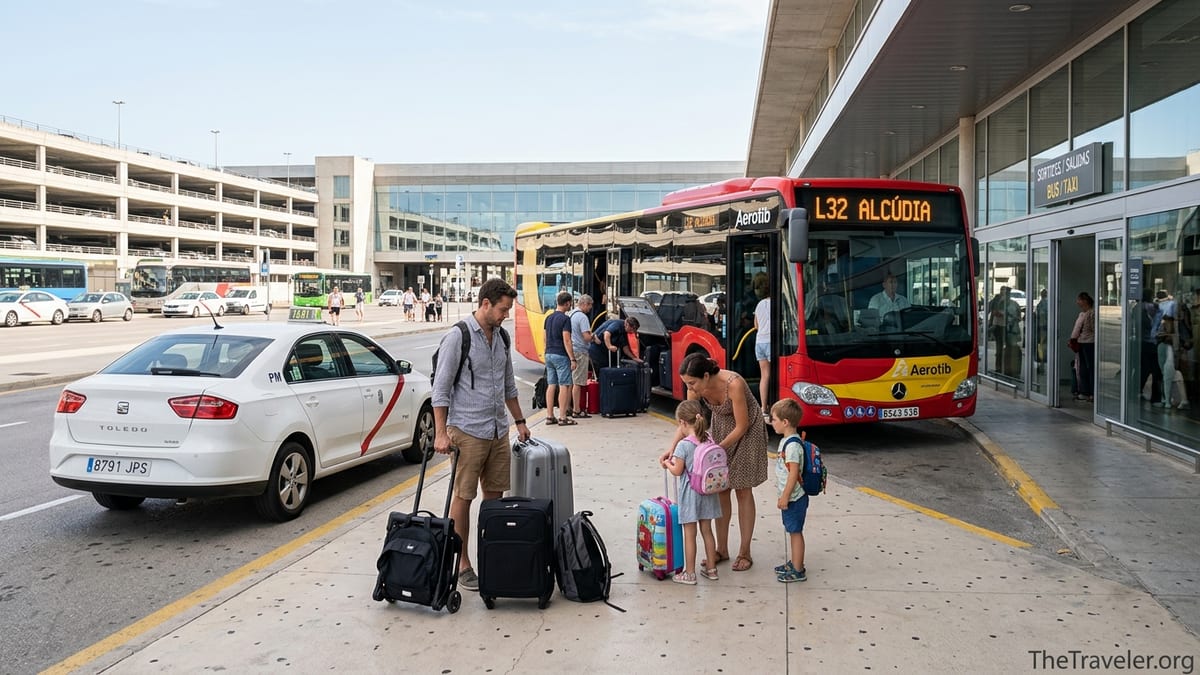
From a practical perspective, the Aerotib stop at Palma Airport is on the ground level outside the terminal, close to the multi-storey car park. When you exit arrivals, you follow the signs for buses, then look for the red-and-yellow TIB coaches displaying the airport line number and destination on the front. The same stop area is used by other resort buses, so always double-check that your coach is headed for Port d’Alcúdia or the A32/A33 line shown for your travel date.
Fares are designed to be competitive for visitors. Although exact prices change periodically, adults typically pay a modest per-person fare that is far below a taxi for solo travelers and couples. Payment is normally contactless bank card on board, and children under a certain age may travel free or at a reduced rate; rules are updated from time to time, so it is wise to check the latest information on the airport or TIB sites just before you fly. As a real-world example, a couple arriving mid-morning in June with hand luggage only could expect to pay a total bus fare that is less than one third of the cost of taking a taxi to Alcúdia at daytime rates.
Travel time by Aerotib between Palma Airport and central Alcúdia is broadly similar to a car journey, usually around 60 to 75 minutes, depending on traffic and how many intermediate stops the bus serves along the bay. In the core summer timetable there are more departures spread across the day, often with morning and evening peaks that suit typical flight waves. Outside of high season, the frequency is lower, so you might wait 30 to 60 minutes for the next departure. For early-morning flights out of Palma or very late arrivals, you should confirm whether a bus is running at your exact time; several travelers report that the last airport bus towards Alcúdia tends to depart shortly after midnight, which can be tight for delayed flights.
Using the Aerotib/TIB Buses With Kids and Luggage
Families can and do use the airport bus to reach Alcúdia, but it requires a bit more planning than hopping in a taxi. The Aerotib coaches are modern intercity buses with underfloor luggage holds and overhead racks. Large suitcases and baby gear such as travel cots usually go underneath; smaller bags can be brought on board. If you are traveling with a stroller, staff will generally expect it to be folded before it goes into the hold, so it helps to have one person free to handle children while another folds and loads.
On board, there are standard forward-facing seats with seatbelts. These are not dedicated child seats, but many parents choose to buckle toddlers in directly, especially for a short highway ride. Others bring compact travel booster seats that can be used on both the bus and in taxis. Infants can sit on a lap, though some families prefer to keep them in a soft carrier to make it easier to get on and off quickly. As a practical example, a family of four with a three-year-old and a one-year-old arriving around 15:00 might board the A32, store two large suitcases and a folded stroller in the hold, and sit together near the front so they are close to the driver and the exit for getting off in Port d’Alcúdia.
During peak season daytime runs, buses can be busy with other holidaymakers and local commuters, so it is wise to move quickly when boarding and to keep smaller children close on the platform. If the bus is almost full, the driver may limit the number of passengers for safety reasons; in that case, families with young kids often appreciate having a fallback option, such as knowing where the taxi rank is or being willing to wait for the next departure. For late flights, when the airport is quieter, the bus can be a more relaxed way to begin your holiday, and children often fall asleep in their seats as soon as the highway section begins.
One important detail is that Aerotib buses are designed for direct travel between the airport and resort areas, not for hopping between nearby stops. That means you cannot use them, for example, just to travel from one beach in Alcúdia Bay to another. They are, however, excellent for a clean, cost-effective airport run if your hotel is near one of the designated stops. Many beachfront hotels on the main strip in Port d’Alcúdia and Playa de Muro are within a short walk of an A32 stop, so you might only need to roll your suitcase for two or three minutes along flat pavements.
Taxis from Palma Airport to Alcúdia
For many families, especially with young children or bulky luggage, a taxi direct from Palma Airport to Alcúdia is the simplest option. The official taxi rank is directly outside the arrivals area on the ground floor. You join the queue, and airport marshals help match parties to taxis in order. Vehicles are usually standard sedans and estate cars, with some larger minivans appearing during busy periods.
Journey time is similar to a private car, often 45 to 55 minutes outside the busiest hours. In summer afternoon traffic or on Saturdays it can be longer, but you are still likely to arrive at your hotel within an hour and a quarter of leaving the terminal. Recent traveler reports suggest that a daytime taxi fare from the airport to Alcúdia typically lands in the roughly 75 to 80 euro range, depending on exact location in the resort and any waiting time. Late-night or very early morning services attract higher tariffs, with some visitors quoting around 90 euros after midnight.
Taxi pricing is metered, and there are supplements for trips beginning or ending at the airport, plus night and weekend surcharges. You can usually pay by card, though it is sensible to confirm with the driver before setting off. If you have a lot of luggage, note that the standard taxi fleet can accommodate two large cases and a couple of smaller bags without issue, but a family carrying multiple large suitcases, a double stroller and a travel cot might be more comfortable in a larger vehicle. At the rank you can request a bigger taxi, though at peak times you may need to wait longer.
One key consideration for families is child seats. Local taxis are not guaranteed to carry child seats as standard. Some drivers may have a basic booster or infant seat, but this is not something you can rely on for safety-critical planning. Many parents choose to bring their own compact travel seat from home, either in checked luggage or as a separate item. Others pre-book a private transfer with specific child seats reserved. If you intend to simply walk to the taxi rank on arrival with a toddler, be prepared either to seat the child using the vehicle’s seatbelt system, carry a small portable seat, or accept that you may need to wait longer for a taxi that can meet your needs.
Private Transfers: Door-to-Door with Child Seats
Private transfers sit between taxis and car rental in terms of cost and convenience. You book in advance with a specialist company or through your tour operator, and a driver waits for you in the arrivals hall holding a sign with your name. Vehicles range from standard cars to spacious minibuses, making them popular with extended families or groups of friends who prefer to travel together without navigating public transport.
Pricing varies by provider and season, but as a typical example, a pre-booked one-way transfer for a family of four from Palma Airport to a hotel near Alcúdia’s Port area might cost somewhat more than a metered daytime taxi, with a modest premium for guaranteed child seats and direct hotel drop-off. Larger family groups of six to eight often find that a private minivan transfer works out similar per person to the Aerotib bus, once you factor in individual fares, but with the major advantage of door-to-door convenience.
One of the main benefits of a private transfer for families is the ability to pre-arrange child seats. Many transfer companies explicitly list infant seats, toddler seats and boosters as options when you book. Some include them in the fare, others charge a small supplement per seat per journey. For example, a couple traveling with a one-year-old and a four-year-old can pre-book two age-appropriate seats and arrive knowing that their children will be properly secured from the airport all the way to their hotel in Platja d’Alcúdia without carrying bulky equipment.
Another advantage is predictability on arrival. After a long flight, particularly with early starts from the UK, Germany or Scandinavia, some families dread the idea of hunting for the right bus or waiting in line at the taxi rank. With a private transfer, you walk out of customs, meet your driver, and are guided straight to your vehicle in the airport car park. The time saved is not always huge in minutes, but in terms of stress reduction it can make the start of your holiday feel more relaxed, especially if you are juggling tired children and several pieces of luggage.
Driving Yourself: Rental Car from Palma Airport
Renting a car at Palma de Mallorca Airport can be attractive if you plan to explore beyond Alcúdia during your stay. The drive to the resort is relatively straightforward, with good signage and mostly dual carriageway. The airport has a cluster of rental car desks inside the terminal and in the adjacent car park, covering international brands such as Hertz and Avis along with local firms. There are also off-airport providers that operate shuttle buses to their depots just outside the grounds.
Real-world prices vary significantly by month and how far in advance you book. Travelers arriving in high season have reported paying several hundred euros for a 7- to 10-day rental with full insurance, especially for larger vehicles suitable for families. In contrast, visitors in shoulder months like May or October often secure lower daily rates for compact cars. One family planning a June stay in Alcúdia, for example, reported being quoted around 425 euros for a week’s rental with airport pickup from a mid-range provider, while another visitor looking for a 10-day summer rental with full coverage noted prices above 500 euros for mid-size models.
For families, the key question is whether you will genuinely use the car. If you mainly plan to relax at Alcúdia’s long, shallow beach, walk to restaurants and perhaps take one or two organized excursions, it may be more economical to rely on a combination of transfer and local buses or taxis. If you intend to visit places like Cap de Formentor, Pollença Old Town, S’Albufera nature reserve or various coves along the north coast, having your own vehicle can make day trips much easier with children, allowing you to carry beach gear and come and go on your own schedule.
Collection and return are straightforward but can be busy in peak periods. At the end of your holiday, you will need to factor in time to drive back to the airport, refuel if required and complete the return process before heading to security. For early-morning departures, this may mean waking children earlier than if you were simply being dropped off by a taxi or transfer. Families with car seats should also consider whether they will rent child seats from the car hire company or bring their own. Local advice suggests that pre-booking seats is essential in summer, as stocks can run low and you may otherwise face a limited choice on arrival.
Comparing Options: Cost, Time and Family Convenience
Choosing between bus, taxi, private transfer and rental car depends on your priorities. If we imagine a family of four with two school-age children arriving at 11:00 on a Saturday in July, landing with two large suitcases, two carry-ons and a stroller, each option looks different. The Aerotib A32 bus will likely cost the least overall, but they will need to wait for the next departure, manage luggage into the hold, and then walk from the bus stop to their hotel. Total door-to-door time could be around 90 minutes to 2 hours from leaving arrivals, depending on wait times.
A taxi or pre-booked private transfer will probably be the fastest. With no significant queues at passport control, they could be in a taxi within 20 to 30 minutes of landing and at their hotel in Port d’Alcúdia around an hour after that. The trade-off is cost: expect to pay roughly the price of four or five Aerotib tickets combined, sometimes more if traveling late at night. However, the convenience of being dropped at the exact entrance of a family hotel with pool and kids’ club can outweigh the additional expense, especially on a short, one-week break.
For couples or solo travelers arriving at off-peak times with light luggage, the bus is often the best value. A solo backpacker landing at 14:00 in September with an Airbnb near the main beach may find the A32 bus almost door-to-door, walking just a few minutes from the nearest stop. For them, paying for a full taxi might feel unnecessary. In contrast, a multi-generational group of six adults and two small children might find that a private minibus transfer offers a good balance of per-person cost, comfort and ease of coordination.
If your holiday plans include exploring the island, a rental car can be cost-effective compared with multiple excursions or taxi journeys. From Alcúdia it is easy to reach Pollença, various calas on the east coast and inland villages within an hour’s drive. But if your idea of a perfect break is staying put by the resort pools and beach, it may be simpler to rely on an airport transfer plus occasional local taxi rides for short trips to nearby attractions or supermarkets.
The Takeaway
Getting from Palma de Mallorca Airport to Alcúdia is straightforward, and the range of options means you can match your choice to your budget, comfort level and family needs. The Aerotib/TIB airport buses are reliable and excellent value, especially if you are traveling light and your hotel lies near a designated stop. They are particularly attractive for couples, solo travelers and families comfortable handling luggage and small children on public transport after a flight.
Taxis and private transfers provide the smoothest, most flexible experience, taking you directly from the arrivals hall to your hotel lobby without navigating bus timetables or stops. They are more expensive, but for families with young children, late-night arrivals or bulky equipment such as strollers and travel cots, that extra cost can translate into a much calmer start and end to the holiday. Pre-booked transfers with child seats reserved remove much of the uncertainty, especially in peak summer.
Rental cars work best for visitors who fully intend to explore beyond Alcúdia, turning the airport transfer into the first leg of a wider island road trip. The route is easy to drive and well signed, but costs, parking and the logistics of car collection and return should all be weighed carefully, particularly for short breaks. Whatever you choose, planning ahead based on your arrival time, luggage and the ages of any children in your group will help ensure that your journey from runway to beach is as smooth as possible.
FAQ
Q1. How long does it take to get from Palma Airport to Alcúdia?
The drive typically takes around 45 to 55 minutes in normal traffic, and up to about 1 hour 15 minutes in peak summer or on busy Saturdays.
Q2. Which bus goes directly from Palma Airport to Alcúdia?
The Aerotib/TIB airport line serving Alcúdia is branded A33 or A32 depending on the season. It runs directly between the airport and Alcúdia, then continues along the bay in summer.
Q3. How much is a taxi from Palma Airport to Alcúdia?
Recent traveler reports suggest a typical daytime fare of roughly 75 to 80 euros, rising to around 90 euros or more for late-night journeys after midnight.
Q4. Is the Aerotib bus cheaper than a taxi for families?
For solo travelers and couples, the Aerotib bus is usually much cheaper than a taxi. For larger families, the total bus fare narrows the gap, but a taxi or private transfer may still cost more overall while offering greater convenience.
Q5. Do I need to book the Aerotib bus in advance?
You generally do not need to book in advance. Tickets are usually bought on board using a contactless bank card, but you should check the latest guidance before travel in case procedures change.
Q6. Are child seats provided on taxis and transfers?
Airport taxis are not guaranteed to carry child seats, so many parents bring their own or pre-book a private transfer where specific child seats can be reserved in advance.
Q7. Is it easy to drive from Palma Airport to Alcúdia?
Yes. The route follows main roads and the Ma-13 motorway, with clear signage and no mountain passes. Many visitors who are comfortable driving on the right find it straightforward.
Q8. Should I rent a car or rely on transfers if I stay only in Alcúdia?
If you mostly plan to relax in Alcúdia and walk locally, a transfer plus occasional taxis is often simpler and cheaper. Rent a car if you know you will take multiple day trips around the island.
Q9. How late does the airport bus to Alcúdia run?
Timetables change by season, but travelers often report that the last Aerotib bus towards Alcúdia departs shortly after midnight. Always check the exact schedule for your travel date.
Q10. Can I take a lot of luggage and a stroller on the Aerotib bus?
Yes, large suitcases and folded strollers go in the underfloor luggage hold, while smaller bags can be taken inside. Families should be ready to load quickly, especially at busy times.