


Palma de Mallorca Airport is one of the busiest holiday gateways in the Mediterranean, especially from May to October when hundreds of flights depart daily for Germany, the UK, Scandinavia and mainland Europe. If you are flying out in summer, good timing and a basic understanding of the terminal layout can make the difference between a calm departure and a stressful dash to the gate. This guide walks you through when to arrive, how check‑in and security work, what to expect at passport control, and where to eat, shop and relax before your flight.
Get the latest updates straight to your inbox!
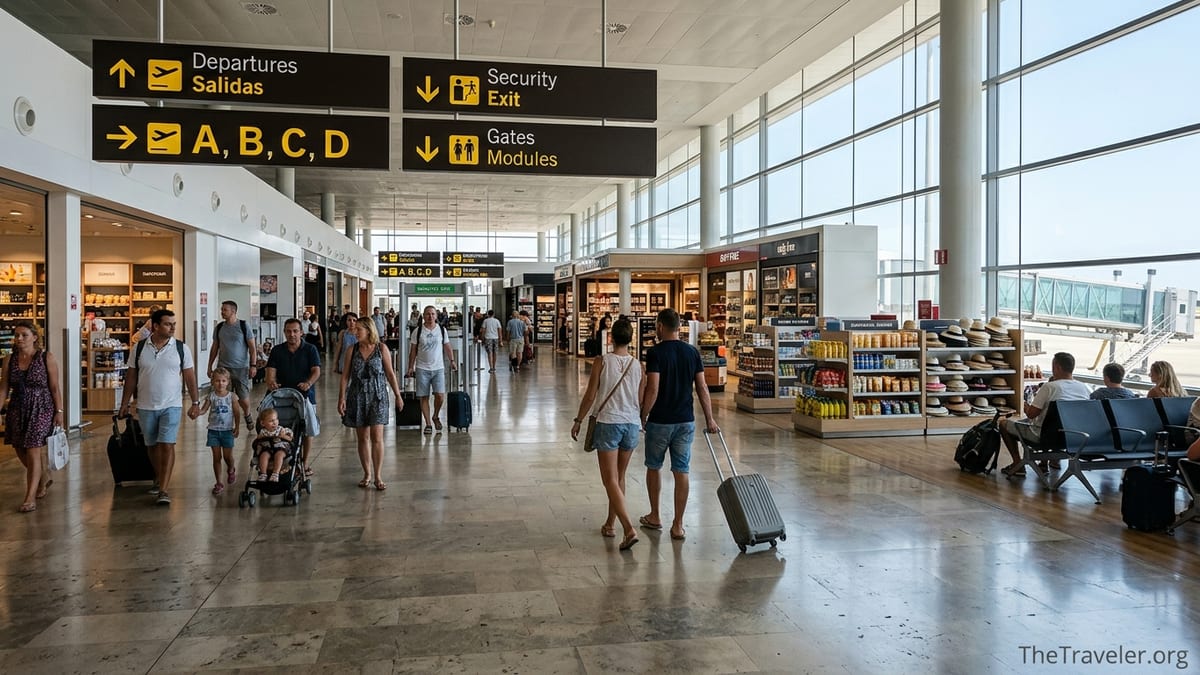
Understanding Palma de Mallorca Airport’s Layout
Palma de Mallorca Airport (PMI) has a single large passenger terminal spread over several levels, with four gate areas known as Modules A, B, C and D. Check‑in and the main security control are located on Level 2, while the large central departures hall, many restaurants and some lounges are on Level 4. After security, you will be directed to one of the modules depending on your airline and destination. For example, many UK leisure flights on carriers like Jet2 and easyJet tend to use Module A, while a large share of German and mainland European flights on airlines such as Eurowings, Condor and Lufthansa often depart from Modules C and D.
Once you are airside, the airport functions like a hub with one central commercial area and corridors leading out to the four modules. Walking times can be surprisingly long. Reaching a more distant gate in Module D from the central departures hall can easily take 10 to 15 minutes at a normal walking pace, especially if you are moving through crowds in high summer. If you are traveling with children or pushing a stroller, allow extra time so you are not rushing down the long corridors when boarding begins.
There are numerous information screens throughout the building, and it is common for the gate number to be assigned only 60 to 90 minutes before departure, particularly for low‑cost airlines that frequently rotate aircraft. Many travelers make the mistake of sitting in the first seating area they see after security, only to realize their gate is a long walk away once it is finally published. A simple habit is to check the screens every 15 to 20 minutes, especially in July and August when gate changes are more frequent due to the intense traffic.
Signage at PMI is clear, with Spanish, Catalan and English used throughout. The key is to follow “Departures / Salidas” to Level 2 for check‑in, then “Security Control” and finally the letter of your gate module. Think of Level 2 as your landside base, Level 4 as the main airside shopping and dining floor, and the modules as spokes leading to the aircraft stands.
How Early to Arrive in Summer
During the quieter winter months, two hours before departure is often enough at Palma for European flights. In peak summer, however, the airport handles very high passenger volumes, particularly on Friday to Monday and around school holidays. As a general rule, aim for a full three hours before departure in July and August, and at least two and a half hours in late May, June and September, even if you are only traveling within the Schengen Area.
If you are checking a bag on a busy Saturday morning charter flight from Palma to Manchester or Birmingham, many airlines will open their check‑in desks around two to three hours before departure. Passengers who arrive when the desks open often find a short queue and can be through security in under 30 minutes. By contrast, those who turn up 90 minutes before departure on the same day may face a longer check‑in line and a slower journey through the building, even if the actual security queue moves fairly quickly.
Non‑Schengen flights, including those to the UK and Ireland, involve an extra step at outbound passport control, so it is wise to build in more margin. In practical terms, that means treating a 10:30 flight to London Stansted in mid‑August as if it leaves at 09:30 when planning your arrival time at the airport. Travelers who come from resorts such as Alcúdia or Cala d’Or also need to remember that road traffic can be heavy on changeover days, so a scheduled 45‑minute transfer can occasionally take well over an hour.
Families, large groups and anyone with reduced mobility should lean toward the earlier end of these timings. For instance, a family of four flying to Stockholm with two checked bags, a stroller and hand luggage will move more slowly than a solo traveler headed to Barcelona with only a backpack. Arriving three hours before departure gives you a comfortable buffer to handle airline check‑in queues, security, passport control and the walk to the gate, without feeling rushed if something takes longer than expected.
Check‑In, Bag Drop and Boarding Pass Basics
Most airlines serving Palma de Mallorca Airport encourage or require online check‑in, usually opening from 24 to 48 hours before departure. Completing this step at your hotel or on your phone means you can often go directly to a bag drop counter instead of the full check‑in queue. For example, airlines like Ryanair, Vueling and easyJet will show separate “bag drop” lines next to their main desks, which tend to move faster because agents are only tagging luggage rather than checking travel documents in detail.
Check‑in desks are grouped by airline rather than destination, and they are all found on Level 2. Overhead screens list flight numbers and the desk range. In practice, this means that for a mid‑morning flight to Berlin on Eurowings, you might see something like “EW 1234 Berlin 08:50 – Desks 101–108.” It is worth looking at the screen before you join any line, because seasonal charter flights on operators such as TUI or Jet2 can build long queues quickly. If you are traveling hand luggage only and your airline allows it, you can skip this step and proceed directly to security.
Self‑service kiosks are available for some carriers, letting you print your own boarding pass and luggage tags. These are especially useful for travelers on large network airlines who are familiar with kiosk use. For instance, a Lufthansa passenger returning to Munich can check in at a kiosk, print bag tags, attach them, and then use a dedicated bag drop belt, significantly reducing time spent in line. However, not every charter or low‑cost airline participates, so always check your airline’s instructions in advance.
Boarding at Palma can start 40 to 50 minutes before departure, particularly for flights using remote stands where passengers are transported to the aircraft by bus. Airlines serving the UK, such as Jet2 and TUI, often begin boarding early for full holiday flights so they can complete document checks and load baggage in time. You do not need to be at the gate at the first boarding call, but you should aim to arrive there at least 25 to 30 minutes before departure to avoid last‑minute stress or the risk of off‑loading if you are not present when the gate closes.
Security and Passport Control: What to Expect
Palma de Mallorca Airport has a large central security checkpoint, recently reorganized and signposted from the Level 2 check‑in hall. The experience can vary from day to day, but traveler reports from recent summers suggest that the actual security process often moves reasonably quickly when all lanes are open, even if the waiting area looks busy. On a typical July Saturday morning, you might join a line that snakes through the queuing system, only to find yourself through the scanners in around 15 to 25 minutes.
Standard security rules apply. You will need to remove large electronics from your bag if asked, and liquids must generally be in containers of 100 ml or less, carried in a transparent resealable bag, unless you are directed to a lane equipped with more advanced scanners where local staff permit liquids to remain in your luggage. It is safer not to rely on that and to pack as if you need to comply with the traditional rules. Families carrying baby food or formula can usually bring reasonable quantities, but plan to remove them from your bag during screening.
For non‑Schengen departures, including all flights to the UK and Ireland, an additional passport control takes place after security on the way to Module A. Travelers with European Union or Schengen passports often find this step quick, sometimes taking only a few minutes. However, if several large flights to the UK are scheduled around the same time, non‑EU passport holders can occasionally face a longer line. A practical example is the cluster of flights to Manchester, Birmingham and London that often depart in the late morning: if they are all boarding around the same period, passport control lines for those flights can lengthen, even if security itself was swift.
There is currently limited priority security capacity at Palma compared with some larger European hubs, though certain airlines and lounge programs may offer fast‑track access in peak periods. If you have purchased fast track or it is included with your ticket, follow the signage carefully, as the entrance to these lanes is not always obvious from a distance. Even with fast track, it is still advisable to follow the three‑hour summer arrival guideline for international departures in case of unexpected bottlenecks or staff shortages.
Food, Drink, Duty Free and Last‑Minute Shopping
Once you are through security at Palma de Mallorca Airport, you enter a central commercial zone with a large duty free store and a wide choice of cafés, bars and fast food outlets. Prices are typical of major European holiday airports: for example, it is common to see a cappuccino in a branded café priced around 3 to 4 euros and a simple sandwich between 5 and 8 euros. Sit‑down restaurants serving pizza, tapas or burgers cost more, but many travelers choose them to enjoy air conditioning, charging points and table service while waiting for boarding.
The main duty free shop located immediately after security can be very crowded on summer afternoons, especially when multiple charter and low‑cost flights are departing within a short window. Some seasoned travelers prefer to walk past the first shop and use a smaller duty free outlet closer to their gate, where the selection is more limited but the queues are often shorter. For example, passengers on an evening flight to Glasgow may find a secondary duty free store near their Module A gate with relatively quiet tills compared with the central zone.
Beyond duty free, there are several travel‑oriented shops selling beachwear, sunglasses, travel pillows, plug adaptors and Spanish food products such as olive oil and cured meats. Keep in mind that many countries outside the EU and Schengen have strict rules on animal products, so if you are flying back to the UK or further afield, double‑check what you can legally bring through customs. Packaged snacks, sweets and non‑perishable food specialties are generally a safer choice than refrigerated items.
Tap water in Mallorca is treated but often considered better for washing than drinking by locals and long‑term visitors. If you prefer bottled water, you can expect to pay around 2 to 3 euros for a 0.5 liter bottle in many airside outlets. A cost‑saving tip is to bring an empty reusable bottle through security and fill it at a fountain or from a restaurant that offers tap water on request, although availability of dedicated refill stations may vary by area.
Lounges and Quiet Spaces Before Your Flight
Palma de Mallorca Airport offers several VIP lounges on the departures side, which can be accessed through airline status, business‑class tickets, paid entry or certain bank and lounge membership cards. The Valldemossa lounge is one of the best known, serving a broad mix of Schengen and non‑Schengen departures. It typically provides comfortable seating, a self‑service buffet with snacks and light meals, soft drinks, coffee machines and a selection of beer and wine. For travelers facing a long wait before an evening flight to Northern Europe, this can be a calmer environment than the main terminal areas.
Other lounges at PMI, such as Mediterráneo and Formentor, serve different gate areas and may be closer to specific modules. In practice, if you are flying to a Schengen destination like Frankfurt or Zurich, you might find it convenient to use a lounge positioned nearer to the C or D gates, whereas a passenger on a UK flight from Module A may prefer a lounge that allows a shorter walk to passport control and the gate. Always check which lounge your access program includes and where it is located in relation to your departure module so that you do not have to rush across the terminal when boarding starts.
Walk‑up lounge access can often be purchased for a fixed fee, typically for a stay of up to three hours. Prices change over time and vary by provider, but travelers in recent seasons have reported paying in the region of 35 to 50 euros for adult entry, with occasional discounts offered through travel cards or lounge pass apps. This can be worthwhile if you are traveling on a busy Saturday with children and want a quieter, more controlled space where you can sit together, charge devices and have access to food without queuing.
If you do not plan to use a lounge, there are still some relatively quiet corners to be found. Seating areas at the far ends of Modules C and D can be less crowded between waves of departures, particularly in the late morning or mid‑afternoon. Another tactic is to move away from the main food court and find a seat near your gate early, then take turns fetching food or drinks. This is especially helpful for solo travelers who want to keep an eye on their belongings while grabbing a quick snack.
Summer Timing Strategies for Different Types of Flights
Not all departures at Palma de Mallorca Airport behave the same way, and adjusting your timing slightly to your flight type can reduce stress. For an early morning Schengen flight to Madrid or Barcelona with a major Spanish carrier, you may find that the first wave of passengers clears security quite smoothly, with relatively short lines before 07:00. In such cases, arriving two to two and a half hours before departure can be sufficient, especially if you are traveling hand luggage only and have already checked in online.
By contrast, late morning and afternoon flights to the UK, Germany, the Netherlands and Scandinavia in July and August tend to be busiest. For a 12:00 departure to Manchester on a low‑cost airline, plan to be at the airport by 09:00. That window takes into account the possibility of a slow‑moving check‑in queue, a 20‑minute security line, time at outbound passport control for non‑Schengen flights, and a 10‑minute walk to a distant gate. Even if everything runs smoothly and you find yourself airside earlier than expected, you can use the spare time for a relaxed meal, duty free browsing or a visit to a lounge.
Evening departures often see a second wave of crowds, particularly on Fridays and Sundays when weekend break travelers are returning home. A 20:30 flight to a German or Scandinavian city can still be very busy at check‑in between 17:30 and 18:30. If you are coming from a resort area with unpredictable traffic, it is better to plan your transfer so that you reach the airport no later than 18:00 for such flights. Tour operator coaches usually build in buffer time, but if you are arranging your own taxi or rental car return, be conservative and expect queues at rental car drop‑off counters as well.
Finally, remember that schedule disruptions in summer, such as weather‑related delays elsewhere in Europe or air traffic control restrictions, can lead to clusters of delayed departures. This can strain airport resources for a few hours. If your airline notifies you of a delay while you are still at your hotel, resist the temptation to drastically shorten your airport arrival buffer. Many delays shift again as the situation evolves, and it is safer to be airside with options than stuck in resort traffic when a previously delayed flight suddenly boards.
The Takeaway
Departing from Palma de Mallorca Airport in summer is entirely manageable with realistic timing and a basic grasp of how the terminal works. Treat three hours as your standard arrival window for July and August flights, especially if you are checking bags or flying to the UK or other non‑Schengen destinations. Use online check‑in and bag drop wherever possible, head straight to security after you finish at the desk, and keep an eye on the departure screens so you are not caught out by a late‑assigned or distant gate.
Once you are airside, choose where you spend your waiting time deliberately. Skip the busiest duty free tills in favor of quieter satellite shops, consider lounge access if you value calm and a guaranteed seat, and factor in the 10 to 15 minutes it can take to walk to some gates. With these simple habits, you can turn what might have been a stressful peak‑season departure into a smooth, almost routine part of your Mallorca holiday.
FAQ
Q1. How early should I arrive at Palma de Mallorca Airport for a summer flight?
For peak summer months like July and August, plan to arrive around three hours before departure, especially if you have checked baggage or are flying to a non‑Schengen destination such as the UK.
Q2. Is two hours enough for a morning Schengen flight from Palma?
Outside the absolute peak times, two to two and a half hours can be enough for an early morning Schengen flight, particularly if you have checked in online and are traveling with hand luggage only.
Q3. Where is the security checkpoint located at Palma de Mallorca Airport?
The main security checkpoint is located after the check‑in hall on Level 2. Once you pass through security, you will move up to the main departures area and then out to your gate module.
Q4. Do I need to go through passport control when departing for the UK?
Yes. Flights to the UK, Ireland and other non‑Schengen destinations require you to clear outbound passport control after security, usually on the way to Module A where many of these flights depart.
Q5. Are there long queues at security in summer?
Security queues can look busy in July and August, but when all lanes are open they often move steadily. Waiting times of around 15 to 30 minutes are common at peak times, though occasional longer queues are possible.
Q6. What food and shopping options are available after security?
After security you will find a large duty free store, international coffee chains, fast food outlets, tapas bars and several travel and fashion shops, with additional smaller duty free and snack points near many gates.
Q7. Does Palma de Mallorca Airport have lounges I can pay to enter?
Yes. Lounges such as Valldemossa, Mediterráneo and Formentor usually offer paid entry, subject to space, and include seating, snacks, drinks and Wi‑Fi. Access can also come via airline status or lounge programs.
Q8. How long does it take to walk to the gates at Palma?
Walking from the central departures area to a more distant gate in Modules C or D can take 10 to 15 minutes. It is wise to leave for your gate as soon as it is shown on the screens, especially in busy periods.
Q9. Can I refill a water bottle after security?
Yes, you can bring an empty reusable bottle through security and fill it from fountains or taps in some cafés and restaurants, though dedicated refill points may be easier to find in some areas than others.
Q10. Is three hours really necessary if I am traveling hand luggage only?
If you are hand luggage only, checked in online and flying at a quieter time, you may be comfortable with slightly less than three hours. However, in peak summer it is still safest to keep a generous buffer in case of unexpected queues or gate changes.