


Driving to Palma de Mallorca Airport can be the easiest way to start a trip, but the real stress often begins when it is time to park. Son Sant Joan Airport (PMI) is one of Spain’s busiest leisure hubs, and its mix of official car parks, express drop-off areas, and off-site long-stay lots can be confusing at first glance. This guide walks you through the main options, what they cost in broad terms, how close they are to the terminal, and the smartest ways to save money without risking a last-minute dash to your gate.
Get the latest updates straight to your inbox!
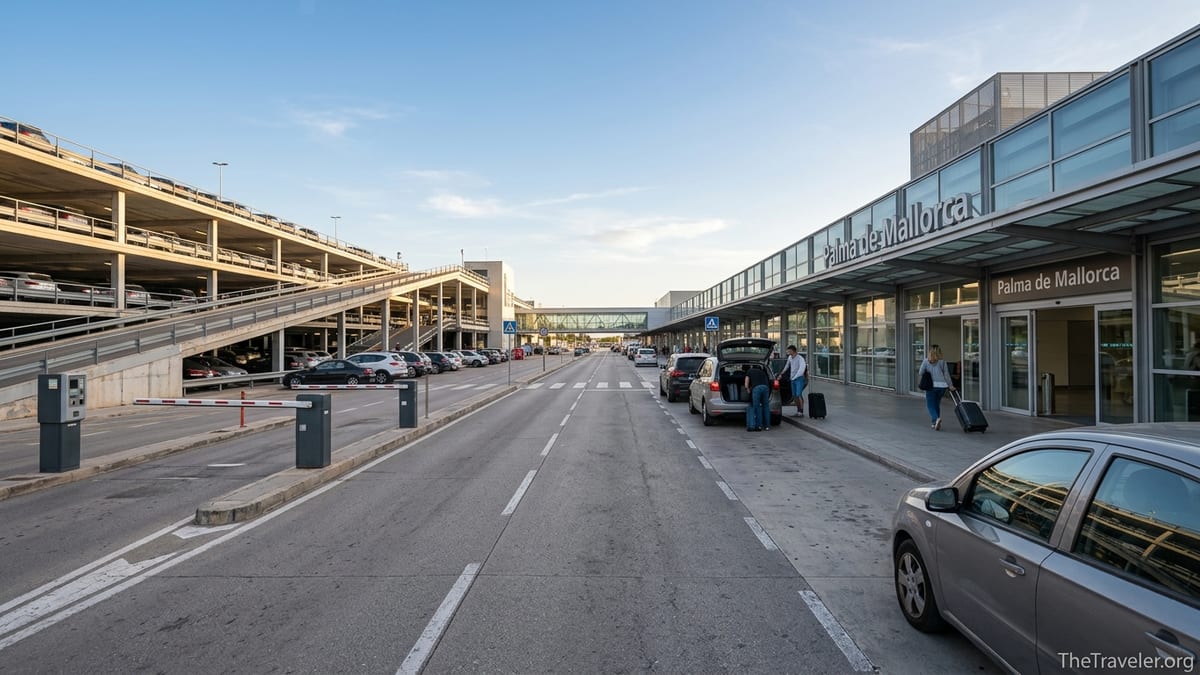
How Palma de Mallorca Airport’s Parking Is Laid Out
Palma de Mallorca Airport sits about 8 kilometers east of the city center and is compact in terms of passenger areas, but its parking is more spread out than many first-time visitors expect. The heart of the system is the multi-story general car park directly opposite the terminal building, connected by covered walkways and lifts. This is the car park most visitors see first when they exit arrivals or walk out from departures, and it is the default choice for short trips of a day or two, rental car collections, and last-minute parking without a booking.
A little farther out you find the official long-stay car park operated by Aena, the Spanish airport authority. This facility is not directly attached to the terminal but is linked via a frequent shuttle bus. It is designed for travelers who leave their car for several days or weeks and want a lower daily rate than the general car park. Signage on the airport access road clearly separates traffic between the terminal, the general multi-story parking, the long-stay lot, and the express areas.
Closer to the terminal doors, there are two small express car parks, one for departures and one for arrivals. These are tightly managed zones intended for very short stops to drop off or pick up passengers. They are physically separate from the main multi-story car park and have their own entrances and exits, barriers, and pricing rules. If you are simply saying goodbye at departures or collecting family with cabin baggage only, these express areas are usually the most convenient choice.
Beyond the perimeter road are several private off-site long-stay operators that target holidaymakers leaving their vehicles for a week or more. These companies typically cluster in the industrial and logistics areas around the airport, particularly toward the highway junctions leading into Palma and toward Llucmajor. They rely on shuttle vans that run between their fenced lots and the terminal, and they compete directly with the Aena long-stay facility on price and included services.
Official General Parking: Best for Short Trips and Flexibility
The official general car park at Palma de Mallorca Airport is the all-purpose option and the one most clearly signed as you approach the terminal. It is a multi-level structure directly opposite the main building, and in normal traffic it takes roughly 3 to 5 minutes to walk from a typical parking space to the check-in desks or arrivals hall. Lifts, escalators, and covered walkways make it relatively comfortable to navigate even with luggage or young children.
Pricing in this general car park is based on short time bands, usually in 15-minute or hourly blocks, adding up to a capped daily maximum. Aena publishes detailed tariffs that apply across several major Spanish airports, and Palma sits within the group of busier Mediterranean airports where parking is priced higher than at small regional fields. As a rough guide, a single day in the general car park can easily reach several tens of euros if you simply drive in without a booking and stay 24 hours or more, which is why locals often avoid leaving their cars here for a full holiday week.
For short trips, the convenience can justify the cost. For example, someone flying on an early morning business hop to Barcelona and back the same evening might accept the higher hourly rate in exchange for parking directly opposite the terminal and minimizing walking time. Families returning from a week in the countryside around Sóller sometimes choose a night in Palma and then leave their car in the general car park for just a few hours on departure day, treating the higher cost like an extra taxi fare rather than a long-stay charge.
Booking ahead can meaningfully reduce the cost of the general car park. Aena’s online reservation platform often offers discounts compared with the drive-up price, particularly outside the absolute summer peak. Travelers who create a free Aena loyalty profile sometimes see additional percentage reductions or promotional campaigns that make a pre-booked space in the general car park cost only slightly more than private off-site options. The trade-off is that you commit to entry and exit times, so this works best when your flight schedule is relatively firm.
Official Long-Stay Parking: When You Are Away for Several Days
The official long-stay car park at Palma de Mallorca Airport is designed for travelers who will leave their vehicle for several days or longer and want a lower average daily rate than the general multi-story facility. It is located a short distance from the terminal on the airport grounds, typically accessed via clearly marked signs for “Larga Estancia” on the approach roads. Because it is not attached directly to the terminal, a dedicated shuttle bus runs between the long-stay car park and the terminal building.
Prices in the long-stay car park are structured around multi-day stays. Aena frequently promotes headline rates such as “from around 3 to 4 euros per day” in marketing material, usually based on a pre-booked stay of around two to three weeks, often with additional discounts for members of its online loyalty club or for low-emission vehicles. Real-world prices for a typical one-week stay booked in advance often work out to a daily average substantially lower than the general parking drive-up rate, although exact figures vary by season, demand, and promotions.
To illustrate, a Mallorcan family planning a 10-day August holiday might compare options a month in advance. When checking Aena’s site, they may find that the long-stay car park, booked online, averages under half the daily cost of leaving the car in the general car park without a reservation. Even during peak summer, the savings can be significant over a full week, especially once you factor in the security and predictability of an official on-airport facility versus leaving the car on city streets or in an unsecured lot.
The shuttle system is a key practical detail. Buses normally run at frequent intervals, but it is wise to allow extra time at busy travel peaks such as early Saturday mornings in July and August, when island residents and visitors alike converge on the airport. Building an extra 20 to 30 minutes into your schedule for parking, waiting for the shuttle, and transferring to the terminal is sensible. For arrivals late at night, shuttles generally continue to operate, but checking the latest timetable before travel and noting the pick-up point at the terminal can prevent confusion when you are tired after a late flight.
Express Drop-Off and Pick-Up: Using the Free Minutes Wisely
Palma de Mallorca Airport has two official express car parks, one dedicated to departures and one to arrivals. These are intended purely for very short-term use: dropping someone at the terminal doors or picking up passengers as they emerge from baggage reclaim. The key advantage is proximity. In both cases, you park just steps from the terminal entrance, minimizing walking distance and exposure to weather, which is particularly welcome on hot summer days.
Crucially, both express areas offer a limited free window. At arrivals, drivers benefit from around 15 minutes of free parking, while at departures the free period is shorter, currently around 10 minutes. Local travel advisories stress that if you exceed these free windows, charges apply retroactively from the moment you entered, rather than only for the extra minutes. This means that lingering for 12 minutes in departures, for example, can convert what you thought was a free stop into a fully charged short stay.
The express car parks are heavily monitored, and enforcement is strict. Barriers record entry and exit times, and stays are limited to short durations, typically with an overall maximum of about two hours. Beyond that, vehicles risk being charged the full daily maximum and potentially being towed. For real-world use, this means you should only enter the express areas when your passenger is genuinely ready to be dropped off or collected. In practice, locals often coordinate via messages so that the arriving traveler texts from the baggage hall when luggage is on the belt, and the driver only then pulls into the express arrivals area.
One practical scenario illustrates how to use the free minutes effectively. A friend landing from London with only cabin baggage might clear the aircraft, walk through passport control, and reach the arrivals hall in about 15 to 25 minutes. If you as the driver arrive too early and sit in the express arrivals car park, you will quickly burn through your free window and start paying. A smarter approach is to wait at a nearby service station or in a legal parking lay-by off the airport access road, then enter the express arrivals car park only when your friend confirms that they are just about to exit the terminal.
Off-Site Long-Stay Parking: Budget Options With Shuttles
Around Palma de Mallorca Airport, several private companies run off-site long-stay car parks that compete directly with Aena’s long-stay facility. These lots are typically located a few minutes’ drive from the terminal in light industrial or commercial areas, and they almost always include a shuttle transfer in the price. Names change over time, but it is common to find brands advertising “Low Cost Parking,” “Park & Fly,” or similar phrases, all emphasizing cheaper weekly rates than the on-airport options.
Prices at these off-site car parks are generally structured by day, with special offers for one or two weeks and longer. In many cases, if you compare online a month or two before your trip, you may see weekly prices noticeably below the official long-stay drive-up rate, and sometimes even undercutting Aena’s promotional rates. Some operators differentiate themselves by including extras such as exterior car washing during your trip, simple maintenance checks, or covered parking for a small supplement. For a two-week summer holiday, the total saving compared with leaving your car in the general car park can be considerable.
Service models vary. Some providers operate on a shuttle basis: you drive to their lot, park, hand over your keys at a reception office, and then board a minibus that drops you at the terminal. Return pick-up is often arranged by phone once you have collected your bags. Others operate a valet-style system where you meet a representative at the airport itself, hand over your car at the departures forecourt or in the general car park, and then the company stores your vehicle in its own lot until you return. This “meet and greet” model can be very convenient if you are traveling with young children or heavy sports equipment such as bicycles or golf clubs.
When choosing a private operator, practical considerations go beyond headline price. It is worth checking customer reviews for punctuality of the shuttle service, clarity of instructions for both drop-off and pick-up, and how the company handles delays or schedule changes. For example, if your return flight is diverted or arrives several hours late, you want assurance that the parking office will still be able to send a shuttle or meet you with your car. Many seasoned travelers prefer companies with clearly posted office hours matching the main flight waves and an emergency contact number for out-of-hours arrivals.
Online Booking, Seasonal Demand, and How to Save Money
Online booking is one of the most effective ways to reduce parking costs at Palma de Mallorca Airport. Aena offers pre-booking for its official car parks, and private off-site operators also rely heavily on reservations to manage capacity. By comparing prices for your exact dates across several options, you can often save a meaningful amount, especially if you book several weeks in advance rather than waiting until the last days before departure.
Seasonality plays a major role. Palma de Mallorca experiences intense peaks during school holidays, early summer weekends, and around local festivals. During these periods, demand for both official and private long-stay parking jumps sharply. Travelers who decide to drive to the airport at the last minute may find that the on-airport long-stay is full or that the most affordable private lots have limited availability. Booking ahead in spring for a July or August trip not only locks in a lower rate but also guarantees a space, reducing the risk that you end up paying top-tier drive-up prices in the general car park.
Cost-saving strategies can be simple but powerful. If you live in Palma or a nearby town with good public transport, consider whether you really need to park at the airport for the entire duration of your trip. Some locals choose to park in secure, long-stay city garages or residential streets where it is legal and safe, then take a taxi or bus to the airport on departure day. Others share parking costs by carpooling with friends or family who are traveling on overlapping dates, leaving only one car at the airport instead of two.
Another way to save involves taking advantage of loyalty schemes and discount codes. Aena’s parking system occasionally offers promotions through its own newsletters or partner airlines, providing percentage discounts for online bookings. Private operators may advertise seasonal codes for early bookings or off-peak stays, such as a reduced daily rate for trips in late autumn and winter compared with high summer. Before finalizing a booking, it is worth checking whether joining a free loyalty program or signing up for a newsletter yields an immediate discount.
Practical Tips for Smooth Terminal Access and Stress-Free Parking
Regardless of where you park, planning for terminal access is essential. If you choose the general car park, allow a few extra minutes to locate a space on busy Saturdays, find the nearest lift, and walk across to check-in. In peak season, some floors fill quickly, and it may be faster to head directly to higher levels rather than circling repeatedly on lower ones. Noting your level and zone as soon as you park, perhaps by taking a quick photo, will save time when you return tired from your trip.
For long-stay and off-site parking with shuttle transfers, timing is even more important. Building in at least 30 additional minutes beyond your normal airport arrival guideline is prudent. For example, if you usually aim to be at the terminal two hours before a European flight, consider arriving at your chosen long-stay facility two and a half hours before departure. This cushion covers parking, paperwork, waiting for the shuttle, and any minor delays on the short drive to the terminal. For very early morning flights, confirm in advance that the shuttle operates at your required time.
Drop-off and pick-up etiquette also matters. At the express areas, prepare passengers and luggage before you reach the barrier. Load suitcases into the boot in advance, keep documents handy, and be ready to move quickly once you stop. Lingering at the curb to repack bags or search for passports is a reliable way to run over the free minutes and irritate other drivers waiting behind you. On return, agree a meeting point in advance inside the terminal, such as a specific exit door or café, so that you are not stuck driving loops while your passengers search for you.
Security and peace of mind should not be underestimated. Official Aena car parks and reputable private lots typically have fencing, lighting, CCTV, and staff presence. They are designed for cars to remain unattended for days or weeks at a time. In contrast, leaving a vehicle in an unmonitored lay-by or residential street near the airport may appear free in the short term but can carry risks of theft, damage, or fines if local parking rules are misunderstood. For travelers leaving high-value vehicles, paying a modest premium for a secure facility is often a sensible trade-off.
The Takeaway
Parking at Palma de Mallorca Airport offers more choice than many travelers expect, from ultra-convenient express drop-off zones and the central multi-story car park to on-airport long-stay and off-site budget options. The best solution for you depends on how long you will be away, your tolerance for shuttle transfers, and how much you are willing to pay for direct terminal access.
For trips of a day or two, the official general car park opposite the terminal is usually the simplest choice, especially if booked online in advance to soften the cost. For week-long holidays and longer stays, the Aena long-stay car park and reputable private off-site operators typically deliver much better value per day, with shuttle transfers that become routine once you have used them once or twice.
Meanwhile, the express arrivals and departures car parks are designed for quick, tightly timed drop-offs and pick-ups. Using the 10 to 15 free minutes wisely can make them an excellent tool, but only if you coordinate closely with the traveler you are meeting or saying goodbye to. Combining this tactical use of express areas with strategic decisions about long-stay or off-site parking can significantly reduce both your stress level and your total parking bill.
With a little planning, most drivers can turn Palma’s busy airport parking landscape into a set of predictable choices. Decide early how much convenience you want, book online when possible, build transfer time into your schedule, and treat secure parking as part of the overall cost of a smooth, enjoyable trip from Mallorca.
FAQ
Q1. How early should I arrive if I use the official long-stay car park at Palma de Mallorca Airport?
Plan to arrive at the long-stay car park at least 30 minutes earlier than you would normally aim to be at the terminal. This extra time covers parking, a short wait for the shuttle bus, loading luggage, and the ride to the terminal, particularly during busy summer mornings.
Q2. Is there really free parking for drop-off and pick-up at Palma de Mallorca Airport?
Yes, but it is strictly time limited. The express arrivals car park offers roughly 15 minutes free, and the express departures area offers around 10 minutes. If you exceed these free windows, charges apply from the moment you entered, so you should only enter when your passenger is ready.
Q3. Which is better for a one-week holiday: the general car park or the long-stay car park?
For a one-week trip, the official long-stay car park or a reputable off-site provider is usually better value. Daily costs in the general car park can add up quickly if you simply drive in and leave the car for seven days, while pre-booked long-stay options are designed specifically for multi-day stays.
Q4. How close is the general car park to the terminal at Palma de Mallorca Airport?
The general car park is directly opposite the terminal and connected by covered walkways and lifts. In normal conditions it takes around 3 to 5 minutes to walk from a typical parking space to the check-in area or arrivals hall, making it the most convenient official option for short stays.
Q5. Are private off-site parking providers around Palma Airport reliable?
Many private off-site operators are well established and used regularly by locals, but quality varies. It is important to compare recent reviews, check shuttle frequency and operating hours, and confirm how they handle delayed flights before you commit. Choosing a provider with clear contact information and secure, fenced facilities is advisable.
Q6. Can I book airport parking at Palma de Mallorca Airport on the same day I travel?
Same-day online booking is often possible for both official and private car parks, but availability and discounts may be limited at peak times. For busy summer weekends and school holidays, reserving at least several days or weeks in advance improves your chances of finding a good rate and a guaranteed space.
Q7. Is it safe to leave my car parked at Palma Airport for two weeks?
Official Aena car parks and reputable private long-stay facilities are designed for vehicles to remain parked for extended periods and typically offer lighting, fencing, and CCTV. While no parking can be completely risk-free, these managed environments are generally considered safer than leaving a car on unmonitored streets near the airport.
Q8. What should I do if my return flight is delayed and I am using an off-site parking shuttle?
If your flight is delayed, contact your off-site parking provider as soon as you have updated arrival information. Most companies monitor flight times but still rely on a call or message from you after landing to send the shuttle or bring your car. Check the provider’s policies on late arrivals and potential extra charges before you travel.
Q9. Do I need to leave my car keys when I use long-stay parking?
In the official Aena long-stay car park you generally keep your own keys and park the car yourself. Many private off-site operators, however, ask you to leave the keys so they can move vehicles within their lot. If you prefer to keep your keys, choose an option that explicitly allows self-park without key handover.
Q10. How can I make sure I remember where I parked at Palma de Mallorca Airport?
The simplest method is to photograph your parking level, row number, and any nearby signs as soon as you lock the car. You can also save the location on your phone’s map app. This avoids confusion on your return, especially late at night or after a long journey when it is easy to forget exactly where you left the vehicle.