


In 2027, travelers between Paris and Berlin once again have a true overnight rail option. Belgian–Dutch cooperative European Sleeper now runs a three‑times‑weekly Paris–Berlin night train, picking up where the ÖBB Nightjet service left off in December 2025. This guide explains how the new train works, what it really costs, how it compares with budget flights and daytime trains, and how to decide whether sleeping on rails is the right choice for your next trip.
Get the latest updates straight to your inbox!
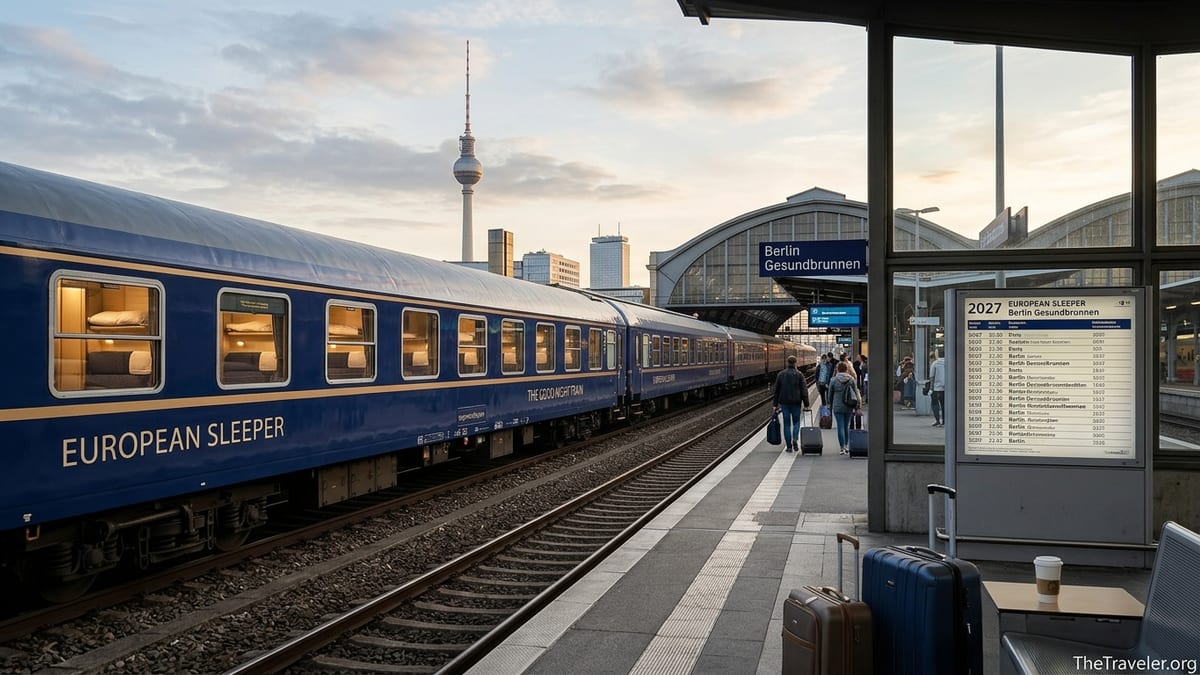
From Nightjet to European Sleeper: What Actually Runs in 2027
ÖBB’s Nightjet Paris–Berlin sleepers, jointly marketed with SNCF, were withdrawn at the 2025/2026 timetable change, with last departures in December 2025. Since then ÖBB no longer serves Paris with Nightjet services, so any current Paris–Berlin sleeper is not an ÖBB train. European Sleeper, an independent Belgian–Dutch cooperative, stepped into this gap and launched its own Paris–Brussels–Berlin night train on 26 March 2026. Public rail timetables and the operator’s own information for 2026–2027 show European Sleeper as the only direct overnight train between Paris and Berlin on most dates.
European Sleeper operates the route as an open‑access service, threading paths through intensely used infrastructure in France, Belgium and Germany. The trains run with refurbished couchette and sleeping cars similar to those used on its Brussels–Amsterdam–Berlin–Prague route. For 2027 the operator publishes a “standard annual timetable” for Paris–Berlin on its timetable page, but stresses that all timings are subject to confirmation by infrastructure managers and to short‑notice engineering work. When planning a 2027 trip, you should always recheck exact timings for your chosen date rather than assuming the pattern will be identical to 2026.
The core pattern that European Sleeper advertises for Paris–Berlin is three departures each week in each direction. From Paris, trains run on Sunday, Tuesday and Thursday evenings. From Berlin, departures are on Monday, Wednesday and Friday nights. This pattern was confirmed by independent timetable aggregators and travel sites in late 2026, which still direct passengers to the European Sleeper service as the only direct night train on the route.
Because of limited path availability, the route does not follow the geographically shortest alignment that a daytime high‑speed service might use. Instead, the train typically leaves Paris Gare du Nord in the early evening, calls at Brussels Midi and intermediate Belgian and German stations, and reaches Berlin the following morning. In late 2026 many journeys use Berlin Gesundbrunnen, in the northern part of the city, as their Berlin terminal, with occasional variations such as different Berlin starting stations on the return leg. The result is an overall journey time of roughly 14 to 18 hours depending on the specific timetable period and engineering diversions.
2027 Timetable Pattern, Stops and the Reality of Engineering Works
As of November 2026, European Sleeper’s official timetable tools and public rail schedules allow selection of dates into early 2027 and show a broadly consistent pattern. Typical Paris–Berlin departures leave Paris Nord around early evening, with many reports describing a departure at about 18:00 and an arrival in Berlin between roughly 06:00 and 10:00 the next morning. Timetable snapshots published in spring and autumn 2026 mention examples such as 18:03 from Paris arriving after 09:00 in Berlin, while some autumn and winter services arrive earlier, around 06:00, reflecting seasonal pathing and diversions.
Intermediate stops generally include Brussels Midi and major Belgian or German cities, and for parts of 2026 and 2027 Hamburg is added as a through stop between Berlin and Brussels/Paris. A typical pattern seen in 2026 has the train running Paris Nord – Brussels Midi – Antwerp – Rotterdam or Deventer – Hamburg – Berlin Gesundbrunnen, although exact calling points change during works periods. The northbound service usually reaches Berlin Gesundbrunnen, an important long‑distance and S‑Bahn node north of central Berlin, rather than the more tourist‑familiar Berlin Hauptbahnhof. In some timetable periods the southbound train starts from a different Berlin station, such as Spandau, then uses Gesundbrunnen or other Berlin nodes as pick‑up stops before heading west.
Crucially, the operator and independent timetable publishers openly warn that heavy infrastructure works in Germany and Belgium can alter the pattern at short notice. For example, during late 2026 and early 2027 European Sleeper publishes disruption notices explaining that some Berlin–Paris trains are truncated, rerouted or retimed on specific dates. Changes can include different departure times by up to an hour, altered calling patterns, or replacement of a section by day trains. For 2027 you should treat any “standard timetable” as guidance only and always click through to check your exact departure date.
If your travel dates fall during known works windows, European Sleeper may temporarily terminate at intermediate hubs such as Brussels or Hamburg, providing alternative daytime connections onward. In these cases you still hold a through ticket, but the overnight section might end earlier than Berlin or begin later than Paris. This is one of the key differences from the old Nightjet, which benefitted from long‑established slots before Paris services were withdrawn; as a new entrant, European Sleeper has to fit around dense daytime and freight traffic, so flexibility is part of the product.
Onboard Experience: Seats, Couchettes and Sleeper Options
European Sleeper sells several accommodation types on the Paris–Berlin route, but not every type is always available on every departure. Broadly, you will see three categories: standard seated accommodation, shared couchette compartments in varying layouts, and proper sleeper accommodation in traditional sleeping cars. For any specific 2027 date, you must check the booking engine to see which categories are offered on that departure, as rolling‑stock allocations can change during works periods.
Standard seats are the lowest‑priced option and are usually sold in classic compartment coaches rather than open‑plan airline‑style cars. Reviews in 2026 describe these as the most basic and least comfortable way to spend the night, with limited recline, shared lighting in compartments and more ambient noise. Bedding is not provided, and passengers who choose seats often bring an eye mask, travel pillow and blanket to improve comfort. Electrical sockets are present in most refurbished cars, but they may be shared and not every seat has its own. Wi‑Fi provision is limited or intermittent, so it is safer to download entertainment in advance.
The core product is the couchette. European Sleeper markets its couchettes in several comfort levels: for example, classic five‑berth or six‑berth couchettes with simple bunks and basic bedding, and “comfort” couchettes where the same bunks are dressed more like beds with thicker mattresses and duvets. Independent reviews from 2026 show six‑berth couchette compartments fitted with three bunks on each side, a small table by the window and storage space under the lower bunks and in racks near the door. Compartments can be booked as mixed‑gender or, when available, women‑only, and may be sold as whole‑compartment options for private use by families or groups.
At the top of the range are sleeper cabins, sometimes sold as “Comfort Plus” or similar branding, depending on the booking interface. These are classic sleeping‑car compartments that by day convert to a sofa and by night to one, two or three beds. On European Sleeper’s other routes, some sleeper cabins offer in‑room washbasins or access to communal showers in the coach; Paris–Berlin uses similar stock, but specific facilities can vary between cars. Typical sleeper bookings include full bedding, towels and more generous luggage space, along with reading lights, upgraded mattresses and more solid doors and walls for privacy. The number of charging points is higher than in couchettes, and the atmosphere is noticeably quieter.
Across all accommodation types, toilets and washrooms are located at the ends of coaches. Feedback from 2026 indicates that facilities can be under pressure on busy nights and may occasionally suffer from maintenance issues such as low water pressure. You should not expect the en‑suite standards of a hotel; instead, think of basic but serviceable facilities for washing and teeth‑brushing before bed. Food and drink are typically limited to a bar‑style trolley or a simple counter offering packaged snacks and drinks, with some fares including a light breakfast such as a pastry and hot drink served at your seat or bunk.
Fares, Real‑World Prices and How to Book for 2027
European Sleeper’s fares are dynamic and vary by date and demand, but late‑2026 examples provide a realistic picture for 2027 budgeting. Public fare examples and promotions show that the cheapest advance tickets on the Paris–Berlin route can start around 40 to 60 euros for a seat and from roughly 40 to 70 euros for a berth in a shared couchette on quieter dates, rising significantly for peak summer or holiday weekends. The headline “from” prices you may see in press coverage and promotions often refer to a single berth in the most densely occupied couchette compartment, not to a private cabin.
For travelers wanting more privacy, European Sleeper sells entire compartments at a flat price for up to the permitted number of occupants. Real booking screenshots and user reports from 2026 suggest that a private couchette compartment for two people between Paris and Berlin can cost in the ballpark of 220 to 350 euros one way depending on season, while a private sleeper cabin for two can easily reach 300 to 450 euros or more on busy nights. A family booking an entire six‑berth couchette compartment might pay somewhere between 300 and 420 euros for up to six people if they secure a promotional fare, which can be good value compared with four or five budget‑air tickets plus bags and hotel.
Tickets are sold directly through European Sleeper’s own booking platform and, on some dates, via partner rail retailers. The operator typically opens bookings several months ahead, but not a full year. In 2026, many summer dates became available around three to six months in advance, sometimes later when track access negotiations were still ongoing. For 2027, you should not be surprised if spring travel only appears on sale in late 2026 or early 2027, and if specific high‑summer dates are loaded only once infrastructure managers confirm their works schedules.
Regarding compartment sharing, the booking process allows selection of mixed‑gender or women‑only couchettes when these are offered. Women‑only options have been reported by travelers on the Brussels–Berlin route and have appeared for some Paris–Berlin dates too, but availability can change and cannot be guaranteed for every departure. Cancellation conditions vary with fare type. Cheaper “non‑flex” or “special” fares may be non‑refundable or only partially refundable, while more expensive flexible fares allow changes or refunds with a fee before departure. If you miss the train due to late arrival from another service or flight and your ticket is a standalone booking, staff are not obliged to accept it on other trains; any rebooking is usually at the operator’s discretion. Travel‑insurance coverage that includes missed connection cover is worth considering if you are chaining multiple tickets.
Door‑to‑Door: Night Train vs Budget Flight and Daytime Rail
To understand whether the sleeper is worthwhile, it helps to compare realistic door‑to‑door timings and costs with a low‑cost flight and with daytime rail. Take a solo traveler staying near Gare du Nord in Paris and heading to a hotel close to Alexanderplatz in central Berlin. With the night train, they can walk or take a short metro ride to Paris Nord, board around 18:00, sleep overnight and arrive at Berlin Gesundbrunnen in the early morning. From Gesundbrunnen, an S‑Bahn train to Alexanderplatz takes roughly 15 minutes, so the total door‑to‑door elapsed time might be about 15 to 17 hours, but eight of those hours can be spent lying down.
For the same journey by budget airline, the traveler might choose a morning flight from Paris Charles de Gaulle or Orly to Berlin Brandenburg. Allow about 45 to 60 minutes to reach the airport from central Paris, arrive two hours before departure, fly for around 1 hour 45 minutes, then spend another 35 to 45 minutes reaching central Berlin by airport train. In practice, door‑to‑door time easily approaches 6 to 7 hours, most of it seated in transit. A cheap promotional fare might be 40 to 70 euros including only a small personal item, but adding a cabin bag and checked baggage can quickly raise the total cost into the 90 to 150 euro range each way.
For a solo traveler on a tight budget who is willing to sacrifice sleep quality, the very cheapest option may be a low‑fare flight plus a hostel bed. Suppose a one‑way flight including one cabin bag costs 80 euros and a central hostel bed 30 euros for the night, plus about 15 euros total for airport and urban transport at both ends; the combined cost would be roughly 125 euros. By contrast, a basic seat on European Sleeper booked well ahead might be 50 to 80 euros. Upgrading to a couchette berth might cost 80 to 120 euros, but replaces the hostel night and two airport transfers. For travelers valuing simplicity and lower emissions, a couchette fare around 100 euros can be competitive with the full, realistic cost of flying.
Couples and families often see the clearest savings. A couple might find return flights at 70 euros each plus 40 euros each for baggage, making around 220 euros total, then add two nights of hotel and transfers if they structure the trip to avoid brutal early flights. A private sleeper compartment on European Sleeper for two people might cost around 350 euros one way on busy dates, which looks expensive in isolation but includes one night’s accommodation for both. For a family of four booking an entire six‑berth couchette compartment for, say, 380 euros, the per‑person overnight transport plus “hotel” cost is 95 euros, which can compare very favorably with four budget‑air tickets including bags and a mid‑range family room in Berlin.
Comfort, Noise, Accessibility and Station Considerations
Sleeping on a moving train is a very different experience from a hotel night. Night train regulars report that European Sleeper’s couchettes and sleepers offer reasonably flat bunks, but you should expect some vibration, braking noise and corridor traffic. Light sleepers may find seats almost unusable for rest and should budget for at least a couchette. Earplugs, an eye mask and comfortable clothes make a significant difference. Compartments can be warm in summer and slightly cool in winter depending on the heating settings; layers are helpful. The benefit, particularly in winter, is that you can board in the evening, settle in for the night and wake up in a new city without an early alarm for the airport.
Accessibility on night trains is more limited than on modern high‑speed daytime trains or aircraft, especially for passengers with reduced mobility. European Sleeper’s rolling stock is based on older conventional coaches, so step‑free boarding is often not possible without staff assistance and mobile ramps. Narrow corridors and compartment doors can make wheelchair access difficult or impossible depending on the coach type. The operator provides information channels for passengers to request assistance, but if you rely on a wheelchair or have significant mobility needs, a daytime high‑speed service with modern accessible stock may be more practical than the night train.
Arriving at Berlin Gesundbrunnen rather than Berlin Hauptbahnhof is rarely a serious drawback. Gesundbrunnen is a major S‑Bahn and regional hub, with frequent trains to Hauptbahnhof, Alexanderplatz, Friedrichstrasse and many other districts, usually in 10 to 20 minutes. If your hotel is near Hauptbahnhof, you simply stay on the S‑Bahn for a few extra stops. However, some travelers who prefer to walk directly from the station to their hotel may wish to choose accommodation in Mitte, Prenzlauer Berg or Gesundbrunnen itself to minimize transfers. Early‑morning arrivals, sometimes around 06:00, can mean your room is not yet ready, so consider booking the previous night at your hotel if you want immediate check‑in, or plan a breakfast and luggage‑storage stop.
Station safety at both ends is comparable to other major European hubs. Paris Gare du Nord and Berlin Gesundbrunnen are busy urban stations where standard big‑city precautions are appropriate, especially late at night and in the very early morning. Inside the train, sleeping with the compartment door locked from the inside is recommended. Compartments that are not fully booked may be shared with strangers unless you have purchased a private compartment; valuables should be kept in a small bag that you can secure close to your bunk, not left in the corridor racks.
Booking Strategy and Practical Tips for 2027
For 2027 travel, flexibility is your friend. Because European Sleeper must negotiate track slots around extensive rail‑works, especially in Germany, you may see some dates loaded late, some departures blocked out entirely, and occasional timetable shifts. Aim to choose travel dates where both your outbound and return sleepers appear as confirmed in the booking engine, and consider avoiding periods that the operator flags for heavy disruption. If you must travel on a specific date and see only seats left in the booking engine, weigh whether to switch to a daytime connection instead of compromising on overnight comfort.
When comparing fares, be precise about what you are buying. If you see a promotional message such as “Paris to Berlin from 49 euros,” assume this refers to the lowest‑category seat or couchette berth on a quiet date. For a realistic comparison with flights plus hotel, look at the price of the accommodation type you actually want, whether that is a berth in a four‑ or six‑berth couchette compartment or a private sleeper. Then subtract the cost of a hotel night that you would otherwise have paid. This simple adjustment often moves the sleeper from “luxury splurge” into “sensible mid‑range” territory.
One concrete approach for couples is to price three scenarios for the same dates: return flights plus two hotel nights, return flights plus one hotel night and one sleeper, and return sleepers both ways. For example, you might find that flying one way and taking the sleeper back to Paris lets you enjoy a full extra day in Berlin before boarding the night train, without needing to pay for another hotel night. Families can similarly consider taking the night train in one direction, turning travel time into an adventure for children and keeping the other leg simple with a daytime high‑speed or flight.
Finally, allow margin for connections. If you are coming into Paris from another French city or from London on Eurostar, avoid same‑station connections of less than 60 to 90 minutes at Gare du Nord. If a preceding train is seriously delayed and you miss European Sleeper, your ticket is not automatically protected as it would be within a single national operator’s system. Likewise, in Berlin, aim to book flights or onward trains that leave at least two to three hours after your scheduled arrival from the night train to account for possible late running.
Who Should Choose the Paris–Berlin Sleeper in 2027?
For budget travelers, the sweet spot is usually a berth in a shared couchette rather than a seat. If you can secure a couchette fare in the 80 to 120 euro range, you are getting both transport and a night’s accommodation in central‑to‑central fashion, with no airport transfers and a reasonable amount of sleep. Very tight budgets may still favor ultra‑cheap flights and hostels, but those prices are increasingly rare once baggage and transfers are factored in. If every euro counts, compare the absolute lowest flight plus hostel combination you can find against the cheapest couchette fare on your specific date and decide whether the extra comfort and simplicity of the train are worth a modest premium.
Couples seeking privacy and a more romantic journey will generally be happiest in a private couchette or sleeper compartment. A private sleeper is the closest thing to a rolling hotel room on this route, with proper beds, more sound insulation and a feeling of seclusion that seats and shared couchettes cannot match. While the headline price can appear high, remembering that it replaces a hotel night softens the blow. Many pairs planning a special weekend or anniversary trip choose to take the sleeper in one direction and a faster daytime train or flight in the other, enjoying both the novelty of the night train and the speed of daytime travel.
Families with children are often ideal candidates for the European Sleeper. Booking an entire six‑berth couchette compartment gives parents full control over the space, turns the journey into a memorable adventure and can be cost‑effective compared with four or five separate hotel beds and multiple air tickets. Children tend to adapt easily to bunks, and overnight travel means arriving in Berlin early enough to enjoy a full day of sightseeing, with the flexibility to return to the hotel for an afternoon rest.
For anyone deciding whether the Paris–Berlin sleeper truly saves time and money, the key questions are how lightly you sleep, how much you value avoiding airports and how you price your time. If you are a deep sleeper who dislikes security lines and is happy to treat the train as both transport and accommodation, European Sleeper can be an excellent 2027 choice. If you sleep poorly in unfamiliar environments, need guaranteed accessibility or are extremely price‑sensitive, a daytime high‑speed train plus a conventional hotel, or a carefully costed budget flight plus accommodation, may suit you better. Used with clear eyes and realistic expectations, however, the revived overnight connection restores something that Paris and Berlin had lost: the ability to go to sleep in one great European capital and wake up in another.