


The long-promised direct train between Prague and Copenhagen is no longer a future project. Since 1 May 2026, České dráhy’s new ComfortJet sets, operated jointly with Deutsche Bahn and DSB, have been linking the Czech and Danish capitals every day. By late 2027 the route is bedded in, but still affected at times by German and Danish infrastructure works, so travelers need up-to-date, practical information rather than old press-release optimism. This guide walks through the real journey as it now operates, explains the onboard experience, and compares the direct service with one-change options and flying.
Get the latest updates straight to your inbox!
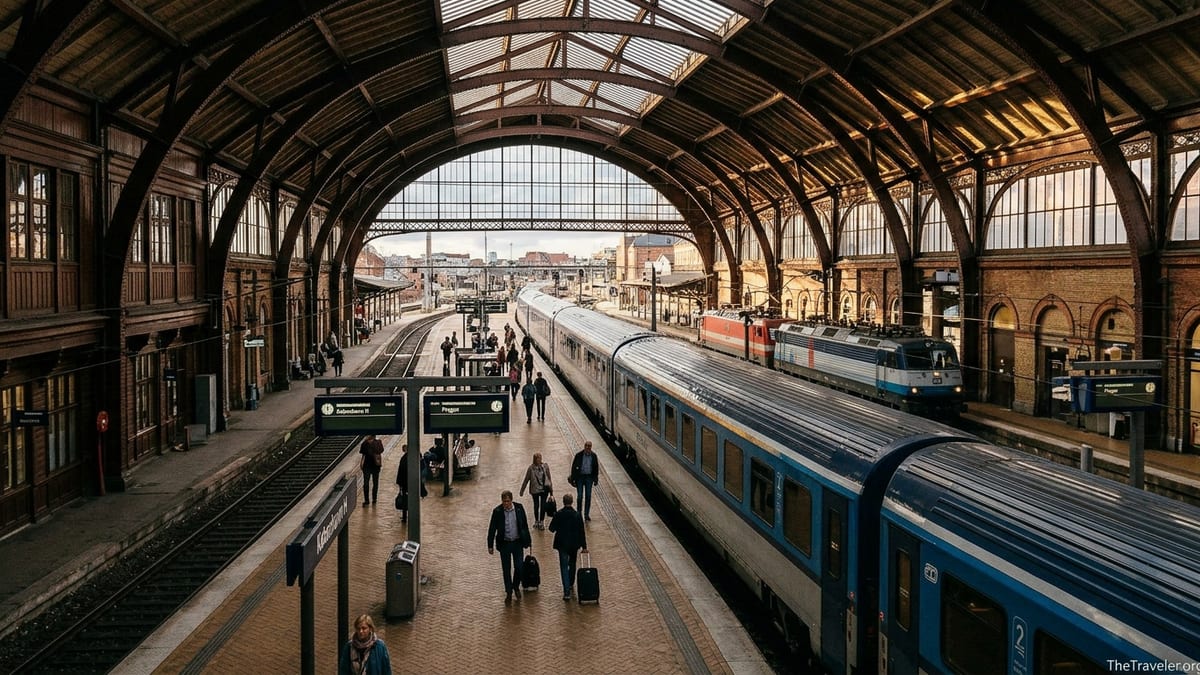
What the Prague–Copenhagen ComfortJet actually is
The direct Prague–Copenhagen train is a daytime Railjet-branded service operated with Czech Railways’ new ComfortJet push–pull sets. České dráhy provides the rolling stock and on-board staff on the Czech and part of the German section, while Deutsche Bahn and DSB handle operations, paths, and crew in Germany and Denmark. The key change is that you can now stay on the same train all the way from Praha hlavní nádraží to København H without changing in Berlin or Hamburg on most days.
Official announcements from České dráhy and Deutsche Bahn confirmed that direct service began on 1 May 2026, coordinated with the end of heavy overhaul work on the Berlin–Hamburg main line. In practice, the first months ran via some diversionary routings while German works continued, but by 2027 the standard path is Prague – Dresden – Berlin – Hamburg – Jutland – Funen – Zealand – Copenhagen. The trains are timetable-planned as Railjet / EuroCity-quality services with mandatory reservations in Denmark and recommended reservations elsewhere.
ComfortJet sets are nine-car formations with both first and second class, a full restaurant or bistro car, areas for bicycles, and a dedicated accessibility coach. They are designed for 230 km/h operation, although real-world speeds on the Prague–Copenhagen axis are lower because of line limits in Germany and Denmark. The benefit for travelers is less about headline speed and more about continuous comfort, a single reserved seat, and avoiding airport-style hassles.
Unlike older mixed coach formations, all carriages are air-conditioned, have power outlets at each seat, and are step-free from platform to at least one door per train. This makes the Prague–Copenhagen route much more attractive for families with strollers, passengers with reduced mobility, and cyclists than the patchwork of rolling stock that used to cover the corridor.
2027 timetable, route and the impact of Berlin–Hamburg works
By late 2027, the regular pattern remains close to what Czech Railways outlined in its launch communications: two year-round direct Prague–Copenhagen trains per day in each direction, with a third seasonal train pair in peak summer. Verified 2027 timetable data from operator and enthusiast sources show a morning departure around 06:30 from Praha hlavní nádraží and a late-morning or early-afternoon departure around 10:30. On summer dates a mid-afternoon departure around 16:30 is added, primarily to offer better connections north of Copenhagen.
For example, a commonly published 2026 launch-day schedule had train RJ 384 leaving Prague at 06:31 and arriving in Copenhagen at 19:38, a journey of just over 13 hours including stops in Dresden, Berlin, Hamburg, and several Danish cities. In 2027, minor adjustments of a few minutes are frequent around Berlin and Hamburg, reflecting ongoing capacity management on the rebuilt Berlin–Hamburg line and periodic track works in Schleswig–Holstein and Denmark. Travelers planning for specific 2027 dates should always re-check exact times on the day with ČD, DB, or DSB journey planners rather than relying on a static example.
The core route runs Praha hlavní nádraží – Ústí nad Labem – Děčín – Dresden – Berlin Hauptbahnhof (via the north–south tunnel) – Hamburg Hbf – Schleswig – Flensburg – Padborg – Kolding – Odense – Nyborg – Korsør – Ringsted – København H. During German construction phases some diagrams were diverted away from the classic Berlin–Spandau to Hamburg main line, but for 2027 the advertised path once again principally uses the rebuilt Berlin–Hamburg high-capacity corridor, with occasional speed restrictions rather than wholesale rerouting. DSB’s own engineering pages still flag intermittent track closures south of Kolding and between Funen and Zealand, so bus substitutions on isolated dates are possible; these usually affect one or two diagrams rather than the entire service pattern.
Because of this, the theoretical fastest Prague–Copenhagen timing of “about eleven hours” that was mentioned in planning documents has not been consistently achieved in daily operation. Real-world timings cluster between 12 hours and 13 hours 30 minutes depending on the date, the number of intermediate stops, and whether any temporary slow sections are in force. Travelers should plan their day around at least 12.5 hours of onboard time and treat any faster timing as a pleasant bonus.
Stations, boarding and where the train reverses
In Prague, the ComfortJet to Copenhagen departs from Praha hlavní nádraží, the city’s main station and the hub for long-distance services. The Railjet / ComfortJet departures to Germany typically use the through platforms under the historic Art Nouveau concourse rather than the suburban tunnel platforms. Passenger information screens list the train as a Railjet or EuroCity service with a clear “Copenhagen” destination, usually in Czech, German and English. Boarding starts around 15 to 20 minutes before departure, with cleaning and catering staff often still finishing their work if the set has just arrived from Budapest or Vienna.
There is no formal check-in. Travelers simply find the marked platform, walk to the car indicated on their reservation, and board when doors open. Electronic coach indicators show the carriage number and class. Prague’s main station has level access via lifts and escalators from the concourse to the platforms, which matches well with the ComfortJet’s low-floor entrance areas at the accessibility coach. For passengers coming from the city center or Old Town, tram or metro journeys of 10 to 15 minutes are typical; this is a key factor when comparing the overall door-to-door time with flights from Prague Airport, which sits north of the city.
On the northbound run, the train keeps the locomotive on the same end throughout, thanks to the push–pull configuration, so formal reversals are not required at Dresden, Berlin, or Hamburg. However, extended commercial stops of 10 to 15 minutes in both Berlin and Hamburg are built into the timetable to allow for crew changes, catering resupply, and pathing. For travelers, this is the best time to stretch legs on the platform, take photographs, and check for any announcements about construction-related delays further north.
In Copenhagen, the train arrives at København H, the main central station. ComfortJet sets typically use one of the longer through platforms under the historic trainshed, shared with other international and intercity services. Denmark does not require passport checks for passengers arriving from Germany in normal Schengen conditions, so disembarkation is as simple as stepping off the train and walking directly into the station hall. For onward connections to Malmö and Stockholm, travelers walk a few minutes to the platforms used by Øresundståg and SJ services, with a suggested minimum margin of 30 to 45 minutes to absorb any late arrival from Germany.
What the ComfortJet onboard experience is like on this route
The Prague–Copenhagen ComfortJet formations are drawn from the same fleet that runs to Berlin, Vienna, Bratislava and Budapest, but operator information and early passenger reports indicate that the full long-distance configuration is usually deployed on the Danish route. That means a mix of first and second class, a restaurant or full-service bistro, family and quiet areas, bicycle spaces, and an accessibility coach with wheelchair seating and an accessible toilet.
In second class, the seat layout is mostly 2+2 across, with a mix of open saloon and small compartments in some cars depending on the exact subtype. Seats recline modestly, with fixed or airline-style tables and at-seat power sockets. Czech Railways’ published specifications for ComfortJet note that each nine-car set offers around 456 second-class seats and 99 first-class seats, plus additional places in the restaurant car. Passenger photos and seat maps confirm that on the Prague–Copenhagen service, the restaurant car is normally staffed for the entire German and Danish sections, not just within the Czech Republic, although occasional staff shortages or exceptional disruptions can shorten its operating hours.
First class offers a 2+1 seating layout with wider, more cushioned seats, additional legroom, and often a quieter atmosphere. On other ComfortJet routes, Czech Railways advertises an at-seat service for first class on parts of the journey; on the cross-border service, this has been applied more flexibly, with at-seat ordering usually available in Germany and the Czech Republic, and more limited service in Denmark when DSB staffing patterns differ. Wi-Fi is provided throughout the train via equipment installed by ČD; signal quality is generally good in urban areas but can be weak in rural sections between Hamburg and Kolding and across Funen where mobile coverage fluctuates.
Wheelchair users and passengers with reduced mobility benefit from a dedicated low-floor coach with wide doors, boarding assistance on request, and at least three wheelchair spaces with charging points for powered wheelchairs. Official specifications and test runs in Denmark mention an accessible toilet and nearby seating for companions. Bicycle carriage is possible, with roughly a dozen bicycle spaces that can also accommodate e-bikes, including charging sockets; these spaces must be reserved in advance, as northbound peak summer trains have already seen reports of “fully booked” bike sections even when seating remains available.
Food, facilities, luggage and traveling with children
On an all-day journey lasting around 12 to 13 hours, food planning matters. The ComfortJet restaurant or bistro car usually opens soon after departure from Prague and remains in service at least until Hamburg, sometimes all the way to Copenhagen depending on staffing. Menus reported in 2026 and 2027 include hot dishes like goulash with dumplings, schnitzel with potato salad, simple pasta dishes, and cold options such as sandwiches and salads, plus Czech beers, soft drinks, and coffee. Prices have been broadly in line with other Railjet and EuroCity restaurants, with a hot main course somewhere in the equivalent of 10 to 15 euros and coffee around 3 to 4 euros, but travelers should check current menu boards on board as prices can change.
For families and budget-conscious travelers, bringing snacks and water from Prague’s station supermarkets is a good idea. Praha hlavní nádraží has several large grocery outlets and bakeries open from early morning, while Berlin and Hamburg stations also offer plenty of takeaway options if you prefer to grab food during a longer platform stop. There is no restriction on bringing your own food and non-alcoholic drinks on board, which is particularly helpful if you have dietary requirements that might not be easily met by the onboard menu.
Toilets are available in multiple carriages, with at least one larger accessible toilet in the accessibility coach. Luggage storage consists of overhead racks, spaces between or at the end of seat blocks, and some larger luggage racks at coach ends. There is no checked baggage service and no formal weight limit, but practical experience from 2026 suggests that on peak summer days between Berlin, Hamburg and Denmark the overhead racks can fill quickly. Keeping rolling suitcases to airline carry-on size for the cabin and stowing any larger items in the end-of-car racks reduces conflict with fellow passengers.
Children generally travel well on the ComfortJet thanks to family-friendly seating areas and the ability to move around more freely than on a plane. Promotional material for the Prague–Copenhagen launch highlighted a “children’s cinema” corner used on some ComfortJet sets, showing cartoons on screens in a small play area. Actual availability can vary with train formation, so parents should treat it as a possible bonus rather than a guarantee. On longer legs like Berlin to Hamburg or Hamburg to Kolding, planning quiet screen time with headphones, simple games, and walks to the restaurant car helps break the journey into manageable chunks.
Tickets, fares and reservations with ČD, DB and DSB
By 2027, ticketing for the Prague–Copenhagen ComfortJet is integrated into the normal international fare systems of ČD, DB and DSB, but each operator presents and prices the journey slightly differently. Czech Railways sells advance-purchase discounted tickets from Prague to Copenhagen on its website, app, and at ticket counters, often branded under its usual “Včasná jízdenka Evropa” style offers. These are quota-controlled advance fares with lower prices the earlier you book, semi-flexible conditions, and compulsory seat reservations included or offered cheaply.
Deutsche Bahn sells the same physical trains as regular long-distance services under the Railjet or EuroCity categories. In DB’s online planner, journeys will show up with one or two through train numbers across the borders, and discounted “Sparpreis” and “Super Sparpreis Europa” fares apply. These can be attractive for passengers starting in Germany or combining the Prague–Copenhagen train with German domestic segments. Change and refund conditions vary: Super Sparpreis tickets are usually non-refundable and non-changeable, while Sparpreis may allow rebooking for a fee. Reservations on DB are typically optional in Germany but become effectively compulsory in Denmark where international trains are reservation-controlled.
DSB, the Danish operator, offers Copenhagen–Prague tickets online and at stations, priced in Danish kroner and often packaged as international saver fares with mandatory seat reservations. Danish practice on international services between Denmark and Germany requires reservations for cross-border segments, so a traveler boarding at Copenhagen without a seat reservation may not be allowed onto the Railjet even if they hold a valid pass or an unreserved ticket. This is particularly important for Interrail and Eurail pass holders, who must buy a separate reservation for the Copenhagen–Hamburg section and, in busy seasons, for the German and Czech sectors as well.
In terms of cost, early reports around the launch in 2026 mentioned advance one-way fares from Prague to Copenhagen in the rough range of 50 to 80 euros equivalent in second class when booked well ahead, rising to 120 euros or more for flexible walk-up fares. First class was typically priced 30 to 60 percent higher depending on the operator and fare type. Exact figures shift annually with fare adjustments and exchange rates, so travelers should treat these as indicative ranges rather than guaranteed prices. The key takeaway is that booking through ČD or DB several weeks in advance usually yields a significantly lower fare than leaving purchase until the day of travel in Denmark.
Building a realistic journey timeline
Given the current state of infrastructure and the tendency for minor engineering works, a realistic Prague–Copenhagen timeline in late 2027 is around 12.5 to 13 hours station-to-station. That matches reported timings such as a 06:31 departure from Prague with a scheduled 19:38 to 20:00 arrival window in Copenhagen, depending on the specific day and pathing. Small delays of 10 to 30 minutes are not uncommon, especially on the Danish side where single-track sections and tight turnarounds can amplify earlier disruptions.
A sample day itinerary for a solo traveler might look like this: arrive at Praha hlavní nádraží around 06:00, pick up breakfast and snacks, board the 06:30 ComfortJet, settle in for the scenic run along the Elbe to Dresden with coffee from the restaurant car, use Berlin Hauptbahnhof’s longer stop around midday to stretch legs and perhaps grab fresh food, work or relax through the flat landscapes between Berlin and Hamburg in early afternoon, then enjoy a late-afternoon break at Hamburg Hbf before crossing into Denmark and arriving in Copenhagen early evening. Door-to-door from a central Prague hotel to a central Copenhagen hotel, this typically means leaving accommodation around 05:30 and reaching your destination around 20:00, roughly 14.5 hours including local transport at both ends.
For families with children, scheduling the main leg on a daytime train helps keep routines intact. Bringing a packed breakfast or early lunch for the morning Czech and Saxon sections, planning a longer meal in the restaurant car between Berlin and Hamburg, and then offering quiet screen time as daylight fades in Denmark can break up the journey. Border formalities are minimal because all three countries are in Schengen, so there are no regular passport controls on the train, though random spot checks by German or Danish police do occur and you should carry valid identification.
Construction-related delays are the biggest risk to tight connections in Copenhagen, especially for onward sleepers to Stockholm or night ferries. Travelers connecting to evening Øresundståg or SJ services towards Sweden should aim for at least a 45-minute to one-hour buffer at København H. Seasoned rail travelers report that when the ComfortJet is significantly delayed within Germany and connections in Denmark are at risk, DB and DSB staff can sometimes arrange re-routing via alternative trains, but this is handled case by case and may require proactive communication with onboard staff.
Comparing the direct train with connections and flights
The direct ComfortJet is not always the objectively fastest way between Prague and Copenhagen, but it often provides the best balance between time, comfort, and cost. Before the direct service returned, travelers typically changed in Berlin or Hamburg, combining a Prague–Berlin ComfortJet with a DB or DSB service to Denmark. That pattern still exists and on certain days may be faster or more punctual if heavy works affect one part of the route.
A one-change option via Berlin might involve taking a morning Prague–Berlin ComfortJet that arrives in Berlin around late morning, then connecting to a DB / DSB service to Copenhagen in the afternoon. In ideal conditions this can theoretically shave 30 to 60 minutes off the total travel time, especially if a high-speed Berlin–Hamburg or Berlin–Copenhagen path lines up neatly. However, each change introduces risk: tight connections at Berlin Hbf have been known to fail when inbound trains run late, leaving travelers waiting for later services and losing any time advantage. Hamburg-based connections offer more redundancy thanks to frequent ICE trains between Berlin and Hamburg, but do not eliminate the need for at least one change of train with luggage.
Flying looks much faster on paper. Non-stop flights between Prague and Copenhagen cluster around 1 hour 30 minutes airborne time. Once realistic door-to-door factors are accounted for, the gap narrows considerably. A typical flying itinerary from central Prague requires 30 to 45 minutes to reach the airport, 2 hours of pre-departure time, flight time of 1.5 hours, about 30 minutes from landing to exiting baggage reclaim in Copenhagen, and then 15 to 20 minutes by train or metro to the city center. Altogether this is often 5 to 6 hours door-to-door if everything runs smoothly, compared to about 14.5 hours by direct train.
Costs for flying vary widely by season and booking date, but economy one-way fares including a checked bag between Prague and Copenhagen often fall in the range of 80 to 180 euros. A realistic comparison in mid-season might see a saver-fare train ticket at 60 to 100 euros in second class versus a flight at 100 to 150 euros with luggage. For couples, two second-class train tickets might be 140 to 200 euros total, while two flight tickets with checked bags could easily exceed that. The train offers more predictable luggage capacity with no per-bag fees, and avoids the additional cost and time of airport transfers.
For travelers prioritizing environmental impact, the electric or mostly electric rail route has a clear advantage over short-haul flying in terms of emissions per passenger-kilometer. For time-sensitive business travelers, flying still wins in travel time, especially for out-and-back trips of one or two days. Leisure travelers with flexible schedules, interest in the scenery along the Elbe and in northern Germany, and an aversion to airports will often find the direct ComfortJet the more pleasant option despite the longer journey.
Sample itinerary, seat tips, connections and indicative costs
Consider a mid-2027 summer weekday for a couple traveling from Prague to Copenhagen with onward travel to Gothenburg the next morning. They might choose the morning ComfortJet departure around 06:30, arriving in Copenhagen early evening and overnighting near København H. Booking about six weeks in advance on Czech Railways, they find second-class saver fares in the region of 70 euros per person, including seat reservations; first class might price around 110 euros per person. They select a pair of seats at a table on the window side of a quiet second-class coach, away from the family area but not too far from the restaurant car.
Onboard, they use the first two hours along the Elbe to enjoy breakfast and the scenery, work for a few hours between Dresden and Berlin using the onboard power outlets and Wi-Fi, take a walk and pick up extra snacks during the Berlin Hbf stop, have a sit-down lunch in the restaurant between Berlin and Hamburg, and then read or watch films through the Danish section. They arrive in Copenhagen roughly on time, walk to their nearby hotel within 10 minutes, and the next morning take an Øresundståg to Sweden, having allowed a generous buffer to absorb any previous-day delays.
Seat selection considerations on this route include choosing between open saloon and compartment seating where available, deciding whether to be near the restaurant car or in a designated quiet zone, and paying attention to the direction of travel if you are prone to motion sickness. Because the ComfortJet is push–pull, some coaches will face forward for the entire journey while others will sit at the opposite end; seat maps on booking platforms sometimes indicate likely direction, but these can change with last-minute formations. Travelers needing easy access to the doors and larger luggage racks may prefer seats near coach ends, while families might favor the family area with space for strollers.
For onward Scandinavian trains, a conservative rule is to allow at least 45 minutes between scheduled arrival of the Prague–Copenhagen ComfortJet and departure of your next train, and closer to 60 to 90 minutes if your tickets are on separate bookings or involve non-flexible fares. That cushion helps absorb ordinary delays and still gives time to buy food, find the right platform, and manage luggage.
Indicative total costs for a solo traveler booking a few weeks out might be around 70 to 120 euros for second class on the train, plus modest amounts for food on board or at stations. A couple might therefore expect 140 to 240 euros all-in for the rail segment, compared with 200 to 300 euros or more for flights with checked baggage plus airport transfers. These figures depend strongly on season, promotions and how early you book, so they should be treated as examples rather than guarantees.
Is the direct ComfortJet better than flying, and key FAQs
Whether the direct Prague–Copenhagen ComfortJet is “better” than flying depends on your priorities. If you value time above all else, need to minimize nights away, or are traveling for a short business trip, a non-stop flight remains much faster in 2027, with realistic door-to-door times around 5 to 6 hours compared with roughly 14.5 hours by rail. If, instead, you value comfort, continuous city-center travel, lower emissions, generous luggage allowances without extra fees, and the experience of watching the Elbe valley and northern Germany roll by from your seat, the ComfortJet delivers a compelling alternative.
The direct train particularly shines for travelers who dislike airport security formalities, for families with children who benefit from more space and movement, and for multi-stop itineraries where Berlin or Hamburg are intermediate destinations. It also provides resilience in times when short-haul flights are disrupted or heavily delayed, as rail services can often be re-routed or combined with alternative trains even when a specific ComfortJet diagram is affected by works.
Common questions in 2027 revolve around reservations, comfort, food, luggage and disruptions. Reservations: for the international Prague–Copenhagen ComfortJet, seat reservations are strongly recommended throughout and effectively mandatory in Denmark, and are required separately for bicycles and sometimes for first-class upgrades. Comfort: the rolling stock is modern, air-conditioned, and broadly comparable to Austrian Railjet trains, with reliable power sockets and generally quiet rides, though punctuality can still suffer when German or Danish construction intensifies.
Food: there is normally a restaurant or bistro car with hot meals and drinks, but travelers with strict dietary needs or traveling on very early or late departures should bring backup snacks. Luggage: you keep bags with you on the train, using racks and overhead shelves; there is no checked baggage but also no airline-style weight limits, so a typical traveler with a suitcase and daypack will have no issues. Disruptions: when works occur on the Berlin–Hamburg or Danish sections, operators may retime the train, truncate it to Hamburg or Berlin with onward replacement, or provide bus substitution on short segments; in all such cases, checking the status the day before travel with ČD, DB or DSB is essential.
For many leisure travelers and rail enthusiasts, the return of a direct Prague–Copenhagen train in the form of the ComfortJet is more than a timetable entry. It is a restored rail bridge between Central Europe and Scandinavia, offering a practical, comfortable and climate-conscious alternative to the plane. With realistic expectations about journey length and a bit of planning around tickets, food and connections, it can be a highlight of a European itinerary rather than just a way of getting from A to B.