


Walk up the Acropolis hill on a hot Athens afternoon and the Parthenon feels strangely familiar. You have seen it on coins, textbooks, news reports and protest banners. Yet nothing quite prepares you for the scale of this broken marble shell that still dominates the skyline. To understand why this ruined temple grips visitors from Tokyo tour groups to local schoolkids, you need its story: the goddess it honored, the politicians and artists who built it, the empires that reused it, and the conservators who are painstakingly stitching it back together today.
Get the latest updates straight to your inbox!
The World of Athena and Classical Athens
The Parthenon was built as a home for Athena Parthenos, the patron goddess of Athens and a symbol of wisdom, strategy and civic protection. According to myth, Athena won the right to protect the city by offering an olive tree in a contest against Poseidon, who struck the rock to produce salt water. Even now, modern guides will often point out an olive tree near the Erechtheion and retell this story as you stand within sight of the Parthenon’s columns, linking myth directly to the stone landscape around you.
By the mid 5th century BC, Athens had emerged from the Persian Wars as a major naval power, leading an alliance of Greek cities and collecting tribute paid in silver. That political and military success paid for a building programme on the Acropolis that would transform the city’s skyline. When you buy a combined Acropolis and Acropolis Museum ticket today, you are essentially walking through the physical expression of that golden age: the Parthenon, the Propylaia gateway, the Temple of Athena Nike and the Erechtheion all date from this burst of activity.
Athena was not only a war goddess. For Athenians she also represented crafts, weaving, and the wise ordering of the city. Inside the Acropolis Museum you can see later Roman copies of her statues that capture this dual identity, with helmet and spear paired with a calm, almost introspective expression. For a modern traveller, that blend of power and intelligence explains why Athena still feels like a fitting emblem for a bustling European capital that exports ideas and culture as much as products.
Pericles, Pheidias and the Birth of the Temple
The Parthenon we see today was begun around 447 BC under the statesman Pericles, whose name you will hear repeatedly on walking tours of central Athens. He championed the idea that Athens should display its wealth and cultural leadership through public monuments. Tribute from the Delian League allies, effectively a shared war chest, helped to fund the project, and that decision is still debated by historians and modern visitors alike as they stand on the hill and look out towards the sea where Athenian ships once patrolled.
Pericles entrusted the design of the Parthenon to architects Iktinos and Kallikrates and put the sculptor Pheidias in overall charge of the artistic programme. Pheidias supervised not just the temple’s layout but also its sculpted decoration and the colossal chryselephantine statue of Athena made from gold and ivory. Museum labels in the Acropolis Museum explain that the gold plates on the lost statue could be removed and melted if the city ever needed emergency funds, a reminder that even piety was tied to Athenian financial strategy.
Construction progressed at remarkable speed for an ancient project, taking roughly 15 years from foundation to completion. When you stand on the south side of the temple and look closely at the steps and columns, it is worth remembering that every block of Pentelic marble was cut in the quarries north of Athens, transported down rough tracks by ox-cart, hauled up the Acropolis and finished on site with astonishing precision. In modern terms, it was as logistically demanding as a major urban infrastructure project, yet it produced a building of remarkable visual lightness.
How the Parthenon Was Built and Decorated
The Parthenon is technically a Doric temple, the simplest of the classical orders, but it incorporates subtle refinements that engineers and photographers still admire. The floor is slightly convex, the columns lean inwards by tiny amounts and the corner columns are thicker than the rest. If you bring a basic zoom lens and line it up with the stylobate edge you can see these curves with your own eyes. These adjustments correct for how the human eye perceives straight lines at scale, giving the building a lively, almost organic appearance.
Around the outside ran a ring of 46 columns, while inside there was a central cella that housed Athena’s statue and a rear room often interpreted as a treasury. The sculptural programme was exceptionally rich. The pediments at either end showed scenes from Athena’s mythic life, while a continuous frieze above the inner colonnade appears to depict a ritual procession in honor of the goddess. In the Acropolis Museum’s Parthenon Gallery, marble originals and casts are mounted at eye level along a glass-walled space that mirrors the temple’s layout, allowing visitors to walk an imaginary circuit through the same sequence of images.
For today’s travellers, one of the biggest surprises is that the Parthenon was originally brightly painted and richly gilded, not the stark white ruin promoted in early photographs. Interactive displays in the museum use digital reconstructions to show reds, blues and golds across the metopes and frieze. Standing on the Acropolis in the strong Attic sun, it is easy to picture how those colors would have glowed against the sky, signaling Athenian power to anyone approaching the city by land or sea.
From Pagan Temple to Church, Mosque and Powder Magazine
The Parthenon served as a temple to Athena for centuries, but like many ancient buildings it changed roles as religions and rulers shifted. By late antiquity, probably after a serious fire, it was converted into a Christian church dedicated to the Virgin Mary. Visitors sometimes struggle to imagine this phase, yet traces of the apse and later alterations were only removed in the 19th century. If you join a specialist archaeological tour, guides often pause near the east end and sketch on the air where Christian walls once stood inside the ancient shell.
After the Ottoman conquest of Athens in the mid 15th century, the Parthenon became a mosque. A minaret rose from one corner, and travellers’ drawings from the 17th century show a very different skyline from the one you photograph today. This layering of functions is not obvious when you queue at the modern entrance gate with cruise-ship groups and school parties, but it underlines how the building survived for so long: people kept finding ways to use it.
The worst disaster came in 1687 during a Venetian siege of the Ottoman-held city. The Ottomans had stored gunpowder inside the Parthenon, counting on its sacred status to protect it. A Venetian mortar shell hit the building, triggering a massive explosion that blew out the roof and destroyed large sections of the colonnades and sculpted friezes. When you stand on the south side and look at the jagged gaps and toppled drums, you are looking at the frozen aftermath of that single night of war rather than slow natural decay.
Damage, Looting and Early Preservation Efforts
In the centuries that followed, the ruined Parthenon was both quarried and coveted. Local residents reused fallen marble blocks in houses and defensive walls. Weather, earthquakes and pollution further weakened the remaining structure. By the time early European travellers and artists arrived in growing numbers in the 18th and early 19th centuries, the Parthenon was already an evocative ruin. Some visitors made careful measured drawings that are now used by restorers; others removed pieces as souvenirs or trophies.
The most controversial removals are the sculptures often called the Parthenon Marbles, taken in the early 1800s under the supervision of Lord Elgin, then British ambassador to the Ottoman Empire. Large portions of the frieze, several metopes and pediment figures were detached and shipped to Britain, where they remain in the British Museum. Modern visitors to Athens quickly become aware of this story because the Acropolis Museum presents its Parthenon Gallery as an almost complete circuit, with pale plaster casts indicating where original blocks currently sit abroad.
After Greece gained independence in the 19th century, the new state began to clear post-classical additions from the Acropolis in an effort to reveal the classical core. Some of these early interventions unintentionally damaged the monument, such as the extensive use of iron clamps that later rusted and split the marble. Today’s restoration teams have had to undo much of this work, carefully extracting corroded metal and replacing it with stainless steel and titanium supports.
Inside the Modern Restoration: What You See Today
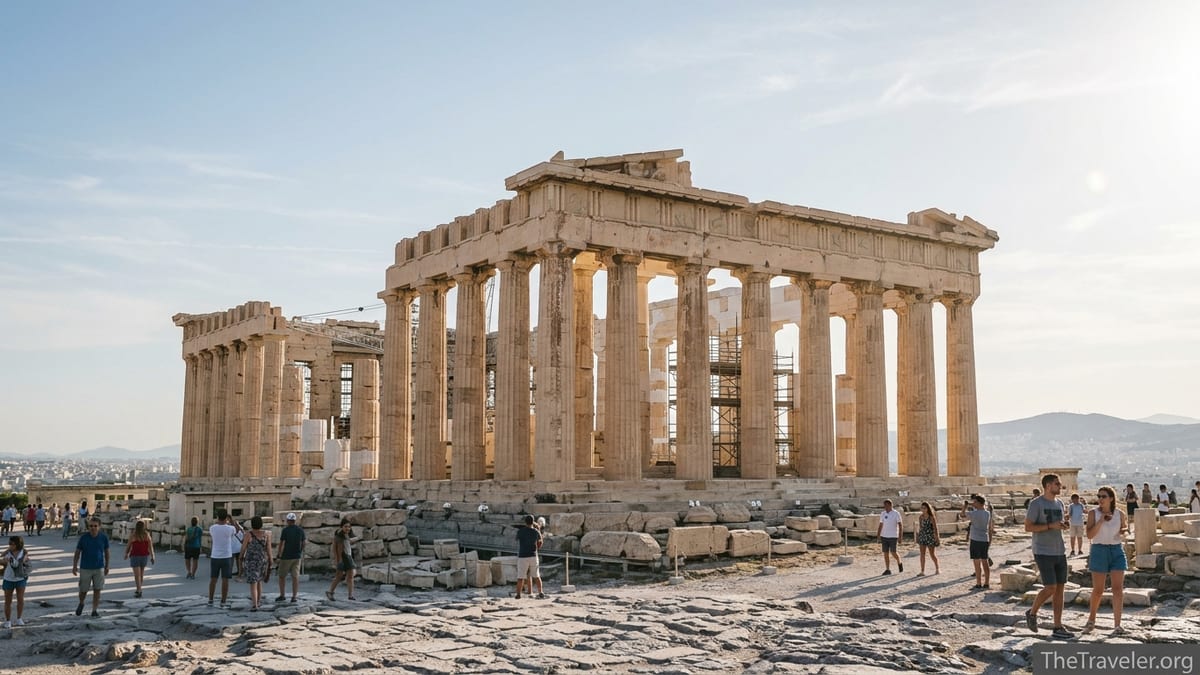
Restoration of the Parthenon has been a continuous, highly technical project since the late 20th century. Visitors today often notice the white marble blocks and column drums that stand out against the honey-colored originals. These new pieces come from the same ancient Pentelic quarries, but their crisp tool marks and unweathered surfaces make them easy to distinguish. The aim is not to recreate a brand-new temple, but to stabilize the ruin and recover enough of its geometry to make sense of the structure.
Walking around the site, you will see cranes, scaffolding and teams of conservators working on different sections. Official information panels, updated periodically, describe current phases, such as resetting architraves on the west side or reassembling fallen column drums using surviving fragments identified by detailed 3D scanning. For travellers, this means the view of the Parthenon changes over the years. Someone who visited Athens a decade ago will notice new reconstructed sections and different scaffold positions if they return today.
The Acropolis Museum complements this work by housing original sculptures in climate controlled galleries, protecting them from modern city pollution that once ate into the marble. On a practical level, many travellers now divide their Parthenon visit into two halves: first the Acropolis itself, often booked as a morning time slot to avoid the fiercest heat, then the museum in the afternoon when the glass-walled Parthenon Gallery offers air-conditioned views of both the sculptures and the temple outside.
Why the Parthenon Still Matters to Travellers Today
For contemporary visitors, the Parthenon is much more than an ancient ruin. It has become a shorthand for ideals of democracy, cultural achievement and contested heritage. When you stand on the Acropolis plateau and look down at the Greek Parliament building on Syntagma Square, it is hard not to connect the city’s 5th century BC assembly with modern political debates taking place below. Many guided tours explicitly draw this line, using the Parthenon as a backdrop to discuss how ancient ideas of citizenship and public life continue to influence today’s institutions.
The building also sits at the heart of global conversations about where cultural objects belong. Panels in the Acropolis Museum deliberately leave gaps where sculptures held in foreign collections would fit, encouraging visitors to imagine a reunited frieze. Travellers who have previously seen the sculptures in London or other European museums often find it striking to encounter the empty spaces and explanatory labels in Athens, turning a sightseeing stop into a reflection on ownership, empire and the responsibilities of modern museums.
On a more personal level, the Parthenon matters because it condenses 2,500 years of European and Mediterranean history into a single, walkable site. In one circuit you encounter pagan religion, Christian worship, Islamic prayer, siege warfare, romantic ruin-hunting, nationalist archaeology and high tech restoration science. Whether you are an architecture student studying column entasis or a casual visitor taking smartphone photos at sunset, the building offers a tangible connection to people who debated power, faith and beauty long before the modern city grew up around the hill.
The Takeaway
Visiting the Parthenon today is not about ticking off a postcard view so much as entering a long conversation between past and present. Athena’s temple began as a bold statement by a confident city at the height of its power, masterminded by Pericles and brought to life by Pheidias and an army of skilled craftsmen. It survived by changing roles, endured catastrophic explosions and lost some of its finest sculptures, yet it still defines the skyline of Athens and the way the world imagines classical Greece.
As scaffolding moves and new marble blocks slot into place, the Parthenon continues to evolve. Each traveller who climbs the Acropolis steps adds a new layer of experience to a monument that has already seen worshippers, soldiers, pilgrims, tourists and conservators pass through its shadow. Understanding its history from Athena to modern restoration does not diminish its mystery; instead it sharpens the sense that you are standing inside a story that is still being written.
FAQ
Q1. What was the Parthenon originally built for?
The Parthenon was built in the 5th century BC as a temple dedicated to Athena Parthenos, housing her monumental gold and ivory statue and symbolizing the city’s power.
Q2. Who were the key figures behind the Parthenon’s construction?
The project was driven by the Athenian statesman Pericles, designed by architects Iktinos and Kallikrates, and artistically overseen by the sculptor Pheidias, who created the main statue.
Q3. When was the Parthenon built, and how long did it take?
Construction began around 447 BC and was largely completed by 432 BC, so roughly 15 years from foundation to finishing the core structure and decoration.
Q4. Why is much of the Parthenon missing today?
Major damage came from a gunpowder explosion during a Venetian siege in 1687, followed by centuries of stone reuse, weathering, pollution and the removal of sculptures to foreign collections.
Q5. What happened to the statue of Athena Parthenos?
The original gold and ivory statue was probably removed and lost in late antiquity, possibly melted for its precious materials; only later copies and descriptions help us imagine its appearance.
Q6. Why are some Parthenon sculptures in the British Museum?
In the early 19th century, agents of Lord Elgin removed many sculptures with permission from the Ottoman authorities; these were later sold to the British Museum, where they remain a subject of debate.
Q7. What restoration work is happening on the Parthenon now?
Greek conservation teams are stabilizing and partially reassembling the structure using original fragments and carefully cut new marble, with modern metal supports designed to prevent further damage.
Q8. Can visitors go inside the Parthenon?
No, the interior is closed to the public for safety and conservation reasons, but you can walk around the exterior on marked paths and view original sculptures in the nearby Acropolis Museum.
Q9. How does the Acropolis Museum relate to a visit to the Parthenon?
The museum houses the original sculptures and architectural pieces in climate controlled galleries and includes a Parthenon Gallery aligned with the temple, making it an essential complement to the hilltop visit.
Q10. Why does the Parthenon still matter today?
It remains a powerful symbol of Athens, democracy and classical art, while also provoking discussion about cultural heritage, museum ethics and how modern societies preserve and interpret the ancient past.