


Few sights in the world match the first glimpse of the Parthenon glowing above Athens. Yet the experience can feel chaotic if you arrive without a plan. This guide walks you through exactly how to reach the Parthenon, which Acropolis gates to use, how to pair your visit with the Acropolis Museum, and the most rewarding walking routes so you spend more time looking at the marble and less time wondering where to go next.
Get the latest updates straight to your inbox!
Understanding the Parthenon and the Acropolis Site
The Parthenon is the largest and most famous temple on the Acropolis hill, but it is only one monument inside a wider archaeological site. When you buy a ticket, you are paying to enter the Acropolis of Athens, which includes the Parthenon, the Erechtheion with its Caryatid statues, the Temple of Athena Nike, and the monumental Propylaea gate. You cannot buy a separate ticket for the Parthenon alone, and there is no additional fee once you are on the hill.
The Acropolis stands on a rocky outcrop rising above central neighborhoods like Plaka, Makrygianni, Koukaki, Thissio, and Monastiraki. That means you can walk up from several directions and link a Parthenon visit with time in these districts. Many first-time visitors underestimate how large the plateau is. From the entrance to the Parthenon itself involves a steady climb over uneven stone paths and worn marble, so comfortable shoes are essential.
It is also important to separate the hill from the museum in your planning. The Acropolis Museum sits at the foot of the southern slope on Dionysiou Areopagitou Street and is run by a different authority from the archaeological site. Tickets, opening hours, and security checks for the hill and the museum are managed separately. In practical terms, this means you can choose to visit them on the same day or on different days according to your schedule and the weather.
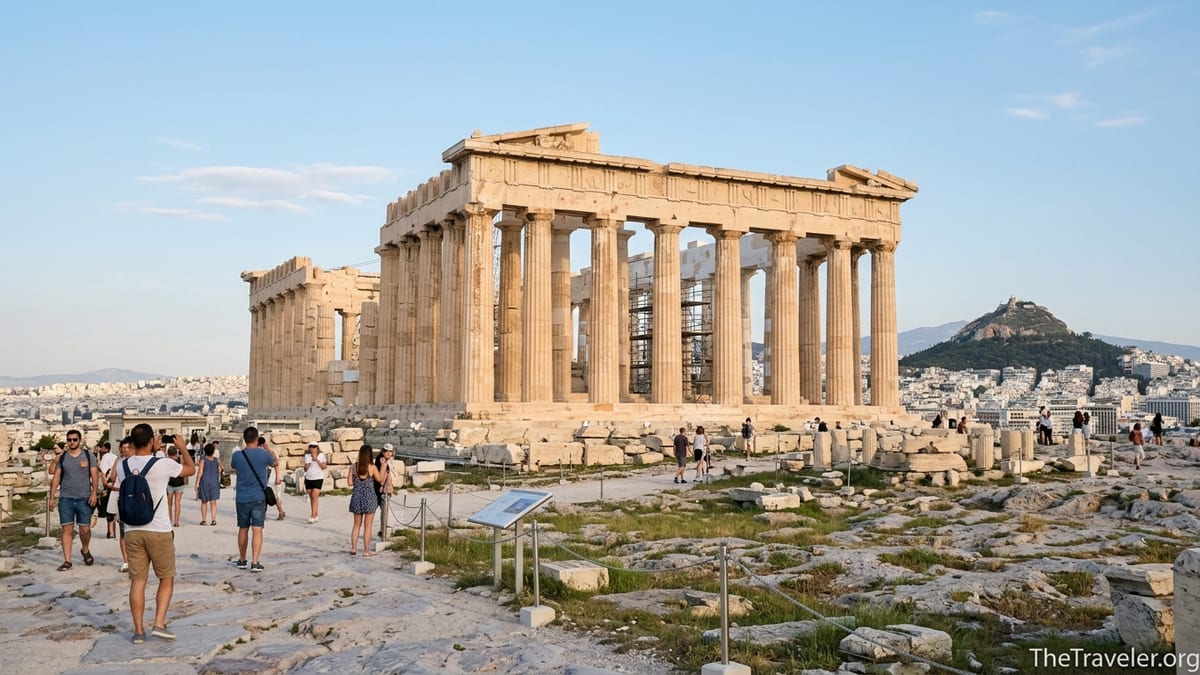
Once on the summit, the Parthenon is fenced off for preservation, but you can walk all the way around its perimeter. The best photographs often come from the northwest corner, where the columns align with views over central Athens and Mount Lycabettus. Expect scaffolding on at least part of the building at any given time, as ongoing restoration is a long term project rather than a temporary construction site.
How to Get to the Parthenon: Metro and City Access
The easiest way for most visitors to reach the Parthenon area is by Athens Metro. The closest station to the main southern approach and the Acropolis Museum is Acropolis station on Line 2, which opens directly onto Makrygianni and Dionysiou Areopagitou streets. When you step out of the station, you are effectively at the foot of the Acropolis hill, with the museum entrance just a short walk away and clear pedestrian signage pointing toward the archaeological site.
Acropolis station is especially convenient if you are staying near Syntagma, Panepistimio, or Omonia, since it is only a few stops away on Line 2. Travelers coming from the airport can take Line 3 to Syntagma and change there to Line 2 for one more stop to Acropolis. This route keeps the journey straightforward even with luggage. The station itself has escalators and elevators, which is useful if you are traveling with children, strollers, or heavy bags.
If you plan to approach the Acropolis from the north side, perhaps after exploring the Ancient Agora, Monastiraki station on Lines 1 and 3 is another practical option. From Monastiraki Square, the walk to the lower northern entrance of the Acropolis and the nearby Thissio area usually takes about 10 to 15 minutes at a relaxed pace. This is a pleasant stroll past cafes, street vendors, and views of the hill rising directly in front of you.
For travelers arriving by taxi, it is best to ask the driver to drop you either near the Acropolis Museum on Dionysiou Areopagitou Street or at the pedestrian area around the Thissio and Monastiraki side. Driving directly up to the ticket gates is not possible because the roads closest to the site are mainly pedestrianized. If you are staying in central areas such as Plaka, Koukaki, or Makrygianni, you can usually walk to either entrance in under 15 minutes, which is often faster and less stressful than dealing with traffic.
Choosing the Right Acropolis Entrance
The Acropolis has two main public entrances that matter for most visitors. The primary southern entrance sits close to the Acropolis Museum along Dionysiou Areopagitou Street. This is the gate most people use, especially those arriving at Acropolis metro station. From here you also pass the Theatre of Dionysus and the Odeon of Herodes Atticus on the south slope as you climb toward the summit.
The secondary northern entrance is closer to the neighborhoods of Monastiraki and Thissio. It is often used by visitors who are combining the Acropolis with the Ancient Agora or who are staying in that part of the city. This gate can sometimes be a little quieter than the southern side, particularly early in the morning. If you reach it from Monastiraki Square, you will see signs for the Acropolis as you follow the pedestrian streets uphill.
For many travelers, the best strategy is to enter at one gate and exit at the other. For example, you might start at the southern entrance near the museum in the early morning, climb up past the south slope monuments, explore the Parthenon and summit, then descend through the northern exit and continue down toward Monastiraki for lunch. This creates a natural walking route that avoids backtracking and lets you experience more of the surrounding neighborhoods.
Queues are a practical reality at both entrances, particularly between late spring and early autumn and during mid morning hours when tour groups arrive. Buying your ticket in advance where possible, or arriving close to opening time, can significantly reduce waiting. Lines also involve airport style bag checks, so keep your daypack light and avoid bringing unnecessary items that might trigger additional inspections.
Planning Your Visit: Timing, Tickets and Practical Tips
Opening hours for the Acropolis vary by season, but in the warmer months the site typically opens early in the morning and closes at or around sunset, while in winter the hours are shorter. Because these times can change, especially on holidays and during heatwaves, check the official listing shortly before you travel rather than relying on outdated guidebooks. The Acropolis Museum has its own timetable, often staying open into the evening on certain days, which allows you to move your indoor visit to the hotter part of the day.
Ticket prices for the Acropolis and the Acropolis Museum are set independently. Expect the Acropolis archaeological site ticket to cost in the range often quoted online for current seasons, and note that in peak periods there may also be combined tickets that cover multiple archaeological sites across Athens. The museum ticket is typically a separate purchase. Online booking platforms sometimes add substantial service fees on top of the base price, so if you see a total that looks far higher than the official rate, you are probably looking at a reseller rather than a direct purchase.
In practice, many visitors buy Acropolis tickets either from the official online system or directly at the gate early in the day. Booking ahead can make sense during busy months or if you have tight timing, such as when visiting from a cruise ship. However, buying on the spot still works for most independent travelers, particularly outside peak times. Always carry a physical or digital copy of your ticket and a form of identification if you are using any discounted or free entry categories.
Heat and crowds are the two factors that most affect the quality of your visit. On summer days, the marble surfaces on the hill reflect the sun and can feel significantly hotter than the air temperature. Early morning visits, from opening time until around 9 or 9:30 am, often offer the most pleasant conditions and lighter crowds. Late afternoon and early evening can also be atmospheric, with softer light and cooler air, although some time slots may still be busy with group tours aiming for sunset.
What to See at the Parthenon and Around the Acropolis
Once you pass through the Propylaea and reach the summit, the Parthenon dominates the plateau. Built in the 5th century BC, it was originally a richly painted temple dedicated to Athena Parthenos. Today its creamy Pentelic marble, restored columns, and partial friezes form the emblematic image of classical Greece. As you walk around the structure, notice variations in the column drums and wall blocks where original stones meet restored pieces, a detail that hints at decades of careful conservation work.
Across from the Parthenon stands the Erechtheion, a more compact temple on an uneven part of the rock. The south porch, supported by six sculpted maidens known as Caryatids, is one of the most photographed corners of the Acropolis. The figures you see on the hill are high quality casts, while the best preserved originals are displayed a short walk away in the Acropolis Museum. The contrast between the weathered forms on the plateau and the protected marbles in the gallery downstairs helps bring the site’s preservation story to life.
Before or after your time on the summit, pay attention to the south slope as you ascend or descend from the southern entrance. The Theatre of Dionysus, often considered the birthplace of Greek drama, spreads out in marble tiers below the path. Farther along, the stone shell of the Odeon of Herodes Atticus hugs the hillside. In summer it still hosts concerts and performances, so you may see modern stage equipment amid the ancient seats.
Views from the Acropolis plateau are as compelling as the temples themselves. One side faces toward the Athenian Riviera and the Saronic Gulf, while another opens onto the dense city center with Mount Lycabettus rising prominently behind it. On clear days, you can trace your earlier metro ride from Piraeus or spot familiar landmarks like Syntagma Square and the Panathenaic Stadium. Photography is allowed across the site, though tripods are generally restricted, and guards may ask visitors to avoid posing with costumes or props that appear disrespectful to the monument.
Pairing the Acropolis with the Acropolis Museum
Visiting both the Acropolis and the Acropolis Museum gives you a far richer understanding of the Parthenon than seeing either on its own. The museum is located on Dionysiou Areopagitou Street, only a few hundred meters from the southern gate of the Acropolis, and its galleries were designed in a direct visual dialogue with the hill. Inside, you will find architectural fragments, sculptures, and friezes from the Parthenon and the other temples, displayed at eye level in controlled light.
One popular approach is to visit the Acropolis early in the morning, when the marble is cooler and the crowds lighter, then move down to the museum late morning or around midday. This way, you can spend the hotter hours indoors walking through the Archaic Gallery, where statues from earlier temples stand free of glass cases, and then reach the top floor Parthenon Gallery, whose layout mirrors the temple above. Glass walls on this floor frame direct views of the real Parthenon, so you can compare originals and casts while looking back to the hill.
Another strategy is to reverse the order on your first day in Athens. Some travelers spend their arrival afternoon or a cloudy day in the museum first, slowly reading the interpretive panels and watching the short introductory films, then visit the Acropolis itself the following morning with that context fresh in mind. This can be especially helpful for families, as children often respond well to seeing the reconstructed colors and details of the sculptures in the museum before confronting the more weathered stone outdoors.
The museum building also offers practical comforts that you will not find on the summit: air conditioning, a café and full service restaurant with terrace views of the Acropolis, clean restrooms, and a gift shop. These facilities make it a natural place to pause before or after the climb. Because the museum has a separate entrance ticket and its own security, plan a little extra time for bag checks on busy days, again keeping your belongings simple to speed up the process.
Suggested Walking Routes Around the Parthenon
One of the most rewarding ways to experience the Parthenon is to think in terms of walking routes rather than isolated sights. A classic loop begins at Acropolis metro station, where you emerge onto Makrygianni Street and turn immediately onto the pedestrian Dionysiou Areopagitou promenade. After a short stroll past street musicians and souvenir stands, you reach the southern Acropolis ticket office. From there, follow the marked path past the Theatre of Dionysus and up to the Propylaea and the Parthenon.
After exploring the summit, you can descend via the northern path toward the exit closest to the Ancient Agora. Once outside the site, simply continue downhill to reach either Thissio or Monastiraki. Take time to wander among the ruins of the Agora or browse the flea market streets around Monastiraki Square. This entire route, from Acropolis station through the summit and down into Monastiraki, comfortably fills a morning or afternoon, including time for photos and short breaks.
A second route suits visitors who want to emphasize neighborhood atmosphere. Start in Monastiraki, where you can grab a quick breakfast from a bakery or a souvlaki stand, then walk along the pedestrianized Adrianou and Apostolou Pavlou streets toward Thissio with the Acropolis rising above you. As you loop around the hill, follow signs to the northern Acropolis entrance and climb up to the summit. After your visit, exit through the southern gate and walk downhill to the Acropolis Museum for a late lunch at the museum restaurant with views back to the Parthenon.
If you have more time in Athens, you can extend your Acropolis day with short detours. From the southern exit, it is a gentle walk to the leafy streets of Koukaki, which has a more local feel and plenty of small cafes. Alternatively, from the northern side you can head toward the Areopagus and Pnyx hills, where Athenians gather in the evenings to watch the sunset paint the Parthenon in warm tones. These free viewpoints are ideal if you want additional perspectives on the monument without reentering the archaeological site.
Accessibility, Safety and On Site Etiquette
The Acropolis hill involves uneven paths, slopes, and marble surfaces that can be slippery even in dry weather. Visitors with mobility issues should be aware that although some improvements have been made, including certain paved sections and an elevator on the north side for those with significant mobility impairments, the experience still requires caution. If accessibility is a concern, check the latest details on eligibility and procedures before your visit and allow extra time.
Footwear is one of the most practical safety choices you can make. Flat shoes with good grip are strongly recommended, as polished marble steps near the Parthenon and the Propylaea can feel like ice under smooth soles. Bring water, particularly from late spring through early autumn, when the sun can be intense and there is little shade on the summit. There are water fountains in and around the site, but having a bottle with you avoids unnecessary detours while exploring.
Local regulations also matter. Climbing on ruins, sitting on ancient walls, or touching sculptural surfaces is not allowed, and site staff will intervene quickly if they see anything that could damage the monuments. Food is generally restricted, though small snacks are usually tolerated in some areas, and there are designated spots for brief rests. Large backpacks, metal-tipped walking sticks, and drones are not appropriate and may be refused at security.
Finally, consider the broader atmosphere of the site. The Parthenon is both a major tourist destination and a symbol with deep cultural significance for Greeks. Loud music, shouting, or theatrical costume photo shoots are discouraged. A respectful tone not only protects the monuments but also enhances your own experience, allowing you to appreciate the contrast between the busy city below and the relative calm on the rock.
The Takeaway
Visiting the Parthenon is less about ticking off a single monument and more about understanding a whole landscape of history that stretches from the marble columns on the hill to the glass galleries of the museum below. With a bit of planning, you can link metro routes, entrance choices, and walking paths into a day that feels coherent rather than rushed.
Using Acropolis station and the southern gate works well if you plan to include the Acropolis Museum, while a loop between Monastiraki and the northern entrance helps you connect the site with the Agora and lively city streets. Choosing early morning or late afternoon visits, wearing proper shoes, and packing light not only keeps you comfortable but also puts you a step ahead of the largest crowds.
Most of all, give yourself time. An unhurried circuit around the Parthenon, followed by a slow walk through the museum’s Parthenon Gallery, will leave you with a far richer impression than any quick photo stop. When you finally see the temple framed by the city and the sea beyond, it is the combination of these moments that will define your memory of Athens.
FAQ
Q1. Can I visit the Parthenon without visiting the rest of the Acropolis?
The Parthenon sits inside the Acropolis archaeological site and does not have a separate entrance or ticket. Your Acropolis ticket covers the entire hill, including the Parthenon, the Erechtheion, the Temple of Athena Nike, and the Propylaea.
Q2. Which metro station is best for visiting the Parthenon?
For most visitors, Acropolis station on Line 2 is the most convenient, as it is only a short walk from the southern Acropolis entrance and the Acropolis Museum. Monastiraki station, on Lines 1 and 3, is useful if you plan to approach from the north side after exploring the Ancient Agora or Monastiraki Square.
Q3. How much time should I allow to visit the Parthenon and the Acropolis?
Most travelers should plan at least two to three hours on the Acropolis hill. This allows time to climb up from the entrance, walk around the Parthenon and the other temples, take photos, and descend without rushing. If you add the Acropolis Museum, expect your total visit to fill much of a day.
Q4. Is it better to visit the Acropolis or the Acropolis Museum first?
There is no single right order. Many people prefer the Acropolis first thing in the morning to avoid heat and crowds, then visit the museum at midday. Others choose to explore the museum on one day to understand the history and then see the Acropolis the next morning. Choose based on weather, your energy levels, and how much time you have.
Q5. Are there toilets, shade, and places to buy food on the Acropolis hill?
Basic facilities exist on the site, but they are limited. There is very little shade on the summit, and food options are minimal. Most visitors use restrooms and eat before or after their visit, either near the Acropolis Museum or in nearby neighborhoods like Plaka, Makrygianni, or Monastiraki.
Q6. Is the Acropolis accessible for visitors with limited mobility?
The Acropolis involves slopes and uneven, sometimes slippery surfaces, which can be challenging. There is an elevator on the north side for visitors with significant mobility impairments, but the overall terrain still requires care. If accessibility is essential for you, check the latest guidance shortly before your visit and plan extra time.
Q7. Do I need to book tickets for the Acropolis in advance?
Advance booking is strongly recommended during busy months or if you have limited time, as it can reduce queuing at the ticket office. Outside peak periods, many visitors still buy tickets at the entrance, particularly early in the day. Always verify that you are purchasing from an official or clearly identified source to avoid unexpected service fees.
Q8. What should I wear to visit the Parthenon?
Comfortable, closed shoes with good grip are the most important item, as polished marble and stone paths can be slippery. In warm months, lightweight clothing, a hat, sunglasses, and sunscreen are advisable. While there is no strict dress code, respectful attire is appreciated given the cultural and historical importance of the site.
Q9. Can I combine the Parthenon visit with other nearby attractions in one day?
Yes. Many travelers combine the Acropolis and Parthenon with the Acropolis Museum and at least one other site such as the Ancient Agora or the Temple of Olympian Zeus. A common pattern is Acropolis in the morning, museum at midday, and a stroll through Plaka or Monastiraki in the late afternoon or evening.
Q10. Is it possible to see the Parthenon at sunset without staying on the hill until closing?
For sunset views of the Parthenon without being on the site itself, locals often head to nearby hills such as Areopagus or the Pnyx, which lie just outside the archaeological area. From these spots you can watch the sky change color behind the temple and enjoy a panoramic view of Athens without needing another ticket.