


The story of the Parthenon Sculptures, often called the Parthenon Marbles, stretches from a fifth century BC temple in Athens to museum galleries in London and beyond. For travelers, this history is not just a legal and diplomatic saga. It directly shapes what you will see on the Acropolis, inside the Acropolis Museum, and in the British Museum today. This guide explains where the sculptures are now, how they are displayed, and what remains on the monument itself so you can understand the controversy while planning your own visit.
Get the latest updates straight to your inbox!
What Are the Parthenon Sculptures
The Parthenon was built between about 447 and 432 BC as a temple to Athena on the Acropolis, the rocky hill that dominates central Athens. Its marble sculptures were among the most ambitious ever created for a Greek temple. They included three main groups: the long frieze running around the inner building, the high relief metopes above the colonnade, and the large free standing statues in the triangular pediments at each end. Together they showed mythological battles, gods and heroes, and a grand procession often linked to the Panathenaic festival.
Today, none of these sculptures remain in their original positions on the temple. Centuries of damage, including a major explosion in 1687 when the Parthenon was used to store gunpowder, shattered the building and its decoration. Later, in the early 1800s, Lord Elgin, the British ambassador to the Ottoman Empire, removed roughly half of the surviving sculptures and shipped them to Britain. Others fell in later collapses, were reused in later buildings, or were damaged by pollution and early restoration attempts.
For modern visitors, this means that the “Parthenon Sculptures” are now a scattered collection of originals and casts. About half of the surviving frieze blocks are in the British Museum in London, while roughly a similar amount are in the Acropolis Museum in Athens, with smaller fragments in museums such as the Louvre in Paris and the National Museum of Denmark in Copenhagen. Some original metopes and pediment figures are in Athens, others in London, and many have been lost entirely.
Understanding this fragmented history is essential context when you step into any gallery that presents the Parthenon. Whether you are standing on the Acropolis plateau looking up at the temple, walking through the glass walled Parthenon Gallery in Athens, or entering the Duveen Gallery in the British Museum, what you see is only part of a much larger story.
Where the Sculptures Are Today
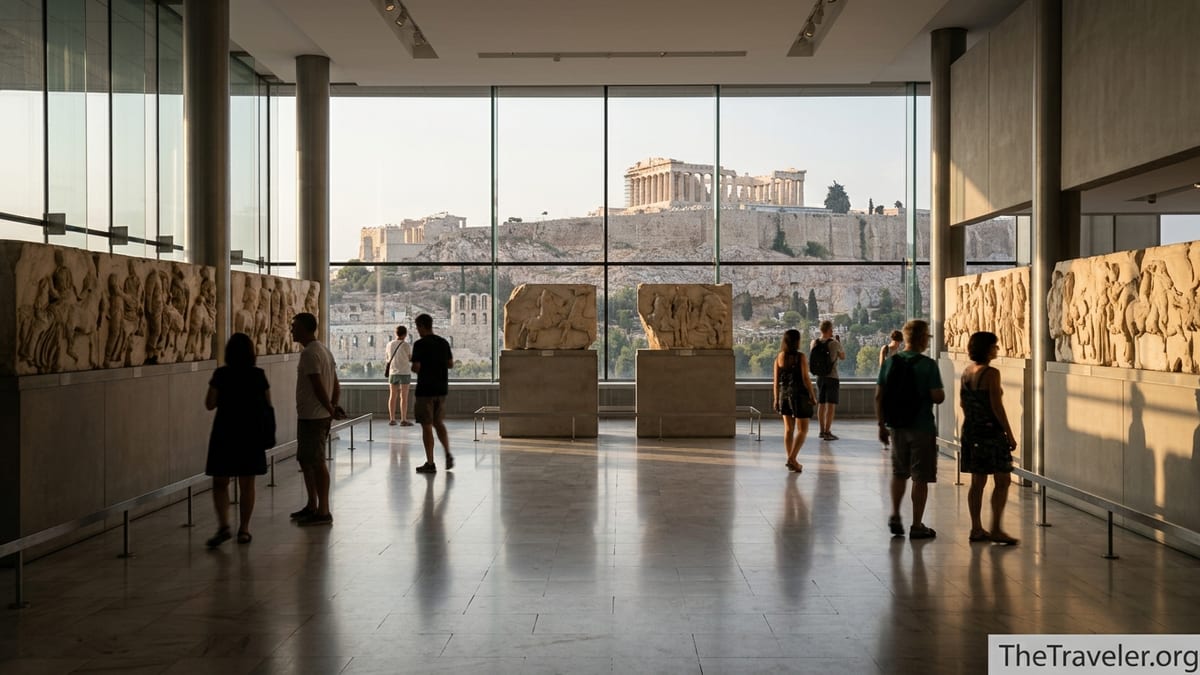
Most travelers encounter the Parthenon Sculptures in one of two main places: the Acropolis Museum in Athens or the British Museum in London. The Acropolis Museum, opened in 2009 roughly 300 meters below the Parthenon itself, was purpose built to house all surviving sculptures from the Acropolis, including the Parthenon’s. Its top floor, the Parthenon Gallery, is aligned with the temple on the hill so that as you walk around the sculptures you can see the real building through floor to ceiling glass.
Inside this gallery, the surviving original blocks from Athens are combined with plaster casts of pieces that are currently held in London or other museums. The frieze is arranged in its original order around a rectangular core, allowing you to follow the procession scene as it would have wrapped around the inner walls of the temple. Metopes and pediment sculptures are mounted at their original heights, but with missing figures indicated by casts or gaps. Visitors often comment that the empty spaces and differently colored plaster sections make the fragmentation instantly visible.
In London, the British Museum exhibits its Parthenon Sculptures in the Duveen Gallery, a long, high hall opened in the 1930s. Here, the museum displays most of its frieze blocks together, with metopes and pedimental figures arranged along the walls. The presentation emphasizes the marbles as key works of classical art within a global collection. For travelers, this means you can study many of the finest surviving sections up close, but without the direct visual link to the Acropolis that you experience in Athens.
A smaller number of pieces are scattered elsewhere. The Louvre, for example, holds a metope showing a Lapith fighting a centaur, and Copenhagen’s National Museum keeps a fragment of the frieze. These objects are usually displayed within broader classical Greek galleries, with labels explaining their Parthenon origin. While few travelers will plan a trip solely to see these fragments, knowing they exist underscores that the story of the sculptures is not limited to just two museums.
Visiting the Acropolis and What Remains On Site
Many visitors are surprised when they reach the Acropolis to find that very little original sculptural decoration remains on the Parthenon itself. From the outside, you will see the familiar colonnade and the restored entablature, supported by extensive modern structural work. However, most original metopes and virtually all of the pedimental sculpture have been removed for protection and are now in the Acropolis Museum or, for some pieces, in London.
What you do see on the temple today is mostly architectural rather than sculptural. Sections of triglyphs and metope frames remain in place, and a few heavily eroded blocks still bear traces of carving. Because marble on the hill continues to weather under strong sun, wind and city pollution, Greek authorities have chosen to transfer surviving artwork indoors. Large areas of the Parthenon are also under ongoing restoration, so expect to see scaffolding or cranes, particularly on the west and north sides, even in 2026.
For a typical visit, you might spend about 45 to 60 minutes walking around the Parthenon, taking in views of Athens and the neighboring temples, then another 90 minutes to two hours inside the Acropolis Museum. A practical route is to visit the museum first, especially in summer when midday temperatures on the rock can exceed 32 degrees Celsius. The museum is air conditioned and offers detailed models and videos that help you interpret what little remains on the actual building.
Tickets for the Acropolis archaeological site and the Acropolis Museum are sold separately. As of mid 2026, you can expect to pay in the range of around 20 to 30 euros for high season entry to the Acropolis site and a separate fee in the low teens for the museum, with reduced prices in winter and combined options through official channels. Buying timed tickets in advance is strongly recommended in peak months to avoid long queues at the entrance and security checkpoints.
Inside the Acropolis Museum: How the Parthenon Gallery Works
The Parthenon Gallery on the third floor of the Acropolis Museum is one of the most carefully designed exhibition spaces in Europe. The room mirrors the footprint and orientation of the original temple. The outer glass walls correspond to the colonnade, while an inner rectangular core represents the cella, or main chamber. Sculptures are mounted around this core at the same relative positions and heights they had on the building, effectively reconstructing the sculptural program in three dimensions.
As you walk clockwise around the gallery, you follow the procession of the frieze. Original blocks in honey colored Pentelic marble sit beside bright white plaster casts, making it easy to see which segments currently reside outside Greece. Large labels and digital screens explain scenes such as horsemen preparing for the procession, gods receiving offerings, and citizens carrying votive objects. Visitors often pause by the windows to line up the frieze with the view of the Parthenon, which sits on the hill only a few hundred meters away.
The metopes and pediment sculptures are displayed along the perimeter. For example, surviving metopes from the south side that depict the battle between Lapiths and centaurs are mounted at a raised height, while pediment fragments, such as the chariot of the moon goddess Selene, are placed to suggest their original positions in the triangular gables. The gaps where pieces are in London or lost entirely remain deliberately visible, reinforcing the sense of absence and separation.
Practical details matter for travelers. The museum has a strict no large bags policy, with security checks at the entrance and a staffed cloakroom. Photography is allowed in most areas, including the Parthenon Gallery, but flash is typically prohibited. A good strategy is to arrive shortly after opening, spend an hour with the Archaic sculptures on the lower floors, then allocate at least 45 minutes exclusively for the Parthenon Gallery. A café terrace with views of the Acropolis offers a useful break between sections.
The British Museum’s Duveen Gallery and the Case for a “World Museum”
In London, the Duveen Gallery at the British Museum offers a very different experience of the Parthenon Sculptures. The long, rectangular hall presents the frieze in a continuous run along the walls, at a height that allows you to examine details of horses, drapery and anatomy at close range. Metopes and pediment figures are spaced out around the room rather than mounted at their original heights, making individual pieces easy to study, though without the architectural context provided in Athens.
The British Museum frames the marbles as part of a world collection that connects cultures from Egypt and Mesopotamia to Rome and beyond. Label texts emphasize that the sculptures can be compared with works from other ancient civilizations within a short walk, encouraging visitors to think about cross cultural influence rather than just Athenian history. For many tourists who might not travel to Greece, the museum argues that this offers broad access to what it sees as a cornerstone of classical art.
The institution maintains that the sculptures were acquired legally from Lord Elgin, who obtained permission from Ottoman authorities of the time. It also stresses that the marbles have been on public display in London for about two centuries, becoming an integral part of British cultural life. The museum has invested in conservation, climate control and research, which it presents as evidence of its responsible stewardship.
For visitors, all of this means that viewing the Parthenon Sculptures in London is free, as general admission to the British Museum does not require a ticket. The Duveen Gallery can be busy, especially in school holidays, but it is often less crowded than the museum’s Egyptian mummies or Rosetta Stone. A realistic plan is to allocate at least 30 to 45 minutes in the gallery, ideally after reading a brief overview of the controversy, so you can look at the labels with a critical eye and consider both the aesthetic value and the history of how the marbles arrived in Britain.
The Repatriation Dispute: Key Arguments on Both Sides
The question of whether the Parthenon Sculptures should remain in London or be returned to Athens has been one of the most high profile cultural heritage disputes of the last few decades. Greece argues that the marbles were taken under dubious circumstances while the country was under Ottoman occupation, and that no valid firman, or decree, has been produced that clearly granted Elgin the right to remove major architectural sculptures from the temple. Greek officials often stress that what is at stake is the reunification of a single, dismembered monument rather than a general claim to all Greek antiquities abroad.
Since the opening of the Acropolis Museum’s Parthenon Gallery, Greece has emphasized that it now has a purpose built, state of the art facility suitable for housing the entire surviving sculptural program. Greek leaders, including recent prime ministers, have publicly called for the marbles’ return, sometimes comparing the current split display to cutting a painting in half and keeping its parts in different countries. High profile cultural figures and international organizations have also lent support to the idea of reunification.
The British Museum and successive UK governments have consistently taken a different view. They maintain that Parliament legally acquired the marbles from Elgin in the early nineteenth century, and that British law currently prevents the museum from permanently deaccessioning core parts of its collection. Museum officials argue that the sculptures are best understood within a global context, where visitors can compare them with objects from many cultures in one place. They also highlight long standing loans of Greek antiquities to other countries as evidence that they are open to sharing heritage.
Diplomatic tensions occasionally flare. In late 2023, for example, a planned meeting in London between the Greek and UK prime ministers was abruptly canceled after public comments about the marbles, drawing coverage from international news outlets and reminding travelers that this is not just an academic debate. At the same time, there have been reports of quiet talks about some form of long term loan or cultural partnership, though no binding agreement has been announced as of mid 2026. Visitors should expect that the situation may evolve, and future trips could encounter different display arrangements.
Planning Your Own Experience: Athens, London or Both
From a traveler’s point of view, the dispute shapes where and how you can experience the Parthenon Sculptures, but it does not prevent you from seeing world class examples in both cities. If your trip includes Athens, prioritize a combined visit to the Acropolis and the Acropolis Museum. In practical terms, that means planning at least half a day, wearing sturdy shoes for the uneven marble surfaces on the hill, and being prepared for strong sun even outside high summer. Many guided tours sold by reputable Athenian agencies include skip the line entry and a licensed guide who can explain the history of the marbles while you stand in front of the casts and originals in the Parthenon Gallery.
If you are based in London, build time for the Duveen Gallery into a wider British Museum visit. Because admission is free, you can choose to focus your energy on just a few key sections, such as the Parthenon Sculptures, the Nereid Monument and the Assyrian reliefs, rather than trying to see everything in one day. Audio guides and short printed trails often include a focused route through the Greek galleries that highlights the marbles and explains the basics of the controversy in plain language.
Travelers who are especially interested in the ethics of cultural heritage may wish to see both displays within a short period. For example, someone on an extended Europe trip might visit Athens first, spending time in the Parthenon Gallery with its visible gaps and direct view of the temple, then fly to London a week later and walk into the Duveen Gallery. Experiencing the same sculptures in two different contexts makes the dispute feel tangible and can be a powerful educational moment, especially for older teenagers and university students.
In all cases, reading a short overview of the history before you go will make the visit more meaningful. Many hotels in central Athens keep free leaflets about the Acropolis and the museum at reception, and bookstores in both cities stock accessible guides to the Parthenon. Even a basic understanding of terms like frieze, pediment and metope, and of the roles of Lord Elgin and modern Greek cultural policy, will help you interpret what you see on the labels and in the architecture of the galleries.
The Takeaway
Whether you stand under the blazing sun on the Acropolis looking up at the Parthenon, or in the cool light of a museum gallery in Athens or London, the Parthenon Sculptures present both beauty and unresolved questions. The surviving marbles are fragments of a single architectural program, created for a specific building in a specific city, yet now divided between institutions that tell different stories about them. As a traveler, you move between those stories every time you cross a gallery threshold.
The dispute over their future is likely to continue, shaped by changing ideas about colonial era collecting, national identity and the role of large museums. You may arrive in Athens to hear local guides speak passionately about reunification, then reach London and find curators emphasizing shared global heritage. Instead of choosing a simple answer, your visit can be a chance to listen to both sides, look closely at the objects themselves, and decide what you think is most respectful to history and to the people who care for it today.
For now, the practical reality is clear. If you want to see the Parthenon Sculptures, you will find major portions in both the Acropolis Museum and the British Museum, with smaller fragments elsewhere in Europe. The Parthenon itself, largely stripped of its original decoration, remains a powerful shell that anchors the whole story. Building your itinerary around these three experiences will give you the fullest possible encounter with one of the most debated works of ancient art.
Whether you leave convinced that the marbles should stay where they are, be reunited in Athens, or circulate on long term loans, you will have engaged with a living issue rather than a static ruin. That, in many ways, is the greatest value of seeing the Parthenon Sculptures in person: they make the ancient world, and our responsibilities to its remains, feel immediate and real.
FAQ
Q1. What is the difference between the Parthenon Sculptures and the Elgin Marbles
The term “Parthenon Sculptures” refers to all surviving sculpture from the Parthenon, while “Elgin Marbles” is a historical British nickname for the large group removed by Lord Elgin in the early 1800s and later acquired by the British Museum.
Q2. How much of the original Parthenon sculpture survives today
Only a portion survives, and it is heavily fragmented. Roughly half of the surviving frieze is in London, much of the rest is in Athens, and individual pieces of metopes and pediments are split between these and a few other European museums, with many figures completely lost.
Q3. Can I see original Parthenon sculptures on the temple itself
Very few original sculptural elements remain in place on the Parthenon. Most surviving sculptures have been removed for conservation and are housed in the Acropolis Museum and the British Museum, leaving mostly architectural blocks and weathered fragments on the building.
Q4. Is the Acropolis Museum worth visiting if I have already seen the marbles in London
Yes. The Acropolis Museum presents the sculptures in a gallery aligned with the actual Parthenon, using originals and casts to reconstruct their original arrangement, and the visual connection to the temple through glass walls offers a context you cannot experience in London.
Q5. Do I need separate tickets for the Acropolis and the Acropolis Museum
Yes. Entry to the Acropolis archaeological site and to the Acropolis Museum is ticketed separately, with different prices and opening hours, so you should check current information and consider buying timed tickets in advance for busy periods.
Q6. Is it free to see the Parthenon Sculptures in the British Museum
Yes, general admission to the British Museum, including the Duveen Gallery where the Parthenon Sculptures are displayed, is free, although some temporary exhibitions in other parts of the museum may require paid tickets.
Q7. Has an agreement been reached to return the marbles to Greece
No final agreement has been announced as of mid 2026. There have been reports of discussions about potential long term loans or cultural partnerships, but the core legal and political questions remain unresolved.
Q8. Why did Greece build the new Acropolis Museum
Greece built the new Acropolis Museum to protect and display artifacts from the Acropolis in modern conditions and to provide a dedicated Parthenon Gallery capable of housing the entire surviving sculptural program if it were ever reunited in Athens.
Q9. Are there guided tours that focus specifically on the Parthenon Sculptures
Yes. In Athens, many licensed guides and tour companies offer combined Acropolis and Acropolis Museum tours that devote considerable time to the Parthenon Gallery, while in London, some British Museum tours and audio guides include sections that focus on the history and controversy of the marbles.
Q10. Will I understand the displays if I do not speak Greek
Yes. Both the Acropolis Museum and the British Museum provide labels and information panels in at least Greek and English, and in some cases additional languages, so international visitors can follow the narrative without needing Greek.