


More news on this day
Regular passenger trains are returning to the northeastern Polish city of Łomża for the first time in 33 years, marking a symbolic milestone in the country’s wider rail revival and reshaping connectivity across a largely car-dependent region.
Get the latest news straight to your inbox!
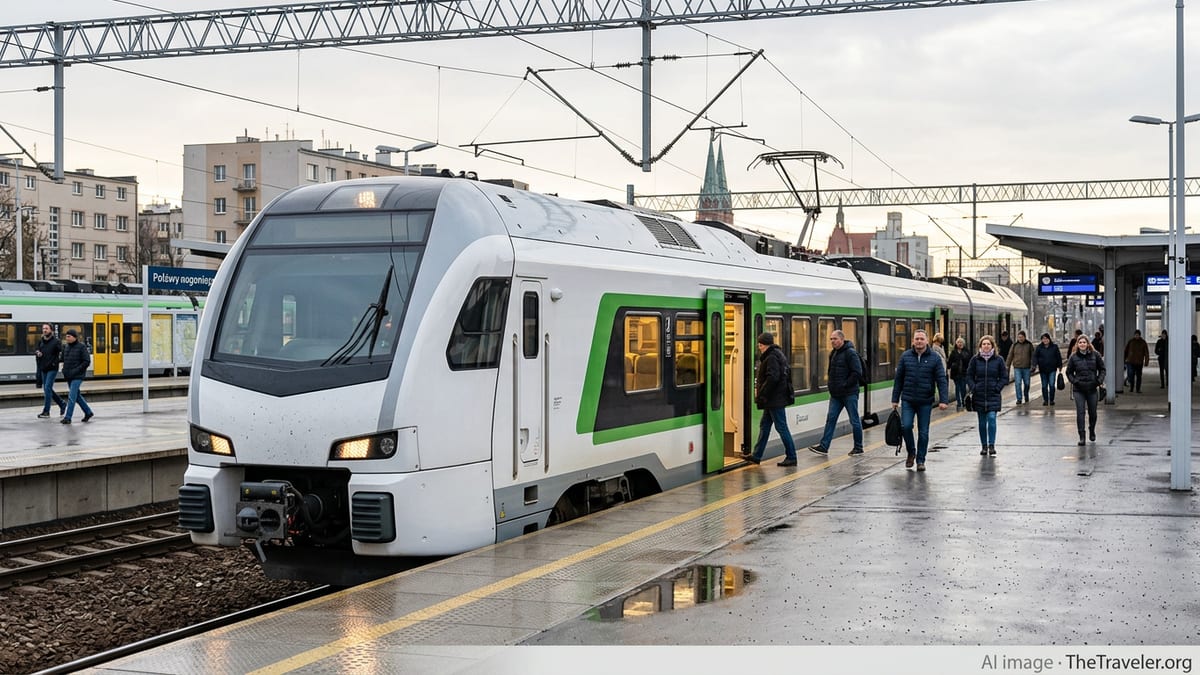
A long-isolated city rejoins the rail map
Łomża, a city of around 60,000 residents in the Podlaskie region, lost its regular passenger services in the early 1990s during a wave of nationwide cutbacks on underused routes. Since then, the nearest long-distance trains have operated from cities such as Białystok and Ostrołęka, leaving Łomża dependent on buses, private cars and regional roads for most long-distance journeys.
According to published coverage in Polish and international rail media, new services are being introduced as part of a broader programme of investments on the Ostrołęka to Łomża corridor, including upgraded tracks, platforms and signalling. Reports indicate that the restored route is designed to offer modern, higher-comfort regional trains and more predictable journey times than the long-distance buses that have dominated travel to and from the city.
Publicly available information shows that the reopening aligns with a timetable correction on the national network, typically introduced in mid-June and early September each year. For Łomża, the change is more than a routine adjustment: it is the first time in more than three decades that the city’s station will appear on regular passenger timetables, rather than only in the context of freight movements or occasional special services.
While the initial offering focuses on regional and interregional trains, the renewed link is also expected to improve access to major hubs such as Warsaw via planned through connections or well-timed transfers, allowing residents a smoother path to the capital and other large cities without relying solely on the road network.
How the 33-year break in service came about
The absence of passenger rail in Łomża dates back to the post-communist restructuring of Poland’s railway system, when declining ridership, aging rolling stock and mounting maintenance costs prompted the withdrawal of trains on many secondary lines. In the case of Łomża, regular services to Ostrołęka were phased out, and the city’s station gradually shifted to a freight-oriented role.
In the following decades, the tracks remained in place but saw limited use, mainly for cargo traffic. Plans to restore passenger services appeared periodically in regional strategies and national transport concepts but were repeatedly postponed as other corridors, including those toward larger regional capitals, were given priority for renewal and electrification.
Reports indicate that the turning point came with a new round of European Union co-financed investments aimed at strengthening medium-sized cities and supporting more sustainable transport. Within this framework, the Ostrołęka to Łomża line was identified as a candidate for modernization, both to serve local communities and to expand alternatives to private car travel in northeastern Poland.
Technical work on the corridor has included track upgrades for higher speeds, renovations of stations and stops, and modern passenger information systems. Publicly available project documents highlight the objective of delivering a service level that can compete with road transport in reliability and comfort, rather than merely restoring a minimal timetable.
Strategic role in Poland’s rail renaissance
The return of trains to Łomża is being framed within a broader expansion of passenger rail across Poland. Data from the national rail regulator and sector reports show that passenger numbers have climbed steadily in recent years, with 2025 marked as the strongest year for ridership in three decades on the country’s railways as a whole.
Alongside major corridor upgrades and high-speed projects, policymakers have increasingly focused on reconnecting towns and cities that lost trains in the 1990s and early 2000s. In western and southern Poland, recent years have brought restored services on lines to spa towns and mountain resorts, while in Pomerania and Mazovia, regional operators have reactivated routes that had gone unused for more than twenty years.
Within this context, Łomża’s return to the timetable is seen as a significant step for a city that had effectively fallen into a rail blind spot despite its size and regional importance. By restoring direct rail access, planners aim to rebalance the transport system and encourage more residents to switch from private cars to public transport for intercity trips.
Sector analyses suggest that such reopenings can deliver wider economic benefits, from supporting local tourism to making it easier for students and workers to commute to larger academic and employment centres. For Łomża, improved connectivity could make the city more attractive for investment and help stem outward migration toward better connected urban areas.
What passengers can expect from the new services
According to press reports and information published by rail operators, the renewed services to and from Łomża are expected to feature modern multiple units with air conditioning, accessible low-floor entrances and space for bicycles, aligning with standards now common on many regional routes in Poland. Timetabled connections will initially focus on the Ostrołęka axis, with travel times designed to be competitive with existing bus options.
New or refurbished platforms along the line are being equipped with basic passenger amenities such as shelters, seating and lighting, as well as visual and audio information systems. In some locations, park-and-ride facilities and improved road access to stations are also being introduced to encourage passengers from surrounding towns and villages to use the rail link.
While the initial frequency may be modest compared with heavily trafficked intercity lines, transport planners indicate through published materials that the timetable has been designed to allow for future expansion as demand grows. Experience from other reactivated routes in Poland suggests that passenger numbers often increase steadily once communities become accustomed to the availability of a reliable rail option.
Ticketing is expected to be integrated with broader regional and national systems, enabling passengers to purchase through-tickets that combine Łomża services with onward connections. This integration, together with digital journey planners and mobile ticketing, is intended to reduce barriers for occasional users who may not have travelled by train for many years.
Symbolic significance for regional development
Beyond its practical transport benefits, the restoration of trains to Łomża carries strong symbolic weight. For local residents, watching passenger trains return to a station that has stood largely quiet for more than a generation signals a renewed commitment to the city’s future within Poland’s transport network.
Urban planners and regional development experts often point to rail access as a key factor in shaping investment decisions and quality of life. With the new services in place, Łomża now has a clearer opportunity to position itself as a more accessible hub for surrounding rural areas and smaller towns that feed into its labour and education markets.
Observers note that the reopening also reflects a broader shift in transport policy, as national and regional authorities give greater priority to climate and energy considerations. By encouraging more journeys by rail instead of by car, projects such as the Łomża line are aligned with European and national goals to cut emissions and reduce congestion on main roads.
As trains begin rolling again after a 33-year break, the city’s experience is likely to be watched closely by other communities in Poland that remain without passenger rail. For many of them, Łomża’s return to the timetable may be seen as evidence that long-discussed projects can move from planning documents to operational reality.