


Like many first-time visitors to Azerbaijan, I arrived in Baku expecting the Absheron Peninsula to be a dusty industrial apron of oil rigs and gas flames. What I found instead was a surprisingly diverse patchwork of sacred fire temples, surreal mud volcanoes, small fishing villages, Soviet resort ghosts and breezy Caspian beaches. Over two long days based in the capital as of spring 2026, the peninsula turned out to be one of the most varied day-trip regions I have explored anywhere in the Caucasus.
Get the latest updates straight to your inbox!
First Impressions: From Glass Towers to Gas Flames
The Absheron Peninsula begins almost the moment you leave central Baku. One minute I was standing beneath the swooping curves of the Heydar Aliyev Center, watching commuters file into spotless metro stations, and less than half an hour later my taxi was threading through low, sandy suburbs where oil tanks and pomegranate trees shared the same backyards. This immediate contrast sets the tone for Absheron: modern and ancient, industrial and natural, all pressed together on a wind-battered finger of land jutting into the Caspian Sea.
I started early, around 8 a.m., from a hotel just off Fountains Square. Ride-hailing apps in Baku often quote 15 to 25 Azerbaijani manat for cross-town drives, and that matched my first journey out toward Surakhani. As we left the polished boulevards behind, flare stacks flickered on the horizon and low-rise houses gave way to a landscape that looked more like a movie set than the outskirts of a major capital.
What surprised me most that first morning was how compact everything felt. Many of the peninsula’s headline sights, from the Ateshgah Fire Temple to the burning hillside of Yanar Dag, lie within roughly 30 to 40 kilometers of downtown Baku. On paper it sounds like a simple loop, but the experience on the ground is complex: each stop reveals a completely different face of Absheron, stitched together by the constant ghost of natural gas underfoot.
Ateshgah Fire Temple: Pilgrims, Trade Routes and an Eternal Flame
My first major stop, the Ateshgah Fire Temple in Surakhani, could hardly be more evocative. Set within a pentagonal stone complex, this 17th and 18th century site once served as a pilgrimage center for Zoroastrians and later Hindu merchants who followed the caravan routes between Persia and the Indian subcontinent. Today the natural gas that once fed its central flame is controlled rather than wild, but the sense of reverence lingers among the stone cells that encircle the courtyard.
Entrance fees as of 2025 and early 2026 are generally modest by European standards, usually quoted in the range of 10 to 15 manat for foreign visitors, sometimes bundled with Yanar Dag or the nearby museum exhibits. At the ticket booth, I watched a mixed crowd of domestic tourists from Ganja and Sumqayit stand in line alongside small tour groups from Dubai and Warsaw. Guides pointed out inscriptions in Devanagari script carved by traders who had sailed across the Caspian or trudged overland with salt and spices.
Inside, information panels in Azerbaijani, Russian and English walk visitors through the layered history of fire worship here. In one corner, a mannequin of a merchant sits by a replica caravan chest, a nod to the days when the Surakhani area was dotted with caravanserais serving travelers heading toward the Caucasus or back to the Persian Gulf. Standing by the altar, with the controlled flame dancing behind a stone arch, I realized how the peninsula’s natural gas seepage has shaped cultures and faiths as much as it inspires Instagram posts today.
Allow at least an hour at Ateshgah if you like to read every caption. For those short on time, many local agencies in Baku sell combined Absheron tours, often in the 60 to 100 manat range per person for a full day, that include transport, a guide and admission to both the fire temple and Yanar Dag, sometimes with a stop in a traditional village or at a Caspian viewpoint.
Yanardag: The Burning Hillside That Never Sleeps
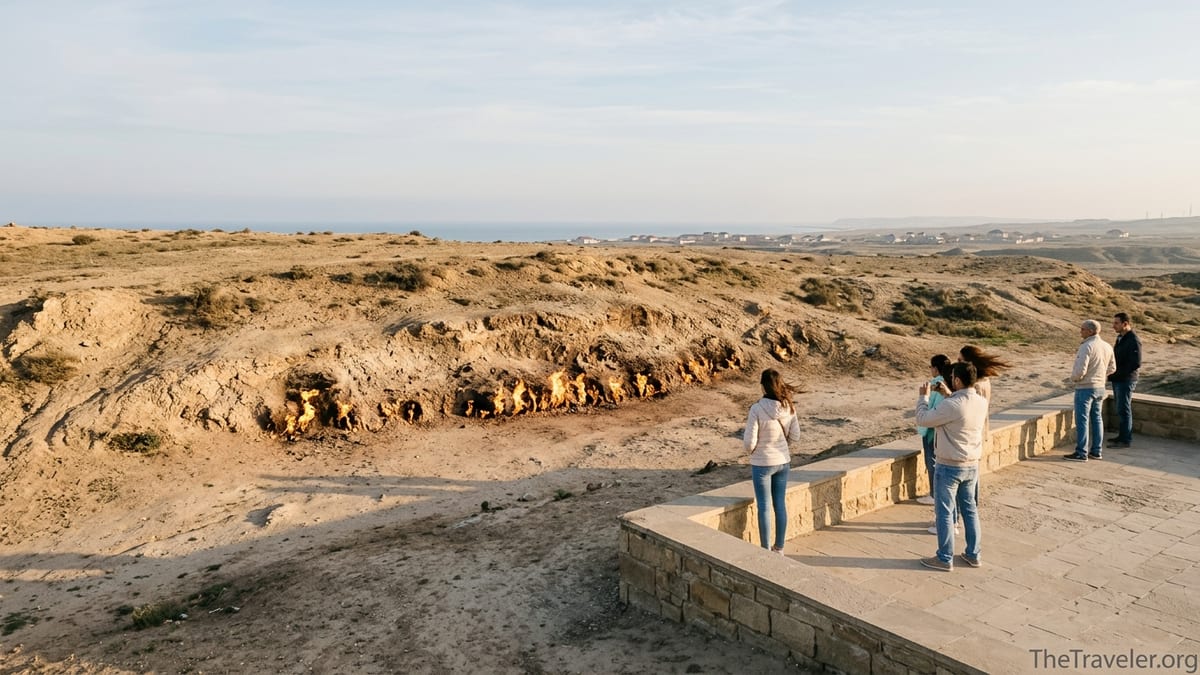
From Surakhani my driver continued north toward Mammadli village and the famous burning hillside of Yanar Dag. Even if you know the photographs, nothing quite prepares you for seeing a wall of orange flames licking out of a seemingly ordinary slope. Scientists explain that a natural gas seam vents to the surface here and ignites, producing a line of fire that has reportedly burned for decades without human intervention.
The facilities around Yanar Dag have seen significant investment in recent years. By 2025, the site included a small visitor center, viewing terraces and a simple museum gallery explaining the geology and folklore of Azerbaijan’s “Land of Fire.” Admission prices published by local authorities for the combined reserves of Yanar Dag and Ateshgah in 2024 and 2025 hovered in the mid-30 manat range for packages, though tour operators may incorporate those costs into their day-trip prices. I arrived mid-afternoon, when the flames were clearly visible but the sun still washed the hillside with harsh light; if your schedule allows, many people prefer late evening, when the contrast between darkness and fire becomes dramatic.
Despite the infrastructure, Yanar Dag remains a strangely intimate place. Children clustered at the safety barrier, counting how many meters of slope were engulfed. A local couple posed for wedding photos against the flames. In a quieter corner an elderly man from Baku told me how he had visited as a child, when there was little more than a rough path and a legend that a shepherd’s careless cigarette had ignited the hill in the 20th century. For him, the new café and interpretive displays were simply proof that Absheron’s natural wonders had finally been given the attention they deserved.
Practically speaking, Yanar Dag is easy to weave into any Absheron itinerary. It lies about 25 to 30 kilometers from central Baku, and taxis typically quote 20 to 35 manat one way depending on traffic. Many travelers, especially those with limited time in Azerbaijan, opt for a small-group tour that strings together Yanar Dag, Ateshgah and often the mud volcanoes or the medieval village of Gala, turning the day into a crash course in the peninsula’s diversity.
Mud Volcanoes and Moonlike Landscapes
One of the great surprises of visiting Absheron is discovering that Azerbaijan hosts hundreds of mud volcanoes, a phenomenon so unusual that NASA scientists have compared some of them to Martian landscapes. While the most famous clusters sit near Gobustan, southwest of Baku, the wider Baku and Absheron area includes a protected Mud Volcanoes State Nature Reserve where conical mounds ooze cold gray mud and occasional bubbles burst with a soft plop.
Reaching the more remote mud volcano fields remains a bit of an adventure. My own visit combined Gobustan’s rock art reserve with a side trip to a group of mud cones reachable only via a rough dirt track. At a roadside pullout, our minivan group transferred into a battered Soviet-era Lada, its suspension protesting every rut. The last 15 minutes felt like driving across a dried seabed. When we finally stepped out, the landscape looked almost extraterrestrial: dozens of ash-colored cones, some as high as a small house, venting cool mud that trickled like thick paint.
Because the mud is cold rather than hot, local guides often encourage visitors to touch it, and some wellness resorts farther afield in Azerbaijan even market mud treatments. On Absheron itself, development is more limited, and it is wise to wear shoes you do not mind sacrificing to the sticky ground. Many combined Gobustan and Absheron tours, advertised in 2025 and early 2026 for roughly 80 to 120 manat per person depending on group size and inclusions, stop at one or two accessible mud fields, making this strange terrain surprisingly reachable from urban Baku.
From a conservation perspective, authorities have been gradually formalizing access to mud volcano sites, designating reserve areas and planning visitor infrastructure to better protect fragile cones. Travelers today encounter clearer rules than a decade ago: informal off-road driving is increasingly discouraged, and some areas now feature viewing platforms to keep the heaviest foot traffic away from the most active vents.
Quiet Villages, Beaches and the Soviet Seaside Legacy
Absheron’s reputation abroad tends to center on gas and fire, but once you move out toward the coast a different character emerges. Driving north from Baku’s city center, the highway curves past Sumqayit and then branches toward small seaside communities that once catered to Soviet vacationers. Resorts in places such as Bilgah and Mardakan, which in the 1970s and 1980s drew workers from across the USSR, still line the Caspian shore, some modernized into polished beach clubs and others standing semi-abandoned, their peeling murals facing the sea.
On a breezy afternoon I walked a stretch of sand near one of the more modest public beaches, where local families had spread blankets and children chased each other into the choppy water. Facilities vary considerably: some beaches charge around 10 to 20 manat for entry including a lounger and access to showers, while public stretches remain free but more basic. Food shacks sell grilled qutab, shashlik and ayran at prices that, as of 2025, often undercut central Baku restaurants, reflecting a clientele made up largely of local residents rather than international tourists.
Further inland, villages like Nardaran and Gala reveal the peninsula’s more traditional side. In Nardaran, mosque courtyards fill with worshippers on Fridays, and small bakeries turn out tandir bread for afternoon shoppers. In Gala, an open-air ethnographic complex has reconstructed stone houses, watchtowers and village workshops, illustrating rural life in Absheron across centuries. While some exhibits are clearly built with tour groups in mind, the village surrounding the complex still feels lived-in, with chickens darting between low stone walls and old Ladas parked beneath grape arbors.
What ties these disparate experiences together is the sense that Absheron is not a theme park created for visitors, but an area where industry, religion, holidaymaking and everyday life overlap. Seaside sanatoriums originally built for Soviet factory workers now host middle-class Baku families on summer weekends. Oil derricks rise behind watermelon stalls. For travelers willing to look beyond the headline flames, the peninsula offers an unusually candid snapshot of Azerbaijan’s social and economic history.
Planning an Absheron Itinerary: Tours, Timing and Costs
By the time I left Azerbaijan in mid-2026, one pattern had become clear in conversations with hotel staff and local guides: most foreign visitors still experience Absheron as a single long day trip tagged onto a Baku city break. The classic loop, sold by numerous agencies, includes Gobustan rock art, a mud volcano field, Ateshgah and Yanar Dag, sometimes with a short stop at the Bibi-Heybat Mosque or a seaside viewpoint. These full-day outings typically run 8 to 9 hours, departing Baku around 9 a.m. and returning around sunset.
Pricing in 2025 and early 2026 varied depending on inclusions, but online listings commonly advertised shared tours in the 80 to 120 manat range per person, often including transport, guiding and entrance tickets, with lunch at a countryside restaurant paid separately. Private tours, especially those using newer vehicles or operating from high-end city hotels, could easily reach 200 to 300 manat or more for a car and driver plus guide. For independent travelers comfortable navigating without a tour, combining taxis, public buses and ride-hailing apps can reduce costs but adds logistical complexity and language challenges.
Season and time of day matter. Summers on Absheron are hot, dry and windy, with temperatures in July and August often soaring well above 30 degrees Celsius under a fierce Caspian sun. Spring and autumn are far more comfortable for exploring open-air sites such as Yanar Dag and the mud volcanoes. If seeing the flames at their most photogenic is a priority, aim to reach Yanar Dag after dusk and consider starting your day with Gobustan and the mud volcanoes before working back toward the fire temple and burning hillside.
It is also worth checking the latest information from local tourism offices or your hotel about any temporary closures or construction works. Several key Absheron attractions have seen upgrades and infrastructure projects in recent years, and opening hours can shift for maintenance. As with much of the region, cash remains useful in smaller villages and at roadside cafés, although card payments are widely accepted at major museums, fuel stations and chain supermarkets closer to Baku.
Food, Hospitality and Everyday Encounters
No visit to Absheron is complete without lingering over a meal. Between sites, our driver steered us to a family-run restaurant just off the main highway, the kind that rarely appears on English-language maps but is known to every local guide. Tables were set beneath grapevines, and a charcoal grill smoked steadily in the corner. We ordered plov, lamb kebabs and a plate of tangy pickled vegetables; for three people, the bill came to less than the price of a single main course in a mid-range Western European capital.
What stood out more than the prices, though, was the warmth of the welcome. Azerbaijan’s tourism industry has grown steadily in the last decade, yet much of Absheron still sees a modest trickle of independent foreign travelers compared to central Baku. At one roadside tea house, the owner brought over a plate of fresh cherries “from my sister’s garden” simply because he was pleased to practice a few words of English. At another, a group of university students heading back to Baku after a beach day asked for a selfie and then spent the next twenty minutes recommending viewpoints I had never heard of.
Language can pose minor challenges beyond the city. Azerbaijani is the lingua franca, and older residents may be more comfortable in Russian than in English. Still, a handful of basic phrases combined with gestures and phone translation apps went a long way. Prices at informal eateries and small shops are typically written in manat, and staff are usually happy to show the amount on a calculator to avoid misunderstandings. Tipping, while appreciated, is low-key: rounding up the bill or leaving 5 to 10 percent in cash is considered polite rather than obligatory.
For travelers who value authentic interactions as much as bucket-list sights, these small moments may be the real highlight of an Absheron visit. Sharing tea at a plastic table while trucks rumble past, listening to a taxi driver’s opinion on the best baklava in Baku, or watching a grandmother bargain over herbs at a roadside stand offers a textured glimpse of everyday life that the grand flames of Yanar Dag cannot provide on their own.
The Takeaway
Going into my trip, I thought of the Absheron Peninsula primarily as an industrial backdrop to Baku, a place defined by oil derricks and gas flares rather than by culture or nature. Leaving, I understood why local tourism campaigns increasingly frame it as a destination in its own right. Within a radius of roughly an hour’s drive from the city center, visitors can encounter a centuries-old fire temple, a naturally burning hillside, Martian-like mud volcanoes, traditional villages, Soviet resort relics and windblown Caspian beaches.
What makes Absheron particularly rewarding is not just this variety, but the way it is layered. The same gas that feeds the flames at Yanar Dag once inspired religious devotion at Ateshgah and now fuels the power stations that keep Baku’s futuristic skyline aglow. The same coastline that hosted Soviet sanatoriums now sees young Baku residents picnicking with smartphones in hand. For travelers willing to stack these experiences together, the peninsula becomes a living museum of Azerbaijan’s past and present.
If you are planning a visit to Baku in 2026 or beyond, give Absheron more than a passing glance. Whether you join a classic day tour or assemble your own route with taxis and buses, you will likely return to the city with the same realization I did: this stub of land jutting into the Caspian Sea is far more diverse, and far more engaging, than its industrial reputation suggests.
FAQ
Q1. How much time do I need to explore the Absheron Peninsula from Baku?
Most travelers cover the main sights, including Ateshgah, Yanar Dag and a mud volcano field, in a single full day of about 8 to 9 hours, but two days allow a more relaxed pace with beach time and village stops.
Q2. Is it better to visit Absheron on a guided tour or independently?
Guided small-group tours are convenient and usually include transport and tickets, while independent travel with taxis and buses can be cheaper but requires more planning and some comfort with language barriers.
Q3. What are typical tour prices for Absheron in 2025 and 2026?
Shared full-day tours that include Gobustan, mud volcanoes, Ateshgah and Yanar Dag commonly range from about 80 to 120 Azerbaijani manat per person, with private tours costing significantly more depending on vehicle type and group size.
Q4. When is the best season to visit the Absheron Peninsula?
Spring and autumn offer the most comfortable conditions, with milder temperatures and clearer skies, while summer can be very hot and windy on exposed sites like Yanar Dag and the mud volcano fields.
Q5. Can I swim at the beaches on Absheron, and what should I expect?
Yes, many locals swim at Caspian beaches such as those near Bilgah and Mardakan, where you can find a mix of public stretches and paid beach clubs with basic facilities, changing cabins and simple cafés.
Q6. Are Ateshgah Fire Temple and Yanar Dag suitable for children and older travelers?
Both sites have relatively easy access with established paths and viewing areas, making them suitable for families and older visitors, though some walking and stair climbing is involved and the terrain can be uneven in places.
Q7. What should I wear and bring for a day on the Absheron Peninsula?
Comfortable walking shoes, a sun hat, layered clothing for wind, sunscreen, drinking water and a light jacket in cooler months are advisable, especially for exposed locations like mud volcanoes and cliff-top viewpoints.
Q8. Is it safe to visit the mud volcanoes near Absheron?
Commonly visited mud volcano fields are generally considered safe when you follow your guide’s instructions, stay on established paths and avoid climbing fragile cones, though footing can be slippery and sturdy shoes are essential.
Q9. How far are the main Absheron sights from central Baku?
Ateshgah Fire Temple and Yanar Dag each lie roughly 25 to 35 kilometers from downtown Baku, while popular mud volcano sites and Gobustan rock art are around 60 to 70 kilometers away, usually about one to one and a half hours by road.
Q10. Can I combine Absheron highlights with Baku city sightseeing in one day?
It is possible but rushed; most visitors dedicate one day to Baku’s Old City and modern architecture and another full day to Absheron’s fire temple, burning hillside and mud volcano landscapes for a more balanced experience.