


It hits you halfway down Nassau Street. The brick sidewalks are busy but unhurried, the stone towers of Princeton University rise just beyond the trees, and somewhere between the sound of a busker’s guitar and the clink of coffee cups on Witherspoon Street, you realize you are walking through a place that feels too perfectly composed to be accidental. Princeton, New Jersey, looks and moves like the backdrop to a film about collegiate dreams, quiet genius, and small-town charm. The surprise is that this set is very much real, and easy to step into on a simple day’s walk.
Get the latest updates straight to your inbox!
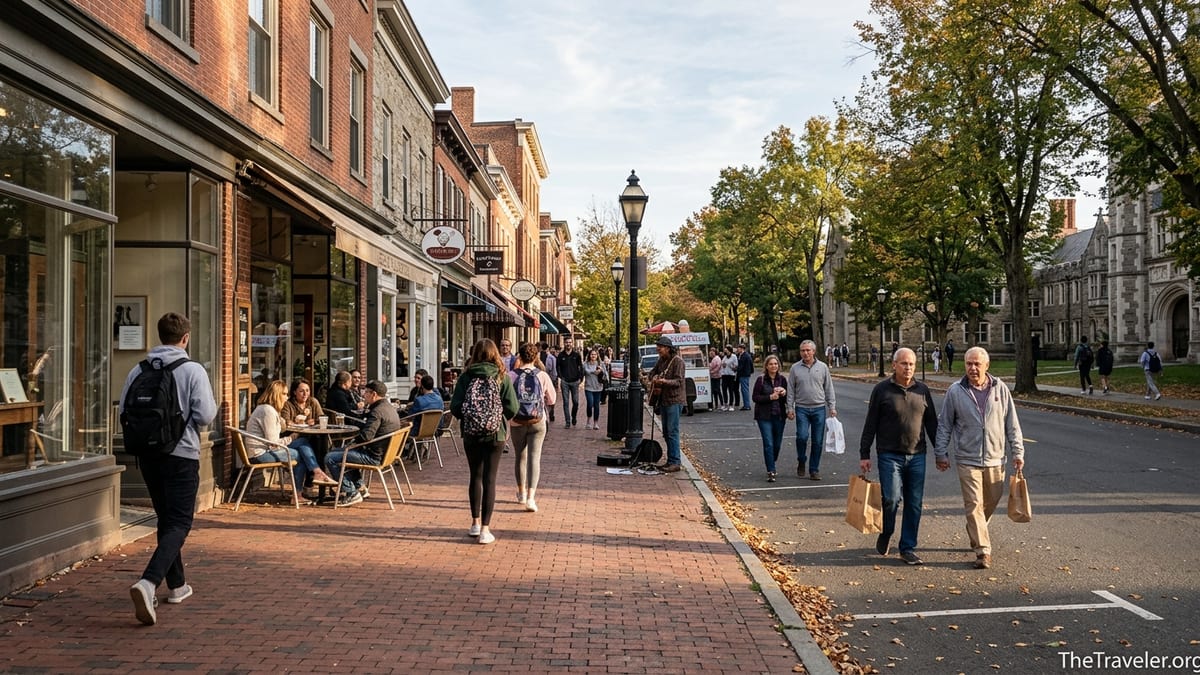
First Impressions on Nassau Street
Your opening shot of Princeton is usually Nassau Street, the town’s main corridor and the invisible line between campus and village. On one side are the university gates and a sweep of manicured green; on the other, a compact run of bookshops, cafes, and low brick buildings that look like they have always belonged there. The scale is modest, often three stories or less, which gives the street a human, almost cinematic intimacy.
Walk east from the Princeton train station shuttle stop and the rhythm reveals itself. A local bakery sets out a chalkboard sign; a student balances a stack of orange and black spirit gear; a couple visiting from New York pauses to photograph the ivy spilling over a stone wall. Traffic is present but rarely overwhelming, and the sidewalks are wide enough for strollers, dogs, and day trippers ambling side by side. You might spend the first fifteen minutes simply slowing your pace to match the town’s.
Prices reflect the college-town-meets-affluent-suburb mix. A pour-over coffee along Nassau or Witherspoon Street typically runs around 4 to 6 dollars, and a casual lunch at a bistro or farm-to-table spot will often fall in the 18 to 30 dollar range per person before tax and tip. It is not a budget destination, but it also does not shout luxury; instead, the town feels curated, like a set designer has decided exactly how polished everything should be and then stopped just short of pretension.
Even simple errands can feel like scenes. Locals step out of the small pharmacy with paper bags; a group of high school students waits in line at a corner pizza counter; a cyclist leans a bike against an old stone church while the bells toll on the hour. For visitors arriving on a day trip, especially from the intensity of New York or Philadelphia, the adjustment feels like slipping into a quieter, more composed genre of film.
Princeton University: Collegiate Gothic In Real Time
Pass through FitzRandolph Gate at the corner of Nassau Street and the atmosphere changes in a single step. Suddenly you are on the campus of Princeton University, known for its sweeping lawns and Collegiate Gothic architecture. Now the feeling of being on a movie set intensifies: arches frame distant towers, walkways crisscross at artful diagonals, and every direction seems to produce another postcard view.
Nassau Hall, just beyond the gate, anchors the first scene with its stone facade and cupola rising above the trees. From there, follow the paths toward Blair Arch, a soaring stone passageway that looks tailored for a closing credits shot. Students cut through with headphones on; a violinist sometimes practices where the acoustics are best; graduation photos are staged here, but in between you simply encounter ordinary campus life taking place in an extraordinary space.
Farther in, the Princeton University Chapel rises in full Collegiate Gothic drama, with flying buttresses, stained glass, and carved stone details that recall Oxford and Cambridge. The building feels intentionally theatrical, but it is also a working chapel where you might slip into a pew while an organist rehearses. On a weekday afternoon, you may find handfuls of visitors moving quietly through the nave, cameras in hand, speaking in low voices as if they have entered not just a religious space but a film set that demands reverence.
It is easy to structure a self-guided walk with the help of printed campus maps or audio tours sold by local companies, which often start near Maclean House and loop past Nassau Hall, East Pyne, the chapel, and the Frist Campus Center. Even without formal guidance, following the crowd will draw you through quads edged with dormitories like Mathey and Rockefeller Colleges, all stone, slate roofs, and leaded windows. Think of it as a live-action establishing shot for every boarding school or college drama you have ever seen.
Palmer Square: The Village Green That Feels Stage-Managed
Step back across Nassau Street and drift toward Palmer Square, and the mood shifts again. This compact plaza and its surrounding streets form Princeton’s de facto village green, complete with brick sidewalks, trees wrapped in lights during the winter, and a central lawn that doubles as an audience for outdoor concerts in warmer months. It is not accidental that many visitors describe it as “storybook” or “European.” The design clusters boutiques, cafes, and restaurants around a walkable core, giving you 360-degree views that seem too neatly composed to be real life.
On a summer Saturday, you may find a free live music performance as part of a seasonal series, families sprawled on picnic blankets, and shoppers drifting in and out of high-end clothing stores and independent boutiques. In spring, seasonal promotions and family events, from strolling costumed characters to outdoor tastings at restaurants like the Mediterranean-inspired spots on the square, give the area the feel of an open-air set where new scenes roll in with each weekend.
Palmer Square is also where small sensory details cement the movie-set illusion. The aroma of wood-fired pizza drifts from a corner restaurant; a line snakes from a beloved ice cream shop serving inventive flavors like lavender mascarpone or dark chocolate sorbet; the ringing of a street performer’s guitar blends with conversation from sidewalk tables. Prices here reflect the setting: expect around 6 to 8 dollars for a generous scoop of artisanal ice cream and 14 to 22 dollars for a casual lunch dish at one of the cafes ringing the square.
What makes Palmer Square especially striking is how complete it feels. You can pan around in a full circle and never hit a visual discordant note. Storefronts are carefully maintained, signage is controlled, and the backdrop is always either brick, stone, or mature trees. It is easy to believe a director could clear the square of cars and turn it into a 1950s college-town set with only minor adjustments.
Following the Geniuses: Mercer Street and Quiet Residential Lanes
Walk south from Nassau toward Mercer Street and the story tilts subtly from glossy campus drama to biopic. Modest houses line shaded sidewalks, and it is here that one of Princeton’s most famous residents, Albert Einstein, spent roughly the last two decades of his life. The house he lived in is privately owned and not open to the public, but audio and printed walking tours will often point out its exterior along Mercer Street, reminding you that world-changing ideas were once incubated behind these unassuming walls.
This part of town feels markedly quieter. College crowds thin out, replaced by joggers, dog walkers, and families pushing strollers. Many homes retain early twentieth century details: deep porches with rocking chairs, clapboard siding, and gardens carefully maintained but not overly manicured. Here the movie analogy shifts to a quieter independent film set in a leafy American town, where the drama happens indoors while the streets stay still and sunlit.
Guided tours often link Einstein’s house with other sites connected to public figures, looping past churches, historic homes where political leaders once lived, and small neighborhood parks. Costs vary, but a small-group walking tour with a local operator commonly runs in the range of 20 to 35 dollars per adult for a one to two hour experience. Independent travelers can recreate parts of these routes with downloadable maps from visitor guides, which mark key addresses and provide brief historical notes.
Even without chasing famous names, simply crossing into residential Princeton offers a different kind of cinematic moment. Children chalk hopscotch grids onto the sidewalk; a neighbor pauses to chat over a white picket fence; someone in a second-floor window waters plants that spill over a balcony railing. For visitors used to destinations dominated by attractions and ticket booths, this everyday calm can feel surprisingly immersive, like wandering into scenes that were never meant for an audience but welcome one anyway.
Cafes, Bookshops, and the Art of Lingering
Any convincing movie set needs background actors who look like they belong, and in Princeton those are the people lingering in cafes and bookshops. A few steps off Nassau Street, independent bookstores display staff picks in the windows and stack academic titles beside glossy travel magazines. Step inside and you might overhear a professor recommending a history text to a prospective student while a local resident browses the new fiction table.
Cafes along Nassau and Witherspoon provide ideal vantage points. Order a cappuccino and a pastry and settle near a window, and the street becomes your film. Undergrads in orange sweatshirts hurry past with laptops; a retired couple consults a paper map near the corner; someone wheels a suitcase toward the train shuttle stop. Prices are close to big-city coffee standards, with espresso drinks often between 4 and 7 dollars and pastries between 3 and 6 dollars, but the real value is the chance to sit quietly and watch the town’s overlapping narratives play out.
Evenings introduce another layer. Restaurants like well-known farm-to-table spots around Witherspoon and Palmer Square fill with a mix of local families, visiting academics, and parents in town for campus events. Reservations can be important on busy weekends, especially during spring reunions or fall homecoming dates when alumni flood back. The glow from interior lighting spills onto the sidewalks, and diners at outdoor tables clink glasses under string lights, giving the streets the soft, flattering illumination of a well-lit night scene.
For a change of pace, locals often mention a few casual legends: a sandwich shop famed for overstuffed hoagies, an ice cream counter where the line bends around the block at peak hours, and a small-batch gelato and sorbetto shop on the square that feels like a rite of passage for first-time visitors. None of these places needs a flashing sign; the crowd of students and day trippers out front is usually signal enough.
Seasonal Shifts: How Princeton Rewrites Its Script All Year
Part of what makes Princeton feel cinematic is how dramatically it changes costume with the seasons. Visit in late April and the campus lawns are dotted with blankets and books, cherry blossoms drifting across stone pathways like confetti. Events on Palmer Square often lean into the season with outdoor tastings, early evening concerts, and family-friendly activities that make the town core feel festive without losing its everyday rhythm.
Summer brings a slightly sleepier script. Many students leave, but not all, and the resulting mix of language-school attendees, local families, and visitors slows the town to an easy drift. Outdoor music series on the Palmer Square lawn or nearby plazas provide free entertainment for anyone passing through; you might arrive expecting a quiet stroll and find yourself staying to listen to a band as the sun drops behind the rooftops.
Autumn is Princeton at peak visual drama. The oaks and maples lining campus quads and town streets flare into deep reds and golds, framing stone towers and college greens like establishing shots for a nostalgic campus film. Weekends in October and early November often see waves of prospective students and alumni, which pushes restaurant and hotel prices higher and fills tables quickly. Day trippers can still enjoy the show by arriving early, claiming a bench outside the chapel or along Cannon Green, and watching fallen leaves accumulate on the paths as students hurry to afternoon lectures.
Winter is quieter and more intimate. Holiday lights appear along Nassau Street and Palmer Square, and the decorated tree on the square offers a center point for seasonal photos. Cold weather drives people into bookstores and cafes, and scenes shift indoors: children in puffy jackets share hot chocolate, undergraduate study groups cluster over laptops, and shoppers move between boutiques wrapped in scarves. Snow, when it comes, transforms the Gothic spires and brick sidewalks into a black-and-white film. Travel can be trickier, and sidewalks occasionally slick, but the reward is a town that feels both hushed and storybook-bright.
Practical Tips for Experiencing Princeton on Foot
For all its cinematic appeal, Princeton remains a practical day-trip destination, especially for visitors coming from New York or Philadelphia. Many travelers arrive via New Jersey Transit trains to Princeton Junction, then connect on the short shuttle train known locally as the Dinky into town. From the campus station, it is a straightforward ten to fifteen minute walk up University Place to Nassau Street, with clear signage along the way.
Once you are in the historic core, walking is the most natural way to move. The distances are compact: a loop that takes in Nassau Street, Palmer Square, the central university quads, and a stretch of Mercer Street can be comfortably completed in two to three hours at a gentle pace, with additional time layered in for coffee stops, bookstore browsing, or a leisurely lunch. Comfortable shoes are non-negotiable, as many paths are paved in brick or older concrete that can be uneven in spots.
Parking is available in municipal garages near Palmer Square and in metered street spots around the downtown grid, though weekends and special university events can fill spaces quickly. Hourly garage rates are roughly comparable to other small Northeast towns, often in the range of 2 to 4 dollars per hour, with daily maximums posted at the entrances. Visitors staying longer than an afternoon may find it simpler to leave the car at a park-and-ride or suburban station and rely on trains and the campus-adjacent shuttle and local buses, which several local riders note are free or low-cost for short hops around town.
Food budgets vary widely depending on choices. A student-style day might involve coffee and a pastry for under 10 dollars, a sandwich from a deli or hoagie shop for around 12 to 15 dollars, and a scoop or two of ice cream for 6 to 8 dollars. A more indulgent version could layer in a sit-down dinner at one of the well-regarded restaurants near Palmer Square, where a main course typically starts around the low twenties and climbs from there. In either case, advance reservations are wise on high-demand weekends tied to campus events or major holidays.
The Takeaway
Walking through Princeton can feel disorientingly like stepping into a production where someone has already done the work of composing every shot. The Gothic arches, manicured greens, and brick-lined shopping streets create a visual narrative that is easy to slip into, whether you are here for an afternoon or a long weekend. Yet the details that keep it real are everywhere: students rushing to labs, locals juggling grocery bags and toddlers, tour groups pausing at crosswalks while traffic waits.
What sets Princeton apart is not just the beauty of its campus or the polish of its town center, but how seamlessly the two meet at Nassau Street. You can move from a world of stone spires and stained glass to a village square lined with ice cream shops and cafes in the space of a crosswalk light. That proximity makes it an unusually approachable destination. You do not need a car once you arrive, you do not need a checklist of must-sees, and you do not need to spend much to enjoy the simple act of wandering.
If you come prepared to slow down, to linger on benches and in bookshops, Princeton rewards you with the sense that you have walked through multiple genres in a single day: campus drama, historical biopic, cozy small-town story. It is a reminder that some of the most cinematic places are not created by studios at all, but by time, intention, and the layered routines of the people who call them home.
FAQ
Q1. Is Princeton, New Jersey, worth visiting if I only have a day? Yes. Princeton is compact enough that in a single day you can walk the core campus, explore Nassau Street and Palmer Square, enjoy a meal, and still have time to linger in a bookstore or cafe.
Q2. Do I need a car to explore Princeton like this? No. Many visitors arrive by train to Princeton Junction and transfer to the short shuttle into town. Once you are at the edge of campus, the main sights are within comfortable walking distance.
Q3. Can I walk through Princeton University’s campus if I am not a student? In general, the outdoor areas of campus are open to the public during daylight hours, and visitors regularly walk the paths and quads. Certain buildings may have restricted access, so follow posted signs and any current university guidelines.
Q4. How expensive is it to eat and drink in downtown Princeton? Prices are similar to other affluent college towns. Expect roughly 4 to 7 dollars for coffee drinks, 12 to 18 dollars for casual lunch items, and main courses from the low twenties and up at sit-down restaurants near Palmer Square and Nassau Street.
Q5. When is the best time of year to visit for a walking-focused trip? Spring and autumn are especially appealing, with comfortable temperatures and striking foliage or blossoms. Summer is quieter, while winter offers a more subdued, festive mood around the holidays but can be cold and occasionally snowy.
Q6. Are guided walking tours of Princeton available? Yes. Several local operators and digital platforms offer guided or audio walking tours that cover campus landmarks, historic downtown streets, and sites associated with figures like Albert Einstein, usually lasting one to two hours for a moderate fee.
Q7. Is Princeton family-friendly for a stroll with kids? Very. The central area features wide sidewalks, open greens where children can run, and plenty of kid-pleasing stops such as ice cream shops and casual eateries, though parents should still keep close watch near busy Nassau Street.
Q8. How crowded does Princeton get on weekends? Weekends, especially during university events or peak foliage and spring seasons, can be quite busy, with restaurants and parking filling quickly. Arriving earlier in the day or choosing weekdays typically means thinner crowds and shorter waits.
Q9. Are there free things to do besides walking around? Yes. You can enjoy the architecture and grounds of the university, relax on the campus lawns, browse independent bookshops, window-shop around Palmer Square, and occasionally catch free outdoor concerts or public events depending on the season.
Q10. What should I wear for a day of walking in Princeton? Opt for comfortable walking shoes suitable for brick and uneven pavements, layered clothing to adjust to changing temperatures, and in sunnier months a hat and sunscreen, as many of the most scenic routes are outdoors with limited shade.