


Step off the train in Princeton and it feels as if you have walked onto the set of a classic American campus film. Stone gates frame green lawns, church spires peek over treetops, and shopfronts along Nassau Street glow warmly in the late-afternoon light. This is a real working town, not a museum, yet there is a storybook quality to the way Princeton University, its compact downtown, and the surrounding neighborhoods fit together. For travelers, that blend of intellectual energy and small-town charm makes Princeton one of the most rewarding day trips or weekend getaways within easy reach of New York and Philadelphia.
Get the latest updates straight to your inbox!
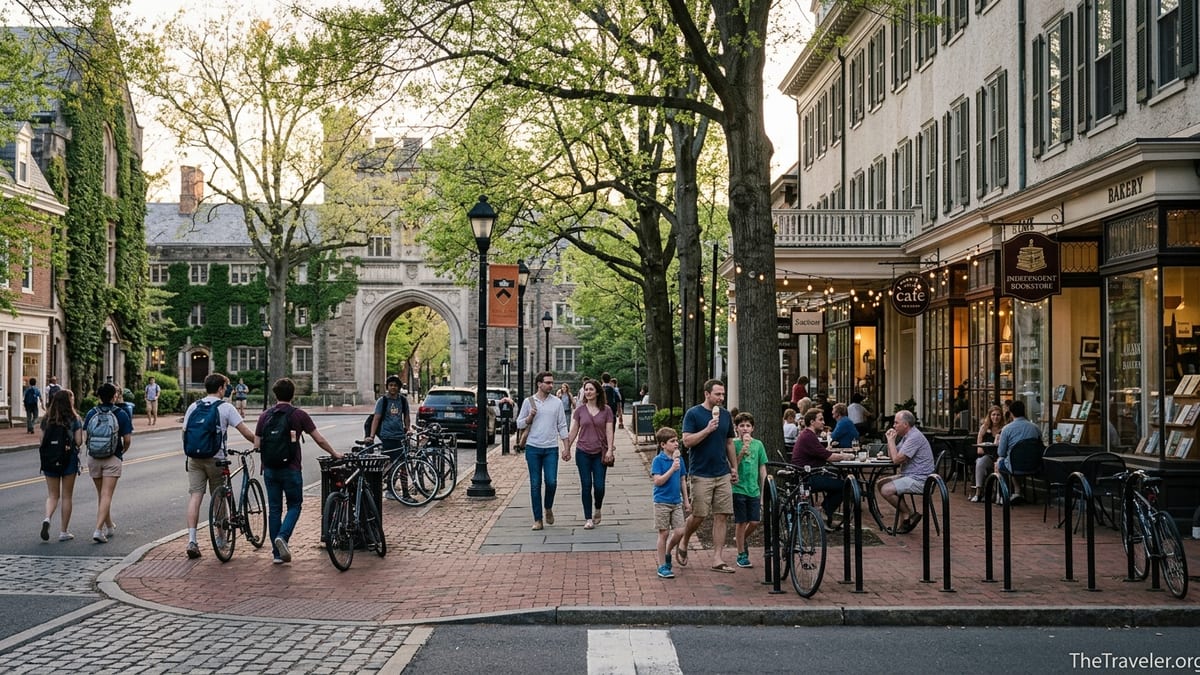
A Walkable College Town Wrapped Around Gothic Spires
Princeton’s spell begins with its scale. The historic campus and the town center are so tightly knit that you can walk almost everywhere you want to go. From Princeton Station, the small terminus of the local “Dinky” shuttle train, it is around ten minutes on foot to Nassau Hall, the stone-clad heart of Princeton University, and only a few minutes more to Palmer Square and the rest of downtown. Streets are shaded by mature trees, intersections are human in size, and most buildings rise only a few stories, which keeps the skyline comfortably low and the sky always in view.
On campus, the architecture sets the tone. Collegiate Gothic halls like Blair Arch and Holder Hall look as if they were lifted from an English fantasy novel, with turrets, cloisters and ivy climbing over sandstone walls. Cross the central lawn of McCosh Walk and you pass students carrying cello cases, professors in conversation, and visitors with campus maps in hand. Yet walk a block north to Nassau Street and you are squarely in town, where buses pull up, delivery trucks unload for local shops, and residents step out for coffee on their lunch breaks.
The transition between university and town is so seamless that many visitors barely notice where one ends and the other begins. Nassau Street functions as both the northern edge of campus and Princeton’s main commercial spine, lined with bookstores, cafes, restaurants and banks. For travelers, that means it is easy to design a day that alternates between campus landmarks like the Princeton University Chapel and purely local pleasures such as browsing at an independent toy store or lingering over a glass of wine in Palmer Square.
Because the town and university are compact, you can experience much of the core area on foot in a single day. A realistic loop runs from the Dinky station through campus to Nassau Street, along to Palmer Square, then down Witherspoon Street toward the quiet residential lanes that lead back toward the train. Allow yourself time to pause on shaded benches and simply watch the rhythm of this college town unfold.
Palmer Square and Nassau Street: Princeton’s Storybook Heart
If Princeton has a storybook village scene, it is Palmer Square. This planned square, just off Nassau Street, was built in a Colonial Revival style that deliberately echoes early American town centers. Brick buildings with white trim frame a central green anchored by the Nassau Inn, a long-standing hotel whose lobby often hums with wedding parties, visiting alumni and conference guests. In winter a tall Christmas tree rises from the square, and in warmer months outdoor tables spill onto the brick sidewalks.
Palmer Square’s storefronts reinforce the fairytale feeling. You will find national brands, but the real character comes from independent businesses. The Princeton Corkscrew Wine Shop offers carefully chosen bottles in a snug, wood-lined space. Nearby, Chez Alice Café & Bakery serves fruit tarts and quiches that locals carry out in bakery boxes tied with string, while an ice cream stop at the bent spoon or a neighboring scoop shop is almost a ritual for families on summer evenings. On a Saturday, expect lines out the door and children racing across the green with cones in hand.
Just beyond the square, Nassau Street stretches east and west, giving you a broader sense of the town. Here you can duck into Labyrinth Books, a beloved independent bookstore, to browse tables of new fiction and university press titles or pick up a Princeton sweatshirt alongside serious philosophy tomes. Steps away, clothing boutiques, stationery shops and small galleries cluster together in a way that makes wandering between them an easy pleasure, especially if you are staying at the Nassau Inn or one of the bed-and-breakfasts within a few blocks’ walk.
Princeton’s coffee culture further underlines its college-town personality. On Witherspoon Street, Small World Coffee hums from early morning until evening with students on laptops, faculty chatting over espresso and visitors studying a paper map of town. Around Palmer Square, newer arrivals like Maman on Hulfish Street add their own charm with rustic décor and latte art in blue-and-white cups. Prices are what you would expect in a prosperous university town, but the atmosphere is relaxed, and lingering over a cappuccino while people-watching through big front windows is part of the experience.
Life Between Lecture Halls and Tree-Lined Streets
Princeton works as a destination not only because of its architecture but because it functions as a living town. That becomes clear if you wander a few blocks off Nassau Street into the surrounding neighborhoods. Streets like Bank Street, Chestnut Street and Library Place are lined with clapboard and brick houses, many with porches and well-tended gardens. In autumn, maple leaves drift across sidewalks; in spring, magnolia trees burst into bloom. Even on a weekday afternoon you may see children biking home from school, dogs being walked and neighbors chatting outside.
For visitors, this everyday life provides context to the more formal university setting. You might leave a high-ceilinged gallery at the Princeton University Art Museum’s temporary downtown space and then step onto a residential street where a resident is raking leaves. That contrast is part of the town’s charm. It is a place where globally recognized scholars share crosswalks with local shopkeepers and schoolchildren lining up for hot chocolate on a cold day.
The university’s presence shapes the cultural calendar in ways travelers can enjoy. During the academic year, you may find student a cappella groups performing under archways, public lectures by well-known authors in campus auditoriums, or free classical concerts in one of the recital halls. In summer, the pace slows but does not stop. Outdoor movie nights, seasonal markets in Palmer Square, and performances at the McCarter Theatre Center offer reasons to stay into the evening rather than rushing back to the city after a day trip.
Yet Princeton remains manageable in size. This is not a city that overwhelms you with options or late-night noise. By ten or eleven in the evening, many streets are quiet, making it an appealing base for travelers who value calm over nightlife. A glass of wine on a restaurant patio, a stroll past the softly lit campus buildings, and a short walk back to your inn can feel like the right kind of ending to the day.
Getting There: The Classic Dinky Ride and Other Routes
Part of Princeton’s storybook atmosphere comes from the way many visitors arrive: on a petite train affectionately called the Dinky. This short shuttle line runs between Princeton Junction, a major stop on New Jersey Transit’s Northeast Corridor, and Princeton Station at the edge of campus. The ride takes around five minutes and covers just a few miles, but it delivers you directly into the university environment, a rare convenience among American campuses.
From New York City, travelers typically board a New Jersey Transit train at New York Penn Station and ride about an hour to Princeton Junction, depending on whether they catch a local or an express service. At Princeton Junction, clear signage points you toward the Dinky platform, where you transfer to the small train for the last leg. Combined one-way fares generally fall in a moderate range compared with regional rail in other Northeast cities, and you can buy tickets through the NJ Transit app or at machines in the station. Because schedules change seasonally, it is wise to check departure times shortly before you travel, especially late at night.
Arrivals from Philadelphia or Newark Liberty International Airport also typically route through Princeton Junction, with travelers changing there to either the Dinky or a local bus or taxi. For visitors who prefer to drive, Route 1 provides the main highway access, with parking available in university garages on evenings and weekends and in municipal lots serving downtown. On busy fall weekends, such as football games or alumni reunions, parking can fill early, so allowing extra time or favoring the train makes the experience smoother.
Once you are in town, you may find you hardly need a car. The campus, downtown shopping streets, Palmer Square and the lakefront at Carnegie Lake are all walkable from each other for most people in reasonable shape. Local shuttle services and buses connect outlying areas and shopping centers along Route 1, though schedules can be limited at night. For short hops, many visitors rely on rideshare services from the train station back to their hotel after dinner, especially in colder months.
What to Do in a Day or a Long Weekend
Even a short visit allows you to sample Princeton’s highlights. A classic day trip might begin with a mid-morning arrival by train and a leisurely walk through campus, pausing to step into the Princeton University Chapel with its stained-glass windows or to explore the exteriors of such halls as Nassau Hall and Blair Arch. Photography enthusiasts will find countless angles: ivy climbing over stone, bicycles lined up under archways, and sunlit quads framed by gothic towers.
From campus, you can wander toward Nassau Street for lunch. Options range from casual pizza and sandwich shops to sit-down restaurants with seasonal menus drawing on local produce. Around Palmer Square, for example, you might share small plates at a Mediterranean-inspired restaurant or choose a bistro with outdoor tables that overlook the brick plaza. Expect prices comparable to other affluent college towns: a main dish at dinner commonly lands in the mid-range, and a coffee and pastry break typically costs only slightly more than in a big-city neighborhood café.
In the afternoon, cultural and outdoor possibilities open up. Art lovers can spend an hour or two at the university’s art museum exhibitions, which are temporarily housed in downtown spaces while a new museum building is under construction. Others might prefer to rent a kayak on Carnegie Lake in season, stroll the towpath along the Delaware & Raritan Canal, or wander through the landscaped grounds of the Institute for Advanced Study’s nearby woods. In good weather, it is common to see students reading on the grass, alumni families playing on the lawns and travelers quietly exploring with cameras in hand.
For a longer weekend, you can layer in more local experiences. An evening performance at McCarter Theatre, whether a new play, touring dance company or concert, introduces you to Princeton’s role as a regional arts hub. The next morning, you might explore neighborhoods north of Nassau Street, stop by the Princeton Shopping Center for more everyday shops and a supermarket, or take a short drive to nearby towns like Hopewell or Lambertville for antique hunting and riverside walks. Returning each night to the calmer, lamp-lit streets of Princeton reinforces that feeling of retreat.
Eating, Drinking and Staying in Princeton
Princeton’s food scene is tailored to its mixed audience of students, faculty, residents and visitors. On any given block you can move from a modest student-friendly eatery to an upscale dining room. Around Palmer Square and Nassau Street, mid-range restaurants dominate, serving everything from Italian pastas to contemporary American cuisine with locally sourced ingredients. Reservations are a good idea on Friday and Saturday evenings, particularly during the academic year and around major university events.
Casual options are plentiful for daytime exploring. Small World Coffee on Witherspoon Street is a local institution for strong espresso and house-roasted beans, while the downtown cafés in and around Palmer Square offer pastries, quiches and light lunches ideal for a quick break between campus sightseeing and shopping. In warmer months, many of these spots set out sidewalk tables, creating an almost European café feel as people linger over iced coffee and salads at lunchtime.
When it comes to accommodations, travelers will find a mix of historic charm and modern convenience. The Nassau Inn, fronting Palmer Square, places you in the center of town and within easy walking distance of both campus and shops. Rooms tend to carry rates in line with other boutique hotels in prosperous small towns, with prices rising on peak weekends tied to university events. A handful of smaller inns and bed-and-breakfasts within town limits offer more intimate experiences, and national-brand hotels line the Route 1 corridor a short drive away, providing more budget-conscious choices with free parking and easy highway access.
Evenings in Princeton are typically mellow rather than raucous. Wine bars, hotel lounges and a handful of pubs provide social spaces without the intensity of a big-city nightlife district. It is entirely possible to spend a contented evening moving from an early dinner to a performance at McCarter Theatre and then finishing with a nightcap on a hotel patio under string lights.
Seasonal Magic: When Princeton Feels Most Like a Storybook
Princeton has four distinct seasons, each coloring the town-and-gown landscape in a different way. Autumn is perhaps the most popular time for visitors. As maples and oaks flame red and gold, the stone and brick buildings take on a warmer hue, and weekends bring home football games at Princeton Stadium and alumni reunions. Bring a sweater: crisp evenings are part of the appeal, especially when you walk under lamplight across campus after dinner.
Winter has its own quieter magic. Palmer Square’s holiday decorations, including a large Christmas tree and twinkling lights along the shopfronts, transform the plaza into something very close to the Hallmark-movie setting that some locals jokingly reference. On snowy days, Nassau Street looks like a postcard, with plows clearing a light dusting and pedestrians treading carefully along the sidewalks. Many travelers choose this season for cozy getaways that revolve around cafés, bookstores and indoor cultural activities.
Spring arrives with an explosion of blossoms. Magnolias, dogwoods and flowering cherries line the streets, and campus lawns fill with students studying outdoors. This is a comfortable time for long walks around Lake Carnegie, with daytime temperatures often mild enough for light jackets. By early summer, leafy shade makes even midday explorations pleasant, and many local restaurants expand their outdoor seating to capture warm evenings.
Because the university calendar heavily influences town rhythms, it is useful to remember that move-in days, graduation week and major alumni events can make Princeton busier and accommodations more expensive. If you value a quieter atmosphere, consider visiting in early summer after graduation or during the mid-winter lull when classes are not in session and hotel availability improves.
The Takeaway
Few places in the United States blend academic prestige and small-town charm as effortlessly as Princeton. The university’s gothic arches and sweeping lawns give the town a cinematic backdrop, while Palmer Square, Nassau Street and the surrounding neighborhoods provide the everyday details that make a place feel lived in: coffee cups on outdoor tables, children chasing bubbles on the green, residents greeting shopkeepers by name. It is this interplay between the extraordinary and the ordinary that makes Princeton feel like a storybook town built around one of America’s great universities.
For travelers, the rewards are immediate and practical. Princeton is easy to reach by train from New York or Philadelphia, walkable once you arrive, and rich in small pleasures rather than grand spectacles. You can spend a morning contemplating art or architecture, an afternoon browsing independent shops or paddling on a lake, and an evening at the theater or over a lingering dinner, all without ever stepping into a car. Whether you visit for a day or a long weekend, Princeton offers a rare kind of escape: a place that feels beautifully composed yet entirely genuine.
FAQ
Q1. Is Princeton a realistic day trip from New York City?
Yes. Many visitors take New Jersey Transit from New York Penn Station to Princeton Junction, transfer to the short Dinky shuttle and arrive in town by late morning, leaving time for campus touring, lunch and a relaxed walk through downtown before returning on an evening train.
Q2. Do I need a car to enjoy Princeton?
No. The university campus, Nassau Street, Palmer Square and nearby residential streets are all comfortably walkable from Princeton Station. A car is helpful only if you plan to stay outside town or explore farther afield along Route 1 or in neighboring river towns.
Q3. When is the best time of year to visit?
Autumn and spring are especially appealing for mild weather and colorful scenery, but winter weekends can be atmospheric around the holiday lights in Palmer Square, and early summer offers long daylight hours and slightly calmer streets after university graduation.
Q4. Is Princeton expensive for travelers?
Princeton reflects its affluent surroundings. Coffee and casual meals are similar in price to those in other upscale college towns, while hotel rates in the historic center can rise on busy university weekends. More budget-conscious visitors often look at national-brand hotels along Route 1 or plan trips outside peak event dates.
Q5. What are the must-see sights for a first-time visitor?
Most first-time visitors focus on the central campus, including Nassau Hall, the Princeton University Chapel and the surrounding quads, combined with time in Palmer Square and along Nassau Street. Depending on interests, a stop at the university’s art exhibitions or a walk by Lake Carnegie adds depth to the experience.
Q6. Is Princeton family-friendly?
Very. Children tend to enjoy running on the campus lawns, climbing the low stone steps and getting ice cream in or around Palmer Square. Many restaurants welcome families, and the compact layout reduces the need for long walks between activities.
Q7. How is the nightlife in Princeton?
Nightlife is relatively low-key. You will find wine bars, pubs and hotel lounges, as well as performances at McCarter Theatre and occasional campus events that are open to the public. By big-city standards, though, Princeton is quiet after about 11 p.m.
Q8. Can I tour the university on my own?
Yes. Visitors are free to walk through most outdoor areas of campus, and self-guided tours using printed maps or mobile guides are common. At times, the university also offers guided tours, particularly for prospective students, though some buildings and residential spaces remain off-limits.
Q9. Are there good options for outdoor activities nearby?
Yes. Lake Carnegie and the Delaware & Raritan Canal towpath offer opportunities for walking, running, cycling and, in season, boating. Several parks and preserves lie within a short drive, making it easy to balance cultural activities with time in nature.
Q10. How many days should I plan for a visit?
A single day is enough to capture the essence of campus and downtown, especially if you are coming from New York or Philadelphia. A two- or three-night stay, however, allows you to see a performance, try multiple restaurants, explore nearby towns and settle into Princeton’s unhurried rhythm.