


For many travelers, the first glimpse of Vatican City is not St Peter’s Square or the museums, but a busy Roman piazza ringed with buses, taxis, and cafes: Piazza del Risorgimento. Sitting just outside the Vatican walls in the Prati neighborhood, this square is one of the most useful practical hubs for visiting the Vatican. Understanding how it works before you arrive can save you time, stress, and even a few euros.
Get the latest updates straight to your inbox!
Where Piazza del Risorgimento Is and Why It Matters
Piazza del Risorgimento lies just beyond the Vatican walls on the Rome side, in the Prati district. If you walk from the square toward the high stone walls and follow them clockwise, you reach the entrance to the Vatican Museums; if you walk the other way, you head toward St Peter’s Square. In practice, this makes the piazza a natural gateway between the secular city and the tiny independent state of Vatican City.
The square is at the southwestern edge of the Prati neighborhood, a late 19th century district laid out with broad streets and residential blocks. Today Prati feels more local than the historic center on the other side of the Tiber, yet it is a short walk from major Vatican sights. Many guided tours of the museums and Sistine Chapel tell participants to meet near Piazza del Risorgimento because it is easy to reach by public transport and offers clear landmarks such as the central bus stands and corner cafes.
Although Piazza del Risorgimento is not a destination in itself the way St Peter’s Square is, it works as a staging area. This is where visitors grab a quick coffee before early-entry Vatican tours, double-check tickets and dress codes, or regroup afterward to find lunch away from the tight crowds around the basilica. If you think of your Vatican day as a small expedition, Piazza del Risorgimento is your base camp.
Because the piazza is in Italy rather than inside Vatican City, it is also where services like city buses, taxis, and rideshares can legally pick up and drop off passengers. That makes it especially important if you are traveling with kids, older relatives, or anyone who wants to minimize walking or complicated transfers.
Getting To and From Piazza del Risorgimento
Most visitors arrive at Piazza del Risorgimento using Rome’s public transport. The closest metro station is Ottaviano on Line A, the city’s orange metro line that runs across Rome from the southeast terminus at Anagnina to Battistini in the northwest. From Ottaviano, it is roughly a 5 to 8 minute walk down Via Ottaviano toward the Vatican walls until the street opens out into Piazza del Risorgimento. Metro Line A is particularly useful because it connects directly with Termini Station, where many airport buses and long-distance trains arrive, so you can reach Ottaviano without changing lines.
Buses are even more central to the piazza’s role. Several city bus lines terminate or pass at Piazza del Risorgimento, including routes that come from central locations such as Piazza Venezia and Termini. For example, lines like 32, 81 and 982 have long stopped at or near the piazza, giving visitors a direct surface alternative to the metro when there are delays or strikes. You will see buses lined up along the edges of the square, using it as a turning loop and layover point before starting their next run.
There is also a tram stop at the square, historically served by tram line 19, which links the area around the Vatican with districts to the east of the Tiber. In practice, most short-stay visitors rely more on the metro and bus, since tram 19 is slower and serves mainly Roman residential neighborhoods. Still, if your hotel happens to lie along the tram route, Piazza del Risorgimento becomes an easy, one-seat ride away.
Taxis and rideshares such as Uber (which in Rome typically connects you with licensed drivers at taxi-style fares rather than the cheaper models used in some other countries) usually drop off and pick up around the piazza’s perimeter. If you are booking a car service for a very early Vatican Museums entry, set your destination as Piazza del Risorgimento or the nearby Via Ottaviano intersection. This avoids confusion with different points named “Vatican” on map apps and gives drivers a clear, legal place to stop.
How Piazza del Risorgimento Fits Into Your Vatican Itinerary
The most practical way to think about Piazza del Risorgimento is as the hinge between transport and sightseeing. From the square, it is about a 10 to 15 minute walk along the Vatican walls to the official entrance to the Vatican Museums and Sistine Chapel on Viale Vaticano. Many visitors exiting the museums after several hours of art and crowds simply follow the same wall back to Piazza del Risorgimento to find a bus or metro or to look for lunch in Prati.
If your priority is St Peter’s Basilica and St Peter’s Square rather than the museums, Piazza del Risorgimento is still useful but slightly less direct. You can walk from the piazza toward the colonnades in roughly 10 minutes, often passing small souvenir stands and gelato shops along Via di Porta Angelica. Guided Vatican tours that include both the museums and the basilica frequently end closer to the church, but independent visitors often return to Piazza del Risorgimento afterward for a calmer transport hub.
For example, a family staying near Termini might take Metro Line A around 7:30 a.m., arrive at Ottaviano shortly before 8:00 a.m., and walk through Piazza del Risorgimento up to the Vatican Museums entrance in time for an 8:30 a.m. early entry slot. After leaving the museums around midday, they may not want to immediately tackle another monument; instead, they can head back to the piazza for lunch in Prati, then decide whether to continue on to St Peter’s or back to their hotel.
Even if you are not visiting the Vatican Museums, Piazza del Risorgimento can sit naturally at one end of a walking route through central Rome. Some travelers like to start in Prati, visit St Peter’s, then cross Ponte Sant’Angelo toward Piazza Navona and Campo de’ Fiori, eventually ending near Piazza Venezia. Using the piazza as your starting point keeps your morning transport straightforward and lets you spend more of the day on foot without having to double back.
What the Square Actually Looks and Feels Like
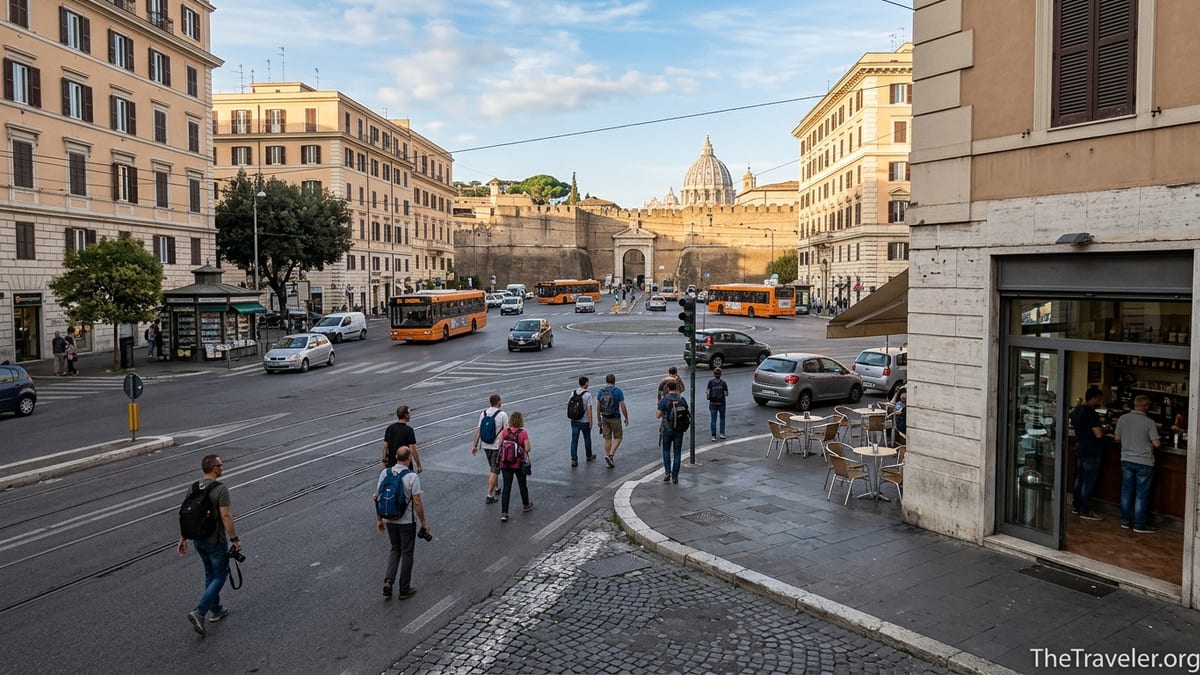
Travelers sometimes expect a grand monumental square at the Vatican’s doorstep and are surprised to emerge into something more functional than spectacular. Piazza del Risorgimento is a broad, open space, ringed by mid-rise residential and office blocks typical of Prati’s late 19th and early 20th century architecture. There is usually a steady flow of buses circulating, cars navigating the roundabout edges, and clusters of pedestrians moving in every direction.
At street level, the edges of the square are lined with practical services: newsstands, simple cafes, pharmacies, and a few small shops selling snacks, phone SIM cards, or umbrellas during sudden rain. On a typical weekday morning, you will see local office workers mixing with tourists in line for coffee. The square itself has some greenery but is dominated by movement and vehicles rather than being a quiet place to linger.
This utilitarian character is not a drawback for visitors; it is precisely what makes the piazza so useful. Because it is a transport node rather than a finely preserved monument, you can confidently use it as a meeting point, a place to reorient yourself using a paper map, or simply a spot to pause and look up routes on your phone. The open space means it is easy to spot companions from a distance, unlike the narrower streets closer to the river.
In recent years, the streets leading from the metro to the square, especially Via Ottaviano, have been made more pedestrian friendly, with improved sidewalks and trees. This has helped smooth the flow of people streaming from the metro to Piazza del Risorgimento during peak Vatican visiting hours. The result is still busy, but a little less chaotic than it was a decade ago, and more forgiving if you are wheeling luggage or pushing a stroller.
Safety, Practicalities, and Using the Square Smartly
Piazza del Risorgimento is generally considered a safe area, especially by big-city standards. Prati is a relatively affluent neighborhood, and the constant presence of commuters, tourists, and police patrols close to the Vatican keeps the atmosphere busy but not threatening. That said, the usual big-city cautions apply: keep wallets, phones, and passports secured, particularly when boarding crowded buses or waiting near bus doors, which are favorite spots for pickpockets.
Because the square is open and windswept, weather can affect your experience more than you might expect. In summer, there is limited shade in the central parts of the piazza, so it can feel hot while you wait for a bus or confirm directions. Simple measures such as carrying a refillable water bottle, a small folding fan, and a hat make a noticeable difference during July and August. In winter, the wind can funnel across the open space; a scarf and gloves can be welcome even on days that do not look particularly cold on a weather app.
Public restrooms directly on the square are limited, so most visitors rely on nearby cafes. It is common practice in Rome to order at least a coffee or bottle of water before using a bar’s restroom. For example, a traveler might step into a cafe on the northeast corner of the piazza, pay a little more than one euro for an espresso at the counter, and then ask politely, in basic Italian or English, to use the toilet. Building a few extra minutes for this into your schedule helps avoid last-minute stress right before a timed-entry museum slot.
Currency and tickets are another practical point. The ticket machines at the Ottaviano metro station sell the standard integrated Rome public transport tickets, which you can use on metro, buses, and trams. It is wise to buy a couple of extra single tickets or a day pass before heading toward Piazza del Risorgimento, so you do not have to hunt for a tobacconist or newsstand that sells tickets when you are trying to leave the Vatican later in the day. Contactless payments are increasingly accepted at ticket machines and in many cafes around the square, but having some small euro notes and coins is still helpful.
Where to Eat and Drink Around Piazza del Risorgimento
Food directly on Piazza del Risorgimento tends to be built around convenience: think coffee, cornetti (Italian croissants), simple sandwiches, and basic pizza by the slice. Prices reflect the square’s location near a major attraction, so a cappuccino might cost slightly more than in a purely local neighborhood further out. That said, many travelers find the trade-off worthwhile for the ability to sit down briefly before or after a Vatican visit without straying far from their route.
For better value and a more local feel, step just a few minutes away from the square into the surrounding Prati streets. Within a 5 to 10 minute walk you can find family-run trattorie, modern bistros, and gelaterie that attract a mix of Romans and visitors. A typical lunch might involve a fixed-price menu of pasta, a simple second course, and house wine for a moderate price, or a single generous plate of cacio e pepe with a glass of local white wine.
Many travelers use Piazza del Risorgimento as a mental boundary line: they tolerate tourist-focused venues on the Vatican side of the walls, then aim to cross back into Prati for a more authentic meal. For example, after exiting St Peter’s Basilica, you might walk back through the colonnades, follow Via di Porta Angelica to the piazza, and then continue along Via Cola di Rienzo or one of its side streets to find dinner. This approach not only improves your chances of eating well, it also gives you a taste of daily Roman life beyond the museums and basilicas.
If you have an especially early Vatican booking, look for bars around the piazza that open by 7:00 a.m. on weekdays. Grabbing a quick coffee and pastry at the counter is typically faster and cheaper than relying on hotel breakfast, and puts you just a short walk from the museums or basilica. Conversely, if you leave the Vatican at sunset, a simple aperitivo at a cafe table facing the bustle of Piazza del Risorgimento can be a satisfying way to decompress and watch the city’s evening rhythm.
Transport Tips, Driving, and Accessibility Considerations
One important thing to understand before attempting to drive near Piazza del Risorgimento is Rome’s system of restricted traffic zones, known as ZTL. Much of the historic center is covered by these zones, where entering by car without authorization can lead to automatic fines. The Prati neighborhood where Piazza del Risorgimento sits is generally outside the strictest central ZTL, which is one reason it is popular with hotels catering to visitors who may arrive by car or taxi. Even so, individual streets can have separate restrictions, bus lanes, or time-limited access. If you plan to drive, confirm your hotel’s directions and parking arrangements in advance and rely on those rather than assuming navigation apps know every local rule.
In practice, most short-stay visitors are better off avoiding driving to the piazza altogether. Public transport, taxis, and pre-booked transfers remove the stress of interpreting unfamiliar signs and allow you to focus on enjoying your time at the Vatican. For example, a couple arriving with luggage from Rome’s main airport might take the train or bus into Termini, change to Metro Line A, and emerge at Ottaviano with no need to navigate city traffic, then walk via Piazza del Risorgimento to their nearby hotel.
Accessibility is gradually improving in this part of Rome, though it still presents challenges. The walk from Ottaviano to the piazza and onward to the Vatican Museums involves mostly level pavements, but surfaces can be uneven and crowded, especially in high season. Recent renovation work has added more elevators and escalators at key metro stations, including improvements at Ottaviano, but it is still wise for travelers with mobility concerns to allow extra time and, where possible, to confirm elevator status on the day through local transit information or by asking station staff.
For wheelchair users or anyone who finds long walks tiring, using Piazza del Risorgimento as your drop-off and pick-up point makes sense. From there, you can choose the shortest available route along the Vatican walls to the museums or toward St Peter’s Square, stopping at benches or cafe terraces as needed. If you are joining a guided tour, ask in advance whether the operator recommends meeting at or near the piazza; many do precisely because it is easier to reach by accessible transport than some of the narrower streets closer to the river.
The Takeaway
Seen on a map, Piazza del Risorgimento is just another Roman square, but on the ground it functions as the practical front door to Vatican City for thousands of visitors each day. It is where trains and buses give way to walking shoes, where group tours quietly assemble before stepping into the Vatican Museums, and where tired travelers return after hours among masterpieces and marble.
By learning how the piazza connects to Rome’s metro and bus network, where it sits in relation to the Vatican walls, and what services you can realistically expect to find there, you remove many of the small uncertainties that can make a busy travel day feel stressful. Instead of emerging from the Ottaviano metro unsure which direction to walk, you will know that following the crowds toward Piazza del Risorgimento is the first step, and that from there, the rest of the Vatican unfolds within a short, straightforward walk.
Most of all, treating Piazza del Risorgimento as your Vatican base camp gives structure to your day. You can plan coffee breaks, bathroom stops, and meal stops around it, use it to change between transport modes, and return to it when you are ready to rejoin the wider city. With that simple mental map in place, you are free to focus on what brought you here in the first place: the art, history, and atmosphere of one of the world’s most remarkable places of faith.
FAQ
Q1. How far is Piazza del Risorgimento from the Vatican Museums entrance?
The walk from Piazza del Risorgimento to the Vatican Museums entrance on Viale Vaticano typically takes about 10 to 15 minutes at a relaxed pace, following the outside of the Vatican walls.
Q2. Which metro stop is best for reaching Piazza del Risorgimento?
Ottaviano, on Rome’s Line A, is the closest metro station. From the station, it is roughly a 5 to 8 minute walk straight down Via Ottaviano to reach Piazza del Risorgimento.
Q3. Are there direct buses from central Rome to Piazza del Risorgimento?
Yes, several city bus routes run from central areas such as Termini and Piazza Venezia to stops at or near Piazza del Risorgimento, making it easy to arrive without changing lines.
Q4. Is Piazza del Risorgimento inside Vatican City?
No. Piazza del Risorgimento is in the city of Rome, in the Prati neighborhood, just outside the Vatican walls. Vatican City begins on the other side of those walls.
Q5. Is it safe to wait in Piazza del Risorgimento early in the morning?
The area is generally considered safe, with a steady presence of locals and police, especially because of its proximity to the Vatican. Standard precautions against pickpockets still apply.
Q6. Are there good places to eat right on the piazza?
On the piazza itself you will mostly find simple cafes and snack-oriented spots. For more character and better value, walk a few minutes into nearby Prati streets such as those leading toward Via Cola di Rienzo.
Q7. Can I get Vatican tour tickets in Piazza del Risorgimento?
You will see agencies and tour operators advertising Vatican tours around the piazza, but it is usually better to prebook official tickets or reputable tours in advance rather than buying on the spot.
Q8. Is Piazza del Risorgimento a good place to meet a tour group?
Yes. Many Vatican tours use the piazza or nearby corners as meeting points because it is easy to reach by public transport and simple for participants to recognize.
Q9. Are there public restrooms in or near the square?
Dedicated public restrooms on the square are limited, so most visitors rely on nearby cafes and bars, purchasing a drink or snack and asking to use the facilities.
Q10. Is it possible to drive and park near Piazza del Risorgimento?
Driving is technically possible, and Prati lies outside the strictest central restricted traffic zones, but parking can be difficult and local rules complex. For most visitors, public transport or taxis are more practical.