


If you are planning a full day around the Vatican Museums and St Peter’s Basilica, you will almost certainly see Piazza del Risorgimento on your map. The large square sits just outside the Vatican walls on the Prati side and functions as a busy transport hub. But is it worth deliberately adding to your walking route, or is it simply somewhere you pass through on the way to more memorable sights? This guide breaks down what Piazza del Risorgimento is really like today, what you can expect to find there, and when it deserves a stop on your Vatican-area itinerary.
Get the latest updates straight to your inbox!
Where Piazza del Risorgimento Fits Into the Vatican Area
Piazza del Risorgimento is a broad, open square that marks the transition between Vatican City and the elegant Prati district of Rome. Stand in the middle and you will see the high Vatican walls on one side and tree-lined avenues like Via Cola di Rienzo and Via Ottaviano fanning out on the other. Many visitors first encounter the piazza as they exit Ottaviano metro station on Line A and follow the stream of people towards the Vatican Museums and St Peter’s Square.
In practical terms, the piazza acts as a hinge between major Vatican sights. Walking from Piazza del Risorgimento to the main entrance of the Vatican Museums takes roughly 10 to 12 minutes at an easy pace along Viale Vaticano. Reaching St Peter’s Square by looping around the outside of the walls typically takes 8 to 10 minutes. For travelers who like to structure their sightseeing in loops rather than out-and-back routes, the square can serve as a convenient anchor point where you start in Prati, visit the Vatican, and then drift back to the neighborhood for lunch or shopping.
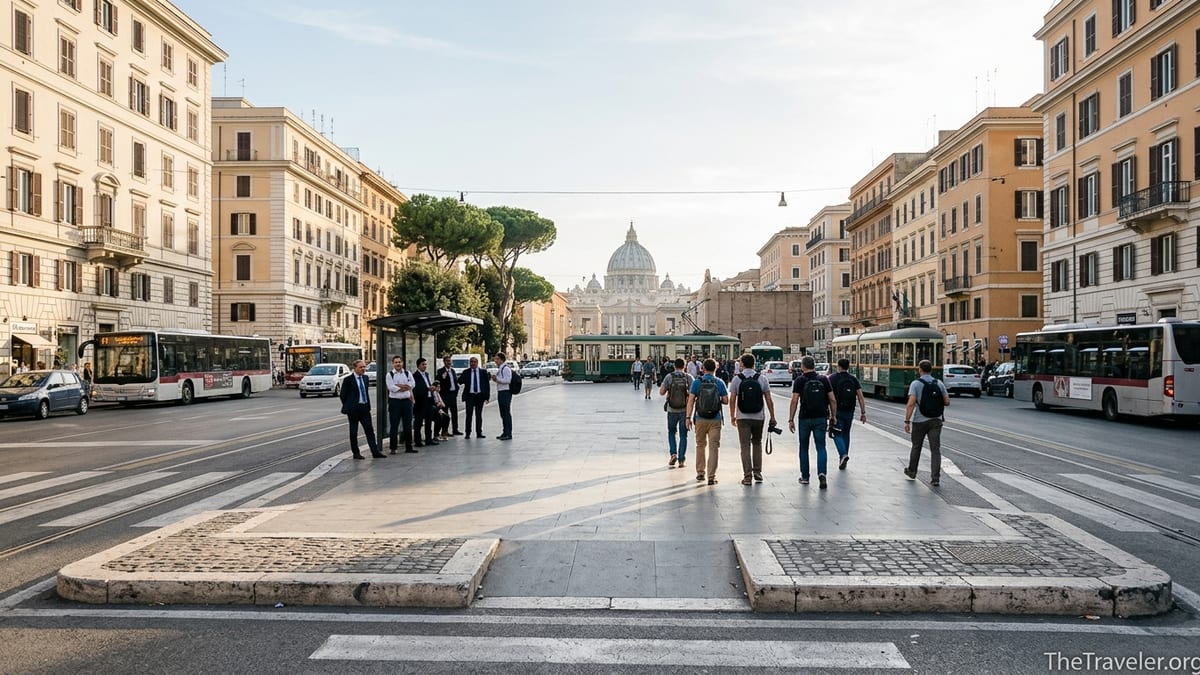
The atmosphere of the piazza itself is more functional than picturesque. You will see Roman commuters changing buses, Vatican visitors checking phones for directions, and tour groups gathering beside bus shelters. This is not a piazza in the sense of a charming Renaissance square with fountains and café terraces. Instead it feels more like a large traffic circle with some green space and monuments in the middle, useful for orientation and logistics rather than lingering.
Because of this, whether you should deliberately include Piazza del Risorgimento on your walking route depends on how you move through the Vatican area. If you are arriving by metro, tram or bus, you will almost certainly pass through here anyway, so it becomes a natural waypoint. If you are walking from central Rome across the Tiber via Ponte Sant’Angelo or Ponte Vittorio Emanuele II, the square is slightly off the most scenic routes and may not add much unless you specifically want to reach Prati.
Transport Hub: When the Piazza Makes Your Life Easier
Where Piazza del Risorgimento truly shines is as one of the most useful public transport nodes around the Vatican. The tram stop here, traditionally served by Tram 19, connects the Vatican area with eastern neighborhoods around Porta Maggiore and Centocelle. Even though service patterns can change due to ongoing works, the Risorgimento / San Pietro stop remains a reference point on tram maps and is often mentioned in Vatican ticketing information as a way to approach the Museums.
Around the edge of the square you will find several ATAC bus stops served by routes that locals use daily. These typically include lines toward the Olympic Stadium area, Flaminio, and other residential districts, which can be handy if you are staying outside the historic center. For example, travelers attending an evening football match at Stadio Olimpico sometimes ride a bus that terminates or passes through Risorgimento, then walk the final section. Similarly, visitors based near Termini or Piazza Venezia can combine a short metro ride on Line A with a bus from the piazza to reach less central hotels without needing a taxi.
For many first-time visitors, the most practical use of the piazza is as a mental label when using Rome’s journey planners or hotel directions. You will frequently see instructions such as “take bus 32 toward Risorgimento” or “change to tram 19 at Risorgimento / San Pietro.” Having a sense of what that destination looks like, and knowing it sits just beyond the Vatican walls, removes a lot of anxiety when changing vehicles. If you land at Fiumicino and take a fixed-fare taxi to a hotel “near Piazza del Risorgimento,” you can picture that you are a 5-minute walk from the colonnades of St Peter’s.
If you rely heavily on public transport for your Vatican day, then adding Piazza del Risorgimento to your walking route is less a question and more an inevitability. In that scenario it is worth planning 10 to 15 minutes of buffer time here, especially in the afternoon, so that you can locate the correct stop, double-check timetables on the digital displays, and orient yourself before heading back into the warren of Vatican queues and security lines.
What You Will Actually See in the Square
Travelers often assume that any large Roman piazza near a major attraction will be visually spectacular. Piazza del Risorgimento is more understated. Its focal points are patriotic rather than ancient: you will see the Museo Storico dell’Arma dei Carabinieri, a museum dedicated to Italy’s national gendarmerie, and monuments commemorating the Risorgimento, the unification movement that gave the square its name. These stone and bronze memorials are of interest if you enjoy modern Italian history, but they do not have the instant wow factor of Bernini fountains or Baroque churches.
Because the piazza is spacious and ringed by traffic, the impression on arrival is one of openness and movement. Cars circle the square, buses pull in and out, and trams glide across on rails. There are pockets of greenery and benches, and you may see locals using them for a quick phone call or snack break. On a typical weekday morning around 9 or 10, the light is bright, and the soundscape is full of engine noise, tram bells and the low murmur of people walking toward the Vatican entrances.
Architecture fans will appreciate the way the surrounding Prati district frames the square. Many of the buildings along Via Ottaviano and Via Cola di Rienzo are early 20th century, with clean lines, tall windows and wrought-iron balconies. From certain angles in the piazza you can glimpse the dome of St Peter’s rising above the walls, reminding you how close you are to the spiritual heart of Catholicism. It is a useful place to get your bearings: face the dome and you are looking south toward the basilica; turn your back to it and you are facing into Prati.
If you are traveling with children, the open space can be a brief relief from narrower sidewalks and dense crowds. While it is not a playground, the central green area allows a few minutes for a toddler to walk around or for a family to regroup before the intensity of the Museums. Just be sure to stay on the pedestrian islands and obey crossings, as traffic around the rim of the square can be fast and impatient, particularly during weekday rush hours.
Food, Coffee and Everyday Errands Around the Piazza
One of the most practical reasons to include Piazza del Risorgimento on your Vatican walking route is the everyday infrastructure that surrounds it. Within a few minutes’ walk of the square you will find several cafés, bars and simple restaurants where you can grab an espresso, a slice of pizza al taglio or a sit-down plate of pasta at prices that are usually lower than those right beside St Peter’s Square. For instance, a cappuccino at a bar just off Via Ottaviano might cost around 1.50 to 2 euros at the counter, compared with noticeably higher prices at tourist-heavy spots facing the basilica.
There are also bakeries, gelaterie and small supermarkets in the nearby streets of Prati. It is common for travelers who have early timed entries to the Vatican Museums to stop around Piazza del Risorgimento first, pick up bottled water and a light breakfast pastry, and then walk along the walls to the museum entrance. Having this cluster of everyday shops close to a major attraction can make a big difference if you are trying to keep costs under control or traveling with someone who needs frequent snacks or specific items from a pharmacy.
The Prati side of the piazza is also known for mid-range shopping streets. Via Cola di Rienzo, roughly 10 minutes’ walk away, is lined with clothing chains, Italian shoe stores, homeware shops and gourmet food boutiques where you can buy items like artisan pasta, olive oil or chocolate to take home. Adding Piazza del Risorgimento to your itinerary can be a strategic way to link a morning of intense art and history in the Vatican with a more relaxed afternoon of shopping without needing to cross the river again immediately.
As with any busy transport node, there are also more anonymous establishments, from fast-food outlets to quick-service pizza counters that cater mainly to passing crowds. These can be perfectly fine for a fast bite between the Museums and a bus or tram, but if you value ambiance, it is worth walking a few blocks into Prati to find a quieter trattoria on a side street rather than eating directly on the square itself.
Pros and Cons of Adding Piazza del Risorgimento to Your Route
When you weigh whether to intentionally build Piazza del Risorgimento into your Vatican area walk, it helps to think in terms of trade-offs. On the plus side, the square is one of the most useful points in the city for switching between modes of transportation, especially if you are combining the Vatican with other neighborhoods not served directly by the metro. It also offers easier access to reasonably priced cafés, supermarkets and shops than you will find immediately around St Peter’s, and it gives you a clear orientation marker between the Vatican walls and Prati.
Another advantage is flexibility. If you finish your Vatican visit and feel overwhelmed by crowds, you can retreat to Piazza del Risorgimento and decide what to do next. From there it is straightforward to stroll into Prati for a slower-paced lunch, hop on a bus toward Piazza del Popolo or the Tiber’s eastern bank, or simply sit for a few minutes while checking alternative plans on your phone. For travelers who like to keep their days open rather than locking in a strict schedule, this kind of crossroads can be invaluable.
On the downside, the square itself is not a destination in the way that Piazza Navona or Campo de’ Fiori are. If you are very short on time and your main goal is to see iconic Roman scenery, you may resent detouring here instead of crossing the river via Ponte Sant’Angelo with its statues and views of Castel Sant’Angelo. The traffic noise and concrete-heavy landscape also make it less photogenic and less relaxing than other Roman piazzas, especially during peak hours when buses and trams arrive every few minutes.
There is also the risk of overloading your Vatican day. Many travelers underestimate how draining several hours inside the Museums and the basilica can be, particularly in busy seasons when lines are long and galleries are crowded. If you have already planned a riverside walk, a stop at Castel Sant’Angelo and an evening meal in Trastevere, building in an extra loop through Piazza del Risorgimento might tip the day from pleasantly full to exhausting, without adding much in the way of memorable experiences.
Suggested Walking Scenarios That Include the Piazza
To help you decide if the square belongs on your route, it can be useful to imagine specific day plans. Picture, for example, a morning where you ride Line A to Ottaviano, emerge near Piazza del Risorgimento, grab a quick coffee at a nearby bar, and then walk along Viale Vaticano to a 9 a.m. timed entry for the Museums. After a few hours indoors you exit near St Peter’s, visit the basilica and square, and then curve back around the walls to the piazza. From there you wander into Prati, find a late lunch on a quieter side street, and later take a tram or bus back toward your accommodation.
Another scenario is for travelers staying in an eastern district like San Lorenzo or near Porta Maggiore. You might use Tram 19 or its replacement services to arrive at Risorgimento in the morning, visit the Vatican, then return to the piazza in the afternoon to ride back out of the center. In that case, Piazza del Risorgimento acts as the hinge that lets you reach the Vatican directly from less touristy neighborhoods without changing multiple times at Termini.
Families with children or older relatives may also benefit from using the piazza as a halfway rest point. You could, for example, start in central Rome, walk across Ponte Vittorio Emanuele II to St Peter’s, tour the basilica, and then stop at Piazza del Risorgimento for a snack and bathroom break before continuing on foot into Prati or boarding a bus home. By consciously building that pause into your route, you reduce the temptation to push everyone too hard between one “must-see” and the next.
In contrast, if your Vatican visit is squeezed into half a day and you are staying in the historic center near Campo de’ Fiori or the Pantheon, you might prefer a more scenic direct walk. In that case, you could cross at Ponte Sant’Angelo, enjoy views of Castel Sant’Angelo, head straight up Via della Conciliazione to St Peter’s and then return the same way, skipping Piazza del Risorgimento entirely. You would trade some transport convenience and shopping options for a tighter, more visually rewarding loop.
The Takeaway
Piazza del Risorgimento is not one of Rome’s headline attractions, but it is deeply woven into how the Vatican area functions day to day. As a transport hub and practical gateway to the Prati neighborhood, it offers clear benefits: easier access to trams and buses, a cluster of everyday services and shops, and a roomy space to catch your breath before or after tackling the Vatican Museums and St Peter’s.
Whether you should deliberately add it to your walking route depends largely on your priorities. If you value efficiency, use public transport heavily, or want to combine the Vatican with shopping and dining in Prati, it deserves a place in your plan and will likely feature naturally in your movements. If, on the other hand, your time is very limited and you are chasing only the most scenic, iconic views, you may prefer to orbit the Vatican along the river and its bridges instead.
For many travelers the best approach is to remain flexible. Keep Piazza del Risorgimento in mind as a nearby option rather than a fixed stop: if you need a supermarket, a reasonably priced coffee, a bus connection or simply a bit of breathing space, you will know that a few minutes’ walk from the Vatican walls lies a big, workaday square that quietly keeps this part of Rome moving.
FAQ
Q1. Is Piazza del Risorgimento worth visiting on its own, or only as part of a Vatican day?
On its own, the square is rarely a must-see. It is most valuable as part of a Vatican day because it works as a transport hub and a gateway to the Prati district’s cafés, shops and everyday services.
Q2. How long does it take to walk from Piazza del Risorgimento to the Vatican Museums entrance?
At a normal pace it usually takes about 10 to 12 minutes to walk from the piazza along the outside of the Vatican walls to the main entrance of the Museums on Viale Vaticano.
Q3. Is it better to arrive at the Vatican via Piazza del Risorgimento or across Ponte Sant’Angelo?
For scenic views and photos, Ponte Sant’Angelo and Via della Conciliazione are more impressive. For quick access from metro, tram or bus, Piazza del Risorgimento is usually more practical.
Q4. Are there good places to eat or get coffee around Piazza del Risorgimento?
Yes. Within a few blocks you will find classic Roman bars for breakfast, pizzerias by the slice, simple trattorias and gelato shops, often at slightly lower prices than right beside St Peter’s Square.
Q5. Is Piazza del Risorgimento safe to walk through early in the morning or in the evening?
The area is generally busy and feels reasonably safe, especially during commuting hours and early evening. As in any large city, keep normal precautions with bags and watch for traffic at crossings.
Q6. Does public transport from Piazza del Risorgimento run reliably to other parts of Rome?
The square is a key node for buses and tram services, so connections are frequent, though delays can occur at peak times. It is a practical starting or ending point for trips to and from the Vatican.
Q7. Is Piazza del Risorgimento a good base area for a hotel near the Vatican?
Many travelers like staying in streets just off the square because they are within a short walk of the Vatican while still enjoying the more local feel, shops and restaurants of the Prati neighborhood.
Q8. Are there notable sights or museums directly on Piazza del Risorgimento?
The main landmark is the historical museum of the Carabinieri and several monuments related to Italy’s unification. They are interesting if you enjoy modern history but not essential for most first-time visitors.
Q9. Can I use Piazza del Risorgimento as a meeting point for guided Vatican tours?
Yes. Many tours specify nearby metro exits or corners of the piazza as meeting points because it is easy for groups to find and has enough space for people to gather without blocking narrow streets.
Q10. Should I plan extra time in Piazza del Risorgimento during very busy Vatican days?
Allowing an extra 10 to 15 minutes is wise on busy days so you can locate the correct bus or tram stop, pick up snacks or water, and regroup before or after navigating Vatican security and crowds.