


Hidden beneath a quiet residential street in Bacoli, about 15 kilometers west of Naples, Piscina Mirabilis is one of those places that rarely appears on first-time itineraries yet lingers in the memory of those who make the detour. This colossal Roman cistern, carved into tuff rock and lined with towering pillars, once supplied fresh water to the imperial fleet at Miseno. Today, it is a haunting, cathedral-like space that prompts a very modern question: is it actually worth leaving central Naples, or even skipping a few hours in Pompeii or the Amalfi Coast, to see it?
Get the latest updates straight to your inbox!
What Exactly Is Piscina Mirabilis?
Piscina Mirabilis is the largest known ancient Roman freshwater cistern, tucked into the hillside above the town of Bacoli in the Phlegraean Fields, northwest of the Bay of Naples. Built in the Augustan age, it marked the end of the Aqua Augusta aqueduct system, which carried water over roughly 100 kilometers from the Apennine springs near Serino to the ports and towns around the bay. The cistern’s purpose was highly strategic: it stored drinking water for the Roman naval fleet based at Miseno, one of the most important military harbors of the empire.
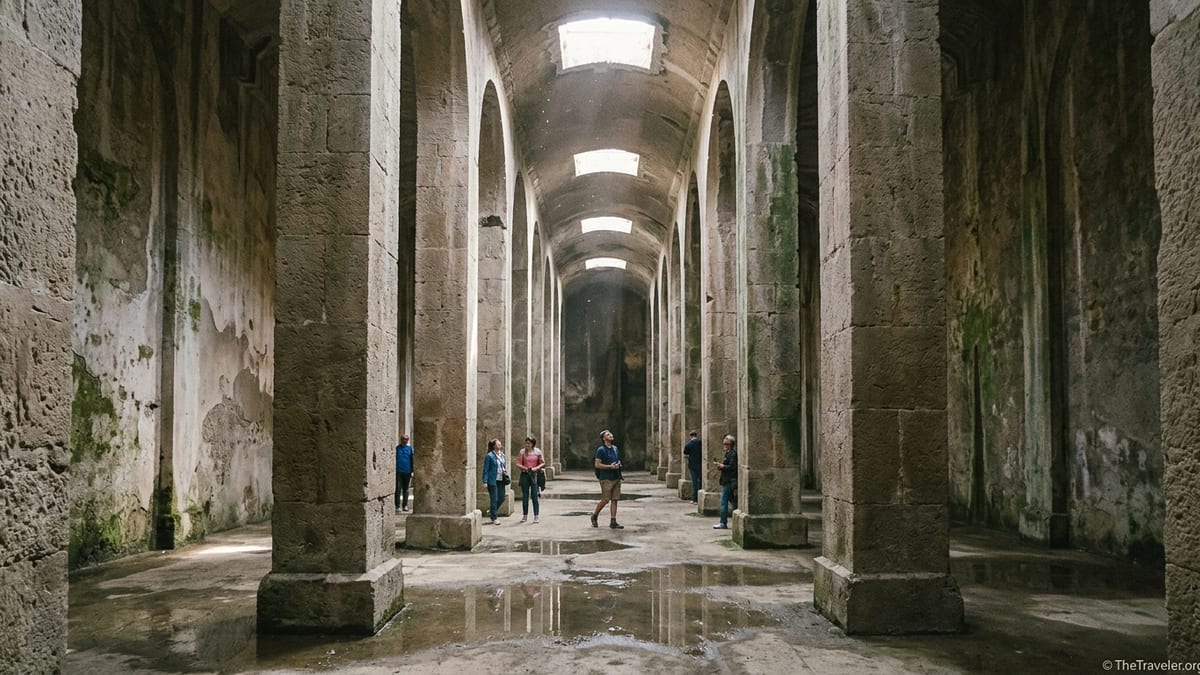
Step inside today and it feels less like infrastructure and more like a submerged basilica. The underground chamber measures roughly 72 meters long, 25 meters wide and 15 meters high, with a capacity of around 12,000 cubic meters of water. A barrel vault roof rests on 48 massive cruciform pillars arranged in regular rows, forming five long “naves” that vanish into shadow. The scale surprises almost everyone: from photographs you might expect a large cellar, but in person it is closer to walking through a stone forest or a dimly lit church nave.
The architecture is also a lesson in Roman engineering. The walls and vault are coated with waterproof opus signinum, and a long sedimentation basin in the central nave was used to clean and maintain the water supply. Vents in the ceiling once allowed light and air to reach the interior. For travelers interested in how Rome functioned on a day-to-day level beyond temples and theaters, Piscina Mirabilis offers a rare look at the infrastructure that kept a military machine and coastal cities alive.
The cistern’s atmosphere has long impressed visitors. Renaissance humanists such as Petrarch wrote admiringly about it, and in recent years its surreal interior has been used as a backdrop for films, music projects and photography. Walking between the damp pillars, with light slanting in from the roof openings and distant footsteps echoing, you quickly understand why.
What Visiting Is Like in Practice
Unlike blockbuster sites such as Pompeii, Piscina Mirabilis still feels intimate and uncrowded, but visiting requires a bit more planning. Access is managed as part of the Campi Flegrei archaeological network, and opening conditions have changed several times in recent years. At the time of writing, visits generally operate in timed slots with mandatory reservations, often via the same booking platform used for other Phlegraean sites. Availability can vary by season, so it is wise to check dates and times and secure a spot a few days in advance if you have fixed travel plans.
Once you reach Bacoli, the entrance is on a quiet street lined with low houses, a short uphill walk from the town center. There is no large visitor center. You typically check in with a custodian or guide at street level, then descend a long, fairly steep staircase to the floor of the cistern. The atmosphere shifts quickly: bright Mediterranean light disappears, the air turns cool and slightly humid, and your footsteps start to echo off stone and water stains.
Inside, visits are generally accompanied or supervised for safety and conservation reasons. Some time slots are simple escorted entries, where a custodian lets you walk around independently for 20 to 30 minutes while keeping an eye on the group. Others are structured guided tours, sometimes combined with nearby sites like the underwater archaeological park of Baia or the Cento Camerelle cisterns. Independent travelers who prefer flexibility may want to look specifically for basic entry slots, while history enthusiasts might opt for a combined guided package.
Facilities on site are limited. There are no cafés at the entrance, and restroom access can be basic or shared with nearby municipal facilities. For a smoother experience, many visitors stop first at a bar in Bacoli’s center or along the waterfront for a coffee, snack and bathroom break before walking up. This low-key, uncommercial setup is part of the charm for some travelers and an inconvenience for others; it is worth knowing what to expect so you are not surprised by the simplicity.
Getting There From Naples: Transport and Time Costs
Reaching Piscina Mirabilis from central Naples is not difficult, but it does take more effort than hopping on the Circumvesuviana to Pompeii. The most common public-transport route is via the Cumana suburban railway from Montesanto station to its western terminus at Torregaveta. Trains typically run several times an hour in daytime, and the journey takes roughly 35 to 40 minutes. From Torregaveta, you connect to a local EAV bus toward Bacoli and get off near the town’s municipal villa or center, then walk up through residential streets to the entrance.
In practice, many visitors allow about 60 to 75 minutes each way from central Naples once train connections, waiting times and the uphill walk are factored in. On crowded days, the Cumana can be busy with commuters and beachgoers heading toward the coast, especially on summer weekends. If your time in Naples is limited to two or three days, you need to weigh this half-day commitment against other excursions such as Pompeii, Herculaneum or the Amalfi Coast, which have more direct tourist infrastructure.
For small groups or those prioritizing comfort, a taxi or ride-hailing service from central Naples to Bacoli can be more convenient, though obviously more expensive. The drive usually takes 35 to 45 minutes outside peak traffic. Some local tour operators offer half-day private excursions combining Piscina Mirabilis with other Phlegraean sites like the Baia archaeological park or the Aragonese castle in Baia, which can be good value when split between several travelers. Drivers accustomed to the area also know where to park near the entrance, something self-driving visitors can find confusing in narrow residential streets with limited legal spaces.
If you do rent a car, be prepared for typically dense Neapolitan traffic, roundabouts and scooters weaving through. From central Naples you generally follow signs toward Pozzuoli and then Bacoli, using the ring road and coastal routes. This option makes sense if you are planning a full day exploring multiple Phlegraean sites and want the flexibility to move between them, but for a single visit solely to the cistern public transport or a pre-arranged transfer may be easier.
How Much Does It Cost, and What About Combined Tickets?
Entry fees and ticket structures for Piscina Mirabilis have evolved as it has been more closely integrated with the wider Campi Flegrei park. In recent years, access has often been included in combined tickets covering multiple sites in the area, or offered at a modest standalone price that is generally lower than headline attractions like Pompeii or the Naples Archaeological Museum. Various reduced or free-entry categories typically apply to young children, disabled visitors, accredited guides, journalists and sometimes local residents or students of relevant disciplines.
Because prices can be adjusted seasonally and in response to conservation needs, it is safest to treat any figures you read in older guidebooks or blogs as approximate. What has remained consistent is that the cistern is one of the more affordable significant archaeological experiences around the Bay of Naples. For many travelers, the real “cost” to consider is not the ticket but the time and logistics of reaching Bacoli and fitting a fixed reservation into a busy itinerary.
If you are planning a broader archaeological day in the Phlegraean Fields, it is worth checking for current combined offers that include Piscina Mirabilis, the Baia archaeological park, Cumae and perhaps the Flavian Amphitheatre in nearby Pozzuoli. Several regional passes and local cards periodically grant discounted or repeat access within a set time window. These can be good value if you are staying in Naples for a week or more and expect to make multiple excursions in this direction.
Guided tours that bundle transport from Naples, entry to Piscina Mirabilis and visits to one or two other sites typically cost significantly more than going independently by train, but they remove the stress of coordinating bus connections and reservations in Italian. For travelers unfamiliar with the region or those who prefer to maximize explanation over logistics, such packages can turn what might otherwise be a complicated half day into a relaxed, informative outing.
Who Will Find Piscina Mirabilis Most Rewarding?
Piscina Mirabilis is not a universal crowd-pleaser in the way that Pompeii or Capri are. Its appeal is specific, and that is where its strength lies. Architecture and engineering enthusiasts often describe it as one of the most memorable places they see in the Naples area. Walking among 15-meter-high pillars in a cool, echoing chamber and realizing that this space once existed solely to store water provides a powerful sense of Rome’s scale and technical confidence. If you have already visited sites such as the Pont du Gard in France or the underground water systems of Istanbul, Piscina Mirabilis feels like the missing Mediterranean link.
Travelers who prefer quieter, less commercial experiences also tend to love it. There are no souvenir stalls at the entrance, no queue of bus tours, and at many times of year only a handful of visitors share the space. Photographers find the filtered light and repetition of columns particularly compelling; with permission from staff and without flash, you can capture moody images that look almost like a medieval cloister or abandoned church.
On the other hand, Piscina Mirabilis is less suited to visitors who expect a high level of interpretation and amenities. Information panels can be minimal, and while some guided tours provide detailed explanations, basic entries may involve only a short safety introduction. Young children without a strong interest in history or adventure may find the dim, repetitive environment less engaging after a few minutes. Travelers who struggle with steep stairs or uneven surfaces may find the descent and climb back up challenging, especially in warm weather.
It is also important to set expectations: this is a single structure, not a vast multi-zone archaeological park. Many visitors spend around 30 to 45 minutes inside, perhaps stretching to an hour if on a detailed guided tour or if taking photographs. The experience is intense but relatively brief. For some, that perfectly justifies the trip as a compact, unforgettable moment; for others, it may feel too short for the travel time involved.
How It Compares With Other Day Trips From Naples
To decide whether Piscina Mirabilis is worth it, it helps to compare it with the classic excursions around Naples. Pompeii and Herculaneum remain the obvious priorities for most first-time visitors: both are easily reached by direct train, well signposted, and offer hours of exploration through intact streets, houses and public buildings. They provide an unparalleled look at daily life in Roman cities and are hard to skip if you have never seen them before.
By contrast, Piscina Mirabilis offers depth rather than breadth. You do not wander through a town; you descend into a single, monumental volume. In terms of emotional impact, it can rival or even surpass more famous sites, especially for those fascinated by infrastructure or atmospheric spaces. Shots of the cistern’s interior often circulate on social media with captions from visitors who found it unexpectedly powerful and serene, particularly when visited in a quiet time slot.
Compared with Naples’ own underground attractions, such as Napoli Sotterranea or the Bourbon Tunnel, Piscina Mirabilis is more architecturally regular and grand, less a maze of tunnels and more a single, vast hall. If you are already planning to explore underground Naples, you might consider Piscina Mirabilis as a complementary experience that shifts the focus from urban cisterns and war shelters to imperial-scale military infrastructure on the coast.
When weighed against coastal escapes like Capri, Ischia or Sorrento, Piscina Mirabilis clearly appeals to a different mood. There are no chic beach clubs or shopping streets attached. That said, Bacoli and nearby Baia offer pleasant waterfront promenades, seafood trattorias and, in good weather, views across the bay to Capri and Vesuvius. Many visitors who make the journey choose to turn it into a full-day Phlegraean outing: morning at Piscina Mirabilis and nearby ruins, afternoon boat tour over the underwater remains of Baia, and an early seafood dinner before heading back to Naples.
The Takeaway
So, is Piscina Mirabilis worth visiting during a trip to Naples? The answer depends less on the monument itself and more on what you want from your time in the region. The cistern is undeniably impressive: it is one of the largest and best-preserved Roman water reservoirs anywhere, and walking among its pillars is a powerful, almost contemplative experience. For travelers who value atmospheric, off-the-beaten-path sites and can spare half a day, it can become a quiet highlight of a Naples stay.
If, however, your itinerary is tight and you have not yet visited Pompeii, Herculaneum or the major museums in Naples, those remain more comprehensive introductions to the ancient world here. Piscina Mirabilis is best seen as an addition for returning visitors, for serious Roman history fans, or for those keen to explore the lesser-known Phlegraean Fields and combine the cistern with other sites in Bacoli and Baia.
In practical terms, factor in the time required to reach Bacoli, the need to reserve ahead, and the limited on-site services. If you are comfortable with a bit of logistical effort and drawn to the idea of standing in a cool, echoing Roman cathedral of water far from the crowds, then the detour is likely to feel very worthwhile indeed.
FAQ
Q1. How long does a visit to Piscina Mirabilis usually take?
Most visitors spend about 30 to 45 minutes inside the cistern, or up to an hour if they are on a detailed guided tour or taking photographs.
Q2. Do I need to book in advance to visit Piscina Mirabilis?
In most recent seasons, advance reservations for specific time slots have been required or strongly recommended, so it is best to secure a booking before you travel.
Q3. How do I get to Piscina Mirabilis from central Naples by public transport?
Typically you take the Cumana train from Montesanto station to Torregaveta, then a local bus toward Bacoli and walk uphill from the town center to the entrance.
Q4. Is Piscina Mirabilis suitable for visitors with limited mobility?
Access involves a long, fairly steep staircase and uneven floors underground, so it can be challenging for visitors with mobility issues or those who cannot manage many steps.
Q5. Are there guided tours available at Piscina Mirabilis?
Yes, entry is often accompanied by a custodian, and various operators offer guided tours, sometimes combined with nearby sites such as Baia or Cumae.
Q6. Can I combine a visit to Piscina Mirabilis with other attractions in the area?
Many travelers pair it with the Baia archaeological park, the underwater ruins of Baia, Cento Camerelle or the coastal promenades and seafood restaurants in Bacoli.
Q7. Is Piscina Mirabilis a good choice for children?
It can be fascinating for older children interested in history or engineering, but younger kids may find the dim, repetitive interior less engaging and the stairs tiring.
Q8. What should I wear and bring for a visit?
Comfortable shoes with good grip are important for the stairs and damp floor, and a light layer can be useful since it is cooler inside than outside, even in summer.
Q9. Is photography allowed inside Piscina Mirabilis?
Non-flash photography is generally permitted, and many visitors enjoy capturing the light and columns, but it is wise to confirm any restrictions with staff on arrival.
Q10. Is Piscina Mirabilis worth it if I only have two or three days in Naples?
If it is your first visit and time is short, you may prefer priorities like Pompeii, Herculaneum and central Naples; Piscina Mirabilis is most rewarding as an additional, more specialized excursion.