


On a low hill above the Bay of Naples, beneath the modern town of Bacoli, an enormous stone forest of pillars disappears into the half‑light. This is Piscina Mirabilis, a 2,000‑year‑old Roman freshwater cistern that once supplied the imperial fleet at nearby Misenum. Today it is one of the most intact pieces of large‑scale hydraulic infrastructure left from antiquity, and it still shapes how archaeologists, architects and engineers understand the brilliance and limits of Roman engineering.
Get the latest updates straight to your inbox!
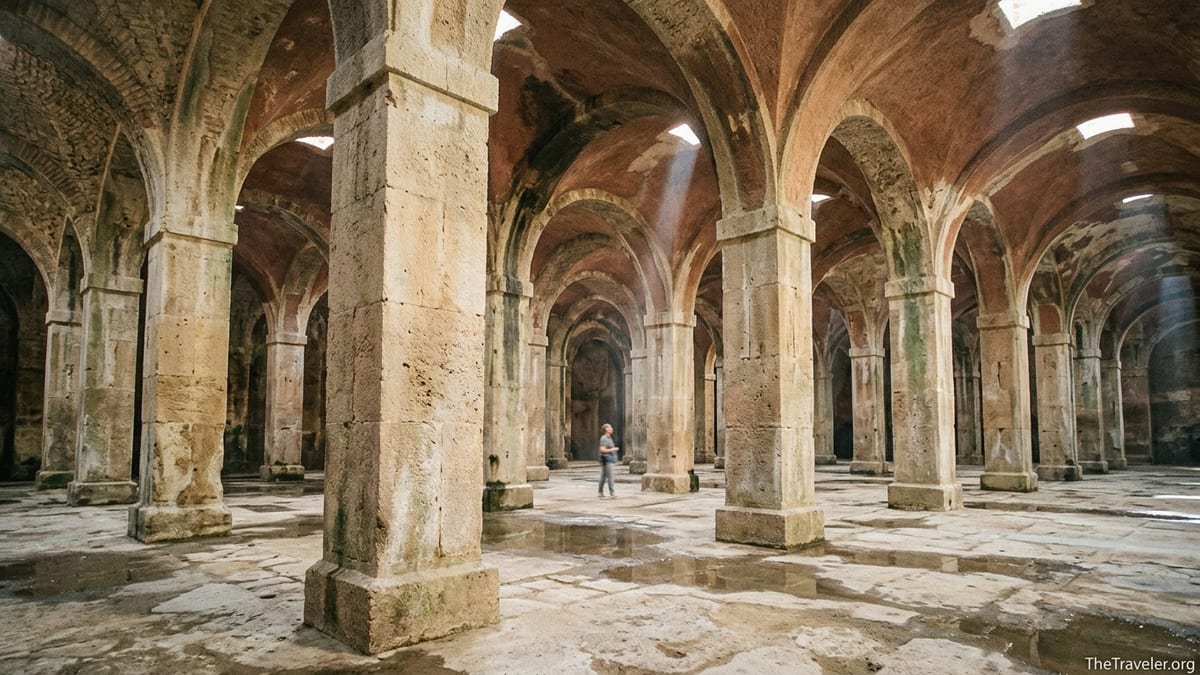
A cathedral of water above the Bay of Naples
Walk down the modern staircase into Piscina Mirabilis and the first impression is not of utility but of architecture. The cistern stretches roughly 70 meters by 25 meters, with a height of about 15 meters, its vast interior broken into vaults by 48 massive pillars arranged in a grid. Visitors often compare it to a stone “cathedral of water,” and from floor level the repeating arches feel closer to a Gothic church than to a tank designed simply to hold drinking water.
The structure was cut directly into volcanic tuff, the soft rock that underlies much of the Phlegraean Fields west of Naples, then lined with Roman concrete and a waterproof mortar rich in crushed pottery known as cocciopesto. At full capacity it could hold in the order of 12,000 cubic meters of fresh water, enough to support the Roman naval base at Misenum along with baths, fountains and households attached to the fleet complex. For modern travelers who have already seen the visible grandeur of Roman aqueducts near Rome or Nîmes, Piscina Mirabilis offers a rare look at the equally important but usually invisible storage side of the system.
Reaching the site today is straightforward. Many visitors base themselves in Naples, then take the suburban railway toward the Phlegraean Fields and continue by local bus or taxi to Bacoli. From the street, the entrance on Via Piscina Mirabile looks almost modest. Only once you descend do you grasp the scale, and with it, why engineers and historians still use this single cistern as a benchmark when they explain Roman water management to students and professionals.
How Roman engineers made gravity work for them
Piscina Mirabilis was the terminal reservoir of the Aqua Augusta, also called the Serino aqueduct, a gravity‑fed system that ran almost 100 kilometers from mountain springs near Serino in the Apennines to the Bay of Naples. The aqueduct dropped only a small amount of elevation over its entire course, using a carefully calculated gradient so that water would flow neither too fast (which could damage channels) nor too slowly (which could stagnate). Standing inside the cistern today, it is easy to forget that every drop that once filled this space arrived without pumps, moved only by the steady pull of gravity.
Modern hydraulic engineers who study the site point out that the Aqua Augusta had to cross valleys, skirt volcanic craters and pass by several important cities, among them Pompeii, Herculaneum and Neapolis. At different points the Romans shifted between open channels, covered conduits, tunnels and bridges, always preserving the essential slope. The final leg delivered water to the naval base at Misenum, where Piscina Mirabilis acted as a buffer, smoothing out daily and seasonal fluctuations in demand. The principle is familiar to any traveler who has seen a municipal water tower on a small‑town skyline, but here it appears expanded to an almost city‑block‑sized underground cavern.
For visitors, the clearest demonstration of gravity’s role lies not in what is visible but in what is missing. There are no large intake pipes at human height, no sluice gates along the interior walls. Most of the hydraulic connections were in the vaults above or in buried channels outside, emphasizing that the cistern was a closed piece of infrastructure, not a public pool. Guides on site often explain this by pointing to small openings in the roof where water was once drawn up using lifting machines, a far cry from the romantic image of sailors walking down to fill jars between the pillars.
Construction techniques that still influence modern design
The fabric of Piscina Mirabilis provides a compact lesson in Roman construction. The side walls combine opus reticulatum, a net‑like stone pattern, with brickwork, while the pillars are built of small tuff blocks and then coated. Overhead, barrel vaults span between the walls and pillars, distributing loads down into the rock. For architects and civil engineers who visit, the way those loads are handled without steel reinforcement is as compelling as the hydraulic story.
The waterproof lining is particularly significant. The Romans mixed lime, sand and crushed terracotta to create a mortar that adheres well even on damp surfaces and resists slow erosion by water. On the floor and lower walls the builders curved the junctions between surfaces, avoiding sharp angles where cracks could form. Many of these details today find analogues in modern water infrastructure, where engineers still avoid stress concentrations, use coatings to protect concrete and design tank interiors around cleaning and inspection needs.
Recent conservation work has highlighted another technical aspect: the roof terrace above the vaults. In the 20th century, Italian authorities reinforced and waterproofed this upper surface to prevent rain infiltration, much as a contemporary engineer might retrofit an aging reservoir. For travelers curious about how heritage and modern engineering intersect, these interventions are a reminder that even a remarkably preserved Roman cistern needs ongoing structural care in a seismically active, densely populated area.
These construction lessons are not purely academic. When international architecture teams entered a competition organized by the Reuse Italy collective to imagine a future museum space in and around Piscina Mirabilis, they had to grapple with the original structure’s load paths, humidity and the need to avoid damaging ancient materials. Their proposals, which ranged from discreet walkways to minimal lighting schemes, are now used in university studios as case studies in adaptive reuse of underground heritage.
Managing water quality long before modern filtration
At the center of the cistern’s main nave, visitors can still see a rectangular depression in the floor, about a meter deep, known as the piscina limaria. This feature functioned as a settling and drainage basin, where heavier sediments could accumulate and be removed during periodic maintenance. In essence, it was a simple sedimentation tank, the same principle that modern treatment plants in cities from Naples to New York still use as a first step to clarify raw water.
The very decision to place the reservoir at the end of a long aqueduct indicates that Roman engineers thought carefully about water quality. As water moved slowly through channels and into the cistern, suspended particles had time to settle. The tuff bedrock surrounding Piscina Mirabilis also helped insulate the interior, keeping temperatures relatively stable and limiting algae growth. Although the Romans lacked germ theory, they were sensitive to taste, clarity and odor, and they designed surfaces to be scrubbed periodically. Today, when guides describe how crews would drain and clean the tank, it invites comparison with modern utilities that must take entire reservoirs offline for inspection and scoring of interior linings.
For contemporary engineers focused on sustainable design, Piscina Mirabilis offers further inspiration. The cistern functioned entirely passively, without mechanical filters or chlorination, relying instead on source protection at the mountain springs, careful routing to minimize contamination and generous storage to ride out demand spikes. In an era when many cities are revisiting gravity‑fed, low‑energy systems to adapt to climate pressures, the site has become a touchstone in conference papers and technical handbooks about resilient water infrastructure.
Travelers with an interest in public health can connect the dots by pairing a visit to Bacoli with time at the Archaeological Museum of the Phlegraean Fields, where inscriptions and artifacts from baths, fountains and private houses show how closely water was woven into Roman daily life. Seen in that wider context, the quiet, echoing interior of Piscina Mirabilis reads not only as a feat of engineering but also as a public health asset that underpinned the functioning of an entire coastal region.
Strategic infrastructure for the Roman naval fleet
Piscina Mirabilis was not an isolated civic amenity. It formed part of the logistical backbone of the Classis Misenensis, the main naval fleet of the western Mediterranean during the early Empire. The base at Misenum, located a short distance from the cistern, housed thousands of sailors and support staff, along with shipyards, warehouses and administrative buildings. Keeping this community supplied with fresh water was as critical as supplying grain or timber.
Modern military planners often study how ancient fleets handled supply, and water emerges as a recurring theme. A warship leaving Misenum for patrol could not rely on finding safe, unpolluted sources along every coastline, so casks filled from reservoirs like Piscina Mirabilis became part of standard provisioning. In this sense the cistern functioned much like today’s large naval base water systems in ports such as Norfolk in the United States or Taranto in southern Italy, which maintain secure, controlled supplies to service ships and crews.
The choice of location further underlines its strategic nature. Bacoli sits at the edge of the Phlegraean Fields, with sheltered anchorages and access to the open sea. By placing the cistern slightly inland and uphill, Roman planners protected it from storm surges, enemy action and accidental contamination from port activities. For visitors walking between the hilltop site and the coastal remains at Miseno, the short distance makes it easy to picture how this system once operated as an integrated whole.
Even in late antiquity, when political power shifted and parts of the aqueduct network fell into disrepair, local communities continued to re‑use or adapt segments of the infrastructure. Archaeological surveys have found later masonry repairs, suggesting that long after the imperial fleet declined, the cistern and its feeder channels remained valuable assets in a water‑scarce landscape. This extended utility is one reason modern urban planners look to Roman works when they argue for infrastructure that can serve multiple generations.
From forgotten cavern to heritage laboratory
For centuries after the fall of the Western Empire, Piscina Mirabilis remained largely out of sight, known to local residents but visited mainly by antiquarians and artists who left romantic sketches of its dim interior. In the last hundred years, however, it has become a focus of more systematic research as part of the wider Archaeological Park of the Phlegraean Fields. Scholars from Italian universities and international teams now use the site as a laboratory to test methods of documenting and interpreting underground heritage.
Recent projects have applied laser scanning, photogrammetry and acoustic measurements to capture the cistern in three dimensions. Acoustic engineers, for example, have studied how sound reverberates between the pillars and vaults, both to inform conservation and to evaluate the risks and possibilities of hosting small‑scale cultural events. The data they produce is shared with architects and conservators, so that any proposal for new lighting, visitor platforms or exhibits can be modeled against the original geometry and material behavior.
For travelers, these research efforts sometimes translate into special openings, guided tours or temporary installations. In the early 2020s, an international architecture competition asked designers to imagine a museum route that would bring contemporary art into dialogue with the ancient structure. While these were speculative, they drew public attention to the cistern’s potential, much as art interventions in industrial sites like the Tate Modern’s former power station in London have reshaped popular views of infrastructural spaces.
Local organizations in Bacoli, including cultural associations and the Italian heritage trust FAI’s campaigns, have also promoted the cistern as a “place of the heart,” encouraging residents and visitors to see it not only as a relic but as part of a living cultural landscape that includes vineyards, volcanic lakes and coastal paths. This blend of academic study and community advocacy is slowly changing how authorities prioritize maintenance and public access.
Visiting Piscina Mirabilis today: practical insights
Although Piscina Mirabilis once formed just one link in a vast imperial network, today it is a standalone attraction with its own rhythms and practicalities. The cistern is managed through the broader Phlegraean archaeological system, and opening hours can change seasonally, so it is wise to check current schedules in Naples or Bacoli before setting out. Travelers often combine a morning visit here with an afternoon at nearby sites such as the Sacello degli Augustali, the submerged remains of Baiae or the beaches at Miseno.
Entry fees are modest compared with major sites in Rome or Pompeii, typically closer to the price of a local museum ticket than a full archaeological park. Some periods have seen free or discounted entry during cultural heritage days. Guided tours, often in Italian with occasional English or French options, add context about the aqueduct and naval base that is not immediately obvious from the bare stone. Independent travelers who arrive without a guide should allow at least 30 to 45 minutes inside to appreciate the changing light as eyes adjust to the gloom and details emerge on the surfaces.
Conditions inside are cool and humid, even in high summer. The floor can be uneven or slightly damp in places, so closed shoes with good grip are more appropriate than sandals. The descent uses modern stairs, but visitors with limited mobility may find the climb back challenging. Photography is generally allowed without flash, and tripods may require special permission. With a wide‑angle lens or even a smartphone held low, it is possible to capture the long perspective of pillars fading into darkness that has made the site popular in architectural magazines and on social media.
Just as important as logistics is timing. Arriving soon after opening, before local school groups or weekend visitors, can mean stretches of silence broken only by dripping water and the distant echo of voices at the entrance. In those quiet moments, it becomes easier to imagine the cistern full, its surface broken only by maintenance boats or cleaning crews, and to feel why engineers still cite this hidden chamber when they talk about infrastructure that quietly sustains a civilization.
The Takeaway
Seen from the street, Piscina Mirabilis is little more than a doorway in a residential lane in Bacoli. Yet below that modest entrance lies one of the most eloquent surviving lessons in Roman engineering: a monumental cistern that harnessed gravity, sophisticated construction and pragmatic water management to support a naval base and a coastal region. Its layout reveals how loads can be handled elegantly without steel, its sedimentation basin shows an intuitive grasp of filtration, and its connection to the Aqua Augusta illustrates the power of thinking in networks rather than isolated structures.
For modern engineers, architects and planners, the site continues to inspire research into resilient, low‑energy infrastructure and the adaptive reuse of underground spaces. For travelers, it offers a sensory experience very different from sunlit ruins: cool air, reflected light, and the sense of standing inside the infrastructure that once made Roman comfort and power possible. In an age when many cities are rethinking their own water systems in the face of climate change and population growth, the silent pillars of Piscina Mirabilis still speak clearly about the value of robust design, long‑term planning and the hidden architectures that sustain daily life.
FAQ
Q1. Where is Piscina Mirabilis and how do I get there from Naples?
Piscina Mirabilis is in Bacoli, west of Naples, near the Bay of Naples. From central Naples, most visitors take the suburban railway toward the Phlegraean area, then continue by local bus or taxi for the final short ride into Bacoli.
Q2. What was the original purpose of Piscina Mirabilis?
The cistern stored fresh water delivered by the Aqua Augusta aqueduct to supply the Roman naval base at Misenum, including ships, personnel and associated facilities such as baths and fountains.
Q3. How big is Piscina Mirabilis compared with other Roman cisterns?
Piscina Mirabilis measures roughly 70 meters long, 25 meters wide and 15 meters high, with a capacity on the order of 12,000 cubic meters, making it one of the largest known Roman freshwater cisterns.
Q4. Can visitors go inside the cistern today?
Yes, visitors can descend into the interior on modern stairs during opening hours managed through the local archaeological authorities. Access may be limited to guided visits at busy times, so checking current arrangements before visiting is advisable.
Q5. Is Piscina Mirabilis suitable for children and non‑specialists?
Children and non‑specialists generally enjoy the dramatic space and forest of pillars, even without deep technical knowledge. A guide or basic introduction helps make sense of how the cistern fitted into the wider aqueduct and naval systems.
Q6. Why is Piscina Mirabilis important for understanding Roman engineering?
It preserves in one place many features of Roman water engineering, including gravity‑fed supply, large‑scale storage, waterproof construction and basic water‑quality management, all of which are easier to study here than in more fragmentary remains.
Q7. What modern engineering fields still learn from Piscina Mirabilis?
Civil and hydraulic engineers study its hydrology and structural behavior, architects examine its vaulting and material use, and heritage professionals use it as a case study in conserving and reusing underground infrastructure.
Q8. Are there other sites nearby that relate to the same water system?
Yes, the wider Phlegraean area includes remains of the Aqua Augusta and related Roman structures such as baths, port facilities and smaller cisterns at Baiae, Cumae and Miseno, many of which can be combined in a day or weekend itinerary.
Q9. Do I need special equipment or clothing to visit?
No special equipment is required, but comfortable closed shoes with good grip are recommended because interior floors can be uneven or slightly damp. A light jacket is useful, as the cistern stays cool and humid even in summer.
Q10. Is photography allowed inside Piscina Mirabilis?
Photography is generally permitted without flash, and many visitors bring a wide‑angle lens or use smartphone panorama modes to capture the long perspectives of pillars and vaults. Professional shoots or tripods may require prior permission from site managers.