


Holi in 2027 falls in the busy late-March travel window, with most Hindu calendars placing Rangwali Holi or Dhulandi on Monday 22 March 2027, following Holika Dahan on Sunday 21 March. At the same time, some government holiday notifications, including Delhi High Court’s 2027 list, show the official court closure on Tuesday 23 March, so visitors will see both 22 and 23 March mentioned in public documents. On top of this, the Braj region around Mathura and Vrindavan celebrates across multiple days before and after the national date, with Barsana and Nandgaon’s Lathmar Holi, Phoolon ki Holi and temple events all keeping their own schedules. Any visitor guide to Holi 2027 therefore starts with one crucial rule: verify state calendars and temple announcements again shortly before publishing or travelling, rather than assuming every celebration happens on the national holiday.
Get the latest updates straight to your inbox!
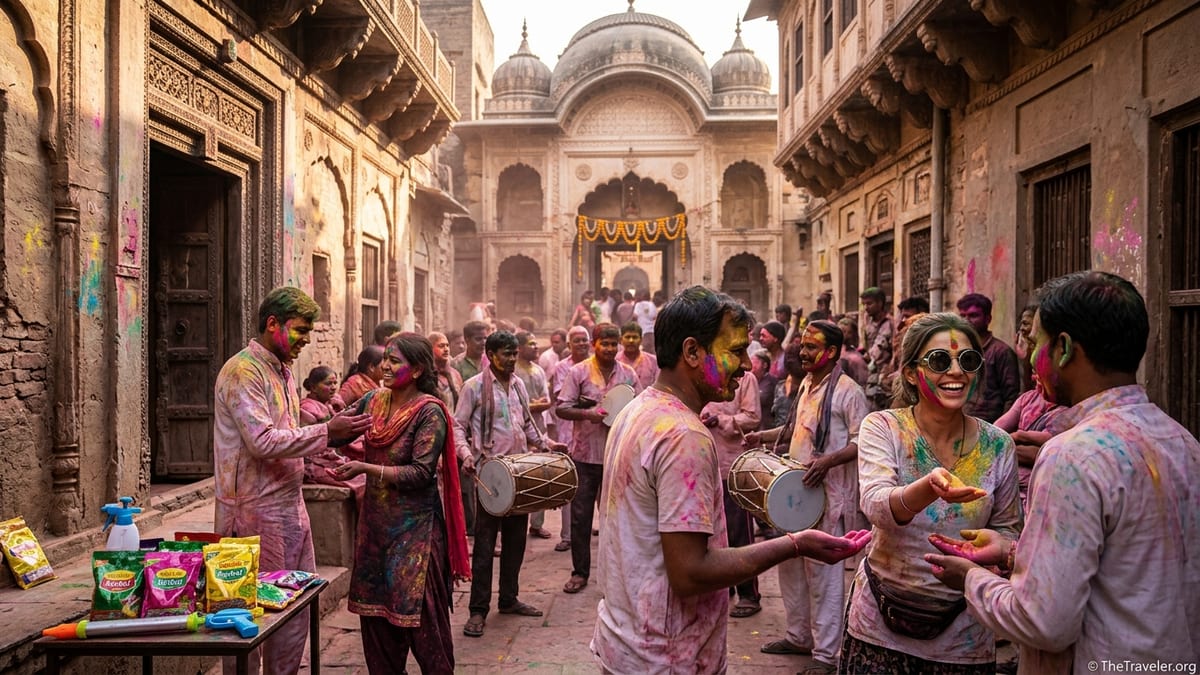
Key dates, regional variations and why calendars disagree
Across India, most panchang-style Hindu calendars, astronomical calculators and festival planners agree that Holika Dahan will fall on the evening of Sunday 21 March 2027, with Rangwali Holi or Dhulandi on Monday 22 March 2027. These dates match widely used astronomical services and multiple temple-oriented calendars that calculate Holi from the full moon and the start of the lunar fortnight. National and international festival lists for 2027 already mark 22 March as Holi, and several academic and government institutional calendars in India list 22 March 2027 as the Holi observance date for much of the country.
Government office closures can still look confusing. For example, a 2027 holiday notification for the Delhi High Court lists Holi on Tuesday 23 March, while central and state-level calendars refer to the festival itself around 22 March. In practice, this means travelers may see colour play in Delhi neighbourhoods and temples on 22 March while banks and courts observe a closure or restricted opening on 23 March. Similar small discrepancies appear in some state calendars, often because offices choose the most convenient weekday closure while the religious rite follows the lunar calculation.
The Braj region focuses less on one “main” day and more on a long sequence of Holi observances. Recent Holi calendars from Mathura–Vrindavan tour operators and temple advisory sites show Barsana’s Laddu Holi and Lathmar Holi starting around the week of 15 to 18 March 2027, followed by Lathmar Holi in Nandgaon the next day, then Chhadi Mar Holi in Gokul, Phoolon ki Holi at Banke Bihari Temple in Vrindavan, Dwarkadhish Temple celebrations and Holika Dahan in Mathura, Rangwali Holi across Braj on 22 March and the intense Huranga at Dauji Temple near Baldeo on 23 March. These dates are still described as “expected” and are always subject to final confirmation by each temple trust.
For a publication or trip plan, the implication is clear. Treat 22 March 2027 as the core Holi date for most of India, explain that some government offices may mark 23 March as the holiday closure, and emphasise that Braj’s events run roughly from 15 to 23 March with individual temple schedules confirmed only in the season. Before going to print or advising readers to book, any serious travel guide should reconfirm state holiday notifications and the official schedules published by major temples such as Banke Bihari in Vrindavan and Dwarkadhish in Mathura.
Comparing major Holi destinations for style, atmosphere and crowds
Jaipur offers a relatively structured and accessible introduction to Holi for international visitors. Rajasthan Tourism and the Rajasthan Tourism Development Corporation routinely organise staged Holi programmes for foreign and domestic tourists, often at venues such as City Palace or state-run hotels. These events combine folk performances, safe herbal colours, music and controlled colour play within a gated compound. In parallel, Jaipur’s old city sees organic street celebrations near Govind Dev Ji Temple and residential neighbourhoods. The overall atmosphere is festive but, compared to Braj, somewhat less chaotic, and the city’s wide roads and strong hotel infrastructure make it easier to retreat to your room once you have had enough colour.
Mathura, Vrindavan and nearby Barsana and Nandgaon are the emotional heart of Holi in North India. Here, Holi is treated both as a devotional expression of Krishna bhakti and a full-contact street festival. In recent years, images of Banke Bihari Temple’s Phoolon ki Holi, where priests shower petals on the crowd, and the colour-drenched laneways of Vrindavan have appeared worldwide. Crowds are extremely dense, especially in the Banke Bihari and Dwarkadhish temple areas, with narrow lanes, low visibility from colour and water, and frequent jostling. Visitors who want the most intense, traditional celebration gravitate here, but the sensory overload can be overwhelming, and the experience demands strong situational awareness and a willingness to be pushed and pulled by the crowd.
Delhi offers a different profile again. In central districts and diplomatic neighbourhoods, private residential societies and clubs organise invite-only Holi parties with security, music and buffets. Middle-class areas such as South Delhi see friendly but boisterous local street Holi, while some older quarters tend to be rowdier. There are also commercial Holi “festivals” at event grounds, with DJs, ticketed entry, usually packaged food and sometimes alcohol. For many overseas visitors, the highlight is joining a Holi gathering hosted by a guesthouse, homestay or local friend in South or Central Delhi, then making a brief foray into nearby parks or streets before retreating.
Varanasi’s Holi combines sacred Ganges rituals with colour play in a much more compact old city. The ghats host early-morning pujas and, around Holi, some neighbourhoods break into lively colour battles. Compared with Braj, Varanasi’s Holi is intense in the lanes closest to the ghats but can feel calmer along the river at sunrise or in residential quarters away from the backpacker hubs. Smaller towns such as Pushkar in Rajasthan or Hampi in Karnataka have also become popular among backpackers, with Pushkar’s main square and fairground hosting a large, semi-organised colour celebration supported by local authorities. These smaller centres feel more manageable than Mathura–Vrindavan yet still offer vivid, if increasingly touristy, Holi experiences.
Safety, consent and choosing between organised and public celebrations
One of the most consequential decisions a visitor makes is whether to join an organised Holi event or dive into an unstructured street celebration. Organised experiences in Jaipur, Delhi, Pushkar and some upscale resorts typically involve a ticket that covers herbal colours, music, vegetarian food, limited alcohol if licensed, basic medical support and security. For example, recent Holi seasons in Jaipur have seen multiple ticketed parties advertised with price points ranging from roughly 1,000 to 3,000 rupees per person for domestic-style events, rising higher at luxury hotels. These curated environments reduce the risk of harassment, offer separate family or women-only zones in some cases, and keep vehicles away from the play area.
Independent participation in public celebrations provides more authentic contact with local residents but requires clear-eyed risk assessment. In the busiest parts of Mathura and Vrindavan during Holi week, crowd density can be so high that visitors lose control of their movement. Anonymous hands can smear colour or throw water from all sides, and it is harder to distinguish playful contact from deliberate groping or aggression. Alcohol and cannabis consumption among some participants increase as the day progresses, particularly in open squares and side streets. Families and solo travelers who are uncomfortable with physical jostling often report feeling safer in the early morning and in or near temples that enforce basic discipline.
Harassment and consent are real issues and should be addressed openly. Female travelers, including Indians from other parts of the country, often share accounts of unwanted touching during Holi, especially in crowded alleyways of tourist-heavy towns. No visitor should assume that throwing colour on strangers is universally welcomed, nor that participation in Holi suspends normal boundaries. A respectful guideline is to offer colour first with a verbal greeting and light touch to the cheeks or hairline only if the other person visibly agrees, and to step back immediately if anyone looks uncomfortable. Parents should recognise that not every public Holi scene is suitable for children, and that “family-friendly” usually means either early-morning temple gatherings, gated residential societies or curated events.
In deciding where to celebrate, factor in your own tolerance for crowds, your group composition and how much structure you want. First-time visitors, families with younger children and photographers who prefer some control over vantage points often do better in Jaipur’s curated events, Delhi’s residential societies or smaller destinations such as Pushkar. Highly experienced travelers seeking full immersion in Krishna-centric devotion and comfortable navigating crush-level crowds may gravitate to Mathura, Vrindavan, Barsana and Nandgaon, ideally with a trusted local guide.
Getting there: trains, roads, closures and booking strategies
By March, India’s north is firmly in its busy season, and Holi week sends demand for trains and buses sharply higher. Rail tickets from Delhi to Mathura, Agra and Jaipur, especially in AC chair car and sleeper classes, often sell out weeks in advance around Holi. For 2027, with Holi on a Monday, travelers can expect the Friday and Saturday preceding 22 March to be peak departure days. Practical advice is to set fare alerts and book train tickets as soon as they open, generally 120 days before departure for many classes, and to consider flexible dates a day or two before or after Holi to avoid the most crowded trains.
Road access also changes during Holi. In Mathura and Vrindavan, police habitually impose temporary closures on central lanes around Holi Gate, Dwarkadhish Temple and Banke Bihari Temple, often restricting entry to residents, e-rickshaws and pedestrians for all or part of Holi day. Visitors arriving by private car or hired taxi are usually dropped on the outskirts and must walk or take e-rickshaws into the old town. In Jaipur, stretches of the old city near Govind Dev Ji Temple can see informal traffic blockages during peak colour play, while in Delhi some municipalities close park car parks or smaller lanes to prevent drunk driving and to reserve space for gatherings.
For trips within Rajasthan, frequent buses and tourist cars run between Jaipur and smaller Holi destinations such as Pushkar. State-run buses are the most economical, often costing a few hundred rupees for a several-hour journey, but can be heavily booked and crowded around festivals. Tourist agencies and hotel desks often arrange shared vans or private cars for roughly 2,500 to 5,000 rupees per day for a basic vehicle, depending on distance and vehicle category, with fuel and driver included. Private transfers between Delhi and Jaipur or Delhi and Mathura fall in a similar range, with prices higher during peak holiday weekends.
Because Holi coincides with a gazetted holiday, many government museums and offices close or operate on reduced hours that Monday, and some extend closures into Tuesday where the local holiday notification specifies. Travelers should expect limited bank and ticket office services on Holi day and sometimes the following morning. Planning ahead by withdrawing cash, confirming electronic tickets, and arranging inter-city transfers for early morning or the day after Holi makes moving around noticeably easier.
Health, safety gear, etiquette and photography
Safe participation in Holi starts with colours. Wherever possible, buy branded herbal powders from reputable shops or from organisers at curated events, rather than ultra-cheap roadside packets whose ingredient list is unclear. Many visitors now choose labelled “gulal” that highlights plant-based or food-grade colouring agents. For wet colours, avoid unknown pastes and industrial dyes that can irritate skin and eyes. Simple protective gear makes a big difference: wrap-around sunglasses to reduce eye exposure, a light scarf or bandana to cover hair, and a basic mask if you are sensitive to dust.
Electronics are at real risk in Holi zones. In the lanes of Vrindavan or near the ghats in Varanasi, colour dust and coloured water fly freely from balconies, rooftops and passing groups. Waterproof pouches for phones, rain covers or dry bags for cameras, and avoiding lens changes in the street are practical, field-tested habits. Many serious photographers now use older camera bodies and weather-sealed lenses for Holi work, or rely on phones sealed in water-resistant pouches. If you are carrying a bag, consider a small, front-worn pack that you can keep zipped and in your direct line of sight.
Hydration and pacing matter more than many visitors realise. March in North India already brings midday heat, often in the high twenties Celsius in Jaipur, Delhi and Mathura, sometimes higher in full sun. Combined with constant movement, loud music and occasional alcohol, it is easy to become dehydrated. A practical routine is to alternate colour play sessions with short breaks in shade to drink bottled water, eat light snacks like bananas or poha, and check in with your group. Visitors with asthma, skin allergies or chronic eye conditions should consult their doctor before planning a Holi-heavy itinerary and carry any necessary inhalers, antihistamines or eye drops.
Cultural etiquette and temple rules deserve equal attention. In Braj temples such as Banke Bihari in Vrindavan or Dwarkadhish in Mathura, Holi is first and foremost an act of devotion. Dress modestly, even in white: loose trousers or long skirts and tops that cover shoulders and chest are both respectful and practical. Many temples restrict photography during certain aarti times or in the most crowded inner sanctums, and some prohibit cameras altogether on peak Holi days. Security teams may ask visitors to deposit cameras or large bags outside. Always ask before photographing individuals at close range and accept a “no” gracefully.
Three-day sample itineraries for Jaipur, Mathura–Vrindavan and a smaller celebration
A three-day Jaipur Holi itinerary for 2027 could work as follows. On Day 1, arrive by train or private car from Delhi, check into accommodation near the old city or in a central neighbourhood such as C Scheme, and spend the afternoon visiting Amber Fort and the evening at aarti in Govind Dev Ji Temple inside the City Palace complex. On Day 2, the Holi-eve Sunday, focus on city sights that may be closed or crowded on Holi itself: Hawa Mahal from the outside in the morning, City Palace museum and Jantar Mantar, followed by a quiet dinner at a rooftop restaurant overlooking the lit-up old city. On Day 3, Holi Monday, join a curated celebration arranged by your hotel, Rajasthan Tourism or a reputable organiser, enjoying controlled colour play, folk performances and a buffet lunch before retreating to shower and catch an evening train or stay an extra night.
A Mathura–Vrindavan focused plan in 2027 hinges on the extended Holi timetable. One option is to time your visit so that Day 1 coincides with Phoolon ki Holi at Banke Bihari Temple in Vrindavan around 20 March, arriving early in the morning, checking into a guesthouse near but not inside the tightest lanes, and spending the afternoon in relatively quieter temples such as ISKCON Vrindavan or Radha Raman. Day 2 could be spent in Mathura for Dwarkadhish Temple rituals and Holika Dahan on Sunday 21 March, keeping to the ghats and older markets during the day, then joining local families to watch the bonfire in the evening from a safe distance. Day 3, Rangwali Holi on 22 March, would unfold in either Vrindavan or Mathura, but with a conscious strategy to be in or near your accommodation during the midday peak, venturing out early in the morning for colour play with known hosts or guides.
For travelers who want a smaller, more manageable Holi, Pushkar in Rajasthan offers a useful template. A three-day plan might start with arrival on Holi-eve Sunday, a sunset visit to the lake ghats and the Brahma Temple, and an early night. Holi Monday would then centre on the main square and adjoining fairground, where local authorities in recent years have supported a semi-organised public Holi with DJs and a controlled area, drawing a mix of locals and backpackers. The third day is ideal for walking to nearby hilltop temples or taking a short camel safari in the surrounding desert, once the colour has settled. Other alternatives include staying in a rural homestay outside Jaipur or a heritage hotel in Shekhawati, where Holi celebrations retain a village feel and involve fewer strangers.
In all three itineraries, building in recovery time matters. Colour is difficult to wash out in one shower, trains and buses on Holi afternoon may be delayed or messy, and some restaurants close early if staff are celebrating with families. Treat Holi morning as the centrepiece and avoid scheduling tight onward connections until at least the following day.
Budgeting in rupees: accommodation, transport, food and event costs
Holi coincides with high season in North India, and visitors should expect noticeable holiday surcharges. In Jaipur and Delhi, mid-range hotels that might charge around 3,000 to 4,000 rupees per night for a double room in February can quote 4,500 to 6,000 rupees or more over the Holi weekend, particularly for properties close to major sights. Boutique heritage hotels and international chain properties easily reach the 8,000 to 15,000 rupee bracket or beyond. In Mathura and Vrindavan, basic guesthouses and dharmshalas remain available for under 2,000 rupees per night for simple rooms, but properties catering to international visitors often charge 3,000 to 6,000 rupees around Holi week, especially if located within walking distance of key temples.
Train fares themselves remain regulated but dynamic pricing on popular classes can push AC chair car or 3AC tickets between Delhi and Jaipur or Delhi and Mathura into the 600 to 1,500 rupee per person range, depending on class and booking timing, with first-class air-conditioned seats higher. Private car transfers between Delhi and Jaipur or Delhi and Mathura commonly cost in the 3,500 to 6,000 rupee range per vehicle for a one-way trip in a small sedan or SUV, with driver and fuel, with some operators charging a seasonal premium around Holi. Within cities, auto-rickshaw rides typically cost 50 to 300 rupees depending on distance and bargaining, and app-based taxis, where available, may add surge pricing on Holi morning and evening.
Food budgets vary widely by destination and style. In Jaipur and Delhi, a traveller eating mostly in mid-range restaurants might spend 400 to 800 rupees per person per meal, with street snacks such as kachori, samosa or chole bhature between 30 and 200 rupees. In Mathura–Vrindavan, temple-adjacent sweet shops and vegetarian eateries offer hearty thali meals in the 150 to 300 rupee range, while tourist cafés charge more. Organised Holi events frequently bundle lunch, snacks and sometimes non-alcoholic drinks into the ticket price. A ticketed Holi party in Jaipur, Delhi or Pushkar in recent years has commonly ranged from about 1,000 to 3,000 rupees per person for general admission, with upscale hotel packages above that.
Factoring in all elements, a modest three-day Holi trip in 2027 for two people to Jaipur, excluding international flights, might begin around 20,000 to 30,000 rupees, including mid-range accommodation, train fares, local transport, meals and tickets to a curated Holi event. A similar three-day immersion in Mathura–Vrindavan with a local guide, private transfers from Delhi, comfortable guesthouse and simple meals could run from around 25,000 to 40,000 rupees or more, depending on transport class and proximity to major temples. These figures are illustrative, not fixed prices, and any serious guide should update them closer to 2027 with current rates from hotels, railways and organisers.
Weather, closures, medical precautions and contingency plans
By late March, North India is warming rapidly. Daytime highs in Delhi, Jaipur and Mathura often sit in the high twenties to low thirties Celsius, with intense sun in the middle of the day. Nights are usually comfortable, and mornings can feel pleasantly cool. Holi’s very purpose as a spring festival means many celebrations involve both dry powders and water. Visitors prone to sunburn or heat exhaustion should use high-SPF sunscreen, wear light but covering clothing, and consider taking main colour play breaks in the earlier morning and late afternoon rather than at midday.
Beyond holiday closures of banks, courts and some museums, travelers should be prepared for informal shutdowns. In Braj, many small shops either close for Holi morning or operate behind half-closed shutters, focusing mainly on selling colour, sweets and snacks. In Varanasi and small Rajasthan towns, some businesses remain closed until later in the afternoon. Essential services such as hospitals and most pharmacies, however, continue operating; it is advisable to carry a small kit with basic first-aid items, oral rehydration salts, painkillers, antiseptic cream and any personal medication, as reaching a clinic through festival traffic can take longer than usual.
Contingency planning is particularly important for those with tight itineraries. Colour-stained streets become slippery, public transport may run on irregular schedules and drivers can be reluctant to take out vehicles until the main celebrations have subsided. Building at least one “buffer” day after Holi into any onward flight schedule reduces the risk of missed connections. Travelers who become overwhelmed by the intensity or experience minor injuries may choose to retreat to their hotel and skip certain events; choosing accommodation with on-site dining or easy access to at least one reliable restaurant makes this choice easier.
Finally, while serious incidents are rare relative to the massive number of participants nationwide, petal and powder inhalation can trigger respiratory issues, and contaminated water can aggravate eye infections. Wearing sunglasses, avoiding water that looks dirty, showering thoroughly after Holi and rinsing eyes with clean water if irritation occurs are simple but effective risk reducers. Travel insurance that covers medical care and changes to plans because of unforeseen disruption is strongly recommended.
Recommendations for first-time visitors, families, photographers and spiritual travelers
For first-time international visitors, a structured Holi in a well-connected city like Jaipur or Delhi offers the best balance of atmosphere and manageability. Joining a curated event at a palace venue, hotel lawn or state tourism property, then taking a short guided walk through a nearby neighbourhood, delivers memorable colour play without the full force of Braj’s crowds. Staying within walking distance of your Holi venue, returning to your room by early afternoon, and keeping the following day free for relaxed sightseeing is a sensible pattern.
Families, especially those with younger children, should prioritise safety, predictability and toilets over being at the “most famous” Holi spot. Gated housing societies in Delhi, heritage hotels in Jaipur that organise in-house Holi for guests, and quieter Rajasthan towns like Bundi or Shekhawati villages can provide joyful, lower-pressure celebrations. Parents can pack spare clothes for children, pre-apply oil or moisturiser to skin and hair to ease colour removal, and agree clear meeting points in case anyone gets separated in the excitement.
Photographers face a trade-off between spectacle and control. Mathura, Vrindavan, Barsana and Nandgaon during Holi offer unparalleled visual drama but involve serious risks to equipment and personal space. Those who do travel to Braj should arrive days early to scout vantage points, attend smaller lead-up events such as Laddu Holi or Phoolon ki Holi, and consider working with local fixers or guides who know back lanes and rooftops. For many shooters, a curated Holi event in Jaipur, Delhi or Pushkar, or the ghats of Varanasi at sunrise with softer, more contemplative colour play, offers a more sustainable working environment.
Travelers drawn primarily to religious tradition rather than large colour-throwing parties may choose to focus on temple rituals and bhajans. In Braj, that could mean prioritising early-morning aarti at Banke Bihari or ISKCON Vrindavan, evening kirtan in Mathura’s smaller temples, and witnessing but not entering the most chaotic colour fights. In Varanasi, sitting quietly on the ghats to watch small Holi offerings, or joining a local family for home-based ritual and a simple vegetarian feast, can be deeply meaningful. In any case, the key to a rewarding Holi 2027 is not chasing the loudest party, but matching destination, celebration style and safety level to your own temperament and travel goals, backed by careful verification of local calendars and temple schedules before you go.