


For a first city break in Bulgaria, most travelers end up choosing between Plovdiv and Veliko Tarnovo. Both are compact, atmospheric and packed with history, yet the experience on the ground feels very different. Plovdiv pairs Roman ruins and a lively creative quarter with easy rail links, while Veliko Tarnovo offers fortress walls, steep medieval streets and dramatic river views. This comparison looks at ancient history, architecture, transport, hotels, budgets and seasonal conditions to help you decide which city fits your itinerary, especially if you are traveling without a car.
Get the latest updates straight to your inbox!
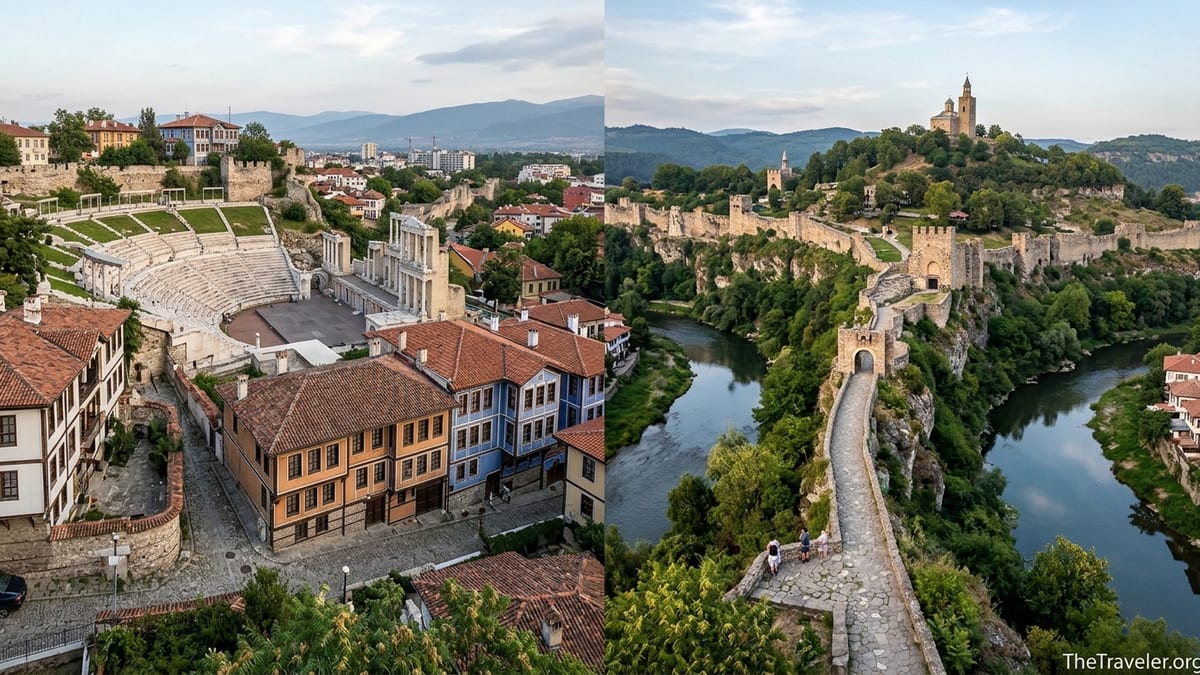
First impressions: Roman Plovdiv vs medieval Veliko Tarnovo
Plovdiv’s historic core is anchored by some of the best-preserved Roman remains in Eastern Europe. The Ancient Theatre of Philippopolis, terraced into the hillside above the modern city, is a working venue that once seated several thousand spectators and still hosts concerts in summer. Just below the pedestrian main street lie the remains of the Roman Stadium, partially exposed so you can literally have coffee on top of what was once the race track. Alongside these showcase monuments, Plovdiv’s Old Town preserves cobbled lanes, Ottoman-period merchant houses and the excavated Bishop’s Basilica, with its large early Christian mosaics.
Veliko Tarnovo tells a different story. Here the focus is medieval rather than Roman. Tsarevets Fortress crowns a rocky promontory above a loop of the Yantra River, encircled by massive walls and gates. Inside are ruined royal palaces, church foundations and defensive towers that evoke the period when Tarnovo was capital of the Second Bulgarian Empire. At night on selected dates, a sound-and-light show illuminates the ramparts and Patriarchal Cathedral, turning the whole hill into a backdrop of colored beams and music.
In terms of everyday city life, Plovdiv feels flatter and more open. The long pedestrian shopping street runs north from the Roman Stadium, lined with 19th and early 20th century buildings and street cafés. To the west, the Kapana district has been reimagined as a creative quarter, filled with small galleries, mural-covered walls, craft beer bars and design shops. Veliko Tarnovo by contrast clings to steep slopes. Its traditional neighborhoods, such as the restored Samovodska Charshiya craft street, step down towards the river on narrow roads and staircases, with stone and timber houses hanging over the valley.
For a first-time visitor, the contrast is clear on day one. Plovdiv feels like a relaxed, walkable city where you can shift easily between Roman ruins, Revival-era houses and contemporary cafés without much effort. Veliko Tarnovo feels more like an old capital perched on rocks, with big views and a strong sense of the Middle Ages, but also more climbing between sights.
Key sights and museum practicalities
Plovdiv’s headline attractions are close together but represent different eras. The Ancient Theatre in the Old Town has regular visiting hours published by the municipality, with a modest entry fee for adults and reduced-price combined tickets available that include several Old Town museum houses. Recent municipal information indicates standard daytime opening roughly from late morning to early evening, with shorter hours and some closures in winter; schedules can shift between summer and winter seasons, so it is sensible to check the current weekly timetable once in town.
The Roman Stadium is largely free to view from the pedestrian street, with a small underground interpretation center charging a low entry fee. The Bishop’s Basilica of Philippopolis, a short walk from the main pedestrian area, operates as a dedicated museum site with its own ticket, conserving extensive mosaic floors; combined tickets with the nearby Small Early Christian Basilica are sometimes offered. In the Old Town, individual merchant houses such as Balabanov and Hindliyan operate as museum-houses with separate admission. The city also promotes a shuttle ticket that covers multiple houses plus the Ancient Theatre, giving good value if you plan to visit several interiors in one day.
In Veliko Tarnovo, the Tsarevets Fortress is the primary paid attraction. Entry tickets for adults are sold at the base of the hill and allow access to the grounds and surviving structures within the ramparts. Official museum information published in autumn 2026 notes different seasonal opening hours, with longer access during the main season and earlier closing times once the winter schedule begins in late October. There are discounts for students and family tickets, and combined tickets that include other sites run by the Regional History Museum.
Trapezitsa Hill, across the river from Tsarevets, is a separate archaeological site with its own ticket and limited seasonal working hours, sometimes including a short funicular ride to the top. Within the city, the Samovodska Charshiya area functions more as an open-air quarter than a museum, so walking is free, with optional entry fees to small private museums or galleries. Nearby Arbanasi, just a few kilometers away on the plateau above Tarnovo, is a separate village of stone houses and richly painted churches; several churches and house-museums there have individual entrance fees and similar seasonal hours aligned with the Tarnovo museum system.
The Tsarevets sound-and-light show runs only on specific evenings, usually tied to weekends, holidays or group bookings. Tickets for the full experience, including synchronized music, are sold through local agencies and tourist offices and cost noticeably more than standard fortress entry. On nights when performances are scheduled, it is also possible to watch the lights from free viewpoints elsewhere in town, though without the soundtrack. Because dates vary month by month, it is best to confirm the current calendar and consider booking ahead if the show is a priority.
Getting there: rail and bus links from Sofia
For many travelers, the trip begins in Sofia. Plovdiv has a clear advantage in rail connectivity. Bulgaria’s national railway runs frequent direct trains between Sofia Central Station and Plovdiv, with a journey time typically around 2 hours 40 minutes to just over 3 hours, according to a 2024 rail overview still reflected in current autumn 2026 schedules. One recent summary of the Sofia to Plovdiv route noted around a dozen trains daily and a typical second-class fare in the region of 12 leva, with travelers in 2026 reporting paying under 10 euros for first class and around 6 euros for second class. Trains depart exclusively from Sofia Central Station in the city center, reachable by metro from the airport.
Buses between Sofia and Plovdiv add flexibility, particularly for departures near Sofia’s main bus terminals on the south side of the city. Schedules change frequently, but year-round services connect Sofia’s large coach stations with Plovdiv’s South and Rhodope bus stations. Journey times are comparable to the train, often around 2 hours, depending on traffic and intermediate stops, and fares are similar to or slightly higher than rail. Most intercity buses use Sofia Central Bus Station or the adjacent Serdika bus terminal rather than the airport directly, so travelers arriving by air should plan on a short metro or taxi transfer first.
To Veliko Tarnovo, rail travel is slower and less straightforward. There are direct trains from Sofia to Gorna Oryahovitsa, the main junction town, with some services continuing or connecting to Veliko Tarnovo station. Journey times are typically over 4 hours and schedules can be sparse at certain times of day. Many visitors therefore prefer the bus. Multiple daily buses run between Sofia and Veliko Tarnovo, as confirmed by Bulgarian bus booking platforms that show several departures spread through the day. Coaches typically leave from Sofia Central Bus Station and arrive at Veliko Tarnovo’s bus station on the edge of town, with travel times around 3 hours to 3 hours 30 minutes depending on the route and traffic. Fares for a one-way ticket often fall in the equivalent of 12 to 18 euros.
Whichever city you choose, it is advisable to buy train tickets either at the station or through the official online platform of Bulgarian Railways, and to double-check current bus schedules a few days before travel. Recent traveler discussions emphasize that rail ticket prices are fixed regardless of purchase channel, while bus operators may vary in comfort and punctuality, so checking recent reviews can help set expectations.
onward connections: coast, Danube and mountains
Plovdiv works well as a hub for reaching Bulgaria’s south and the central plain. Direct trains and long-distance buses connect Plovdiv with Burgas on the Black Sea, often in around 4 to 5 hours by rail according to recent traveler reports about the Sofia to Burgas route via Plovdiv. Plovdiv also sits on rail and bus lines toward Pazardzhik and the western approaches to the Rhodope Mountains, giving access to destinations such as Velingrad and Smolyan with one change. Buses link Plovdiv with smaller Rhodope towns like Devin, making day or overnight trips into spa resorts and hiking areas realistic if you are willing to work with indirect schedules and occasional connections.
Veliko Tarnovo is better positioned for the Danube and northeastern Bulgaria. Buses to Ruse, an important Danube port city, depart several times a day from Veliko Tarnovo, with journey times typically between 2 and 3 hours. This makes it feasible to continue on to Romania via the Danube bridge near Ruse. Varna and the northern Black Sea coast are also attainable from Veliko Tarnovo by direct bus, often taking on the order of 3 hours 30 minutes to 4 hours depending on the route. To Burgas from Veliko Tarnovo, direct buses exist but are less frequent and can take longer, usually more than 4 hours.
The Rhodope Mountains are more naturally approached from Plovdiv than from Veliko Tarnovo. From Plovdiv’s bus station, you will find services toward Asenovgrad and further into the mountains, with buses continuing to places such as Smolyan or Chepelare, important bases for hiking and winter sports. While it is possible to reach the Rhodopes from Veliko Tarnovo by connecting through Plovdiv or Sofia, this adds several hours of backtracking. Conversely, if your wider itinerary includes both the northern coast around Varna and Danube towns like Ruse, Veliko Tarnovo sits more logically on that axis than Plovdiv.
When planning, it is important not to assume that every pair of cities has a direct link. For example, there is no widely advertised direct rail connection from Veliko Tarnovo to Burgas comparable to the Sofia to Burgas services; travel usually involves a change at a junction such as Stara Zagora or Gorna Oryahovitsa. Likewise, bus links may be more frequent in summer than winter and may not run late into the evening. Checking the current season’s timetable and allowing generous connection times is safer than relying on tight transfers at intermediate towns.
Urban feel, walking difficulty and neighborhoods
Plovdiv’s central areas are relatively compact and gentle to walk. The main pedestrian street from the Roman Stadium north to the central square is essentially flat, with side streets leading to the Kapana district, which occupies a low rise just west of the center. The Old Town, on one of the city’s hills, does involve some climbing on cobblestones, but these sections are short and you can intersperse them with café stops or small museum visits. Many sidewalks in the newer central areas are broad, and the pedestrianization of key streets reduces conflicts with traffic.
Kapana itself is a dense grid of narrow lanes with small squares, street art and an ever-growing concentration of bars, wine spots and casual restaurants. It feels more like a creative quarter than a museum and has become a logical base for younger travelers who want nightlife on the doorstep yet still be a short walk from the Roman sites and the Old Town hill. Nebet Tepe, one of the city’s older hilltop settlements, requires a bit more uphill walking, but the path is not technically difficult for most visitors in ordinary shoes.
Veliko Tarnovo is more demanding physically, especially if you want to see the main viewpoints on foot. Streets in the historic core climb and descend steeply along the contours of the Yantra valley. To walk from the riverfront up to Tsarevets Fortress, for example, you will navigate inclines and stretches of steps. The residential terraces above the Samovodska Charshiya are linked by staircases and narrow lanes that can be slippery in wet or icy conditions. For travelers with limited mobility, this can be challenging, and taxi rides for short hops between the bus station, Tsarevets and hilltop viewpoints are worth budgeting for.
Arbanasi, on the plateau a short drive above Veliko Tarnovo, is comparatively level but has uneven stone lanes and some inclines between church complexes and house-museums. Central Plovdiv, by contrast, offers more continuous flat walking surfaces, at least in the newer neighborhoods and along the main pedestrian street. If you or your travel companion uses a stroller or has joint issues, two full days in Veliko Tarnovo will involve more effort than two days in Plovdiv, and choosing accommodation closer to Tsarevets or along the main old street helps reduce vertical distance.
Food, nightlife and hotel options
Food is one of Plovdiv’s strong points. Around the pedestrian center and in Kapana you will find modern bistros, specialty coffee bars, craft beer pubs and wine bars featuring local Thracian Valley wines. Menus mix Bulgarian classics such as shopska salad, grilled kebapche and slow-baked stews with contemporary vegetarian and international dishes. Kapana in particular stays lively late into the evening in summer, with outdoor tables and live music at weekends. For a mid-range dinner for two with wine, you can expect to spend an amount in the equivalent of roughly 35 to 55 euros, depending on venue and number of courses.
Hotels in Plovdiv cluster in three useful areas for visitors. Around Kapana and the pedestrian street, small boutique hotels and guesthouses offer stylish rooms within walking distance of everything, though parking is limited and often located in nearby paid garages. In the Old Town, restored merchant houses provide atmospheric rooms with wooden ceilings and courtyard gardens. Access usually involves a short uphill walk from the lower town and parking can be tricky on narrow cobbled streets, though some properties offer reserved spaces slightly downhill. Slightly further out, modern business-style hotels near main boulevards have easier access for drivers and more straightforward on-site parking, at the cost of a longer walk or short taxi ride to the historic center.
Veliko Tarnovo’s accommodations largely string along the ridge of the old town and the roads facing the fortress and river. Many mid-range hotels and family-run guesthouses here specialize in rooms with fortress or river views, sometimes with balconies overlooking the loops of the Yantra and the walls of Tsarevets. Central hotels have the advantage of being within walking distance of the fortress entrance and the Samovodska Charshiya, though some front onto roads with traffic. Prices are generally modest by Western European standards, with a comfortable double room often available in the broad band that spans 40 to 80 euros per night, depending on season, rating and view.
Arbanasi, a few kilometers away, offers a different kind of stay. Restored stone complexes function as guesthouses and small hotels, often with courtyards, gardens and on-site traditional restaurants serving grilled meats, local cheeses and clay-pot dishes. Parking is usually easier than in the tight streets of Tarnovo’s center, and nights are quieter. The trade-off is that you will need a short taxi ride into Veliko Tarnovo for fortress visits and evening walks. For travelers focused on relaxation and traditional atmosphere more than nightlife, Arbanasi can be an appealing base.
Sample itineraries and realistic budgets
From Plovdiv, a practical two-day itinerary might unfold as follows. On day one, explore the pedestrian center and Roman remains: start at the Roman Stadium and main square, then curve up into the Old Town to tour one or two museum houses and the Ancient Theatre, finishing with sunset on Nebet Tepe and dinner in Kapana. On day two, devote a morning to the Bishop’s Basilica and remaining Old Town sights, then take a short bus or taxi to one of the city hills or parks, or visit a nearby winery or village. For a nearby excursion on a third day, consider heading south toward Asenovgrad and the approach to the Rhodope Mountains, or taking a bus to one of the spa towns on the foothills for walks and hot mineral pools.
In Veliko Tarnovo, a two-day schedule naturally centers on the fortress and views. Day one can focus on Tsarevets Fortress, including a slow circuit of the walls and a visit to the reconstructed Patriarchal Cathedral at the summit, followed by a walk through the old streets and craft shops of Samovodska Charshiya. Day two could combine Trapezitsa Hill, reached with a mix of walking and short rides, with a late-afternoon transfer to Arbanasi for its decorated churches and panoramic views back toward Tsarevets at sunset. For a three-day stay, add an excursion to nearby villages along the Yantra or a bus trip to a smaller historic town in the region.
For budgets, costs naturally vary by season and taste, but some ballpark figures are possible using recent prices. A couple traveling off-peak and staying in a mid-range guesthouse in either city might allocate the equivalent of roughly 70 to 110 euros per night for a centrally located double room including breakfast. Add around 30 to 45 euros per day for lunches, cafés and snacks for two, plus 35 to 60 euros for a restaurant dinner with drinks. Museum and site tickets in each city are generally modest; setting aside around 15 to 25 euros per person across two days will usually cover fortress and museum entries, including a handful of interiors in Plovdiv or Tarnovo, but not premium extras like the Tsarevets sound-and-light show, which requires a higher separate ticket.
Transport from Sofia adds another layer. A return train ticket between Sofia and Plovdiv or a return bus ticket between Sofia and Veliko Tarnovo generally falls below 40 euros per person at current fares, often significantly less if using second class rail. Putting this together, a realistic two-night budget in either city for a couple, including return transport from Sofia, mid-range lodging, meals and standard attractions, often lands in the broad range of about 320 to 450 euros in total outside the busiest summer weeks. Solo travelers can expect to spend less on food and tickets but more per person on accommodation unless choosing hostels or budget guesthouses; a solo off-peak budget around 170 to 260 euros for two nights including transport and standard sightseeing is achievable with careful choices.
Weather, seasons, crowding and nightlife
Both Plovdiv and Veliko Tarnovo have continental climates with hot summers and cold winters, but the on-the-ground experience differs due to topography and shade. Plovdiv in July and August can feel very hot in the afternoon on the flat pedestrian streets, with temperatures often climbing well above 30 degrees Celsius. There is limited natural shade in some wide squares, though cafés mitigate this with awnings and umbrellas. Evenings are warm and pleasant, so it is common to sightsee in the morning, retreat indoors at midday and re-emerge to explore Kapana and the Old Town after 17:00.
Veliko Tarnovo’s hills and river valley create microclimates. Summer afternoons can be hot when climbing the exposed paths of Tsarevets, yet many of the old streets and stairways are shaded by buildings. Because uphill walking at 30 degrees Celsius feels more strenuous than flat strolling at the same temperature, the fortress is best planned for early morning or late afternoon in midsummer. Crowd levels peak in both cities from June through early September, and on long weekends when domestic tourism is strong. Plovdiv’s summer calendar of concerts in the Ancient Theatre and festivals in Kapana also attracts extra visitors at specific times.
Winters can be cold in both cities, with the possibility of snow and ice, especially in Veliko Tarnovo where north-facing lanes stay slippery longer. Some smaller museums in Arbanasi and certain church sites reduce hours or close one or two days per week in the off season, and fortress opening hours are shorter. For city breaks that rely mostly on indoor museums and cafés, Plovdiv is easier to handle in winter thanks to its flatter core and slightly milder feel compared to hilltop Tarnovo.
Nightlife is more varied and compact in Plovdiv, particularly in Kapana and the adjacent center. Here you will find live music bars, wine bars, late-opening cafés and street-life that runs well into the night on summer weekends. Veliko Tarnovo has student life linked to its university and a scattering of bars and restaurants along the main streets overlooking the valley, but overall the evening scene is quieter and more focused on meals with a view rather than bar-hopping. Arbanasi is even calmer at night, which suits travelers prioritizing sleep or family-friendly stays.
Which city for which traveler
For history enthusiasts, the choice depends on period. Travelers drawn to the Roman Empire and early Christianity will get more out of Plovdiv’s Ancient Theatre, Stadium, Bishop’s Basilica and archaeological sites. Those fascinated by medieval fortifications, royal courts and the story of the Bulgarian state will find Tsarevets Fortress, Trapezitsa and Arbanasi’s painted churches more compelling. Serious history travelers can easily visit both cities in a week, using rail and bus links to move between the central plain and the Yantra valley.
Photographers often fall for Veliko Tarnovo’s sweeping vistas. The classic views from terraces above the Yantra, with fortress walls framed by meanders of the river and layers of houses stacked on the slopes, provide especially good light in the golden hours. Arbanasi offers long panoramas back over Tsarevets at sunset. Plovdiv, by contrast, rewards street photographers with colorful Kapana facades, street art, details of carved wood in Old Town houses and vantage points from Nebet Tepe looking over the modern skyline and distant hills.
Families with younger children frequently find Plovdiv more convenient. The flat pedestrian zone is stroller-friendly, and distances between sights are short. Children can climb among the seats of the Ancient Theatre, look down into the Roman Stadium from street level and enjoy ice cream stops without constant steep staircases. Veliko Tarnovo can delight older children interested in knights and castles, but parents should be prepared for more supervision on uneven paths and fortress walls, as well as more uphill walks.
Food travelers and those exploring Bulgaria without a car may lean toward Plovdiv as a first base. The density of contemporary restaurants and cafés in Kapana, combined with easy rail access from Sofia and onward bus links to the Rhodope foothills, makes it simple to plan a short break focused on tasting local wines, modern Bulgarian cooking and regional specialties. Veliko Tarnovo, on the other hand, excels for visitors who prioritize fortress history, broad views, and a quieter evening atmosphere, and who are comfortable relying on intercity buses for onward hops to Varna, Ruse and other northern towns. In practice, the two cities complement each other. If you have three or four extra days in Bulgaria, a first stay in Plovdiv followed by two nights in Veliko Tarnovo, linked by train and bus via Sofia or another junction, provides a compact introduction to the country’s Roman and medieval heritage without needing to drive.