


More news on this day
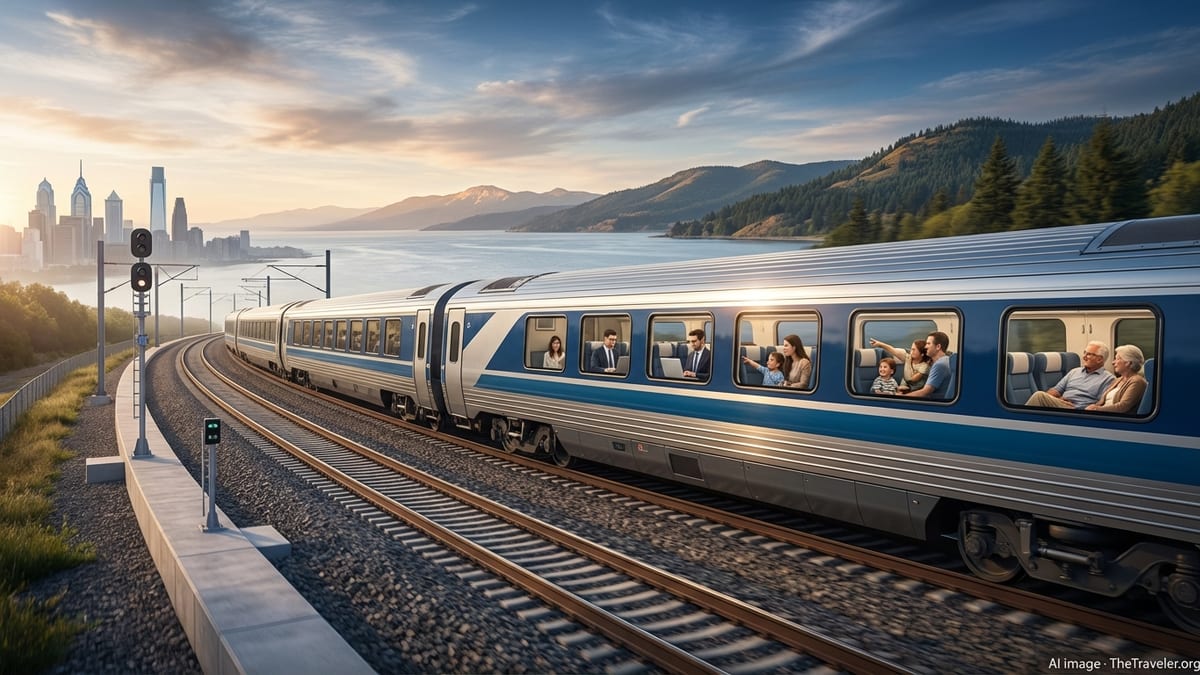
Passenger rail service between Portland and Seattle has been thrown into uncertainty after a major warehouse fire near Portland Union Station led Amtrak to suspend multiple Cascades and Coast Starlight trains on the busy West Coast corridor “until further notice.”
Get the latest news straight to your inbox!
Fire-Damaged Warehouse Triggers Safety Shutdown
Publicly available information indicates that a large warehouse complex near the north end of Portland’s Union Station tracks suffered an extensive fire earlier this week, leaving the structure badly damaged and unstable. Local coverage has identified the site as part of the historic industrial riverfront, with the burned building sitting only a short distance from mainline tracks used by Amtrak’s Cascades corridor and long-distance Coast Starlight services.
Officials overseeing the emergency response have raised concerns that portions of the fire-damaged building could collapse toward the adjacent rail alignment. As a result, freight and passenger movements through the immediate area have been tightly restricted, and some nearby public spaces, including a riverfront park, have been temporarily closed. Structural engineers are still evaluating the warehouse, and municipal agencies are reported to be working toward an eventual demolition plan, but no firm timetable has been made public.
The uncertainty around the building’s stability has left rail operators with few immediate options. While freight carriers have some ability to reroute trains along alternative lines or across the river, the specific alignment used to reach Portland Union Station from the north remains blocked, directly affecting Amtrak’s ability to run through-trains between Oregon and Washington.
Amtrak Cascades and Coast Starlight Services Curtailed
Service alerts posted by Amtrak and transportation agencies in Oregon and Washington show that key corridor trains linking Portland and Seattle have been fully canceled, while others are operating only on partial segments. Multiple reports describe northbound and southbound Cascades departures between the two cities being suspended, including trains in the 500-series that normally form the backbone of regional rail travel along the Interstate 5 corridor.
Some Coast Starlight departures, the long-distance service connecting Los Angeles and Seattle, initially attempted to navigate around the fire zone using an alternate route along the east side of the Willamette River. Subsequent updates, however, describe a shift to a more conservative approach, with certain Coast Starlight trains now originating and terminating in Portland instead of running through to Seattle, and others canceled entirely on the affected segment.
A limited number of Cascades trains are still operating within Washington state, with some schedules adjusted to run only as far south as Vancouver, Washington. In these cases, published information indicates that passengers must make their own arrangements to cross the Columbia River into Portland, using local transit, taxis, or rideshare services, as no dedicated transfer has been publicly announced.
Bus Substitutions, Gaps and Passenger Confusion
Amtrak has experience substituting buses along the Cascades corridor during maintenance projects and previous disruptions, but the sudden nature of the warehouse fire has led to a patchwork of solutions. Some suspended Cascades departures between Seattle and Portland have been replaced with chartered buses, while others have no substitute service listed, leaving booked passengers to rebook, reroute, or cancel their trips.
Travelers posting on rail-focused forums describe receiving short-notice text and email notifications that their trains were canceled due to the Portland-area incident, sometimes only hours before departure. In several cases, customers reported discrepancies between official service alerts and the status shown in booking apps or train-status tools, contributing to confusion about whether particular trains would operate.
The mixed pattern of partial bus bridges, truncated train runs, and outright cancellations is creating uneven impacts along the route. Riders making short hops between cities in Washington may still find train options, while those needing to travel through to Portland face more complex journeys involving multiple modes or overnight changes. For visitors relying on rail to access the Pacific Northwest during the busy late-summer travel period, the disruption adds uncertainty to already tight itineraries.
Key West Coast Corridor Feels Regional Impact
The Portland–Seattle rail link is one of the most heavily used passenger corridors in the western United States, carrying business travelers, students, and tourists along a route that parallels Interstate 5. Pre-pandemic Amtrak and state-level reports highlighted the Cascades line as a core part of regional mobility planning, with long-term visions calling for increased frequencies and faster schedules between Eugene, Portland, Seattle, and Vancouver, British Columbia.
The current shutdown underscores how a single infrastructure incident in a constrained urban rail corridor can ripple across a multistate network. With the tracks leading into Portland Union Station blocked from the north, the disruption reaches beyond local commuters to affect long-distance travelers on the Coast Starlight and connecting services. The closure also places additional pressure on parallel modes, particularly interstate buses and short-haul flights that may see higher demand as passengers shift away from rail.
For state transportation departments that have invested in incremental improvements to the Cascades corridor, the event highlights ongoing vulnerabilities. Much of the route shares tracks with freight railroads and passes through tight industrial districts, river crossings, and legacy structures where alternate pathways are limited. When incidents occur near junctions, stations, or bridges, options to maintain through-service can shrink quickly.
Timeline for Reopening Remains Unclear
Local news and transport-focused coverage agree that there is no clear reopening date for the Portland–Seattle passenger rail link. Structural assessments of the damaged warehouse, coordination among city agencies, and decisions about partial or full demolition will all shape how long trains remain sidelined north of Portland Union Station.
Until those decisions are made, Amtrak is expected to continue posting rolling service updates and day-by-day adjustments to schedules, including additional bus substitutions where equipment and drivers can be found. Travelers with upcoming tickets on the Cascades or Coast Starlight routes are being advised, through public notices and travel forums, to monitor their reservations frequently and consider alternative arrangements.
The episode is likely to intensify ongoing discussions in the Pacific Northwest about rail resiliency, redundancy, and the need for more flexible routing options into key hubs such as Portland. For now, however, passengers face an indefinite period of disrupted service on one of the region’s most important travel corridors, with long-distance and corridor rail operations alike constrained by the fate of a single, fire-damaged warehouse beside the tracks.