


More news on this day
Portugal is turning Corvo, the smallest and most remote island in the Azores, into a real-time laboratory for managing tourism capacity, as regional planners test how much visitor pressure the 17-square-kilometre territory and its 400 residents can realistically sustain.
Get the latest news straight to your inbox!
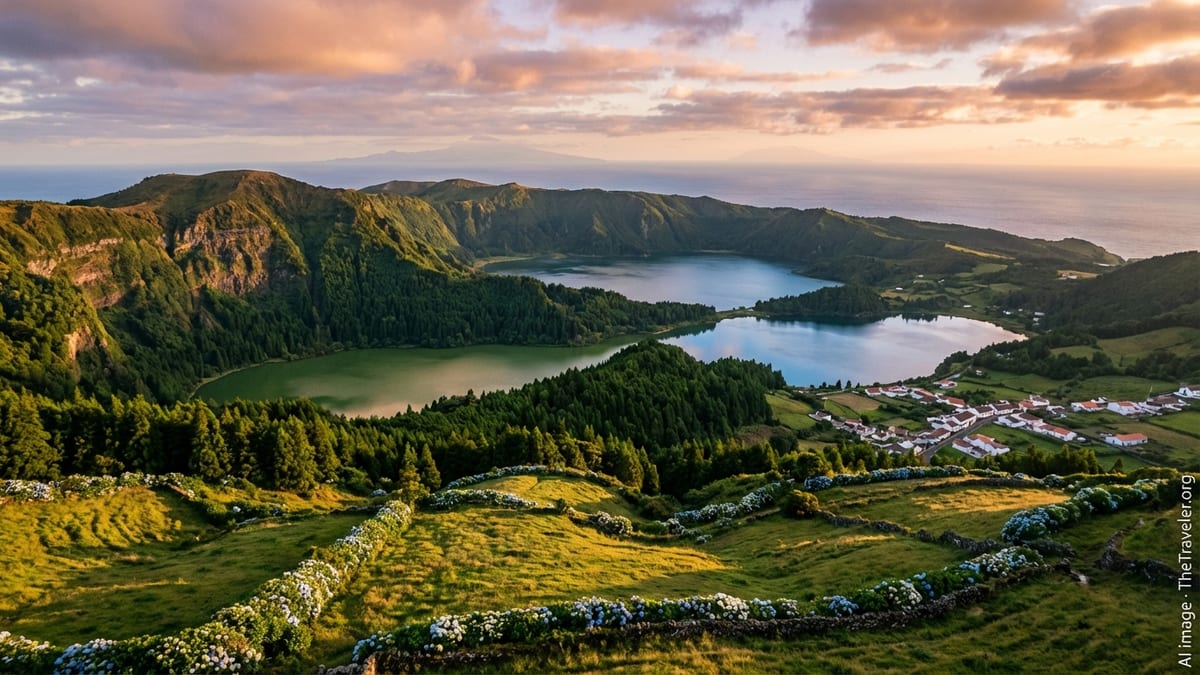
A Microscopic Island Under a Macroscopic Lens
Corvo sits alone on the northwestern edge of the Azores, a volcanic cone rising from the Atlantic with a single village, Vila do Corvo, and a population of around 400 people. Publicly available demographic data describe it as the least populated municipality in Portugal and the smallest island in the archipelago by area, which makes any fluctuation in tourist numbers immediately visible in daily life.
The island’s physical constraints are unusually sharp. There is one small airstrip at Corvo Airport, limited road infrastructure, and only a handful of accommodation units, restaurants and service providers. Planning documents for the Azores highlight Corvo’s isolation, fragile ecosystems and close-knit community as both its main attraction and its primary vulnerability when tourism rises too quickly.
Regional strategies for 2030 position Corvo as a niche destination for birdwatchers, hikers and visitors in search of quiet and nature rather than mass-market tourism. The island is promoted around its UNESCO Biosphere Reserve status, the Caldeirão volcanic crater and marine life. That positioning is now intersecting with concrete experiments on how many visitors the territory can safely host at any given time.
Policy papers and technical studies on the archipelago’s tourism model point to Corvo as an “outlier” in terms of scale and seasonality, suggesting that traditional indicators used on larger islands need to be recalibrated for such a small and resource-limited community.
Capacity Tests Focus on Transport Bottlenecks
In practice, much of the testing of tourism capacity on Corvo is taking place through control of access, particularly via air and sea links. Publicly available traffic data show that Corvo Airport handles a fraction of the passenger volumes seen on other Azorean islands, with a short runway served only by small propeller aircraft. This limited lift capacity acts as a physical ceiling on daily arrivals.
According to regional planning documents and academic analysis, the island’s tourism patterns are highly seasonal, with most visits concentrated in the summer months. Flights between neighboring Flores and Corvo, as well as small passenger boats that operate in good weather, tend to fill quickly in peak season, effectively creating a de facto reservation system where last-minute access is rare.
Recent summers have provided live tests of how transport limitations translate into visitor caps. Reports from travelers and local tourism operators describe days when sea crossings from Flores to Corvo were suspended or heavily restricted due to safety rules, weather conditions or operational decisions, sharply reducing the number of day-trippers able to reach the island.
These constraints are being watched closely by policymakers in the Azores, who view Corvo as a case study in how air and maritime capacity can be used as a subtle but effective tool to manage tourist flows without resorting to overt entry bans or high visitor taxes.
Environmental Safeguards Shape Visitor Experience
Environmental protection is central to Corvo’s capacity debate. The island’s designation as a UNESCO Biosphere Reserve and its reputation among international birdwatchers have led regional authorities and conservation groups to advocate for strict limits on visitor numbers at sensitive sites, particularly during migration seasons.
Planning documents for Azores tourism reference Corvo’s role as a sanctuary for American and European migratory bird species, as well as the importance of the Caldeirão crater and surrounding geosites. These areas are being managed with marked trails, viewing points and recommended carrying capacities that aim to minimize erosion and disturbance.
Publicly available guidelines encourage low-impact activities such as hiking, birdwatching and cultural visits within the village, while discouraging any large-scale development of resorts or road expansion. This effectively channels tourism into a slow, low-density model in which a relatively small number of visitors stay longer and spend more per person.
The island’s small waste-management systems, water supplies and energy infrastructure are also key factors in the capacity tests. Technical assessments for the Azores highlight that sudden spikes in day visitors can strain these services, reinforcing the case for pre-planned limits tied to transport capacity and pre-booked excursions.
Community-Centered Tourism in a One-Village Island
Corvo’s social fabric is another dimension of the ongoing capacity experiments. With one compact village and a population smaller than many city apartment blocks, any shift in visitor numbers can alter the balance between everyday life and the tourism economy.
Local planning references emphasize that most of Corvo’s services exist primarily to meet the needs of residents, with tourism treated as an additional, not dominant, activity. Shortage of housing for locals, rising prices or overcrowding in public spaces are risks that regional policymakers and community leaders are seeking to avoid by keeping visitor numbers proportionate.
Travel accounts and advisory materials for the Azores frequently encourage visitors to Corvo to stay overnight rather than treating the island as a quick stop from Flores. This approach is framed as a way to support local businesses more evenly while reducing pressure from concentrated waves of same-day visitors.
The emphasis on community-centered tourism also shapes how new initiatives are introduced. Small-scale guesthouses, family-run eateries and guided walks appear more compatible with Corvo’s capacity limits than large external investments, which could strain both physical infrastructure and the social cohesion of the village.
Corvo as a Template for Managing Fragile Destinations
The experiments underway on Corvo fit into a broader effort by Portugal and the Azores to position the archipelago as a model for sustainable island tourism. Strategic documents for 2030 underline the need to balance economic benefits with protection of culture, landscapes and biodiversity across all nine islands.
In this context, Corvo functions as an extreme test case. Its tiny scale, isolation and limited connectivity make it an ideal place to trial ideas such as dynamic visitor caps, seasonally adjusted access rules and priority for specific market segments like nature enthusiasts and “slow travel” visitors.
Lessons from Corvo’s capacity tests may inform debates in other small destinations grappling with similar issues, from crowding at fragile viewpoints to pressures on local housing. Observers in the tourism sector are watching whether the Azores can maintain Corvo’s appeal as a wild, quiet island while ensuring that residents gain tangible benefits and ecosystems remain intact.
For now, Corvo remains difficult to reach, lightly developed and tightly managed through its narrow transport channels. Those same constraints are at the heart of Portugal’s experiment in proving that, for some islands, less tourism can mean better tourism over the long term.