


Remote professionals weighing Spain against Thailand are typically choosing between two mature but very different remote work ecosystems. Both countries are established digital nomad destinations, yet they differ significantly in digital infrastructure quality, reliability, work environments and operational risks. This briefing compares Spain and Thailand purely on remote work practicality, to support decision makers who prioritize consistent online performance and professional-grade work conditions over lifestyle factors.
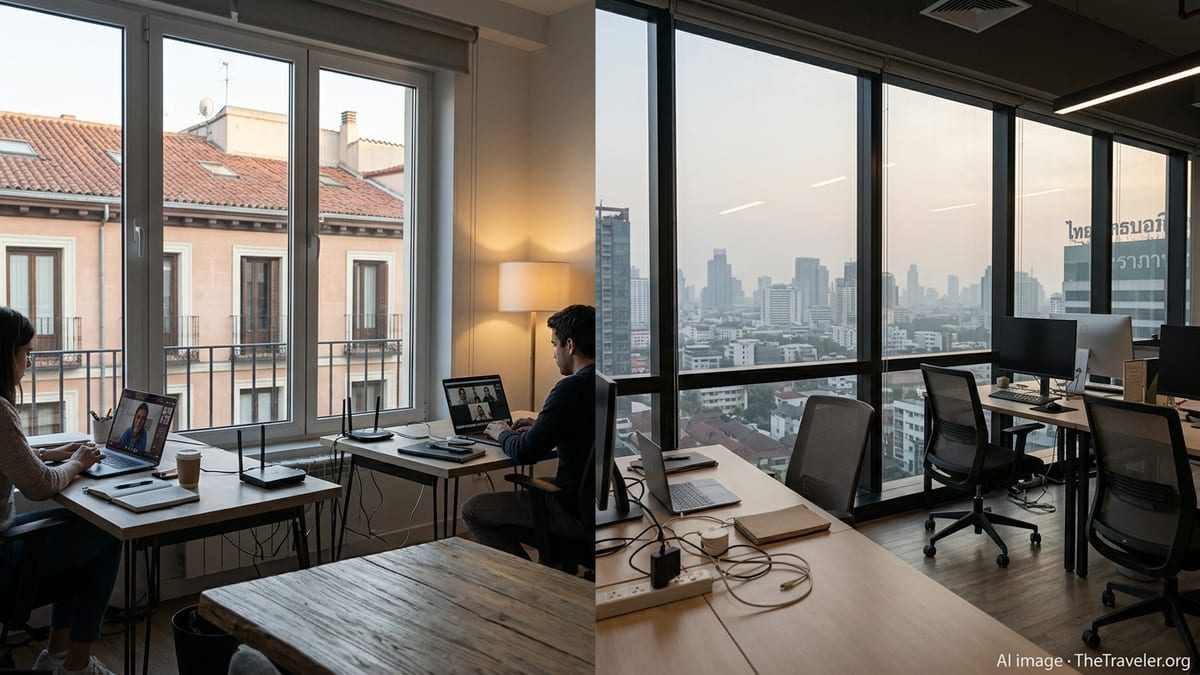
Framework for Comparing Spain and Thailand for Remote Work
Evaluating Spain and Thailand for remote workers requires a structured focus on digital workability: internet speed and reliability, availability of coworking and work-ready housing, time zone alignment with client markets, and basic operational continuity such as power stability and backup options. This section defines those criteria and how they typically manifest in each country.
At a high level, Spain operates within the European Union’s advanced digital policy framework, ranking near the top of EU indices for digital public services and high-speed broadband coverage. A large share of fixed broadband subscriptions are at or above 100 Mbps, reflecting a strong fiber rollout and dense urban networks.([espanadigital.gob.es](https://espanadigital.gob.es/sites/espanadigital/files/2025-12/D%C3%A9cada%20Digital%20en%202025%20-%20Progreso%20y%20perspectivas.pdf?utm_source=openai))
Thailand, while not an EU member, has invested heavily in mobile networks, especially 4G and 5G, achieving nationwide 3G and 4G coverage and rapidly expanding high-performance 5G in urban and some regional areas. Fixed broadband quality is strong in major cities such as Bangkok and Chiang Mai, but becomes more variable in smaller towns and islands, where many remote workers like to base themselves.([gsma.com](https://www.gsma.com/connectivity-for-good/spectrum/wp-content/uploads/2024/12/GSMA_Accelerating-5G-and-5G-Advanced-in-Thailand-2024.pdf?utm_source=openai))
For relocation decisions, remote workers should consider not only headline speed figures but also the consistency of service, the ease of accessing business-grade connections when needed, and how digital infrastructure intersects with time zone practicality for existing or target client markets.
Internet Speed, Coverage and Reliability
Spain’s fixed broadband infrastructure is among the more advanced in Europe. European digital progress reporting indicates that by 2024 roughly seven in ten fixed broadband subscriptions in Spain were at speeds of 100 Mbps or higher, illustrating the wide reach of high-speed connections into households and small offices.([espanadigital.gob.es](https://espanadigital.gob.es/sites/espanadigital/files/2025-12/D%C3%A9cada%20Digital%20en%202025%20-%20Progreso%20y%20perspectivas.pdf?utm_source=openai)) In major cities such as Madrid, Barcelona and Valencia, residential fiber packages commonly advertise several hundred Mbps, with premium plans in the 600 to 1,000 Mbps range.([linkedin.com](https://www.linkedin.com/pulse/top-8-spain-digital-nomad-cities-live-work-remotely-nextnationco-zm7yc?utm_source=openai))
Real-world experience reported in digital nomad and relocation communities suggests that urban Spanish connections are not only fast but also stable, with minimal downtime in large cities and well-served secondary cities. Spain’s position near the top of EU digital indices for network quality and public digital services supports this perception of maturity and redundancy in the fixed-network backbone.([en.wikipedia.org](https://en.wikipedia.org/wiki/Internet_in_Spain?utm_source=openai))
Thailand presents a different profile. Official and industry analyses show strong national coverage, with near-universal 3G and 4G availability and expanding 5G implementation. Average national mobile download speeds of around 40 Mbps and fixed broadband around the tens-of-Mbps range are reported, though these national averages mask much faster performance in cities like Bangkok and popular hubs such as Chiang Mai, where coworking spaces routinely deliver 100 Mbps or more.([gsma.com](https://www.gsma.com/connectivity-for-good/spectrum/wp-content/uploads/2024/12/GSMA_Accelerating-5G-and-5G-Advanced-in-Thailand-2024.pdf?utm_source=openai))
Independent rankings of cities by internet speed and reliability for remote work now place Bangkok among the global leaders, quoting average downloads around 200 Mbps with high reliability scores approaching 99 percent in top coworking venues and premium home connections.([relomap.app](https://relomap.app/blog/internet-speed-coworking-nomad-cities?utm_source=openai)) However, Thailand shows greater regional variance than Spain. Island locations and rural areas can suffer from slower fixed lines, congestion during peak periods, or more frequent outages, making coworking spaces and dual-connection setups (fixed plus 5G hotspot) more critical for risk management.
Coworking, Coliving and Work-Ready Spaces
Spain has seen rapid growth in coworking and flexible office options, especially since the rise of hybrid work. Major cities such as Madrid and Barcelona host hundreds of coworking spaces, from international brands to local operators, typically equipped with high-speed fiber, meeting rooms and private call booths. National reports on Spain as a destination for digital nomads highlight a dense coworking ecosystem across coastal cities like Valencia, Malaga and Alicante, as well as inland hubs.([one.gob.es](https://one.gob.es/sites/default/files/2025-05/Spain%20A%20Top%20Destination%20for%20Digital%20Nomads%20in%202025.pdf?utm_source=openai))
Secondary Spanish cities increasingly offer modern coworking facilities integrated with startup accelerators and municipal innovation hubs. For remote workers, this provides a relatively seamless transition from home to professional office environments, with predictable service levels and often English-speaking support. Even medium-sized towns tend to have at least one structured coworking facility plus a range of cafes with adequate Wi-Fi for low-intensity tasks.([thenomadcloud.com](https://thenomadcloud.com/the-best-cities-in-spain-for-digital-nomads/?utm_source=openai))
Thailand’s coworking market is highly developed in its main remote work destinations. Bangkok, Chiang Mai, Phuket and certain islands feature numerous spaces optimized specifically for digital nomads, often combining ergonomic setups, community events and extended opening hours. Community reports emphasize that Chiang Mai in particular has been a long-standing hub for remote workers, with several established coworking brands and a dense network of work-friendly cafes.([reddit.com](https://www.reddit.com/r/digitalnomadlife/comments/1ml502l?utm_source=openai))
One differentiating factor is that Thailand’s coworking and coliving offerings are more concentrated in a handful of hubs, with pronounced drop-off outside those zones. In contrast, Spain’s coworking scene is more evenly distributed throughout the country, although still denser in urban centers and along the Mediterranean and Atlantic coasts. For remote workers who anticipate frequent internal moves within the country, Spain may provide more consistent access to structured workspaces across multiple cities, while Thailand delivers very strong options in a smaller set of proven hubs.
Power Stability and Business Continuity Risks
Consistent electricity supply is a non-negotiable factor for remote workers whose productivity depends on uninterrupted sessions for calls, coding, trading or high-volume client work. Spain, as an advanced European economy, generally offers stable grid performance with infrequent outages in urban and suburban areas. Short interruptions occur but are usually rare and quickly resolved, and many coworking spaces in major cities operate within commercial buildings equipped with backup systems.
Thailand’s situation is more mixed. In Bangkok and other major cities, modern apartment buildings and business districts tend to experience reasonably reliable electricity, with outages typically brief. However, remote worker reports and local experience indicate that in provincial towns, mountain areas and on islands, power cuts can be more common, especially during storms or peak demand periods. Many well-known coworking spaces and some modern condominiums mitigate this with backup generators or uninterruptible power supplies, but these features are not universal outside premium properties.([relomap.app](https://relomap.app/blog/internet-speed-coworking-nomad-cities?utm_source=openai))
For remote workers handling time-critical tasks, Thailand often requires an explicit continuity strategy: selecting buildings with documented backup power, maintaining dual internet connections, and planning fallback options such as alternative coworking spaces in different districts. In Spain, redundancy planning is still prudent but generally less complex, as both grid stability and fixed broadband resilience are higher at the national level.
This difference does not make Thailand unsuitable for serious remote work. Rather, it places more weight on location selection within the country and on deliberate risk management, while Spain offers a more uniformly predictable baseline, especially across its major and mid-sized cities.
Time Zone Alignment and Communication Windows
Time zone position fundamentally shapes communication patterns with clients and employers. Spain operates mostly on Central European Time (UTC+1) and Central European Summer Time (UTC+2), which aligns closely with the working day in the wider European Economic Area and provides overlapping hours with the United Kingdom and parts of the Middle East and Africa.
For remote workers serving European clients, Spain provides near-optimal overlap with standard business hours, minimizing the need for early morning or late-night calls. There is also limited but manageable overlap with the east coast of North America, where afternoons in Spain correspond to mornings across the Atlantic. For west-coast North American clients, however, overlap narrows, often requiring evening work sessions to attend real-time meetings.
Thailand operates on Indochina Time (UTC+7) with no daylight saving changes. This places it six hours ahead of Central Europe during Spanish winter time and five hours ahead during European summer time. The result is minimal overlap with European business hours at the very start of the European day and minimal overlap with North America in late evenings or very early mornings Thai time.
For remote workers whose client base is heavily European or North American, Thailand typically requires either asynchronous workflows or acceptance of irregular working hours to maintain real-time collaboration. Conversely, Thailand’s time zone is advantageous for serving clients in East Asia, Australia and New Zealand, creating robust overlap with those markets. Spain, in contrast, is better suited to European and some transatlantic work but less optimal for Asia-Pacific without schedule adjustments.
Urban vs Regional Remote Work Environments
Within Spain, the remote work experience varies between large metropolitan areas, mid-sized regional cities and rural towns, but the disparities are mostly in lifestyle and cost rather than in core digital infrastructure. Reports on Spain’s digital decade progress highlight very high coverage of fast broadband in urban and suburban zones and rising penetration of high-speed lines in less populated areas.([espanadigital.gob.es](https://espanadigital.gob.es/sites/espanadigital/files/2025-12/D%C3%A9cada%20Digital%20en%202025%20-%20Progreso%20y%20perspectivas.pdf?utm_source=openai)) Remote workers basing themselves in smaller Spanish cities typically still have access to fiber connections and at least one coworking facility, though very rural areas can be more constrained.
Urban Spanish centers like Madrid, Barcelona, Valencia and Malaga combine strong digital infrastructure with extensive coworking and corporate office ecosystems. Smaller regional capitals and coastal towns add a layer of lower-density, quieter environments while preserving solid connectivity. This allows remote workers to trade off city size, cost and climate without fundamentally sacrificing digital performance in most cases.
Thailand shows more pronounced variation between hubs and peripheral locations. Bangkok and Chiang Mai perform well on internet speed and workspace quality, and major tourist centers such as Phuket or certain Gulf islands host purpose-built digital nomad spaces. However, once beyond these major corridors, remote workers may encounter slower fixed lines, patchier Wi-Fi and more intermittent power, especially during extreme weather.([relomap.app](https://relomap.app/blog/internet-speed-coworking-nomad-cities?utm_source=openai))
For remote workers seeking maximum flexibility inside Thailand, the practical approach is often to anchor in a well-connected hub and treat more remote locations as short-term work-light periods rather than primary operational bases. In Spain, by contrast, a more diverse set of cities and regions can function as long-term primary bases without substantial digital compromise.
The Takeaway
From a purely remote work infrastructure perspective, Spain offers a more uniformly reliable environment, anchored by extensive high-speed fiber coverage, stable electricity, and a dense network of professional coworking spaces spreading beyond the main metropolitan areas. Its time zone is particularly favorable for remote workers with European clients and still workable for some transatlantic relationships, although less convenient for Asia-Pacific collaboration.
Thailand, meanwhile, provides very strong digital conditions in its main hubs, with Bangkok now ranked among top global cities for internet speed and reliability in coworking and premium residential settings. However, quality and stability are more location-dependent, and power or connectivity disruptions can be more common in smaller towns and islands. Its time zone favors work with Asia-Pacific clients but introduces significant challenges for standard European or American office hours.
For remote workers whose highest priority is predictable, enterprise-grade connectivity across multiple potential bases within one country, Spain currently has a structural advantage. For those prepared to manage operational risk more actively, and who either work largely asynchronously or serve Asia-Pacific markets, Thailand’s hubs can match or exceed Spanish urban centers in raw speed while offering a more variable but still workable infrastructure environment.
FAQ
Q1. Which country generally has more reliable home internet for remote work, Spain or Thailand?
Spain generally offers more uniformly reliable home internet, with a high proportion of subscriptions at or above 100 Mbps and strong fiber penetration in cities and many towns, while Thailand’s reliability is excellent in major hubs but more variable in regional areas.
Q2. Are coworking spaces in Spain or Thailand better equipped for high-bandwidth tasks like video production and large file transfers?
Premium coworking spaces in both countries can support high-bandwidth tasks, but Spain’s broader fiber-based infrastructure means such facilities are widely distributed, whereas in Thailand they are concentrated in hubs like Bangkok and Chiang Mai.
Q3. How do mobile networks compare for working on the move in Spain versus Thailand?
Both countries have strong mobile networks, with Spain offering mature 4G and expanding 5G coverage, and Thailand featuring nationwide 3G and 4G plus growing 5G, though performance in Thailand can drop more noticeably in remote or island areas.
Q4. For European clients, which country offers more convenient working hours?
Spain aligns much more closely with European business hours, allowing a typical workday with minimal schedule adjustment, whereas Thailand requires either very early starts or late finishes to maintain real-time overlap.
Q5. Is it realistic to rely only on a home connection in Thailand without coworking or backup options?
In central Bangkok or well-served districts of Chiang Mai it can be realistic, but many remote workers still maintain backup mobile hotspots or coworking memberships due to higher outage risk compared with Spain.
Q6. How does power outage frequency affect remote work in Spain and Thailand?
Spain’s major cities experience relatively infrequent and short outages, while parts of Thailand, especially outside major hubs, can see more frequent interruptions, making backup power and flexible work locations more important.
Q7. Which country is better suited for remote workers who move frequently between cities within the country?
Spain is generally better for frequent internal moves, as strong fixed broadband and coworking options are available across a wide range of cities, not just in a few hubs.
Q8. Are upload speeds sufficient for frequent video conferencing in both Spain and Thailand?
In major urban centers and established coworking spaces in both countries, upload speeds are typically sufficient for high-quality video conferencing, but Thailand’s secondary and rural locations may struggle more with consistent upstream capacity.
Q9. Which country offers better infrastructure for fully asynchronous remote work where live meetings are rare?
For fully asynchronous work, both Spain and Thailand can perform well, but Spain offers more uniform reliability, while Thailand can be attractive if the worker is based in a well-connected hub and comfortable managing occasional disruptions.
Q10. If remote work continuity is critical and downtime must be minimized, which destination is safer overall?
For minimal tolerance to downtime, Spain is generally the safer choice due to more consistent grid stability and nationwide high-speed broadband, while Thailand can work well in selected hubs with careful redundancy planning.