


More news on this day
Passengers who rely on portable chargers to keep phones and laptops alive at 35,000 feet are increasingly finding those same power banks at the centre of flight delays and diversions, as regulators and airlines move to tighten rules on how many can be carried and where they are stored.
Get the latest news straight to your inbox!
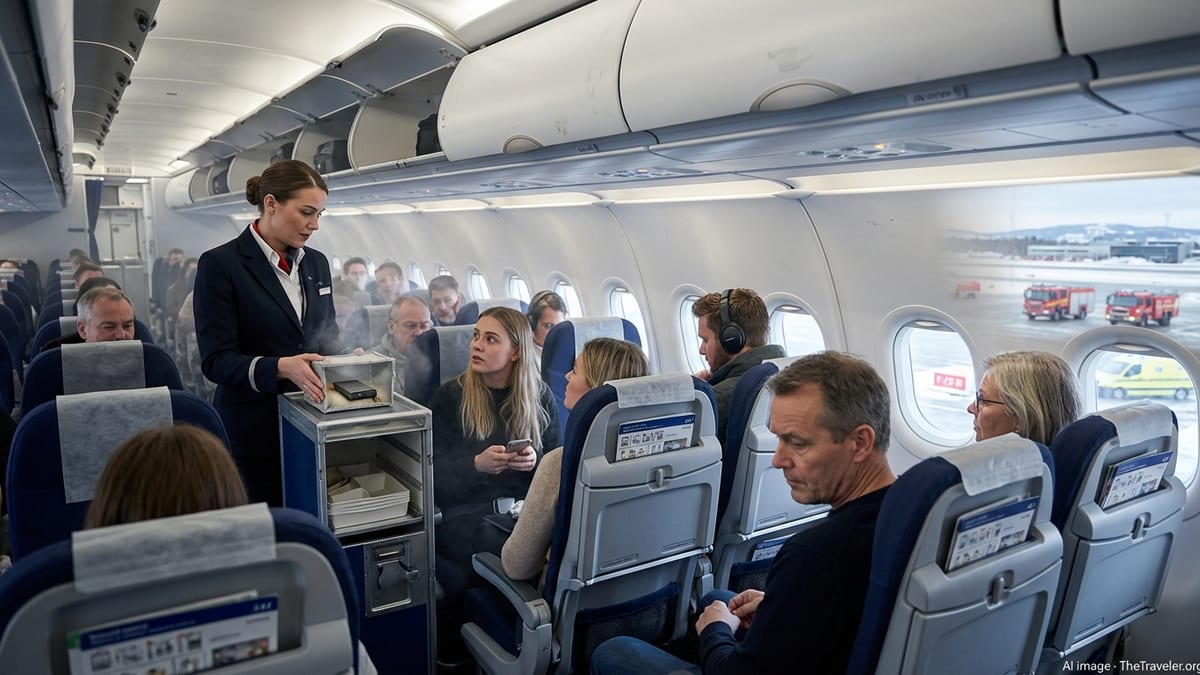
Why power banks are under new scrutiny
Airlines have been grappling with a steady rise in incidents involving lithium batteries, including power banks, overheating or catching fire in cabins and overhead bins. Industry and safety bodies report that such events have increased through 2024 and 2025, prompting international regulators to revisit long standing guidance on how portable batteries should be carried on board.
Power banks contain lithium ion cells similar to those in smartphones and laptops, but often packed at higher capacities in compact housings. If damaged, poorly manufactured or used incorrectly, they can enter thermal runaway, a chain reaction that can result in intense heat, smoke and fire. In the confined environment of an aircraft, even a small fire can force a diversion, disrupt schedules and generate expensive knock on delays for airlines and passengers.
According to widely shared safety data, most reported issues originate from devices placed where crew cannot easily reach them, such as in overhead lockers or, more seriously, in checked baggage. This has reinforced the push to keep power banks in the cabin where they can be monitored, while at the same time limiting their number and capacity to reduce overall risk.
Recent online discussions among frequent flyers highlight several diversions in the past year linked to passengers who either packed power banks in checked luggage or left them charging unattended, underlining how quickly a single mistake can affect hundreds of travellers.
Global rules: what ICAO and IATA now say
Airline specific policies sit on top of a global framework set by the International Civil Aviation Organization (ICAO) and interpreted in industry guidance from the International Air Transport Association (IATA). Both organisations classify power banks as spare lithium batteries, which are treated as dangerous goods and therefore subject to strict controls.
Under the long established baseline, power banks must never be placed in checked baggage. They are allowed only in cabin baggage or on the passenger’s person, and must be protected from short circuit and accidental activation. Most consumer models are limited to 100 watt hours of capacity without special permission; larger units up to 160 watt hours are allowed only with airline approval, while anything above that is generally prohibited on passenger flights.
In response to rising incident numbers, ICAO approved new specifications for power banks that take effect in March 2026, introducing tighter limits and clarifying how many spare batteries a typical traveler may carry. Industry coverage of the changes indicates a standard cap of two power banks per passenger in the cabin on international services, a move designed to balance convenience with risk reduction.
IATA’s latest dangerous goods guidance for passengers, updated for 2026, echoes this more conservative stance and encourages airlines to adopt consistent, easily communicated rules. The association also stresses that carriers are free to impose more restrictive policies, something several low cost and regional airlines have already begun to do.
How easyJet is applying the new limits
easyJet, one of Europe’s largest low cost carriers, has updated its dangerous goods information to emphasise that power banks are allowed only in the cabin and must meet strict technical conditions. The airline states that lithium power banks with a rating up to 160 watt hours are accepted, but they must be treated as spare batteries and therefore kept out of checked luggage at all times.
Smart baggage has also come under the spotlight. Public information from easyJet notes that bags with built in batteries or power banks are not accepted for travel unless the battery can be readily disconnected and removed by the passenger. Once removed, the battery or power bank must travel in hand luggage, not in the hold. This mirrors guidance from IATA on so called smart luggage, which has become a recurring source of confusion at check in counters.
Recent passenger accounts describe crew announcements on some easyJet flights reminding travelers that power banks may not be used during the journey, reflecting a broader trend among European carriers to prohibit in flight charging from portable batteries. The restriction is aimed at reducing heat build up around soft furnishings and in tight spaces such as seat pockets, as well as ensuring that any issue with a power bank is immediately visible.
Travelers on easyJet are therefore advised to keep power banks accessible in small under seat bags, ensure that capacity labels are visible, and expect both security staff and gate agents to intervene if a device appears oversized or is suspected to be in checked baggage.
Ryanair and Wizz Air: strict cabin only rules
Ryanair and Wizz Air, two other major European low cost carriers, follow the same fundamental prohibition on placing power banks in checked baggage, but have adopted notably strict interpretations on how many devices can be carried and how they may be used on board.
Guidance circulated to passengers and discussed widely in traveler forums indicates that Ryanair treats power banks as spare lithium batteries that must be in small cabin baggage only. Typical limits align with the 100 watt hour threshold for unrestricted carriage, with larger units up to 160 watt hours requiring prior airline approval. Flyers report that Ryanair does not provide an easy channel for obtaining that approval, effectively steering passengers toward smaller, clearly marked consumer models.
Wizz Air has also been associated with firm in flight messaging about power banks. Recent trip reports describe safety briefings that explicitly forbid the use of power banks during the flight, even when devices are kept in sight. Cabin crew are said to remind passengers that power banks should not be stored in overhead lockers, and should instead remain where they can be quickly accessed if they become hot, swollen or emit unusual smells.
Across both airlines, the trend is toward tighter enforcement at the gate. Oversized cabin bags may be placed in the hold at busy departure times, and passengers are being repeatedly told to remove any power banks before surrendering hand luggage at the aircraft door to avoid delays or the need to retrieve bags later.
Delays, diversions and what travelers should do now
A growing number of flight delays and diversions are being linked, directly or indirectly, to mishandled power banks. Online aviation communities have highlighted recent examples, including an easyJet flight that diverted to Rome after a passenger reported a power bank left in checked luggage. While in that case no fire occurred, the safety protocols required the crew to land so that the risk could be assessed on the ground, causing disruption for everyone on board and potentially for following services using the same aircraft.
Similar incidents on other carriers, where power banks have overheated in overhead bins or been discovered charging out of sight, have reinforced how seriously crews must treat any report of smoke or heat from electronic devices. Even when events are resolved quickly, the resulting inspections, paperwork and aircraft checks can ground a flight for hours.
For passengers, the practical takeaway is clear. Power banks should be treated as critical items that stay with you at all times, not as spare gadgets to be buried deep in luggage. Travelers flying with easyJet, Ryanair, Wizz Air and other carriers should ensure that all power banks are in cabin baggage, that each unit’s capacity in watt hours is visible, and that the total number carried matches the latest airline specific limits.
With new international specifications coming into force in 2026, airlines are likely to keep refining and enforcing their policies. Passengers who check their carrier’s current rules before packing, keep power banks accessible and avoid using them in flight where prohibited are less likely to face awkward conversations at the gate or delays caused by avoidable safety scares.